Finding Digital White Space In A World With 50 Billion Connected Devices

Writing about William Powers’ Hamlet’s BlackBerry, Steve Myers summarizes,

The key, Powers, said, is to create gaps between these periods of connectedness. Just as white space on a page draws attention to what is most visually important, digital white space can help us focus on those ideas that take some time to formulate.

Digital white space is nice metaphor and Powers’ himself ran with it in a blog post on his site.  In case you missed it, you can listen to Powers’ discussing his very sensible approach to digital life with Jerry Brito in an interview we mentioned here a few months ago.

White space, however, may become increasingly hard to find.  Marshall Kirkpatrick discusses Chetan Sharma’s vision of an uber-connected world in, “How 50 Billion Connected Devices Could Transform Brand Marketing & Everyday life.” These devices will include not only smart phones and tablet PCs, but also cereal boxes.  What do you do with a connected cereal box, you ask?

“With a cereal box? You’ll communicate about health related issues, add social elements, easy ordering. A brand can build a direct relationship with the consumer without relying on retail stores. Look at the aftermarket, 30% of the diapers ordered are now ordered online. There’s no reason why that can’t happen on other objects. I think the chance for the brand to interact with consumers directly is huge.

Earlier Sharma explained, regarding the uber-connectivity he envsions:

This is where it needs to go and will go in 10 years, making everyday experiences much better and friction free. If a person has a desire to learn or shop or engage in social interaction, it’s right there. Beyond just doing things on televisions and cell phones, you’ll be able to do these things on a wall anywhere. It’s about reducing friction. You can accomplish any given task today with 50 different steps but this future of connected devices is all about making things much easier.

Good luck finding that white space.  No really, good luck, because we need that white space.

After reading this last piece, I vaguely remembered a movie that gave us a picture of this frictionless world, and then it came to me:


Don’t Worry, Be Idle

Our’s is an age of anxiety, at least it seems to feel that way to many.  Of course, this is far from an original observation.  Among the several works taking this phrase as a title is W. H. Auden’s post-war poem, The Age of Anxiety, first published as the world emerged from the shadows of war into the disconcerting light of the nuclear age.  Since then anxiety has settled in as a permanent feature of the American cultural and psychic landscape.

In a recent Slate interview, Taylor Clark, author of Nerve: Poise Under Pressure, Serenity Under Stress, and the Brave New Science of Fear and Cool, talked about anxiety in the United States:

Is the United States more prone to higher levels of anxiety than other nations?

Put simply, we are. Perhaps the most puzzling statistics are the ones that reveal that we’re significantly more anxious than countries in the developing world, many of which report only a fraction of the diagnosable cases of anxiety that we do. One of the reasons for this is that the people in many of these third-world nations are more accustomed to dealing with uncertainty and unpredictability. I talk about this a fair amount in the book, but lack of control is really the archenemy of anxiety. It’s its biggest trigger.

That explains the disparity in anxiety levels between the United States and the developing world, but why are we more anxious than, say, your average European nation?

It’s hard to pinpoint an answer, but I think Americans have become extremely vulnerable to the pressures of the 21st century. For the past 50 years, we’ve been getting progressively more anxious in good economic times and bad, so we can’t even blame it on the recession.

Clark goes on to suggest three factors contributing to our “deteriorating” psychic state:

  1. “The first is a simple matter of social disconnection. As we spend more time with our electronic devices than we do with our neighbors, we lose our physical sense of community. Social isolation flies in the face of our evolutionary history.”
  2. “The second major cause is the information overload that we’re experiencing with the Internet and the 24-hour media cycle. We’re all aware of it, but I’m not sure we realize how big an impact it’s having on our brains.”
  3. “The third explanation can be attributed to what one psychologist refers to as a culture of “feel goodism” — the idea that we shouldn’t ever have to be upset and that all our negative emotions can be neutralized with a pill. This to me feels like a distinctly American phenomenon.”

Clark seems to lay a good bit of the blame, if we may call it blame, for our anxiety on technology that paradoxically disconnects us and connects us too much.  This diagnosis will ring true and self-evident to some, but I suspect others will take issue, particularly for the exclusion of other significant social and cultural factors that predate the advent of digital media.  After all, social disconnection has a long history.  We may be talking much less on the phone, but Freud noted long ago that the wonder of being able to hear a loved one’s voice over the telephone was a slight salve for the condition that necessitated it to begin with, that is the loved one’s absence.

But regardless the causes, anxious we are, and quite clearly we are interested in doing something about it which quite often amounts to popping a pill.  While that may sometimes be a necessary and helpful remedy, I’d like to also pass along a prescription written by Sven Birkerts in his recent essay, “The Mother of Possibilities”: Idleness.

While admitting that Idleness, as he is envisioning it, is a difficult concept to pin down, Birkerts suggests that,

Idleness is what supervenes on those too few occasions when we allow our pace to slacken and merge with the rhythms of the natural day, when we manage to thwart the impulse to plan forward to the next thing and instead look—idly, with nascent curiosity—at what is immediately in front of us …

Birkerts leisurely traces the tradition of idleness from the Greeks to the much too harried present via pastoral and lyric poetry, Milton, Montaigne, the Romantics, Baudelaire, Proust, Benjamin, and Camus, to name a few.  It is a pleasant jaunt. Along the way we find Montaigne claiming, “It seemed to me that I could do my mind no greater favor than to allow it, in idleness, to entertain itself.”  And according to Birkerts,

Through the figure of the flâneur—via the writing of critic and philosopher Walter Benjamin—the idle state was given a platform, elevated from a species of indolence to something more like a cognitive stance, an ethos. Benjamin’s idea is basically that the true picture of things—certainly of urban experience—is perhaps best gathered from diverse, often seemingly tangential, perceptions, and that the dutiful, linear-thinking rationalist is less able to fathom the immensely complex reality around him than the untethered flâneur, who may very well take it by ambush.

Yet Idleness has its enemies, not least of which is a bad reputation to which Birkerts addresses himself early on, but also the pace of modernity, and yes, alas, distraction, which is not to be confused for Idleness proper.

The spaces and the physical movements of work and play are often nearly identical now, and our commerce with the world, our work life, is far more sedentary and cognitive than ever before. Purposeful doing is now shadowed at every step with the possibilities of distraction. How do we conceive of idleness in this new context? Are we indulging it every time we switch from a work-related document to a quick perusal of emails, or to surf through a few favorite shopping sites? Does distraction eked out in the immediate space of duty count—or is it just a sop thrown to the tyrant stealing most of our good hours?

We are a task oriented people, equipped with lists and planners, goals and objectives, action points and plans.  Productivity is our mantra.  Distraction pour into our work and our plans, but it has not introduced Idleness; it has rather elided work and play, labor and leisure by their convergence upon the devices that are now instruments of both.

But here again we feel the anxiety rising and with it, perversely, the guilt.  Birkerts remedy:

The mind alert but not shunted along a set track, the impulses not pegged to any productivity. The motionless bobber, the hand trailing in the water, the shifting shapes of the clouds overhead. Idleness is the mother of possibility, which is as much as necessity the mother of inventiveness … “In wildness is the preservation of the world,” wrote Thoreau. In idleness, the corollary maxim might run, is the salvaging of the inner life.

Social Media, Social Memory: Remembering with Facebook

I’m a casual Facebook user.  I have a profile, I’ve got friends, I occasionally check in.  I rarely post anything other than links to this blog (shameless self-promotion), I don’t post status updates, I haven’t uploaded a picture in over a year.  Clearly, I’m not heavily invested and I’ve posted more than a few critical remarks about Facebook’s hegemony and its consequences on this blog.  But recently I’ve been thinking about Facebook in relationship to memory, memory being a recurring theme of late.

For example, in light of the research article I summarized yesterday, “Is Memory in the Brain? Remembering as Social Behavior”, one could view Facebook as a form of social remembering.  Rather than reminiscing in person, we have asynchronous reminiscences with friends, past and present, often centered on posted photographs.  We might even view tagging photos as a kind of social remembering, a collective curating of shared memories.  Often a very old photograph will be posted by one of a circle of friends, the other friends will be tagged, and a round of reminiscing will follow on the comments.

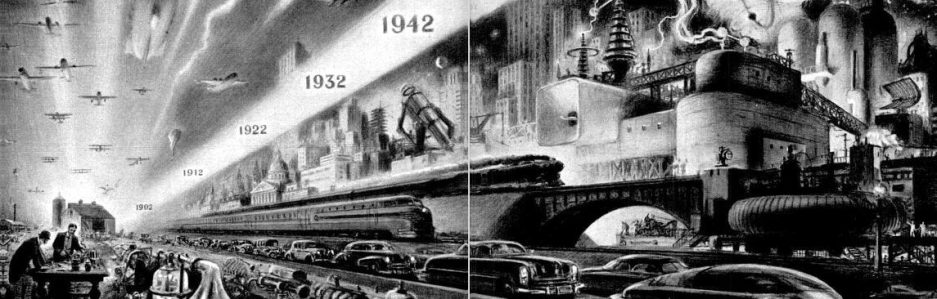
One other analogy that I’ve been toying with is Facebook as memory theater.  I’ve mentioned memory theaters in at least a couple of past posts (here and here), the basic idea is that one constructs an imagined space in the mind (similar to the work of the Architect in the film Inception, only you’re awake) and then populates the space with images that stand in for certain ideas, people, words, or whatever else you want to remember.  The theory is that we remember images and places better than we do abstract ideas or concepts.  During the Renaissance these mental constructs were sometimes externalized in built structures that housed all sorts of artifacts visually representing the store of human knowledge.

Perhaps it is a stretch, but Facebook seems to function in some respects as kind of externalized memory theater.  Instead of storing speeches or knowledge of the world, it is used to store autobiographical memory.  The architecture of the application is the constructed space and profiles are like images kept in the places, each profile carrying with it by association a trove of particular memories.  Most people report as one of the joys of Facebook the reconnection with an old friend from childhood.  While certainly some of these reconnections lead into renewed and sustained contact, most I imagine do not.  We exchange a message or two, we look over their life as it is now, and then we don’t really keep in touch any better than we used to.  But the memories have been activated, and now their profile takes its place in our memory theater, happily recalling those same memories whenever we like.  The profile is not the friend, of course; it simply becomes a placeholder for particular set of memories.

Facebook taps in to more than one aspect of our psychology.  I have often explained its appeal as a function of our desire to be noticed, to receive attention; and surely this is part of the mix. Lately Facebook’s role in the political sphere has been receiving a good deal of attention.  But it may be that its trade in our memories gives Facebook its uncanny persistence.  Increasingly we hear people taking issue with Facebook’s privacy protocols or otherwise complaining about the pressures of always on social media.  Not too long ago, I noted the grumblings over Facebook’s bid to become the ambient background of the Internet and Zuckerber’s disingenuous push for online “integrity.”  Recent studies have also drawn attention to the potentially negative effect of Facebook on psychological well-being, particularly for women.  But for all of this most people struggle to kill their accounts permanently. Like a bad high school romance, we break up with Facebook, only to flirt and make up, and then break up again.

This begins to make sense when we realize that Facebook has become a prosthetic of our memory.  But not just a prosthetic of memory in general, a simple list on a scrap of paper is that much; it is a prosthetic of our autobiographical memory.  It’s a part of our identity, and it is very difficult to kill off a part of one’s self.

One last thought, only a suggestive one at that: it is one thing to artificially condition one’s memory to store up vast amounts of information about the world or large chunks of poetry, it is quite another to artificially store up one’s autobiographical memory.  Our technology has made the storage of memory cheap and easy, but there is something to be said for forgetting.  The artificial extension of autobiographical memory involves us in some of the more complex regions of human psychology and personality.  We enter into the realm of mourning, catharsis, obsession, fantasy, and more.   We might consider as well that healing and forgetting very often go hand in hand.  In any case, we have a good deal to contemplate.

“They tell, and here is the enigma, that those consulting the oracle of Trophonios in Boetia found there two springs and were supposed to drink from each, from the spring of memory and from the spring of forgetting.”  Jacques Derrida (Memoires for Paul de Man)

__________________________________________________________

If this post was of interest, you may also want to consider Social Media and the Arts of Memory.

No, I Don’t Want To Be A Medieval Peasant

Admittedly, most days I tend toward critique, not praise of digital media and technology.  Aware of my proclivity, I try to compensate and hope that I strike a reasonable balance.  I’m sure everyone thinks they are successful in their efforts to achieve balanced views, so I’m probably the last person to judge how well I do or don’t.  That said, I do get into a fair number of discussions about technology in a variety of settings, and, more often than not, I’m raising certain questions and concerns, urging for discernment, moderation, et cetera, et cetera, et cetera … (The last bit best read in Yule Brenner tones.)  What this usually is taken to mean, judging from typical responses, is that I would like to be Amish, live without electricity, farm my own food, and wear black homespun clothes in the heat of the summer sun.   Okay, so maybe, there is a tiny part of me that wouldn’t mind trying that out for awhile, but generally speaking this actually isn’t my goal, and much less, the point.

What the reaction reveals, however, is that we tend to think in binary oppositions — this or that, either/or — and that the binary opposite of contemporary technology, in many people’s minds, is some past technological state, for some reason often associated with the 19th century religious sectarianism or Medieval Europe.  So it seems that on the assumption of this binary opposition, any critique of present technology necessarily groups you with either the Amish or the “bring out your dead” crowd.  In fact, there is a good deal of wisdom residing in the past and in intentional communities, but this is beside the more narrow point I’d like to make here.

Binary oppositions are often inherently unstable or else false dilemmas.  But even if we were to set up a binary opposition with present day technology being one member of the pair, who says that some past technological state must be the other member?  We could just as easily imagine the other member being some ideal future state.  I don’t mean this is in some strong utopian sense.  The idealized future is  more dangerous than the idealized past.  However, most of us have certain ideas about what a marginally better world might look like, even if only on the very limited scale of our own personal lives.   So why not make this desire for a better way, which at its best is informed by the past, the other of the present ecology of technology?  In this light, we might consider reasonable critiques of our technologies not as interventions in favor of an unrecoverable past, but rather as steps toward a better, attainable future.

It may be worth remembering that one very famous critic of technology, Marshall McLuhan, believed  that, “There is absolutely no inevitability as long as there is a willingness to contemplate what is happening” (The Medium is the Massage).  Sometimes, however, it is precisely the contemplation part that we struggle with.  Perhaps because in technology, as in politics, binary oppositions tend to undermine, rather than encourage, thought.
Mark Zuckerberg, Moral Philosopher of Identity

In a recent blog post, Steve Cheney bemoans the ongoing progress that Facebook is making toward becoming the ambient background of the Internet.  Specifically, he is concerned that Facebook is killing your authenticity:

… now Facebook’s sheer scale is pushing it in a new direction, one that encroaches on your authenticity.

Facebook is no longer a social network. They stopped being one long before the movie. Facebook is really a huge broadcast platform. Everything that happens between its walls is one degree away from being public, one massive auditorium filled with everyone you’ve ever met, most of whom you haven’t seen or spoken to in years.

Cheney’s post was triggered by the recent adoption of Facebook commenting by a number of large websites, a move that builds on the earlier integration of the “Like” button into almost every commercial, news, and entertainment site of note as part of Facebook’s “Open Graph” platform.  The trajectory here seems fairly clear.  Facebook is forging a global internet identity for you, one that it owns, of course, and with which it stands to make a fair bit of money.

Helpfully, Cheney did not frame his complaint within a denial of the basically social nature of human beings along the lines suggested by Andrew Keen not too long ago.  On the contrary, Cheney acknowledges our social impulses and is concerned that one singular online identity will not do justice to the complexity of human personality and truly social interaction.  One indiscriminate identity will result in one inauthentic and shallow identity that will inhibit rather than promote meaningful sociability.

“A George divided against itself cannot stand!”

The George in question is, of course, the character of George Costanza on Seinfeld.  In one of the more memorable exchanges from the remarkably memorable series, George explains what would happen if Relationship George were to come into contact with Independent George – Independent George would be no more.  We can relate to George in this situation because most of us maintain a handful of different personas that we cycle through as we navigate our way through life.  There are elements of our personality we reveal in some settings that we do not disclose in others; we present some aspects of our selves to certain people and not to others.  When for some reason these roles come into contact with one another it is possible that a little tension and confusion may ensue.  No news here.

In the early days of the Internet, when a kind of felicitous anarchy seemed to reign, it was fashionable to view the anonymity of the web as a playhouse of identity.  Individuals were able to try on and experiment with all sorts of identities — for better or for ill —  with relative safety and little worry of being found out.  It would have been unthinkable that one single and fully transparent identity would mark us across our Internet experience.

But that is exactly the trajectory we have been on for the last several years and this increases the odds of our many worlds colliding occasionally leading us to experience the kind of existential crisis that George’s histrionics embodied.  When our worlds collide, we too begin to sense that we might be losing our independent self, or the ability to control what people see and hear of us, control of what we might call our public identities.  We have a more difficult time calibrating our public personas to fit specific audiences and tasks.

Take for example the awkwardness and angst that arose when parents began joining Facebook and attempted to “friend” their children.  A Washington Post story on the topic from September 2008 cited protest groups formed in response with less than subtle names such as “What Happens in College Stays in College: Keep Parents Off Facebook!”  The author noted that it might seem odd that a “generation accustomed to sharing everything online” and with little or no apparent awareness of the distinction between private and public becomes apoplectic when merely two more people gain access to their already remarkably public personas.  But this misses the point.  What was at stake, of course, was control over who knew what.  The students experienced exactly what George did – their worlds collided and their anxiety reflected the increasing difficulty of controlling their public identity.

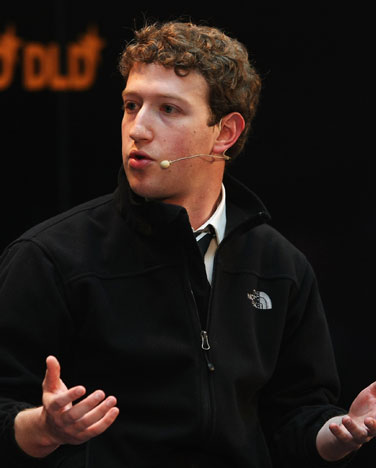
The ubiquity of one dominant social media platform makes it harder to exercise effective control over the presentation of our identities.  Mark Zuckerberg, moral philosopher that he is, rather conveniently believes,

You have one identity… The days of you having a different image for your work friends or co-workers and for the other people you know are probably coming to an end pretty quickly… Having two identities for yourself is an example of a lack of integrity.

Facebook’s near monopoly on social networking has reigned in the proliferation of profiles and, if fact, studies suggest that a Facebook profile tracks fairly closely to the truth about a person.  But there is still the question of who sees that more or less truthful public approximation of our personality and how much they see.  Furthermore, should Facebook, or any social media site be in the business of compelling people to live with integrity, particularly while profiting from the enforcement of this integrity?  More importantly, is it really integrity that is being forced upon us?  Or, to put it another way, does the maintenance of various personas necessarily entail a morally problematic lack of integrity? Is duplicity the only reason why we would withhold some aspect of our personality in certain circumstances?

Authentic and meaningful relationships typically depend upon the natural evolution of interpersonal trust and confidence.  Demanding immediate and equal transparency across the board works against the natural progression of social interaction.  Pace Mr. Zuckerberg, there are good reasons why we don’t reveal ourselves in equal measure to everyone and in all circumstances that have nothing to do with a lack of integrity.