Religious apps for the iPhone and iPad have been in the news lately. In “Religion on Your iPhone?”, Lisa Fernandez discusses a variety of apps created for Christians, Muslims, Jews, Hindus, and Buddhists. The Apple app store is, if nothing else, an apparently ecumenical space. Among the various religious apps, however, “Confession: A Roman Catholic App” has probably received the most attention and a good deal of it seemingly misguided. The folks at Get Religion have broken down some of the misleading news stories related to the app and the Catholic League collected a few of the offending headlines including:
• “Can’t Make it to Confession? There’s an App for That”
• “Catholic Church Approves Confession by iPhone”
• “Bless Me iPhone for I Have Sinned”
• “Catholic Church Endorses App for Sinning iPhone Users”
• “Forgiveness via iPhone: Church Approves Confession App”
• “New, Church-Approved iPhone Offers Confession On the Go”
• “Confess Your Sins to a Phone in Catholic Church Endorsed App”
• “Catholics Can Now Confess Using iPhone App”
Bottom line: the app is intended to help prepare for confession and is not intended to substitute for face-to-face confession. There is no virtual priest, and there is no virtual absolution. As Terry Mattingly put it at Get Religion,
This app is actually a combination between a personal diary and the “examination of conscience” booklets and tracts that Catholic and Orthodox Christians have carried in their pockets, wallets and purses for generations.
The Wall Street Journal has also recently posted a video report on religious apps: “From apps that let you tweet Bible verses to those that help you face Mecca or pray the right Hebrew blessings with the right foods, some of the pious are embracing mobile technology.” The story follows the usual pattern: new thing > positive reaction to new thing > negative reaction to new thing > conclusion offering moderating position. Concerns, voiced mainly by a Christian pastor, include the danger of disengaging from the face-to-face community and misdirecting the focus of religious experience onto the device and away from God.
Professor Rachel Wagner, author of the forthcoming “Godwired: Religion, Ritual and Virtual Reality,” also appears in the report and frames the issue as a struggle between relevance to contemporary culture and faithfulness to ancient traditions. She suggests that what is at issue is the degree of interactivity with the ritual or practice that the apps allow. As she puts it, “Those religious groups that want to stay true to their traditions are going to allow less wiggle room.” It’s not entirely clear from the segment what exactly Wagner means by interactivity, but I suspect she has in view the flexibility of the rituals. In other words, interactivity implies that ancient rituals may be reshaped by their re-presentation in new media.
Putting the issue this way recalls Paul Connerton’s thesis in How Societies Remember. In Connerton’s analysis,
Both commemorative ceremonies and bodily practices therefore contain a measure of insurance against the process of cumulative questioning entailed in all discursive practices. This is the source of their importance and persistence as mnemonic systems. Every group, then, will entrust to bodily automatisms the values and categories which they are most anxious to conserve. They will know how well the past can be kept in mind by a habitual memory sedimented in the body.
In other words, embodied practices or rituals represent the most durable mode of remembering. This is in part because they are less likely to be questioned and altered than knowledge encoded in spoken or written texts. The core of a tradition’s identity then is wrapped up in its rituals and embodied practices; changes to the rituals and practices effect changes to collective memory and identity.
Consider, for example, that while the Reformation clearly involved the reformulation of key doctrines, it also restructured the embodied rituals of Catholic practice and re-ordered the material conditions of worship. Bodily habits such as crossing oneself and material conditions such as the architecture of churches changed as much as doctrinal standards. I suspect one could argue convincingly that for laymen and women, the changes in embodied practice and material conditions of worship were more significant than abstract doctrinal reformulations.
Anecdotally, I vividly recall some years ago being in a certain Protestant context and witnessing a young boy being pulled up rather brusquely from a kneeling posture during prayer with the very straightforward admonition, “We don’t do that here!” It apparently smacked of Catholicism. A particular vision of the faith was thereby inculcated by regulating the body.
With this in mind, then, the most interesting thing about religious apps may not be their content, but the way that they insert themselves into the embodied experience of worship and religious practice. This may occur through the use of a cell phone to access the apps during worship. (Remember how easy it is to spot someone who is being attentive to their cell phones by simply observing their posture.) It may also occur through the way an app repackages a ritual or practice for digital mediation, perhaps abstracting bodily elements while preserving more mental components. In either case, religious apps are likely leave their mark by subtly reshaping the way the body engages in worship and spiritual practice.
We are still learning more about World War II, and much of it is rather depressing. Recently German researchers have published the transcripts of conversations among German soldiers held as POW’s. The soldiers and airmen were secretly recorded by the Allies and their conversations offer a disturbingly honest glimpse of the war from the soldier’s perspective. You can read about the transcripts in a Der Spiegel Online article, “Nazi War Crimes Described by German Soldiers.” Here is an excerpt that caught my attention:
Men love technology, a subject that enables them to quickly find common ground. Many of the conversations revolve around equipment, weapons, calibers and many variations on how the men “whacked,” “picked off” or “took out” other human beings.
The victim is merely the target, to be shot and destroyed — be it a ship, a building, a train or even a cyclist, a pedestrian or a woman pushing a baby carriage. Only in very few cases do the soldiers show remorse over the fate of innocent civilians, while empathy is almost completely absent from their conversations. “The victim in an empathic sense doesn’t appear in the accounts,” the authors conclude.
Be advised the content of the article is at points graphic and disturbing.
Much of what we use our cell phones for has very little to do with making a phone call. In fact, one could argue that the calling feature of our phones is becoming largely irrelevant. Our cell phones are more likely to be used to access the Internet, send a text message, or take a picture. Our cell phones have also become memory devices. Most of us have taken a picture of something we want to remember, a trivial thing perhaps like the name of a book we want to later buy. The picture is a mental note, except that it is not in the brain. We set alarms to remind us of meetings, we’ve long since stopped remembering phone numbers, we text directions to ourselves, we send ourselves text messages with reminders, we record the baby’s first words, and the list goes on. Our cell phones have become an integral part of our memory, to lose them is to find ourselves in a state of partial amnesia.
In a 2007 study, 180 students at London South Bank University between the ages of 19 and 41 were asked to express in one word how they felt when they were without their cell phones. The responses, reported by Anna Reading in “Memobilia: The Mobile Phone and the Emergence of Wearable Memories,” included: uncomfortable, isolated, lost, lonely, disconnected, unsafe, insecure, unguarded, naked, and without time. This language suggested to Reading that cell phones more or less functioned as an extension of the self and their absence was experienced as the “loss of part of the ‘me’ or part of themselves.”
This, however, was only one side of the story. Other respondents also used the words free, more private, and peaceful. This suggested that cell phones also had the effect of generating a panoptic claustrophobia, or a sense of being always available/never alone. Taken as a whole the study suggests a rather ambivalent relationship with the access and availability cell phones enable.
As the title of her article implies, however, Reading’s focus is on the cell phone as a memory device, and one that is wearable, portable, and social. The cell phone wearability renders it an extension of the self carried unobtrusively on the body. Its portability constitutes almost any environment as field of memories waiting to be captured. Finally, its sociability (my word for her “meme-like qualities,” essentially its connectivity) allows for the instant publication of memories to selected others or more indiscriminate audience via the Internet, particularly social media sites.
This last quality, sociability, blurs the traditional boundary between private and public memory and creates what Jose van Dijk has termed “mediated memory.” Mediated memory is simultaneously individual and collective. Every image or video captured say, or every note taken, is ready to be publicized or shared. We can’t really imagine the sensibility that lead to Roland Barthes’ refusal to include a picture of his mother as a young girl in his book about photography, Camera Lucida.
The second quality, portability, has the interesting effect of making memory something hunted and taken, so to speak, rather than something that is spontaneously generated. This same move, however, creates a certain detachment from immediate (unmediated) experience and, one could argue, a certain artificiality as well. This is not much different than the effect of the camera, especially the digital camera. We can all remember being on vacation and thinking everything we saw needed to be captured with a photograph, so much so that we didn’t experience the vacation so much as we documented it. In such case my memories are not of time past, but very narrowly of the images I captured. We don’t always carry a digital camera, however; we always have our cell phones.
Cell phones are by now more or less a taken for granted feature of contemporary life. They’ve almost blended into the unnoticed and unremarkable background of experience. It is from this position of ubiquity and transparency that any technology is most likely to have a significant effect on the shape of daily life and our own experience of reality.
In 1903, E. M. Forster imagined the future. Teleconferencing, instant global communication, and televisions all make an appearance. Forster envisioned a networked world in which every person lived physically isolated from, yet at the same time, mechanically connected to every other person. Humanity had driven itself under ground and each person lived in a habitation like the one Forster describes at the start of his story, The Machine Stops:
Imagine, if you can, a small room, hexagonal in shape, like the cell of a bee. It is lighted neither by window nor by lamp, yet it is filled with a soft radiance. There are no apertures for ventilation, yet the air is fresh. There are no musical instruments, and yet, at the moment that my meditation opens, this room is throbbing with melodious sounds. An armchair is in the centre, by its side a reading-desk-that is all the furniture. And in the armchair there sits a swaddled lump of flesh-a woman, about five feet high, with a face as white as a fungus. It is to her that the little room belongs.
The action begins when the woman is contacted by her son who lives on the other side of the globe. His call is taken as a great inconvenience because it requires the mother to silence the music, dim the lights, and disconnect from the flow of networked communication. The constant wall of sound and sight is the norm, and the woman must press the “isolation knob” in order to speak exclusively with one person. We discover that this person to person communication takes place with the help of a device which projects a holographic image of the other person. The son, we learn, wants to see the mother face to face, and in the following exchange we begin to recognize the nature of the third main character in the story, The Machine:
“I want to see you not through the Machine,” said Kuno. “I want to speak to you not through the wearisome Machine.”
“Oh, hush!” said his mother, vaguely shocked. “You mustn”t say anything against the Machine.”
“Why not?”
“One mustn”t.”
“You talk as if a god had made the Machine,” cried the other. “I believe that you pray to it when you are unhappy. Men made it, do not forget that. Great men, but men. The Machine is much, but it is not everything. I see something like you in this plate, but I do not see you. I hear something like you through this telephone, but I do not hear you.”
In the world Forster has created ideas rule; physicality is taken as a great encumbrance. Explaining why she would rather not travel to see her son, the mother whose name we learn is Vashti, explains, “I dislike seeing the horrible brown earth, and the sea, and the stars when it is dark. I get no ideas in an air- ship.” And it is the ideas that everyone is after.
Each day they awake, they are bathed automatically, they are fed artificial food, and they tap into the network in search of ideas. They gather virtually for “lectures” to hear about ideas; Vashti herself delivers lectures on the history of music. When the artificial day is done, a bed emerges so that they may sleep and do it all over again tomorrow. People rarely emerge from their cocoons where everything is brought to them and from which they may communicate with everyone else. The “clumsy system of public gatherings had been long since abandoned” and while an earlier age made machines to take people to things, this age had learned the real purpose of machines was to bring things to people. They were “funny old days, when men went for change of air instead of changing the air in their rooms!”
Finally unable to convince Vashti to make the journey, the son disconnects, Vashti re-enters the flow of networked communication, and “all the accumulations of the last three minutes burst upon her.” Time goes on and Vashti carries on, delivering lectures and searching for ideas, all from her armchair. Meanwhile the “Machine hummed eternally,” yet no one noticed the noise for they had heard it from birth. Vashti, finally moved by a tempered maternal compassion, decides that she must go to see her son. It would not be hard since a system of airships still ran across the globe. Few ever used it, however, “for, thanks to the advance of science, the earth was exactly alike all over … What was the good of going to Peking when it was just like Shrewsbury?”
Travel in the airships exposed people to more physical stimulation than they were used to and it was taken as a great annoyance. The glimmer of light from the sun or the stars, the sight of others, god forbid the touch of others, and the smell – it was all nearly unbearable. Vashti regretted her decision, but pressed on. As she glides over the earth the narrator informs us that “all the old literature, with its praise of Nature, and its fear of Nature, rang false as the prattle of a child.”
As the story unfolds we come to understand that the Machine and the book that explains how to use the Machine to satisfy every need are treated with nearly religious veneration even though religion had long since been exposed as a superstition. Occasionally, the characters in the story break into liturgical exchanges:
How we have advanced, thanks to the Machine!”
“How we have advanced, thanks to the Machine!” said Vashti.
“How we have advanced, thanks to the Machine!” echoed the passenger …
Passing over one place and then another, Vashti sighs, “No ideas here.” Later she looks again, “They were crossing a golden sea, in which lay many small islands and one peninsula. She repeated, ‘No ideas here,’ and hid Greece behind a metal blind.”
When Vashti finally arrives at her son’s room, he informs her that he had been to the surface. Strictly speaking this was not forbidden and one could request a respirator with which to travel momentarily to the outside world whose air was taken to be unbreathable. The son, however, had found his own way out through an old ventilation shaft, and because of his impudence he was now being threatened with homelessness. Homelessness, we later learn, was akin to a death sentence imposed by exposure and abandonment on the earth’s surface.
The story goes on to its stirring climax, which the title already suggests, but I will not give away anymore of the plot here. Take an hour or so and read the whole thing for yourself. It is thought provoking and entertaining in equal measure. Like most dystopian visions of the future, it is exaggerated. And like Orwell’s 1984, the evil lies in a centralized, authoritarian power represented by the Machine and its Committee. But in a Huxleyean mode, it is a power that humanity has acquiesced to in its pursuit of comfort and its flight from material reality.
The body is the victim in Forster’s tale. The body has been starved while the mind has been indulged. The senses have atrophied in a world of ideas, or we might say, of Information. Even sex is uninteresting, having been reduced to merely a proscribed and mechanical act for the sake of propagating the race. At one point the narrator informs us that, “by these days it was a demerit to be muscular.” In one of the more striking exchanges in the story, the son tells of his first experience with genuine physical activity:
You know that we have lost the sense of space. We say “space is annihilated”, but we have annihilated not space, but the sense thereof. We have lost a part of ourselves. I determined to recover it, and I began by walking up and down the platform of the railway outside my room. Up and down, until I was tired, and so did recapture the meaning of “Near” and “Far”. “Near” is a place to which I can get quickly on my feet, not a place to which the train or the air-ship will take me quickly. “Far” is a place to which I cannot get quickly on my feet; the vomitory is “far”, though I could be there in thirty-eight seconds by summoning the train. Man is the measure. That was my first lesson. Man’s feet are the measure for distance, his hands are the measure for ownership, his body is the measure for all that is lovable and desirable and strong.
This is a remarkable passage for the way that it insists that our embodied experience is an essential component of our apprehension of reality. It anticipates the later philosophical work of Maurice Merleau-Ponty and the even later cognitive science that has revealed the degree to which our thinking and experience of reality depends on our embodied interactions with the world and with others. Forster’s imagined world, however, was a Cartesian paradise. Ideas and abstractions reigned. The further removed from experience and the more abstract an idea could become, the better:
Those who still wanted to know what the earth was like had after all only to listen to some gramophone, or to look into some cinematophote. And even the lecturers acquiesced when they found that a lecture on the sea was none the less stimulating when compiled out of other lectures that had already been delivered on the same subject. “Beware of first- hand ideas!” exclaimed one of the most advanced of them.
Contemporary readers, as you may have already guessed, tend to read the Machine as a prescient allegory of the Internet. It is not a perfect allegory for, among other reasons, Forster’s network is not quite wireless, but it is remarkably suggestive nonetheless. Most striking perhaps is the degree of dependence upon the network of telecommunications exhibited by all of the characters except the son, as well as the ubiquity of the Machine’s stimulation represented by the constant, unnoticed hum. As he approaches the surface, the son explains,
The light helped me for a little, and then came darkness and, worse still, silence which pierced my ears like a sword. The Machine hums! Did you know that? Its hum penetrates our blood, and may even guide our thoughts. Who knows! I was getting beyond its power.
Many will also be jolted into startled recognition by the degree of agency that was handed over to the Machine. In a passage that reminds us of The Matrix, we read:
We created the Machine, to do our will, but we cannot make it do our will now. It was robbed us of the sense of space and of the sense of touch, it has blurred every human relation and narrowed down love to a carnal act, it has paralysed our bodies and our wills, and now it compels us to worship it. The Machine develops – but not on our lies. The Machine proceeds – but not to our goal. We only exist as the blood corpuscles that course through its arteries, and if it could work without us, it would let us die.
Later on we also catch a warning about the alienation from humanity and the exploitation of nature, all in the name of efficiency:
Year by year it was served with increased efficiency and decreased intelligence. The better a man knew his own duties upon it, the less he understood the duties of his neighbour, and in all the world there was not one who understood the monster as a whole … Humanity, in its desire for comfort, had over-reached itself. It had exploited the riches of nature too far. Quietly and complacently, it was sinking into decadence, and progress had come to mean the progress of the Machine.
Still tempted to go on telling more of the story, I’ll content myself by leaving you with this last line:
“Quicker,” he gasped, “I am dying – but we touch, we talk, not through the Machine.” He kissed her. “We have come back to our own. We die, but we have recaptured life …”
Now go read the rest, and then take a walk outside and hug someone — not necessarily in that order.
Budget cuts have put over 450 libraries across the UK in jeopardy and consequently launched protests and a vigorous campaign to save the libraries. Writing in Prospect Magazine, Leo Beneditus suggests that while this is unfortunate, the whole situation is not quite so desperate as the rhetoric of the library enthusiasts make it out to be. The sky, Benedictus, suggests is not quite falling. Perhaps. I don’t have a specific point to make here, so much as a few observations:
For one thing, Benedictus is correct to observe,
Listening to a declaration of how wonderful books are (World Book Night, on 5th March, was one recent example), what I hear most loudly is a group of people feeling they have to say so. No one troubles to declare this for computer games. Instead of making books seem fun, the well-intentioned merely spread a whiff of burning martyr round the act of reading.
Theodor Adorno, Alasdair MacIntyre, and others I’m sure, have pointed out that something has already given way when a culture begins to rationalize its moral code. Ethics is a sign that moral consensus has already broken down and often amounts to little more than a rear-guard action. Impassioned defense of the book may likewise signal the passing of an era.
I’m not certain if the subtitle of the article was penned (keyed?) by Benedictus or some editor, but it reads:
It’s a shame some libraries are closing, but this is not the end of civilisation. Quite the opposite.
This line is probably true enough, although “Quite the opposite” is debatable. But one could justly reply that while it is not the end of civilization per se, it may signal the end of civilization as we know it (or, as we had known it as the transition has been in process for some time now). And this is no small thing.
Benedictus goes on to warn about the “overuse” of books:
One might argue that books offer a better education than games, but they are also more isolating—there are no two-player books—and just as prone to being overused.
It would be hard to imagine what the overuse of books might look like, but I suppose in principle it is possible. But the idea that books are isolating is only partly true. Reading a book does initially isolate the individual, I’m reminded of Julian Smith’s fantastic music video; but a book, precisely by speaking to our inner self, reminds us that we are, none of us, so isolated that others cannot put words to our experiences. In this way, books immerse us in solitude only to reconnect us more profoundly with the world around us. Needless, to say a book may also connect us intimately with the experience of others by providing a window into their experience that is unavailable otherwise.
Later on, speaking of the potential virtue of e-readers, Benedictus suggests that,
Freed from paper in this way, books have a much better chance of becoming cool again.
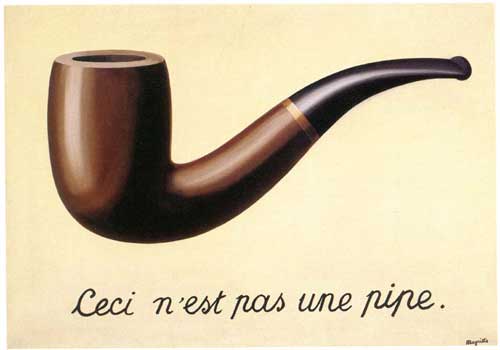
In the first place, the pursuit of “cool,” is always decidedly uncool. Beside that, though, it is a curious statement to make because it confuses a text for a book. A book freed from paper (unless you are imagining papyrus or vellum) is an oxymoron. And this, perhaps, begins to reveal a deeper assumption at play in Benedictus’ essay — materiality is insignificant. The book as object does not matter. Perhaps what is needed is a work of art along the lines of Magritte’s “This Is Not A Pipe” in order to provoke us into understanding the significance of textual materiality.
Reading is imagined merely as the transfer of immaterial data from one container (book, e-reader, etc.) to another (the human brain). This seems blind to the significance of the embodied experience involved in reading a book which activates each of our senses in very particular ways, ways an e-reader (regardless of its virtues otherwise) simply cannot. E-readers, of course, have their own materiality, and that matters as well.
Discounting materiality also ignores the manner in which the book as object, by virtue of its particularity, is the repository of a host of memories and associations. A book can only be itself and so collects around itself its own unique history; the e-reader is every text it used to read, and thus it is simultaneously none of them. I remember where and when I bought many of my books. I remember where I read them and to pick up certain books is to be transported back to different moments in my life. The book as object, its particular and unique materiality, matters. This is not to suggest that e-readers have no place and no benefits, but it is to suggest that moving from books to an e-reader is not a transaction without remainder.
A failure to recognize the significance of materiality may also be at play in the willingness to bid adieu to the library. Benedictus concludes his essay by noting that,
When the children of 2011 look back, they will not see this as the year their local libraries were taken away. This will be the year they all got libraries of their own.
Perhaps, but notice the equivocation. “Libraries closed” are not the same thing as “libraries of their own.” The former refers to a material fact, the latter refers vaguely to an assemblage of data. In any case, when they do look back, if they do, they may also be oblivious to the rich and textured experience of reading that attended those curious relics of a past civilization.
___________________________
Listen to Zadie Smith’s reflections on libraries here.

 .
.

 L.M. Sacasas