iSpirituality: Religous Apps and Spiritual Practices

Religious apps for the iPhone and iPad have been in the news lately.  In “Religion on Your iPhone?”, Lisa Fernandez discusses a variety of apps created for Christians, Muslims, Jews, Hindus, and Buddhists.  The Apple app store is, if nothing else, an apparently ecumenical space.  Among the various religious apps, however, “Confession: A Roman Catholic App” has probably received the most attention and a good deal of it seemingly misguided.  The folks at Get Religion have broken down some of the misleading news stories related to the app and the Catholic League collected a few of the offending headlines including:

• “Can’t Make it to Confession? There’s an App for That”
• “Catholic Church Approves Confession by iPhone”
• “Bless Me iPhone for I Have Sinned”
• “Catholic Church Endorses App for Sinning iPhone Users”
• “Forgiveness via iPhone: Church Approves Confession App”
• “New, Church-Approved iPhone Offers Confession On the Go”
• “Confess Your Sins to a Phone in Catholic Church Endorsed App”
• “Catholics Can Now Confess Using iPhone App”

Bottom line: the app is intended to help prepare for confession and is not intended to substitute for face-to-face confession.  There is no virtual priest, and there is no virtual absolution.  As Terry Mattingly put it at Get Religion,

This app is actually a combination between a personal diary and the “examination of conscience” booklets and tracts that Catholic and Orthodox Christians have carried in their pockets, wallets and purses for generations.

You may also want to take a look at Maureen Dowd’s rather snarky take on the Confession app in her NY Times column, “Forgive Me, Father, For I Have Linked.”

Click image to see WSJ video report

The Wall Street Journal has also recently posted a video report on religious apps:  “From apps that let you tweet Bible verses to those that help you face Mecca or pray the right Hebrew blessings with the right foods, some of the pious are embracing mobile technology.”  The story follows the usual pattern:  new thing > positive reaction to new thing > negative reaction to new thing > conclusion offering moderating position.  Concerns, voiced mainly by a Christian pastor, include the danger of disengaging from the face-to-face community and misdirecting the focus of religious experience onto the device and away from God.

Professor Rachel Wagner, author of the forthcoming “Godwired: Religion, Ritual and Virtual Reality,” also appears in the report and frames the issue as a struggle between relevance to contemporary culture and faithfulness to ancient traditions.  She suggests that what is at issue is the degree of interactivity with the ritual or practice that the apps allow.  As she puts it, “Those religious groups that want to stay true to their traditions are going to allow less wiggle room.”  It’s not entirely clear from the segment what exactly Wagner means by interactivity, but I suspect she has in view the flexibility of the rituals.  In other words, interactivity implies that ancient rituals may be reshaped by their re-presentation in new media.

Putting the issue this way recalls Paul Connerton’s thesis in How Societies Remember.  In Connerton’s analysis,

Both commemorative ceremonies and bodily practices therefore contain a measure of insurance against the process of cumulative questioning entailed in all discursive practices.  This is the source of their importance and persistence as mnemonic systems.  Every group, then, will entrust to bodily automatisms the values and categories which they are most anxious to conserve.  They will know how well the past can be kept in mind by a habitual memory sedimented in the body.

In other words, embodied practices or rituals represent the most durable mode of remembering.  This is in part because they are less likely to be questioned and altered than knowledge encoded in spoken or written texts.  The core of a tradition’s identity then is wrapped up in its rituals and embodied practices; changes to the rituals and practices effect changes to collective memory and identity.

Consider, for example, that while the Reformation clearly involved the reformulation of key doctrines, it also restructured the embodied rituals of Catholic practice and re-ordered the material conditions of worship.  Bodily habits such as crossing oneself and material conditions such as the architecture of churches changed as much as doctrinal standards.  I suspect one could argue convincingly that for laymen and women, the changes in embodied practice and material conditions of worship were more significant than abstract doctrinal reformulations.

Anecdotally, I vividly recall some years ago being in a certain Protestant context and witnessing a young boy being pulled up rather brusquely from a kneeling posture during prayer with the very straightforward admonition, “We don’t do that here!”  It apparently smacked of Catholicism.  A particular vision of the faith was thereby inculcated by regulating the body.

With this in mind, then, the most interesting thing about religious apps may not be their content, but the way that they insert themselves into the embodied experience of worship and religious practice.  This may occur through the use of a cell phone to access the apps during worship.  (Remember how easy it is to spot someone who is being attentive to their cell phones by simply observing their posture.)  It may also occur through the way an app repackages a ritual or practice for digital mediation, perhaps abstracting bodily elements while preserving more mental components.  In either case, religious apps are likely leave their mark by subtly reshaping the way the body engages in worship and spiritual practice.

Social Memory, Social Order

“Concerning social memory in particular, we may note that images of the past commonly legitimate a present social order.  It is an implicit rule that participants in any social order must presuppose a shared memory.  To the extent that their memories of a society’s past diverge, to that extent its members can share neither experiences nor assumptions.  The effect is seen perhaps most obviously when communication across generations is impeded by different sets of memories.  Across generations, different sets of memories, frequently in the shape of implicit background narratives, will encounter each other; so that, although physically present to one another in a particular setting, the different generations may remain mentally and emotionally insulated, the memories of one generation locked irretrievably, as it were, in the brains and bodies of that generation …

… images of the past and recollected knowledge of the past … are conveyed and sustained by (more or less ritual) performances …

I believe, furthermore, that the solution to the question posed above — how is the memory of groups conveyed and sustained? — involves bring these two things (recollection and bodies) together …

If there is such a thing as social memory … we are likely to find it in commemorative ceremonies; but commemorative ceremonies prove to be commemorative only in so far as they are performative; performativity cannot be thought without a concept of habit; and habit cannot be thought without a notion of bodily automatisms.”

— Paul Connerton, How Societies Remember, 3-5.

Connerton’s observations, further developed throughout the rest of the book, raise interesting questions about the kind of social order that the personalization and digitization of memory yields.  If Connerton is correct in his claim that a social order rests upon shared memory and that this memory is fundamentally embodied in a quasi-liturgical mode, what becomes of the social order when the memories we most obviously sustain are strictly personal and digitized?

As Connerton also notes in his introduction, this is not merely a technical question, it is also a political question.  If social order hinges on social memory, then, to paraphrase Alasdair MacIntyre, it is worth asking, “Whose memory, which order?”

Social Media, Social Memory: Remembering with Facebook

I’m a casual Facebook user.  I have a profile, I’ve got friends, I occasionally check in.  I rarely post anything other than links to this blog (shameless self-promotion), I don’t post status updates, I haven’t uploaded a picture in over a year.  Clearly, I’m not heavily invested and I’ve posted more than a few critical remarks about Facebook’s hegemony and its consequences on this blog.  But recently I’ve been thinking about Facebook in relationship to memory, memory being a recurring theme of late.

For example, in light of the research article I summarized yesterday, “Is Memory in the Brain? Remembering as Social Behavior”, one could view Facebook as a form of social remembering.  Rather than reminiscing in person, we have asynchronous reminiscences with friends, past and present, often centered on posted photographs.  We might even view tagging photos as a kind of social remembering, a collective curating of shared memories.  Often a very old photograph will be posted by one of a circle of friends, the other friends will be tagged, and a round of reminiscing will follow on the comments.

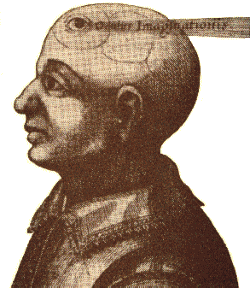
One other analogy that I’ve been toying with is Facebook as memory theater.  I’ve mentioned memory theaters in at least a couple of past posts (here and here), the basic idea is that one constructs an imagined space in the mind (similar to the work of the Architect in the film Inception, only you’re awake) and then populates the space with images that stand in for certain ideas, people, words, or whatever else you want to remember.  The theory is that we remember images and places better than we do abstract ideas or concepts.  During the Renaissance these mental constructs were sometimes externalized in built structures that housed all sorts of artifacts visually representing the store of human knowledge.

Perhaps it is a stretch, but Facebook seems to function in some respects as kind of externalized memory theater.  Instead of storing speeches or knowledge of the world, it is used to store autobiographical memory.  The architecture of the application is the constructed space and profiles are like images kept in the places, each profile carrying with it by association a trove of particular memories.  Most people report as one of the joys of Facebook the reconnection with an old friend from childhood.  While certainly some of these reconnections lead into renewed and sustained contact, most I imagine do not.  We exchange a message or two, we look over their life as it is now, and then we don’t really keep in touch any better than we used to.  But the memories have been activated, and now their profile takes its place in our memory theater, happily recalling those same memories whenever we like.  The profile is not the friend, of course; it simply becomes a placeholder for particular set of memories.

Facebook taps in to more than one aspect of our psychology.  I have often explained its appeal as a function of our desire to be noticed, to receive attention; and surely this is part of the mix. Lately Facebook’s role in the political sphere has been receiving a good deal of attention.  But it may be that its trade in our memories gives Facebook its uncanny persistence.  Increasingly we hear people taking issue with Facebook’s privacy protocols or otherwise complaining about the pressures of always on social media.  Not too long ago, I noted the grumblings over Facebook’s bid to become the ambient background of the Internet and Zuckerber’s disingenuous push for online “integrity.”  Recent studies have also drawn attention to the potentially negative effect of Facebook on psychological well-being, particularly for women.  But for all of this most people struggle to kill their accounts permanently. Like a bad high school romance, we break up with Facebook, only to flirt and make up, and then break up again.

This begins to make sense when we realize that Facebook has become a prosthetic of our memory.  But not just a prosthetic of memory in general, a simple list on a scrap of paper is that much; it is a prosthetic of our autobiographical memory.  It’s a part of our identity, and it is very difficult to kill off a part of one’s self.

One last thought, only a suggestive one at that: it is one thing to artificially condition one’s memory to store up vast amounts of information about the world or large chunks of poetry, it is quite another to artificially store up one’s autobiographical memory.  Our technology has made the storage of memory cheap and easy, but there is something to be said for forgetting.  The artificial extension of autobiographical memory involves us in some of the more complex regions of human psychology and personality.  We enter into the realm of mourning, catharsis, obsession, fantasy, and more.   We might consider as well that healing and forgetting very often go hand in hand.  In any case, we have a good deal to contemplate.

“They tell, and here is the enigma, that those consulting the oracle of Trophonios in Boetia found there two springs and were supposed to drink from each, from the spring of memory and from the spring of forgetting.”  Jacques Derrida (Memoires for Paul de Man)

__________________________________________________________

If this post was of interest, you may also want to consider Social Media and the Arts of Memory.

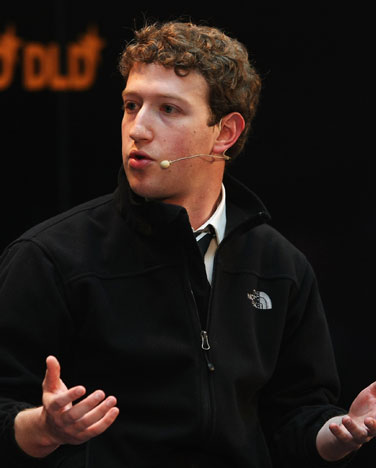
Mark Zuckerberg, Moral Philosopher of Identity

In a recent blog post, Steve Cheney bemoans the ongoing progress that Facebook is making toward becoming the ambient background of the Internet.  Specifically, he is concerned that Facebook is killing your authenticity:

… now Facebook’s sheer scale is pushing it in a new direction, one that encroaches on your authenticity.

Facebook is no longer a social network. They stopped being one long before the movie. Facebook is really a huge broadcast platform. Everything that happens between its walls is one degree away from being public, one massive auditorium filled with everyone you’ve ever met, most of whom you haven’t seen or spoken to in years.

Cheney’s post was triggered by the recent adoption of Facebook commenting by a number of large websites, a move that builds on the earlier integration of the “Like” button into almost every commercial, news, and entertainment site of note as part of Facebook’s “Open Graph” platform.  The trajectory here seems fairly clear.  Facebook is forging a global internet identity for you, one that it owns, of course, and with which it stands to make a fair bit of money.

Helpfully, Cheney did not frame his complaint within a denial of the basically social nature of human beings along the lines suggested by Andrew Keen not too long ago.  On the contrary, Cheney acknowledges our social impulses and is concerned that one singular online identity will not do justice to the complexity of human personality and truly social interaction.  One indiscriminate identity will result in one inauthentic and shallow identity that will inhibit rather than promote meaningful sociability.

“A George divided against itself cannot stand!”

The George in question is, of course, the character of George Costanza on Seinfeld.  In one of the more memorable exchanges from the remarkably memorable series, George explains what would happen if Relationship George were to come into contact with Independent George – Independent George would be no more.  We can relate to George in this situation because most of us maintain a handful of different personas that we cycle through as we navigate our way through life.  There are elements of our personality we reveal in some settings that we do not disclose in others; we present some aspects of our selves to certain people and not to others.  When for some reason these roles come into contact with one another it is possible that a little tension and confusion may ensue.  No news here.

In the early days of the Internet, when a kind of felicitous anarchy seemed to reign, it was fashionable to view the anonymity of the web as a playhouse of identity.  Individuals were able to try on and experiment with all sorts of identities — for better or for ill —  with relative safety and little worry of being found out.  It would have been unthinkable that one single and fully transparent identity would mark us across our Internet experience.

But that is exactly the trajectory we have been on for the last several years and this increases the odds of our many worlds colliding occasionally leading us to experience the kind of existential crisis that George’s histrionics embodied.  When our worlds collide, we too begin to sense that we might be losing our independent self, or the ability to control what people see and hear of us, control of what we might call our public identities.  We have a more difficult time calibrating our public personas to fit specific audiences and tasks.

Take for example the awkwardness and angst that arose when parents began joining Facebook and attempted to “friend” their children.  A Washington Post story on the topic from September 2008 cited protest groups formed in response with less than subtle names such as “What Happens in College Stays in College: Keep Parents Off Facebook!”  The author noted that it might seem odd that a “generation accustomed to sharing everything online” and with little or no apparent awareness of the distinction between private and public becomes apoplectic when merely two more people gain access to their already remarkably public personas.  But this misses the point.  What was at stake, of course, was control over who knew what.  The students experienced exactly what George did – their worlds collided and their anxiety reflected the increasing difficulty of controlling their public identity.

The ubiquity of one dominant social media platform makes it harder to exercise effective control over the presentation of our identities.  Mark Zuckerberg, moral philosopher that he is, rather conveniently believes,

You have one identity… The days of you having a different image for your work friends or co-workers and for the other people you know are probably coming to an end pretty quickly… Having two identities for yourself is an example of a lack of integrity.

Facebook’s near monopoly on social networking has reigned in the proliferation of profiles and, if fact, studies suggest that a Facebook profile tracks fairly closely to the truth about a person.  But there is still the question of who sees that more or less truthful public approximation of our personality and how much they see.  Furthermore, should Facebook, or any social media site be in the business of compelling people to live with integrity, particularly while profiting from the enforcement of this integrity?  More importantly, is it really integrity that is being forced upon us?  Or, to put it another way, does the maintenance of various personas necessarily entail a morally problematic lack of integrity? Is duplicity the only reason why we would withhold some aspect of our personality in certain circumstances?

Authentic and meaningful relationships typically depend upon the natural evolution of interpersonal trust and confidence.  Demanding immediate and equal transparency across the board works against the natural progression of social interaction.  Pace Mr. Zuckerberg, there are good reasons why we don’t reveal ourselves in equal measure to everyone and in all circumstances that have nothing to do with a lack of integrity.

The (Un)Naturalness of Privacy

Andrew Keen is not an Internet enthusiast, at least not since the emergence of Web 2.0.  That much has been clear since his 2007 book The Cult of the Amateur: How Today’s Internet is Killing Our Culture and his 2006 essay equating Web 2.0 with Marxism in The Weekly Standard, a publication in which such an equation is less than flattering.  More recently, Keen has taken on all things social in a Wired UK article, “Your Life Torn Open: Sharing is a Trap.”

Now, I’m all for a good critique and lampoon of the excesses of social media, really, but Keen may have allowed his disdain to get the better of him and veered into unwarranted, misanthropic excess.  From the closing paragraph:

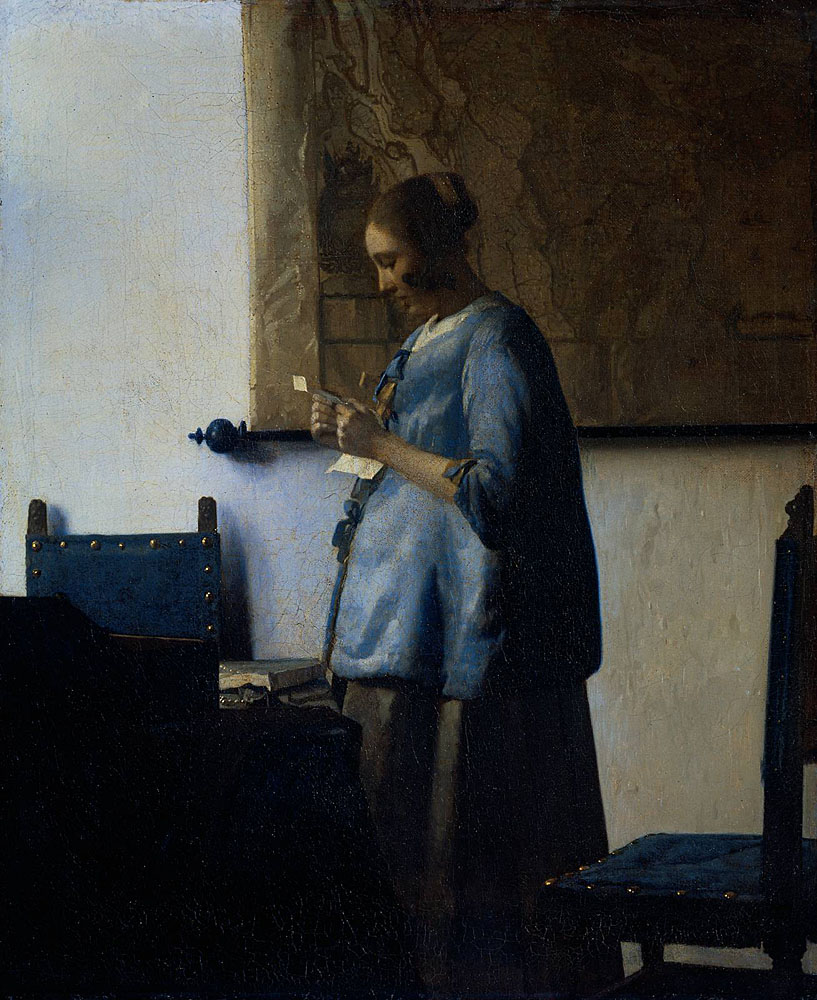
Today’s digital social network is a trap. Today’s cult of the social, peddled by an unholy alliance of Silicon Valley entrepreneurs and communitarian idealists, is rooted in a misunderstanding of the human condition. The truth is that we aren’t naturally social beings. Instead, as Vermeer reminds us in The Woman in Blue, human happiness is really about being left alone. …. What if the digital revolution, because of its disregard for the right of individual privacy, becomes a new dark ages? And what if all that is left of individual privacy by the end of the 21st century exists in museums alongside Vermeer’s Woman in Blue? Then what?

“Human happiness is really about being left alone” and “The truth is that we aren’t naturally social beings”? Striking statements, and almost certainly wrong. It seems rather that the vast majority of human beings long for, and sometimes despair of never finding, meaningful and enduring relationships with other human beings. That human flourishing is conditioned on the right balance of the private and the social, individuality and relationship, seems closer to the mark. And while I suppose one could be raised by wolves in legends and stories, I’d like to know how infants would survive biologically in isolation from other human beings.  On this count, better stick with Aristotle.  The family, the clan, the tribe, the city — these are closer to the ‘natural’ units of human existence.

The most ironic aspect of these claims is Keen’s use of Vermeer’s “Woman in Blue” or, more precisely, “Woman in Blue Reading a Letter,” to illustrate them.  That she is reading a letter is germane to the point at issue here which is the naturalness of privacy.  Contrary to Keen’s assertion of the natural primacy of privacy, it is closer to the truth to correlate privacy with literacy, particularly silent reading (which has not always been the norm), and the advent of printing.  Changing socio-economic conditions also factor into the rise of modern notions of privacy and the individual.  Notions formalized by Locke and Hobbes who enshrine the  atomized individual as the foundation of society, notably, with founding myths which are entirely a-historical.

In The Vineyard of the Text, Ivan Illich, citing George Steiner, suggests this mutual complicity of reading and privacy:

According to Steiner, to belong to ‘the age of the book’ meant to own the means of reading.  The book was a domestic object; it was accessible at will for re-reading.  The age presupposed private space and the recognition of the right to periods of silence, as well as the existence of echo-chambers such as journals, academies, or coffee circles.

Likewise, Walter Ong, drawing on Eric Havelock, explains that

By separating the knower from the known, writing makes possible increasingly articulate introspectivity, opening the psyche as never before not only to the external objective world quite distinct from itself but also to the interior self agaisnt whom the objective world is set.

Privacy emerges from the dynamics of literacy.  The more widespread literacy becomes, as for example with the printing press, the more widespread and normalized the modern sense of privacy becomes.  What Keen is bemoaning is the collapse of the experience privacy wrought by print culture.  I do think there is something to mourn there, but to speak of its “naturalness” misconstrues the situation and seems to beget a rather sociopathic view human nature.

Finally, it is also telling that Vermeer’s woman is reading a letter.  Letters, after all, are a social genre; letter writing is a form of social life.  To be sure, it is a very different form of social life than what the social web offers, but it is social.  And were we not social beings we would not, as Auden puts its, “count some days and long for certain letters.” The Woman in Blue Reading a Letter reminds us that privacy is bound to literate culture and human beings are bound to one another.

_____________________________________________________________

Updates:  To reinforce that it is a balance we are after, also consider this article in yesterday’s Boston Globe, “The Power of Lonely.” Excerpt:

But an emerging body of research is suggesting that spending time alone, if done right, can be good for us — that certain tasks and thought processes are best carried out without anyone else around, and that even the most socially motivated among us should regularly be taking time to ourselves if we want to have fully developed personalities, and be capable of focus and creative thinking.

My attention has also been drawn to an upcoming documentary for which Andrew Keen was interviewed.  PressPausePlay will be premiering at South By Southwest and addresses the issues of creativity and art in the digital world.  Here’s  a preview featuring Andrew Keen: