
“With Only Their Labor to Sell”

Glenn Beck drew a crowd and a good deal of commentary from across the political and religious spectrum.  I wasn’t at Beck’s “Restoring Honor” rally this past weekend and I haven’t spoken to any one who was, but I did come across a number of articles, editorials, and blog posts that offered their take on what was going on.  Needless to say, it wasn’t all positive.  But, as if to demonstrate that people remain more complex than our tendency to reduce the world into binary oppositions suggests, the most scathing review I read came from conservative, Southern Baptist seminary professor Russell Moore, and one of the more self-consciously open-minded pieces came from the LGBT Editor of Religion Dispatches, Alex McNeill.  Ross Douthat, who was at the rally, offered his take on the political implications of the “apolitical” rally in  his NY Times editorial and a follow-up blog post.

There is not much that I would care to add.  I’m basically in agreement with Moore, but rather preferred the sensibility to the actual people at the rally demonstrated by McNeil.  But thinking about the rally put me in mind to comment on a couple of other pieces I’d read within the last few days.  Beck (along with Limbaugh, Hannity, and company) tends to symbolize for many people the marriage of free market economics with cultural conservatism that came to dominate the political right from the late ’70’s through the present.  Essentially it is the Reagan coalition.  But what if that marriage was an inherently unstable mixture?

Sometime ago I was struck by a particular formulation offered by historian Eric Miller of Christopher Lasch’s critique of the both ends of the political spectrum.  According to Lasch, both ends harbored a fatal tension.  The Left called for socially conscious and active individuals while promoting a vision of the self that was atomized and unencumbered.  The Right called for the preservation of moral tradition and community while promoting an economic order that undermined those very institutions.  This remains, to my mind, a very apt summation of our current political situation.

In two recent essays, Philip Blond and Jonny Thakkar call for what they have respectively termed Red Toryism and Left Conservatism.  Neither Blond nor Thakkar cite Lasch, but they each channel Lasch’s analysis of the inner tension within modern conservatism’s attachment to free market ideology.

In “Shattered Society,” Blond, a London based academic turned political activist, laments the loss of mediating institutions which sheltered individuals from the power of the state and the market.

The loss of our culture is best understood as the disappearance of civil society. Only two powers remain: the state and the market. We no longer have, in any effective independent way, local government, churches, trade unions, cooperative societies, or civic organizations that operate on the basis of more than single issues. In the past, these institutions were a means for ordinary people to exercise power. Now mutual communities have been replaced with passive, fragmented individuals.

And according to Blond, “Neither Left nor Right can offer an answer because both ideologies have collapsed as both have become the same.”  The left lives by an “agenda of cultural libertarianism” while the right espouses an agenda of “economic libertarianism,” and there is, in Blond’s view, little or no difference between them.  They have both contributed to a shattered society.  “A vast body of citizens,” Blond argues, “has been stripped of its culture by the Left and its capital by the Right, and in such nakedness they enter the trading floor of life with only their labor to sell.”

In the provocatively titled, “Why Conservatives Should Read Marx,” Thakkar argues that there is no compelling reason for conservatives to wed themselves to free market ideology.  He cites Samuel Huntington who described conservatism as a “‘situational’ ideology which necessarily varies from place to place and time to time …” “The essence of conservatism,” Huntington believed, “is the passionate affirmation of the values of existing institutions.”

Following anthropologist Arnold Gehlen, Thakkar assumes that habits and routines and the cultural institutions that support them are necessary for human flourishing.  These culturally inculcated habits and routines function as instincts do for other animals.  Apart from them we would be “prone to unbearable cognitive overload.”  A predicament that is all the more palpable at present than when Gehlen wrote in the middle of the last century.

But following Marx, Thakkar believes that it is in the nature of capitalism to undermine existing social and cultural institutions.  The reason is simple.  Competition necessarily drives technological innovation (not necessarily a bad thing of course!), and technological innovation in the realm of economic production elicits social change as well.  “To the degree that technological change is built into capitalism,” Thakkar summarizes, “so must institutional change be.  In every single generation certain institutions will become obsolete, and with them their attendant practices and values.”

Whatever one may think about the merits of this process, it certainly isn’t inherently conservative.  As Thakkar writes further on, “In theory it is possible to be an economic libertarian and a social conservative; in practice the two are irreconcilable.”

You can read both pieces to get the whole of their respective arguments as well as their proposals for moving forward.  Neither Thakkar nor Blond claim to be against the free market, but they are both in favor of re-prioritizing the health of society, particularly its mediating institutions.  In Blond’s view, this can lead to a “popular capitalism” that entails “a market economy of widely disbursed property, of multiple centers of innovation, of the decentralization of capital, wealth, and power.”

For Thakkar, this means pursuing a “commitment to think each case through on its own merits:  if something is harmful or unjust, we should try to change it; but if something valuable is being destroyed, we should try to conserve it,” rather than blindly submitting to the demands of the growth economy.

Whether we agree with the details of their policy suggestions or not, it seems to me that both Thakkar and Blond, like Lasch before them, have perceptively diagnosed the inner tensions of the political right (and left) and the cultural consequences of those tensions.


Understanding as a Mode of Resistance

Most everyone knows by now that it was the late Marshall McLuhan who told us that “the medium is the message” and who also first alerted us to the emergence of the “global village.”  He is widely recognized as a communication and media theorist of abiding significance and among the most astute observers of our technological age.  Not surprisingly, in its 1993 debut issue, Wired magazine adopted McLuhan as its patron saint .

Depending on how familiar one is with McLuhan, however, the following exchange from an interview he gave in 1966 may be a bit surprising:

Fulford:  What kind of a world would you rather live in?  Is there a period in the past or a possible period in the future you’d rather be in?

McLuhan:  No, I’d rather be in any period at all as long as people are going to leave it alone for a while.

Fulford:  But they’re not going to, are they?

McLuhan:  No, and so the only alternative is to understand everything that is going on, and then neutralize it as much as possible, turn off as many buttons as you can, and frustrate them as much as you can.  I am resolutely opposed to all innovation, all change, but I am determined to understand what’s happening because I don’t choose just to sit and let the juggernaut roll over me.  Many people seem to think that if you talk about something recent, you’re in favor of it.  The exact opposite is true in my case.  Anything I talk about is almost certainly to be something I’m resolutely against, and it seems to me the best way of opposing it is to understand it, and then you know where to turn off the button.

(Understanding Me:  Lectures and Interviews, 101-102)

The Search

Kurt Vonnegut’s “Harrison Bergeron” presented us with a striking illustration of the potentially debilitating consequences of the constant distraction.  In that story the distraction is brutally imposed; but, as we noted last week, we choose our distractions.  In fact, we embrace our Internet-empowered distractions.  We love to be distracted and we crave diversion.  We can hardly stand it if we are without distraction or diversion for more than a few moments at a time.  We complain incessantly about our busyness, but were it all to stop we would hardly know what to do with ourselves.  This raises some interesting questions.  Why are we so keen to envelope ourselves in constant distraction?  Why do some of us develop an addictive relationship to the constant flow of distraction?  Why are we so uneasy when the distractions stop?

Back in June, I reflected on the theme of distraction and diversion on the heels of a post about the religious aura that sometimes surrounds our love affair with sports.  We were then, you will remember, at the height of World Cup fever.  I want to revisit some of those same thoughts and tweak them just a little bit as a follow up to Friday’s post on distraction and “Harrison Bergeron.”

Distractedness and the need for diversion are not new phenomenon of course.  Although the condition may now be intensified and heightened, it has been with us at least since the 17th century, and almost certainly before then.  It was in the 17th century that Blaise Pascal began assembling a series of notes on scraps of paper in preparation for a book he never wrote.  When he died at the age of 39 he left behind hundreds of barely organized notes which were later collected and published under the French title Pensées, or thoughts.  Pascal is today remembered, if at all, either for his law of fluid pressure or an argument for God’s existence known as Pascal’s Wager.  Neither quite does justice to the depth of his insight into what we used to call the human condition.
Pascal knew that we needed our diversions and distractions and that without them we would be miserable.  His description of the younger generation sounds wholly contemporary:

Anyone who does not see the vanity of the world is very vain himself.  So who does not see it, apart from young people whose lives are all noise, diversions, and thoughts for the future?  But take away their diversion and you will see them bored to extinction.  Then they feel their nullity without recognizing it, for nothing could be more wretched than to be intolerably depressed as soon as one is reduced to introspection with no means of diversion.

But Pascal is not merely an old crank berating a younger generation he fails to understand.  Pascal applies the same analysis indiscriminately.  Young or old, rich or poor, male or female — for Pascal it just comes with being human.  “If our condition were truly happy,” he explains, “we should not need to divert ourselves from thinking about it.”  As things stand, however,

What people want is not the easy peaceful life that allows us to think of our unhappy condition, nor the dangers of war, nor the burdens of office, but the agitation that takes our mind off it and diverts us.  That is why we prefer the hunt to the capture.

We need distractions and diversions to keep us from contemplating our true condition, frail and mortal as it is.  For this reason we cannot stand to be alone with our own thoughts and seek to fill every moment with distraction.  Pascal’s view is admittedly rather grim even as it resonates with our experience.  Yet, Pascal knew there was more than this to the human condition.  There was also love and passion, knowledge and creativity, wonder and courage.  Pascal knew this and he insisted that we recognize both the glory and the misery of humanity:

Let man now judge his own worth, let him love himself, for there is within him a nature capable of good; but that is no reason for him to love the vileness within himself.  Let him despise himself because this capacity remains unfilled; but that is no reason for him to despise this natural capacity.  Let him both hate and love himself; he has within him the capacity for knowing truth and being happy, but he possesses no truth which is either abiding or satisfactory.

Pascal insists that we reckon with all that is good and all that is bad in us.  It is our awareness of the possibility of goodness, however, which heightens our misery.  And, yet again, it is our awareness of our misery that is part of our glory.  In the end Pascal believed that “God alone is man’s true good” and Christ the “via veritas.”  With St. Augustine, whose influence permeates Pascal’s thought, he would have prayed, “Our hearts are restless until they find their rest in Thee.”  Perhaps this is why at times something akin to spirituality and the language of worship suffuses our most prominent and powerful diversions.

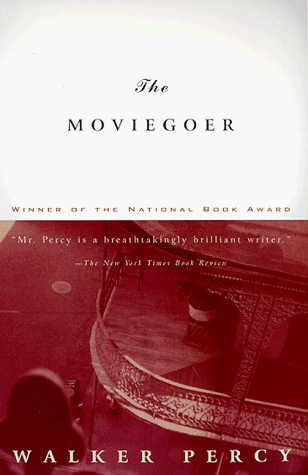
Augustine and Pascal in turn both helped shape the thought of  2oth century novelist Walker Percy.  Percy blended Pascalian insight with a touch of existentialism in his best known novel The Moviegoer (1960) in which the main character, Binx Bolling, finds himself on a search.  “What is the nature of the search? you ask.”

Really it is very simple, at least for a fellow like me; so simple that it is easily overlooked.  The search is what anyone would undertake if he were not sunk in the everydayness of his own life …. To become aware of the possibility of the search is to be onto something.  Not to be onto something is to be in despair.

Near the middle of the novel throughout which Bolling has been amassing clues he thinks are somehow related to the search, he despairs:

… when I awake, I awake in the grip of everydayness.  Everydayness is the enemy.  No search is possible.  Perhaps there was a time when everydayness was not too strong and one could break its grip by brute strength.  Now nothing breaks it — but disaster.

However, through a rather tortured relationship with a very broken young woman named Kate whom he has come to love, Binx begins to see grace in the ordinary.  Near the very end of the novel, while he and Kate are sitting at a service station discussing marriage and the worries that still fill Kate’s mind, Binx notices a man coming out of a church.  It is Ash Wednesday.  Binx watches while the man sits in his car looking down at something on the seat beside him.  The man’s presence puzzles Binx:

It is impossible to say why he is here.  Is it part and parcel of the complex business of coming up in the world?  Or is it because he believes that God himself is present here at the corner of Elysian Fields and Bons Enfants?  Or is he here for both reasons:  through some dim dazzling trick of grace, coming for the one and receiving the other as God’s own importunate bonus?  It is impossible to say.

In June with sports on my mind, I wondered whether, as Pascal would have it, sports were a mere distraction which facilitated our unwillingness to acknowledge our true condition; or, taking a cue from Percy, whether it might be a rupture of the “everydayness,” the ordinariness of our lives that may awaken us to the possibility of the search.  My sense at the time was that both were on to something, each was a possibility.  Sports can be merely a distraction conducive to living in bad faith in denial of the truth of our situation.  But at times bursts of grace and beauty appeared suddenly and unexpectedly in the midst of our diversion to remind us that we ought to be searching for their source.  “Through some dim dazzling trick of grace, coming for the one” we receive “the other as God’s own importunate bonus.”

Thinking now about the distractions enabled by the Internet, social media, smart phones, and all the rest I wonder if something like the same analysis might also apply.  Do we embrace these distractions as a way of refusing silence and contemplation because we do not care to entertain the thoughts that may come?  Perhaps.  Surely more than this is going on.  Sometimes a moment of carefree distraction is just that.  Is it possible that coming for distraction we might find something more — a real connection with another human being, a new insight, real wisdom, genuine laughter?

I am not so much of a pessimist that I would discount such possibilities.  But I do fear that more often than not our distractions, as Pascal would put it, are diversions that keep us from considering our true condition. They are part of the “everydayness” of life that is the enemy of the search and might even hide from us the possibility of the search.   To give up on the search, to be unaware of it, is to be in despair. If it doesn’t feel like despair, is it because, as Kierkegaard put it in a line that opens The Moviegoer, “… the specific character of despair is precisely this:  it is unaware of being despair”?

Perhaps it is also because we are too distracted to notice.  We are the “diverted selves” Percy described in Lost in the Cosmos: The Last Self-Help Book,

In a free and affluent society, self is free to divert itself endlessly from itself.  It works in order to enjoy the diversions that the fruit of one’s labor can purchase.  The pursuit of happiness becomes the pursuit of diversion …

The Cost of Distraction: What Kurt Vonnegut Knew

“The year was 2081, and everybody was finally equal.”

So begins the late Kurt Vonnegut’s 1961 short story, “Harrison Bergeron.” In 2009, Chandler Tuttle released a 25 minute film version of the story titled 2081, and you can watch the trailer at the end of this post.

Vonnegut goes on to describe the conditions of this equality:

They weren’t only equal before God and the law. They were equal every which way. Nobody was smarter than anybody else. Nobody was better looking than anybody else. Nobody was stronger or quicker than anybody else. All this equality was due to the 211th, 212th, and 213th Amendments to the Constitution, and to the unceasing vigilance of agents of the United States Handicapper General.

This government enforced equality was achieved by imposing prosthetic technologies on those who were above average; these prosthetics, however, were designed not to enhance, but to diminish.  So, for example, ballerinas who might otherwise rise above their peers in grace, elegance and beauty,

were burdened with sashweights and bags of birdshot, and their faces were masked, so that no one, seeing a free and graceful gesture or a pretty face, would feel like something the cat drug in.

Then there were those of above average intelligence like the title character’s father, George Bergeron.

[He] had a little mental handicap radio in his ear. He was required by law to wear it at all times. It was tuned to a government transmitter. Every twenty seconds or so, the transmitter would send out some sharp noise to keep people like George from taking unfair advantage of their brains.

Whenever George began to formulate a complex idea, which often involved questioning the status quo, a sharp, piercing noise would shoot in his ear distracting him and derailing his train of thought.  Sometimes the noise was like a siren going off, other times “like somebody hitting a milk bottle with a ball peen hammer.”  Regular and incessant, the distraction overwhelmed and undermined natural intelligence.

George’s son, Harrison Bergeron possessed gifts and abilities that rendered him an especially potent threat to the regime of equality.  Because of this he was taken away and locked up by the authorities when he was fourteen.  Midway through the story, however, as George and his wife Hazel watch encumbered ballerinas dancing on television, a news bulletin interrupts the performance.  A ballerina takes over from a stuttering  announcer to read the bulletin.

“Harrison Bergeron, age fourteen,” she said in a grackle squawk, “has just escaped from jail, where he was held on suspicion of plotting to overthrow the government. He is a genius and an athlete, is under-handicapped, and should be regarded as extremely dangerous.”

Shortly thereafter, Harrison, whose debilitating prosthetics made him look “like a walking junkyard,” bursts into the building.  He effortlessly rips off the multiple “handicaps” that had been attached to his body in an unsuccessful effort to equalize his prodigious strength and ability.  He then proclaims himself emperor, declaring to the wonder-struck onlookers, “Now watch me become what I can become!”

Having been joined by a beautiful ballerina who came forward to be his empress, they dance.  They dance majestically and preternaturally breaking not only “the laws of the land,” but “the law of gravity and the laws of motion as well.”  And while they danced so high they kissed the ceiling,

Diana Moon Glampers, the Handicapper General, came into the studio with a double-barreled ten-gauge shotgun. She fired twice, and the Emperor and the Empress were dead before they hit the floor.

And just like that, equality is restored.

“Harrison Bergeron” is a nicely executed short story that can be read from a number of perspectives, yielding insights that can be variously applied to political, economic, or cultural circumstances.  As I read it, the story shares a certain sensibility with both Orwell’s 1984 and Huxley’s Brave New World.  It has been noted by, among others, Huxley himself that Brave New World pictures a more likely image of the future because it is not posited on a heavy-handed totalitarianism.  It is, rather, a freely embraced dystopia.  I want to suggest that, in “Harrison Bergeron,” Vonnegut offered us an Orwellian adumbration of one particular dimension of our Internet soaked world that has in fact emerged along a more Huxleyian trajectory.

Consider the manner in which the advantages of the intellectually gifted are equalized in Vonnegut’s story — distraction, regular and constant distraction.  The story provides a vivid and disturbing image of the consequences of perpetual distraction.

We’ve noted more than a few critics who have been pointing to the costly consequences of living with the perpetual distractions created by the very nature of the Internet and the ubiquity of portable tools which allow us to be always connected, always accessible.   Recently a group of neuroscientists made news by taking a trip into the Utah wilderness to disconnect long enough to appreciate the mental costs of constant connectivity and the perpetual distraction that comes with it.

In the world of 2081 imagined by Vonnegut, the distracting technology  is ruthlessly imposed by a government agency.  We, however, have more or less happily assimilated ourselves to a way of life that provides us with regular and constant distraction.  We have done so because we tend to see our tools as enhancements.  They promise, and often provide, pleasure, comfort, efficiency, and productivity.  What’s more, our distractions are not nearly so jarring as those that afflict the characters in “Harrison Bergeron”; in fact, our distractions can often be quite pleasant.

But might they also be inhibiting the development of our fullest potential?  Are we trading away certain real and important pleasures and possibilities?  Have we adopted technologies that in their democratizing power, also engender mediocrity? Do our perpetual distractions constitute a serious impairment of our cognitive abilities?  Can we learn to use our tools in a way that mitigates the costs?

These are just a few of the questions suggested by “Harrison Bergeron.”  Our future, at least in part, may hinge on the answers.

Identity Reset

A few days ago we noted the conflicting opinions of Jeffrey Rosen and David Dylan Thomas on how much the Internet will or will not remember.  In a recent interview with The Wall Street Journal’s Holman Jenkins, Jr., Google CEO Eric Schmidt appears to think the Internet will in fact have a very long memory:

“I don’t believe society understands what happens when everything is available, knowable and recorded by everyone all the time,” he says.

A possible response?

He predicts, apparently seriously, that every young person one day will be entitled automatically to change his or her name on reaching adulthood in order to disown youthful hijinks stored on their friends’ social media sites.

Among the other things Schmidt said, also apparently seriously:

“I actually think most people don’t want Google to answer their questions,” he elaborates. “They want Google to tell them what they should be doing next.”

Super.