Reinvigorating Friendship

For friendship these are the best of times, and these are the worst of times.  We claim, with a straight face, hundreds of friends on social networking sites.  Our cell phones contain scores of contacts.  Rare are the minutes when we are not somehow in touch with someone, whether virtually or in person.  It has never been easier to keep up with old friendships or to establish new ones.  And yet …

How many of us still experience an abiding sense of loneliness?  How many of our friendships surpass mere familiarity and convenience?  How many of our friends will we still count as such in ten, twenty, or thirty years? Is it not the case, to paraphrase poet Richard Foreman, that ours are “pancake” friendships, “spread wide and thin,” but with little or no depth?  Are we not, as Daniel Akst wonders in a recent essay in The Wilson Quarterly, “America: Land of Loners?”

This is not a new concern, and Akst is not the first to raise it; he is only the most recent.  Akst cites Robert Putnam’s well known Bowling Alone, published in 2000, which argued with extensive statistical data that in the late-20th century Americans were increasingly choosing to live in isolation.  Putnam’s work, in turn, recalls David Riesman’s earlier classic, The Lonely Crowd. Riesman wrote in 1950, and it was in the “seemingly placid 1950′s, when mass unhappiness and mass loneliness began” according to Ronald Dworkin’s recent article on “The Rise of the Caring Industry” which we noted here a couple of weeks ago.  Dworkin and Akst both observe that many of us now pay professionals for what in previous generations friends had supplied at the mere cost of reciprocity (which, admittedly, can sometimes be steeper than a therapist’s hourly fee).

Concern for friendship, of course, goes back much farther than the 1950’s, and Akst touches on this history briefly. He cites Aristotle who, while acknowledging the place of merely useful and entertaining friends, nonetheless viewed deep, meaningful friendships as an essential part of a good life.  And Aristotle is only the first in a long tradition:

The myth of Damon and Pythias and the biblical story of David and Jonathan resonated across the centuries, and in the Middle Ages knights bound themselves in ceremonies to comrades in arms. Cicero, Johann Wolfgang von Goethe, Sir Francis Bacon, Michel de Montaigne, William Wordsworth—the list of Western luminaries who have waxed rhapsodic over friendship is long enough to fill anthologies from both Norton and Oxford.

At present, however, we find ourselves in an unfortunate situation. We have the trappings of friendship all around us, and we can probably list more people we call friends than our parents or grandparents ever could. But somewhere along the way we seem to have forgotten how to transform at least a few of these relationships into the sorts of friendships that will sustain and enrich our lives over the long haul.

Nicholas Christakis and James Fowler, authors of Connected: The Surprising Power of Our Social Networks and How They Shape Our Lives (2009), surveyed more than 3,000 randomly chosen Americans and found they had an average of four “close social contacts” with whom they could discuss important matters or spend free time. But only half of these contacts were solely friends; the rest were a variety of others, including spouses and children.

Joseph Epstein, whose essay “My Friend Edward”  in Narcissus Leaves the Pool remains one of the more moving pieces on friendship I have ever read, wrote elsewhere that he “can think of exactly seven friends, very good friends, whose death or disappearance from my life would devastate me.”  He was there reflecting the ancient Roman historian Plutarch who claimed that one needs no more than seven good friends in a lifetime.  Seven seems better than two.  I wonder if even those two are of the sort Epstein and Plutarch had in mind —  “Close social contact” seems a bit sterile.

Akst explores a number of factors that in his view have contributed to our dearth of meaningful friendships: high rates of mobility, the press of busy schedules, divorce which split groups of friends as well as spouses, the American penchant for “self-reliance,” and the “remorseless eroticization of human relations” that inhibits male friendships in particular.  Akst lists a few more and we could think of more still — I wonder how many refuse close friendships because they are fearful of the emotional vulnerability involved — but you get the point.

Fundamentally, however, I wonder if we are not also dealing with a failure of the imagination.  Have we contented ourselves with shadows of friendship because we no longer remember what the reality looked like?  If so, then perhaps we are in need of reminders.  Gilbert Meilaender and Alan Jacobs have both written thoughtfully and evocatively on friendship and in the process offered us powerful images of friendship in its fullness.

In the past I’ve quoted from an insightful piece Meilaender wrote for First Things, “Men and Woman — Can We Be Friends,” and it is worth quoting again.  Meilaender concluded his article with the following poignant reflections on Katherine Paterson’s Bridge to Terabithia:

The friendship in the book is one between a boy and a girl, Jess and Leslie …. In different ways they are both outsiders in the world of their peers at school, and that very fact draws them together. They create — largely at the instigation of Leslie — a “secret country” named Terabithia, in which they are king and queen. This country — a piece of ground on the other side of a creek, to which they swing across on a rope — is, in Leslie’s words, “so secret that we would never tell anyone in the whole world about it.” And, at least at first, it must be that way …. [W]ere no friendships of theirs to be special and particular, were they to have no secret country that others did not share, they would never come to know themselves as fully as they do. Thus, for example, Jess finds that his friendship with Leslie opens up new worlds for him. “For the first time in his life he got up every morning with something to look forward to. Leslie was more than his friend. She was his other, more exciting self- his way to Terabithia and all the worlds beyond.”

Jess says that Leslie is his way not only to Terabithia but also to “all the worlds beyond,” but he learns that truth only slowly and with great bitterness. When the creek is swollen from a storm and Jess is gone, Leslie still tries to cross to Terabithia on the rope. It breaks, she falls onto the rocks, and is killed. Grief-stricken and alone, without his alter ego, Jess can barely come to terms with what has happened. But he does, finally, and in doing so learns something about the purpose of all friendship.

“It was Leslie who had taken him from the cow pasture into Terabithia and turned him into a king. He had thought that was it. Wasn’t king the best you could be? Now it occurred to him that perhaps Terabithia was like a castle where you came to be knighted. After you stayed for a while and grew strong you had to move on. For hadn’t Leslie, even in Terabithia, tried to push back the walls of his mind and make him see beyond to the shining world-huge and terrible and beautiful and very fragile?”

Jacobs closes his “Friendship and Its Discontents” with a justly famous and equally moving passage from Montaigne.  In it Montaigne remembers a friend whose death had indeed devastated him:

.. our souls mingle and blend with each other so completely that they efface the seam that joined the, and cannot find it again.  If  you press me to tell you why I loved him, I feel that this cannot be expressed, except by answering:  Because it was he, because it was I.

Jacobs adds,”Few people in any age and in any culture have had a friendship like this one; how many people in our world can comprehend, or even imagine, the experience Montaigne describes?”

We have no guarantee that we will find and sustain such friendships in our lifetime, friendships that help us to see beyond our own secret countries; but it would be very sad indeed if we did not even know they were possible and consequently never searched them out.

“You have to be somebody before you can share yourself”

Will the Internet make it impossible to make clean starts in life?  Will every word and every picture we have posted, however ill advised, find a way to haunt us?  This is the fear legal scholar Jeffrey Rosen articulated in his NY Times piece, “The Web Means the End of Forgetting.” That is the same piece that led me to wonder several days ago if we might need a new economic statistic to track social media induced unemployment.

According to David Dylan Thomas at In Medias Res, the real problem might actually be the opposite of what Rosen feared.  In a post titled “The Myth of Online Inertia,” Thomas argues that “things disappear from the web” all the time.  The evolution of hardware and file formatting renders much of what is produced potentially inaccessible with the passage of time.  “As a web manager,” Thomas explains,

I’ve overseen the overhaul of many a content management system, and there’s always a compatibility issue which forces editors and technology teams to ask the same question. How much? How much will it cost (in time and money) to convert how much information? Do we really want to bother reformatting 400 news stories that were published in 2000 to a whole new format on the off chance that someone will search for them? The answer is almost always no. And that’s just 10 years.

My sense is that both Rosen and Thomas are on to something and that if they were to sit down together to discuss their positions, a synthesis preserving elements of both arguments would emerge.  Regardless of how powerful the Internet’s long term memory proves to be, however, its short term memory is quite good and potentially quite damaging.  Consequently, we are becoming increasingly self-conscious and cautious about what we post and where.

Some are concerned enough to implement tools such as Google Goggles that are designed to keep us from sending that stupid drunken email that ends up costing us our job or a relationship.  A great deal of time and money is also being spent to keep individuals from not only ruining their own reputations with a misguided tweet, but also tarnishing the image of the institutions with which they are associated.  In a recent story about the effort colleges are putting forth to manage the social media activities of their student athletes, a consultant gave the very basic rule he tries to instill in student athletes:  if you would have a problem with your mother reading or seeing it, don’t post it.

This is good advice as far as it goes, I suppose.  Although, it would depend a great deal, wouldn’t it, on the sensibilities of each particular mom.  In any case, this all brought to mind a recent article in The New Republic by Jed Perl.  In “Alone, With Words,” Perl laments the loss of writing that  begins as and remains a private act.

Writing, before it is anything else, is a way of clarifying one’s thoughts. This is obviously true of forms such as the diary, which are inherently solitary. But even those of us who write for publication can conclude, once we have clarified certain thoughts, that these thoughts are not especially valuable, or are not entirely convincing, or perhaps are simply not thoughts we want to share with others, at least not now … I believe that most writing worth reading is the product, at least to some degree, of this extraordinarily intimate confrontation between the disorderly impressions in the writer’s mind and the more or less orderly procession of words that the writer manages to produce on the page.

Most of what is made public in the arena of social media was never private in Perl’s sense, at least not for very long at all.  We are becoming used to the idea of providing a more or less real time feed of our thoughts and actions to the world.  The process of clarification and crafting that Perl describes has been replaced by the urge to publicize immediately.  Little wonder then that some of what we make public is damning and much of it is quite inane.

Citing Jaron Lanier, Alan Jacobs makes a point that we seem to have forgotten:

“You have to be somebody before you can share yourself.” And the process of becoming somebody takes time, effort, discipline, and study.

That process also tends to happen when we have preserved  a certain private space for our selves.  Social media and the Internet have given us an unparalleled ability to make our thoughts, our writing, our  pictures, our very selves public.  Our task now may be to carve out and preserve a private space that will help render what we make public meaningful and worthwhile.  Or, at least not potentially disastrous.

Follow Ups

Often valuable  material related to earlier posts I had written comes to my attention.  Rather than attach the new stuff to the original posts which are by then buried beneath more recent items, it made more sense to collect the new material and from time to time devote  a post to these follow ups.  So here you go:

Following up on “Hitchens and Prayer,” here is one of the more thoughtful reflections I’ve come across on the topic:  “The Most Pressing Question” by Damon Linker at The New Republic.

Following up on “Parenting and Its Discontents,” Jason Peters at Front Porch Republic writes on the importance of extended families in “The Orphans of Success.”

And following up on “Technology Sabbaths and Other Strategies for the Digitized World,” I found that Erika Kosina had also written a great post, “Time for a Technology Sabbath?”, at Yes! with some very helpful suggestions.

Dot, Dot, Dot

Recently it struck me that I have been using ellipses (. . .) quite a bit in my informal writing.  Like most people I compose at least a few emails each day and while, by most standards I am an infrequent texter, I do send out a modest amount.   In both of these formats I’ve been dot, dot, dotting left and right.  And after sharing this observation with a few people and following up with a quick search on Goolge it became clear that I wasn’t alone.  The ellipsis is the darling of new media.  So this led me to wonder if there was some significance in this grammatical development, or if it was just some combination of convenience and coincidence.  An intuition of sorts formed in my gut telling me there was something deeper going on.  So why is it this particular mark of punctuation has suddenly become so prominent?

Within the world of emails, texts, and chat rooms a certain grammar has evolved.  It’s not the King’s English, but it isn’t quite anarchy either.  Rules and established usages have emerged, and within this emerging grammar the ellipsis functions in certain defined ways.  For example, it can signal that the sender is still awaiting a reply after an unusually long break in a text exchange, as if to say “Still waiting . . .”  Or, it can signal that another text will follow to complete the present thought, “Hold on, more to come . . .”  And in some other cases still it may be used to express awkward silence . . .

As I kept thinking about my own use of the ellipse I realized I was also using the dots in some more subtle ways.  For example, Seinfeld came to mind.  This isn’t all that unusual, after all the show about nothing sometimes appeared to be about everything.  So it struck me that the dots sometimes functions in much the same way as the phrase “yada, yada, yada” made famous on the sitcom, as a way of saying “etc. etc.” with a certain bored indifference. At still other times I was using the ellipsis as a stream of consciousness device, stringing together thoughts that may not be formally or self-evidently related, but that nevertheless flow one from another in some weird associative way . . . in my mind.  And as that last line suggests, sometimes one may use the ellipsis, as my wife noted, as a way of getting the reader to read in a dramatic pause, often for comedic effect.

All of these ways of using the ellipsis, however, were not getting at my gut instinct.  These were all still fairly utilitarian uses of the mark, but I sensed that something more was going on.  I suspected the dots somehow signaled some shift in our way of thinking and expressing ourselves, that perhaps it was a symptom of our cultural condition surfacing through our writing.  Then it dawned on me.  I realized that at times I used the ellipsis to communicate a certain vagueness and ambiguity in what I was saying.  I used the dots to convey hesitancy and indeterminacy.  It was the mark of a thought that refused to assert itself.

Classic example:  On Facebook, where ellipses run wild, I might post a link on someone’s wall with the note, “Thought you might like this . . .”  If you were to put what the ellipsis communicates into words you would get,

Thought you might likes this, maybe you will, maybe you won’t, I’m not too sure exactly, actually I don’t like it so much myself, well maybe a little, but don’t think me stupid if you don’t like it …

The ellipsis gives expression to a habit of ironic detachment and preemptive indifference.  And here is where I found the point of contact with larger cultural trends.  The mood of ironic detachment that has settled over so many of us was manifesting itself in three simple dots.  With those dots we were evading conviction, giving off an apathetic vibe, and guarding ourselves from seeming unfashionably earnest.

Thinking about the ellipsis brought to mind a performance by Taylor Mali, “Speak With Conviction.” It’s meant to be heard so watch the video below, but here is the part that comes to mind:

Declarative sentences … so called, because, they used to you know … declare things to be true … ok … as opposed to other things that are like totally … you know … not … They’ve been infected by this tragically cool and totally hip interrogative tone … as if I’m saying, “Don’t think I’m a nerd just ‘cuz I’ve like noticed this okay … I have nothing personally invested in my own opinions … I’m just like inviting you to join me on the bandwagon of my own uncertainty …”

In writing the ellipsis captures nicely the tone that Mali identifies and lampoons in his performance.  These three dots are the punctuation mark of an indeterminate age.  We are becoming Eliot’s hollow men and this is the way each thought ends,

Not with a bang but a whimper.

I think . . .


If you’ve appreciated what you’ve read, consider supporting the writer.

Technology Sabbaths and Other Strategies for the Digitized World

We avert catastrophes by making adjustments.  At times those adjustments are sudden swerves out of the path of some suddenly on-rushing disaster.  More often our adjustments amount to subtle course corrections as distant dangers become visible on the horizon.  My sense is that a growing number of people are beginning to make just these kinds of small but deliberate adjustments in their interaction with the wide array of technologies that envelop our daily lives.

In a remarkably helpful post (complete with charts), “Are You An Internet Optimist or Pessimist?  The Great Debate over Technology’s Impact on Society,” Adam Thierer surveys the major voices in the debate and proposes a pragmatic middle ground between unbridled optimism and reactionary pessimism.  In his view, the pragmatic middle should, all things considered, lean toward optimism.  The pragmatic middle is not a bad place to be, although my tendency is to slouch toward pessimism.  I attribute this to my sense that we are more likely to embrace technologies uncritically rather than the reverse, so it is important to advocate for a certain critical distance.  Again, this is just my sense and I could be off target.

One thing I am sure about though:  very few people care about the criticism you offer unless you also have some solutions in tow, practical solutions that can be readily implemented.  Now, in the case of navigating the world the Internet created, I’m not sure that solutions are quite what we’re looking for.  Perhaps the better word is strategies, and a growing number of people are talking about the strategies they employ to strike a more fulfilling balance between the technology in their lives and other significant priorities.

A constellation of these strategies can be group together under the heading “slow movements.”  These are strategies designed to counteract the break-neck speed of our digitally enhanced world.  In his article, “The Art of Slow Reading,” a somewhat skeptical Patrick Kingsley tells us,

First we had slow food, then slow travel. Now, those campaigns are joined by a slow-reading movement – a disparate bunch of academics and intellectuals who want us to take our time while reading, and re-reading. They ask us to switch off our computers every so often and rediscover both the joy of personal engagement with physical texts, and the ability to process them fully.

Along the same lines, in his 2009 article, “Not So Fast,” John Freeman advocates “slow communication.”  We have come to take progress for granted, but Freeman is surely right in observing that “the ultimate form of progress … is learning to decide what is working and what is not,” and, in his view, the pace of our digitally enhanced communication is one of those things that is not working for us:

The speed at which we do something — anything — changes our experience of it.  Words and communication are not immune to this fundamental truth. The faster we talk and chat and type over tools such as email and text messages, the more our com­munication will resemble traveling at great speed. Bumped and jostled, queasy from the constant ocular and muscular adjust­ments our body must make to keep up, we will live in a constant state of digital jet lag.

The remedy Freeman suggests is simple and yet elegantly stated,

The difference between typing an email and writing a letter or memo out by hand is akin to walking on concrete versus stroll­ing on grass. You forget how natural it feels until you do it again. Our time on this earth is limited, the world is vast, and the people we care about or need for our business life to operate will not always live and work nearby; we will always have to com­municate over distance. We might as well enjoy it and preserve the space and time to do it in a way that matches the rhythms of our bodies.

Like Freeman, Linda Stone is attentive to the forgotten significance of our embodiment.  In “A new era of post-productivity computing?” Stone takes issue with recent applications such as Freedom which are designed to “force” us to focus on our work by locking us out of the Internet for predetermined amounts of time.  She is concerned that with such an approach,

… we re-assign the role of tyrant to the technology. The technology dictates to the mind. The mind dictates to the body. Meanwhile, the body that senses and feels, that turns out to offer more wisdom than the finest mind could even imagine, is ignored.

For example, she draws our attention to something so basic that it easily slips beneath our notice:  just breathe.

At the heart of compromised attention is compromised breathing. Breathing and attention are commutative. Athletes, dancers, and musicians are among those who don’t have email apnea. Optimal breathing contributes to regulating our autonomic nervous system and it’s in this regulated state that our cognition and memory, social and emotional intelligence, and even innovative thinking can be fueled.

Neither Stone nor Freeman suggest that we abandon our technologies; they carry no pitchforks or torches.  Their very legitimate concern is that we not allow our technologies to determine the pace and shape of our lives.  Better that our lives be attuned to more humane rhythms that honor our embodiment and our personhood.

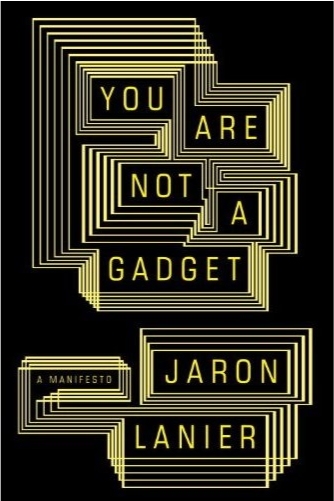
Jaron Lanier, a tech-industry insider if ever there was one, also voices concerns about the loss of personhood in his 2010 book You Are Not a Gadget: A Manifesto.  In a recent post at Text Patterns, Alan Jacobs helpfully summarizes the very practical advice Lanier offers for those interested in preserving their integrity as a human person while online:

“These are some of the things you can do to be a person instead of a source of fragments to be exploited by others.”

  • Don’t post anonymously unless you really might be in danger.
  • If you put effort into Wikipedia articles, put even more effort into using your personal voice and expression outside of the wiki to attract people who don’t yet realize that they are interested in the topics you contributed to.
  • Create a website that expresses something about who you are that won’t fit into the template available to you on a social networking site.
  • Post a video once in a while that took you one hundred times more time to create than it takes to view.
  • Write a blog post that took weeks of reflection before you heard the inner voice that needed to come out.
  • If you are twittering, innovate in order to find a way to describe your internal state instead of trivial external events, to avoid the creeping danger of believing that objectively described events define you, as they would define a machine.

All of it very good, and very practical advice.  Like Stone and Freeman, Lanier is not advising people to disconnect and unplug.  His advice is for those desiring to navigate the Internet world rather than retreat from it.  There have been some, however, who have experimented with the option of unplugging altogether.  James Sturm, for example, has recently concluded a four month experiment in Life Without the Web.  He has chronicled his experience through a series of columns at Slate (he used a third party to submit his columns).  He writes engagingly about his experiment and he appears to have inspired more than a few others (look up “quitting the internet” on Google, all the while noting the irony, but then keeping it to yourself because it is really not that clever).

In his last post, Sturm reflected on the possibility of writing a book based on his experience.  Feeling four months might be unreasonable for those whose livelihood now depends on the Internet, he wonders if a 30 day hiatus might not be more manageable.  But then he writes,

… even if a few of you could disconnect for 30 days, then what? It’s only a finger in the proverbial dike. One month might be a futile effort—how long until you’re back in front of the computer, incessantly updating your Facebook page? When dealing with something as powerful as the Internet, perhaps a more extreme measure is needed, a manifesto along the lines of Jerry Mander’s 1978 classic Four Arguments for the Elimination of Television.  I’m not hard-core enough to write a book that advocates living entirely without the Internet, but I do find taking such a forceful position appealing.

In the end it might be a less severe approach that turns out to be most helpful.  In a 2008 post on his blog MediaShift, Mark Glaser observed a growing trend “among bloggers and media people who are overwhelmed with the always-on nature of the broadband Internet and smartphones.  [And for whom] the overwhelming feeling, is exacerbated by instant messaging, social networking and services such as Twitter, that allow us to do more informal communications electronically rather than in person.”  It was a trend toward taking a “Technology Sabbath.”  Not surprisingly, it was also a trend emerging in certain Jewish and Christian circles.  In the two years since Glasser wrote, the circle of the overwhelmed has almost certainly expanded.

There is a good chance that talk of keeping Sabbath will most likely suggest a rather drab and joyless affair, a relic of a grayer age.  Either that or it conjures images of debilitating attention to countless puritanical  rules regulating the life out of an otherwise pleasant day.  We tend, after all, to equate restriction with loss.  But consider this alternative vision articulated by Jewish scholar Abraham Heschel in his class work, The Sabbath:

To observe the seventh day does not mean merely to obey or to conform to the strictness of a divine commandment. To observe is to celebrate the creation of the world and to create the seventh day all over again, the majesty of holiness in time, a day of rest, a day of freedom …

Heschel goes on to quote a Jewish prayer that describes the Sabbath as “a day of rest and holiness, a rest in love and generosity, a true and genuine rest, a rest that yields peace and serenity, tranquility and security, a perfect rest with which Thou art pleased.”

This vision of the Sabbath should resonate with those who may be experiencing tech-fatigue accompanied by that disquieting sense that their tools are running, rather than facilitating their lives.  The Sabbath was intended to remind us that while we must work and work can be noble and useful, we were not made for work and work is not our highest calling.  Taking a day, or even some hours in a day, to disconnect and rest from our technologies, useful and noble as they may otherwise be, can likewise remind us that we were not made for our technology and being connected is not our highest calling.

The idea of a technology Sabbath presents a number of advantages.  It is simple, practical, and effective.  It recognizes the significance of intentional practices in shaping our habits and our dispositions.  It avoids extremes.  And it creates a space for both  silence and introspection on the one hand, and on the other, celebration and joy in company friends and family.

It may be that deliberate and regular unplugging can help us rediscover a more humane rhythm for our lives, one that is attuned to the needs of our bodies and in sync with the world around us.  If so, then perhaps celebration, rest, freedom, love and generosity, peace, serenity, and tranquility may more frequently characterize our experience.