Inevitable Elitism

A charge of elitism carries with it a healthy dose of opprobrium in today’s society.

First question to ask yourself:  Was it elitist to use the word opprobrium?

Second question to ask yourself:  “Would it be too Stalinist to exile to Siberia anyone who thinks big words are Leninist?”

That second questions is asked near the conclusion “Revolt of the Elites,” an exploration of elitism in contemporary American culture by the Editors of N+1.

It’s a longish piece referring to the likes of Pierre Bourdieu and Ortega y Gasset which will of course, in certain circles, mark it as irredeemably elitist.  But you may want to read it anyway; who will know unless you go off and talk about the “diffusion of a non-Bourdieu-reading-but-nevertheless-Bourdieuvian view of culture” at your local Super Bowl party.  I feel this might be particularly damaging among Steelers’ fans, although I can’t imagine that it would go over much better with Packer aficionados.

Here is what I take to be the heart of the article’s argument:

Who, then, is guilty of elitism, if not the elitely educated in general? The main culprits turn out to be people for whom a monied and therefore educated background lies behind the adoption of aesthetic, intellectual, or political values that demur from the money-making mandate that otherwise dominates society.

The funny thing about such cultural antielitism is how steeped in the work of the left-wing French sociologist Pierre Bourdieu all “real Americans” would appear to be. Bourdieu’s Distinction famously unmasked “good” or distinguished, educated taste as so much “cultural capital,” a mere panoply of status markers. To favor a more challenging type of book, a less strictly tonal sort of music, a less representational kind of painting — or, more to the point today, a less completely shitty grade of film product — mostly demonstrated that you came from a higher social class. And many Americans have come to agree. So when Al Gore said his favorite book was Stendhal’s Red and the Black, this could be boiled down to mean, You know what? I’m an upper-class guy who went to Harvard . . . .

The noxious thing about the cultural elite is supposed to be its bad faith. Everyone else in America more or less forthrightly confesses that they’re trying to grab as much money as they can, and if somebody has meanwhile forced a liberal education on them, that doesn’t mean they’ve had to like it. Upon making their money, real Americans are furthermore honest enough to spend it on those things that evolution or God have programmed humans to sincerely enjoy. In winter recreation, this might be snowmobiling — genuine petroleum-burning fun! — as opposed to cross-country skiing, a tedious trial of aerobic virtue. In wintry Scandinavian literature, it might be Stieg Larsson rather than Knut Hamsun. Oppositions of the same kind — between untutored enjoyment and the acquired taste — can be generated endlessly, and are. Half the idea is that genuine, honest people differ not so much in their tastes as in their economic ability to indulge those tastes; there exists an oligarchy of money but no aristocracy of spirit. The other half is that less sincere people — elitists — lie to themselves and everybody else about what’s really in their red-meat hearts. Instead of saying I’m pleased with my superior class background, they pretend to like boring books, films, and sports. Cynical common sense, a draught of table wine Bourdieu, permits you to see through this maneuver.

I suspect that there are many ways to parse the roots, essence, and consequences of elitism in America — Tocqueville launched the enterprise nearly two centuries ago — and this is a compelling enough analysis.  But here is my (third) question:  Isn’t something like a cynical, Bourdieuvian view of culture and elitism inevitable in the context of a generally agreed upon, yet unstated and perhaps “soft” relativism in all matters aesthetic and cultural?

To put this another way: in the absence of a shared vision of the true, the good, and the beautiful won’t every choice to “trade easy pleasures for more complex and challenging ones” be seen as a transparent facade for some deeper, darker motive usually assumed to involve power, status, or ambition?

And to try it yet one more way:  unless I can appeal to some inherent worth and value independent of my own subjectivity, but to which my subjectivity is nonetheless drawn, in choosing this over that, then the choice of this over that will always appear to be motivated by something else.  And since we are all good Nietzscheans  now, it will be interpreted through a hermeneutic of suspicion which will judge my choice to be a grab for status, power, influence, etc.  — hence the inevitability of the charge of elitism.  In other contexts, elitism may not be a charge at all, but rather a compliment.

Or, since in fact we know that there are those who have always pursued power, wealth, and status through their cultural choices (Bourdieu was hardly the first to point out as much), perhaps we reserve the charge not for those who believe in a hierarchy of beauty, goodness, and truth, but rather for those who believe that their recognition of such makes them inherently better than others.

Of course, for such as those there are other more colorful words too, words which will fit in quite nicely at your Super Bowl party.
Reading, With Attitude

I can’t improve on Matthew Battles’ introduction:

Maybe in the rush towards the Singularity, towards our apotheosis as networked demiurges who are always plugged in, always on, always checking and modulating moods and statuses and messages, the book will carve out a niche as the technology that lets you disappear. Until they get the whole quantum cloaking thing worked out, after all, the book is the best invisibility tech we have. Reading one increasingly seems like a cultural kilt, a silent version of the skirl of pipes on a misty hillside. The reader is the one true Scotsman of culture.

Please do enjoy:

Julian Smith

via Alan Jacobs

The Kings’ Speeches

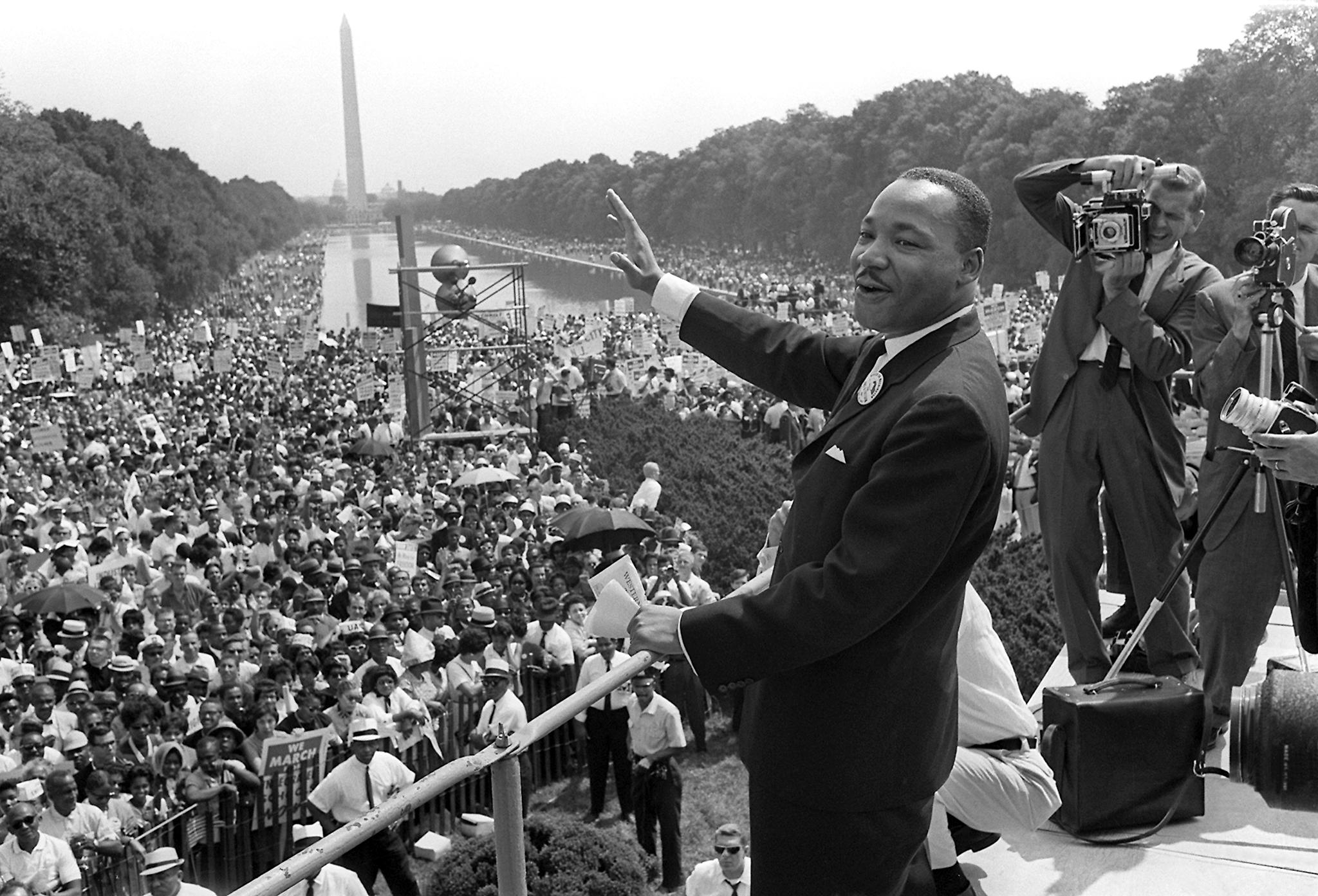
Driving home yesterday I caught Martin Luther King Jr.’s “I Have a Dream Speech” being replayed on NPR.  It is, as everyone who has listened to the speech knows, a moving experience.  It is also an experience that is mostly lost to our time.  It is relic of a different age, a different world.  One can hardly imagine a contemporary public speaker, particularly in a political context, striking the same cadence and intonation as Dr. King.

Two reasons initially came to mind.  On the one hand, we make a virtue out of ironic detachment and we have internalized the hermeneutic of suspicion.  We cannot take seriously anyone who takes themselves seriously enough to speak with moral authority.  On the other hand, and this is just the other side of the same coin, there appear to be no public figures who in fact have the requisite moral authority.  Chicken and the egg, Catch-22 …

I was also reminded that upon the passing of Senator Robert C. Byrd not long ago it was noted that a rhetorical style died with him.  Different in so many ways, Dr. King and Senator Byrd came from a shared rhetorical world, one that united them and separates both of them from us.

Serendipitously, I also watched The King’s Speech later that evening — a felicitous coincidence given the thoughts I was already entertaining about speeches and notably another King’s speech.   The film features Colin Firth brilliantly playing King George VI of England who must struggle to overcome a stammer in his speech on the eve of the Second World War with the help of a speech therapist played by Geoffrey Rush.  It was impossible to miss the significance given to oratory, and the film makes a point of connecting this significance with the advent of radio.  The film reminds us of this visually by prominently and frequently drawing our eyes to the microphones, receivers, and other accouterments of radio from the era.  But the connection is made explicit by the King George V, the imposing father figure, who notes that in times past the nobility and royalty could get by by merely looking the part.  Thanks to the wireless, they must now speak the part too.

Thinking about both K/kings and their speeches also coincided with rereading Walter Ong’s Orality and Literacy in which Ong lays out the momentous cultural consequences of literacy.  Ong argues that the introduction of alphabet technology radically restructured consciousness and society.  He goes on to identify three related transitions: from oral to literate culture with the invention of the alphabet, the amplification of that transition with the coming of the printing press, and the onset of what Ong calls secondary orality resulting from the appearance of electronic media that immerses us again in an economy of sound. Ong died before he could extend his analysis into the digital age, but his work certainly helps us think more clearly about our present media developments.

Noting the transitions from orality to literacy and then on to secondary orality also helps us make sense of the rhetorical worlds inhabited by MLK, George VI, and Robert C. Byrd.  Each was shaped by rhetorical traditions that were in turn formed by cultural, religious, political, and technological factors that placed great store by the spoken word and the word spoken in a particular style.  There are differences among them, no doubt, but those differences pale in comparison to the difference between all of them and those for whom they are all just pictures in a history book or images/sounds on Youtube.

Finally, and at the expense of oversimplifying matters, it is always interesting to ask what different media require from public figures.  The age of the photograph required one to look a certain way, the age of radio required one to sound a certain way, the age of television required one to both look and sound a certain way (but both were different from what was expected in the age of photographs and radios).

The photograph and radio still traded in the dominant visual and oral norms of the culture into which they were introduced.  Television appears to begin shaping these norms to its own constraints and demands; demands that arise not only from the medium, but also from its dominant revenue model.  Most notably the distance between the public and the public figure is shrinking all the while.  And with this shrinking distance comes the great difficulty we have in investing our public figures with either heroic stature or moral authority.  The digital age seems to proceed along this same trajectory, so that accessibility, informality, immediacy, and ordinariness become for the public figures of our age what high flung oratory and dignified, aloof composure were for an earlier time.

Darkness, Depth, Dirtiness: Metaphors and the Body

In Metaphors We Live By, Lakoff and Johnson drew attention to the significant and often unnoticed work metaphors perform in our everyday use of language.  Once you start paying attention you realize that metaphors (and figurative language in general) are not merely the ornaments of speech employed by poets and other creative types; they are an indispensable element of our most basic attempts to represent our experience of the world with words.  Lakoff and Johnson also suggested that many of our most basic metaphors (up is good/down is bad; heavy is serious, light is not) are grounded in our embodied experience of reality.  Did we not stand erect, for example, we’d have a very different set of metaphors.
It’s been thirty years since Metaphors We Live By was published, but it has been in the last few that studies have been confirming the link between embodied experience in the world and our metaphorical language.  Many of these studies were helpfully summarized in the January 2010 issue of the Observer, a publication of the Association for Psychological Science.  In a short article titled  “The Body of Knowledge:  Understanding Embodied Cognition,” Barbara Isanski and Catherine West describe a series of experimental studies that establish links between our bodily experience and our metaphorical language.  Here’s a sampling of some of those links:

  • Temperature and social relationships — think “cold shoulder”
  • Cleanness and moral purity — think Lady MacBeth or Pontius Pilate
  • Color and morality — think black is bad
  • Weight and judgment/seriousness — think “a heavy topic” or “deep issue”
  • Movement and progress/achievement — think “forward looking,” “taking a step back”

Most interesting perhaps are the elaborate set ups of the experiments that attempted to get at these connections and the article does nice job of succinctly describing each. For example:

In a recent study by Nils B. Jostmann (University of Amsterdam), Daniël Lakens (Utrecht University), and Thomas W. Schubert (Instituto Superior de Ciências do Trabalho e da Empresa, Lisbon), volunteers holding a heavy clipboard assigned more importance to opinions and greater value to foreign currencies than volunteers holding lighter-weight clipboards did. A lot of physical strength is required to move heavy objects around; these results suggest that in a similar way, important issues may require a lot of cognitive effort to be dealt with.

As always bear in mind the nature of “recent studies,” but it is not too surprising to learn that our embodied experience is at the root of our way of talking and thinking about the world.

“Sealed in the tombs of their revealed preferences”

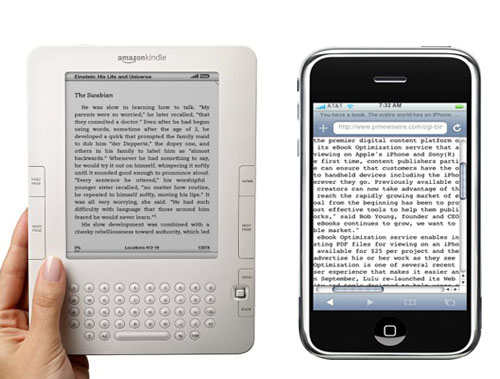
I’ve recently been emailed two interesting posts that intersect nicely with my reading of Illich’s In the Vineyard of the Text.  Illich is looking back at a transition in reading technologies and practices in the 12th century in order to gain perspective on the transformation taking  place when he is writing in the early 1990’s.  Illich’s analysis may be even more timely now, 15+ years after he wrote, as e-readers seem to have finally caught on and secured widespread acceptance and use.

The first post, “Bye, Bye, Borders?” by Megan McArdle at The Atlantic, considers recent rumors about the imminent demise of Borders (rumors which most likely are not, as in the case of Mark Twain, greatly exaggerated).  Here is her main point:

Personally I hope they’re wrong, too; like most writers, I like bookshops.  I suspect most of us had our destiny shaped while we were sandwiched behind the bookshelves at our local dealer.

On the other hand, like most of the writers I know, I rarely go into bookshops anymore.  Instead, the UPS truck stops at our house at least once a week, thanks to Prime, and more and more, I order Kindle books straight from my iPad.  I know that I am missing something–the serendipity of browsing through the bookshelves–which I have never replaced at Amazon; much as I love the convenience of online shopping, I never find anything that I am not looking for.

This is when the communitarians start looking for a government rule that will make it harder for people to buy books online; the environmentalists complain about all the energy wasted on shipping; and the moderate nostalgists start urging people to support their local bookstore.  But I’ll go by a combination of revealed preference and introspection:  the world may be better off without Borders, even though I (and everyone else who has stopped shopping there) likes the idea of its existence.

There is a certain irony here since it was not that long ago that Borders and Barnes & Noble were the villains, not the victims, in the story we told about the demise of small, independent books shops.  You remember You’ve Got Mail, no?

The second post, “Open Books:  The E-Reader Reads You” by Rob Horning at The New Inquiry, considers the wealth of data about the user that becomes available to publishers and distributors through E-Readers like Amazon’s Kindle.  Horning makes a number of observations that pair up suggestively with themes in Illich.  Consider this paragraph, for example, in which Horning cites literary critic Franco Moretti:

That is, the truth about them for publishers will be no different from what it is for distant-reading critics like Moretti — a matter of tabulated, graphable data. “Distance, let me repeat it, is a condition of knowledge: it allows you to focus on units that are much smaller or much larger than the text,” Moretti argues. “And if, between the very small and the very large, the text itself disappears, well, it is one of those cases when one can justifiably say, Less is more.”

Moretti’s advocacy of distance appears a ways down a road tread by Hugh of Saint Victor’s when he advocated a pilgrim ethic for scholars summarized as follows by Illich:

With the spirit of self-definition, estrangement acquires a new positive meaning.  Hugh’s call away from the ‘sweetness of one’s native soil’ and to a journey of self-discovery is but one instance of the new ethos . . Hugh’s insistence on the need that the scholar be an exile-in-spirit echoes this mood.

Like McArdle, Horning explores the loss of the physical bookstore (or library) as a place of serendipitous discovery in light of increasingly sophisticated recommendation algorithms used by online booksellers.

Thanks to these innovations, publishers will know what books you’ve read; when you read them; what you chose to read next, or simultaneously; how long it took you; and what other books people read when they read what you have. The potential data mine this all represents may eventually divest readers of their need to discover anything. Instead, recommendation engines can take over, manufacturing serendipity for users as is already the case on Amazon’s website, only now with the not necessarily solicited advice being ported directly into the scene of reading. And if you shop through Google’s new bookstore, all that information and be joined with all the data derived from your search and browsing histories to further refine recommendations and circumscribe the scope of what is readily offered to you.

Horning, however, is slightly less sanguine than McArdle:

But perhaps more important, publishers will be able to draw from trends in this rich data for its editorial decision making, exploiting connections this information reveals among various demographics in the reading public, calibrating their lists to actual reader behavior with more precision that dumb sales data once allowed. Such rapid responsiveness can trigger a feedback loop that precludes the possibility of spontaneous, unexpected desires, fashioning a smoothly functioning market sealed off from vital disruptions. Readers will be sealed in the tombs of their revealed preferences. To capture the feeling of discovery and possibility again, they will have to look somewhere other than books.

The most startling contrast is clearly between McArdle’s somewhat begrudging embrace of “revealed preference” and Horning’s characterization of the same as “tombs” into which readers will be sealed.  Horning’s concerns also echo those of Jaron Lanier which we noted here a couple of months ago:

Students spend a lot of time acting as trivialized relays in giant schemes designed for the purposes of advertising and other revenue-minded manipulations. They are prompted to create databases about themselves and then trust algorithms to assemble streams of songs and movies and stories for their consumption . . . . The problem is that students could come to conceive of themselves as relays in a transpersonal digital structure.

The title of Horning’s post is interesting in this regard:  “Open Books:  The E-Reader Reads You.”  There was also a sense in which the book read the reader in twelfth century.   The book presented the reader with an external standard to which the reader, depending on the text,  may need to conform.  This is why Hugh believed reading and learning required humility.  Without humility the reader would fail to subject his own views and practices to the order of things that a text may reveal.  In other words, the book read the reader by illuminating where the reader must change; the reader read to discover an order to which they must align their inner world.  The technology bundled with the E-reader, and the economic models it participates in, reads the user and precisely the opposite sense.  It reads the reader in order to bring external realities into conformity with the existing internal dispositions of the user.

What reading is and is for, what counts for knowledge and wisdom, the rise and fall of social hierarchies — these have been transformed over the course of time as new technologies for representing and communicating human thought have emerged .  With Illich, I’m hopeful that understanding past developments in these areas will give us some guideposts to steer by as we experience these types of transformations in the present.

_______________________________

Thanks to Mr. Ridenhour and Mr. Greenwald for the links.