“Monastic Reading” — Reading with the Body

“Monastic Reading,” the third chapter in Ivan Illich’s In the Vineyard of the Text, gives us a window into a form of reading that involved the body along with the mind.  Illich is attentive to the physicality of reading and modes of remembering that (figuratively) engrave the text onto the body so that the body and mind work in tandem to remember and recall what has been read and learned.  Very interesting material given my recent fascination with embodied knowledge.

The easiest way to recognize instances of embodied knowledge is to take note of athletes and dancers who “know” how to do a great deal of things that they may have a very hard time putting into words.  Or, if you can type, ask yourself, where is the letter “L” on the keyboard?  How did you think of the answer?  If you are like most people in that situation you moved your fingers around to remember.

I’m most interested in how embodied knowledge — which is also picked up through the habits and rituals, religious and otherwise, that make up our cultural milieu — plays a significant role in shaping our dispositions, attention, inclinations.

Illich, who is drawing on the work of anthropologist Marcel Jousse, gives us some more instances of embodied knowledge, this time in the service of recalling articulated speech.

Previous posts:  Introduction, chapter one, chapter two.

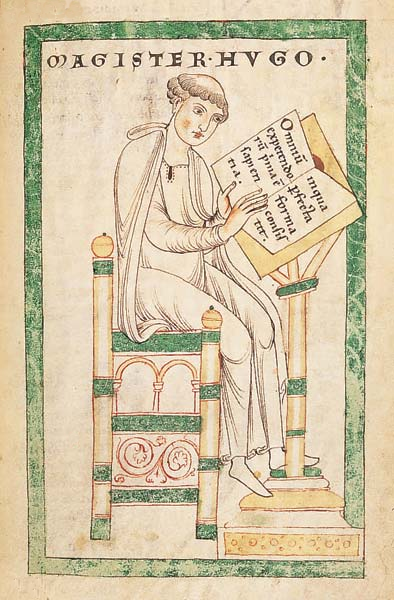
  • Quoting Hugh of Saint Victor:  “Meditation is sustained thought along planned lines . . . . Meditation takes its start from reading, but is bound by none of the rules or precepts of reading.  Meditation delights to range along open ground, where it fixes its free gaze upon the contemplation of truth, drawing together now these, now those causes of things, or now penetrating into profundities, leaving nothing doubtful, nothing obscure.  The beginning of learning thus lies in reading but its consummation lies in meditation.” (52)
  • “Meditative reading can sometimes be difficult, a chore which must be faced with courage, fortitudo.  But the reader, sustained by the ‘zeal to inquire,’ will derive joy from his application.  Eagerness comes with practice.  To foster his zeal, the student needs encouraging example rather than instruction.”  (53)
  • “Hugh’s meditation is an intensive reading activity and not some passive quietist plunge into feelings.  This activity is described by analogy to body movements:  striding from line to line, or flapping one’s wings while surveying the already well-known page.  Reading is experienced by Hugh as a bodily motor activity.
  • In a tradition of one and a half millennia, the sounding pages are echoed by the resonance  of the moving lips and tongue.  The reader’s ears pay attention, and strain to catch what the reader’s mouth gives forth.  In this manner the sequence of letters translates directly into body movements and patterns nerve impulses.  the lines are a sound track picked up by the mouth and voiced by the reader for his own ear.  By reading, the page is literally embodied, incorporated.
  • The modern reader conceives of the page as a plate that inks the mind, and of the mind as a screen onto which the page is projected and from which, at a flip, it can fade.  For the monastic reader, whom Hugh addresses, reading is a much less phantasmagoric and much more carnal activity:  the reader understands the lines by moving to their beat, remembers them by recapturing their rhythm, and thinks of them in terms of putting them into his mouth and chewing.  No wonder that pre-university monasteries are described to us in various sources as the dwelling places of mumblers and munchers.” (54)
  • “For Hugh, who uses Latin, the act of reading with the eyes implies an activity not unlike a search for firewood:  his eyes must pick up the letters of the alphabet and bundle these into syllables.  The eyes are at the service of the lungs, the throat, the tongue, and the lips that do not usually utter single letters but words.”  (58)
  • “. . . for the monk, reading is not one activity but a way of life . . . . Reading impregnates his days and nights.”  (58-59)
  • “The process by which the written text of Scripture becomes part of each monk’s biography is typically Jewish rather than Greek.  Antiquity had no one book that could be swallowed.  Neither Greeks nor Romans were people of a book.  No one book was — or could be — at the center of the classical way of life, as it is for Jews, Christians, and Muslims.  For the first Christian millennium, memorization of this one book was performed by a process which stands in stark contrast to the building of memory palaces.  The book was swallowed and digested through the careful attention paid to the psychomotor nerve impulses which accompany the sentences being learned. Even today, pupils in Koranic and Jewish schools sit on the floor with the book open on their knees.  Each one chants his lines in a singsong, often a dozen pupils simultaneously, each a different line.  While they read, their bodies sway from the hips up or their trunks gently rock back and forth.  The swinging and the recitation continue as if the student is in a trance, even when he closes his eyes or looks down the aisle of the mosque.  The body movements re-evoke those of the speech organs that have been associated with them.  In a ritual manner these students use their whole bodies to embody the lines.
  • Marcel Jousse has studied these psychomotor techniques of fixing a spoken sequence in the flesh.  He has shown that for many people, remembrance means the triggering of a well-established sequence of muscular patterns to which the utterances are tied.  When the child is rocked during a cradle song, when the reapers bow to the rhythm of a harvest song, when the rabbi shakes his head while he prays or searches for the right answer, or when the proverb comes to mind only upon tapping for a while — according to Jousse, these are just a few examples of a widespread linkage of utterance and gesture.  Each culture has given its own form to this bilateral, dissymmetric complementarity by which sayings are graven right and left, forward and backward into trunk and limbs, rather than just into the ear and the eye.  Monastic existence can be viewed as a carefully patterned framework for the practice of such techniques.”  (pages 60-61)
  • “It is, however, not a social technique incorporated in the rule which makes the monk, but rather the attitude with which he approaches the book as the center of his life.  In the short chapter on meditation, Hugh refers to the spirit in which this life of reading ought to be lived.  He uses the word vacare, which says all but just cannot be translated into English . . . . Vacare means ‘to have been set or become free.’  When Christian authors use the term the stress is not on the release a person gets, but on the freedom he takes of his own volition.  The term stresses ‘the desire to be engaged ‘ in a new way of life rather than a release or flight from one’s old habits of bondage and lifestyle.  The verb is also used in classical Latin . . . . With generosity, [Seneca] urges, one should choose what to be free for.  True leisure can be found only by those who give themselves to wisdom (sapientiae vacant).”  (61-62)
  • Lectio is forever a beginning, meditatio a consummatio, and both integral to studium . . . For Hugh, there is only one kind of reading that is worthwhile, lectio divina.  This place him at the end of one thousand years during which lectio and otio vacare had defined each other.”  (63-64)
  • “The new way of reading the newly laid-out page calls for a new setting within the city:  colleges that engender the university, with its academic rather than monastic rituals.  The studium legendi ceases to be a way of life for the great majority of disciplined readers, and is viewed as one particular ascetical practice now called ‘spiritual reading.’  On the other hand, ‘study’ increasingly refers to the acquisition of knowledge.  Lectio divides into prayer and study.”  (64-65)
“Order, Memory, and History”

Excerpts from the second chapter of Ivan Illich’s In the Vineyard of the Text, “Order, Memory, and History.”  Previous posts:  Introduction and first chapter.

From the first few excerpts, one gets a feel for a mental world which had not yet divorced the sign from the signifier and still regarded the cosmos as inherently meaningful, like a book to be read.  Most of what follows centers on the fascinating history of memory techniques and Hugh’s attempt to revive these techniques as the foundation of the search for wisdom.  What we end up with then is an effort to microcosmically represent the macrocosmic order of things in the mind.  The mind symbolically captures the order of the cosmos.  I hope the excerpts below convey the gist of this ambitious project.

(Read here for an excellent recent essay delving into the history of memory techniques and books.)

  • “The passage from childlike searching to adult reading is governed by something that Hugh calls ordo.  In many instances Hugh stresses the importance that the reader advance with order, ordinate procedere debet, or that one ought to stride forward with a harmonious gait.  Hugh does not create, he follows, observes, searches the order of things.  “To order” is the interiorization of that cosmic and symbolic harmony which God has established in the act of creation.  “To order” means neither to organize and systematize knowledge according to preconceived subjects, nor to manage it.  The reader’s order is not imposed on the story, but the story puts the reader into its order.  The search for wisdom is a search for the symbols of order that we encounter on the page.”  (31)
  • Quoting Gerhart Ladner:  “It was one of the fundamental character traits of the early Christian and medieval mentalities that the signifying, symbolizing and allegorizing function was anything but arbitrary or subjective; symbols were believed to represent objectively and to express faithfully various aspects of a universe that was perceived as widely and deeply meaningful.”  (31)
  • In the “somethings never change” category:  “Hugh expresses dissatisfaction with the students of his day who, ‘whether from ignorance or from unwillingness, fail to hold to a fit method of study, and therefore we find many who study but few who are wise” . . . . Hugh looks for students who read so well that without leafing they instantly have details ready in their heart.  Memory training, for Hugh, is a precondition for reading, and something which he treats in a manual that readers of the Didascalicon are supposed to know.” (35)
  • “The child’s mind was trained to build the memory mazes, and to establish the habit to dart and retrieve in them.  Remembrance was not conceived as an act of mapping but of psychomotor, morally charged activity.  As a modern youth, from childhood on I was trained to the Baedeker [popular German travel guide].  As a mountain guide I learned to decipher maps and photographs before venturing into the rock.  Decades later, when I first arrived in Japan I purchased a map of Tokyo.  But I was not allowed to use it.  My host’s wife simply refused to let me map my way through the city’s mazes by looking at them, mentally, from above.  Day after day she led me around this, and then that corner, until I could navigate the labyrinth and reach my destinations without ever knowing abstractly where I was.  Reference work before the table of contents and the index must have been much more like this kind of mapless orientation for which our modern schools disqualify us.” (37)
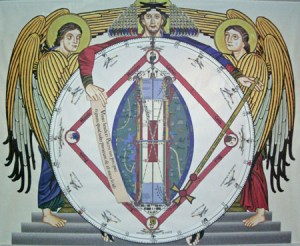
  • “For more advanced readers, Hugh proposed a much more complex, three-dimensional ark — a space-time matrix built within the mind of the student and modeled on Noah’s ark . . . [a] three-dimensional multicolored monster memory scheme.  The man who has best studied Hugh’s writings on the moral and mystical ark has come to the following conclusion:  220 square feet of paper would be needed for a still readable blueprint of Hugh’s ark-model of historical interrelationships.  Twentieth-century medievalists, who in the great majority have never had any training in mnemotechnics, can perhaps imagine a blueprint of Hugh’s ark, but they cannot recapture the experience of having such an ark in their own mind, or ‘be thoroughly at home with this thought and way of imagining.'”  (37-38)

Read here about a recent digital reconstruction of Hugh’s ark by Conrad Rudolph of the University of California and commissioned by the US National Gallery of Art.  Click on the image above for a more detailed representation.

  • “Some rudiments from the history of memory must be recalled to grasp Hugh’s unique place.  What anthropologists distinguish as ‘cultures’ the historian of mental spaces might distinguish as different ‘memories.’  The way to recall, to remember, has a history which is, to some degree, distinct from the history of the substance that is remembered.”  (39)
  • “We sometimes forget that words are creatures of the alphabet.” (39)
  • “In fact, the alphabet is an elegant technology for the visualization of sounds.  Its two dozen shapes trigger the memory of utterances that have been articulated by the mouth, the tongue, or the lips, and filter out what is said by gesture, mime, or the guts.  Unlike other writing systems, it records sounds, not ideas.”  (39)
  • “The one most common method used by the Greeks to achieve this purpose was the mental construction of a memory palace . . . . To become the student of a reputable teacher, the pupil had to prove that he was at home and at ease in some vast architecture that existed only in his mind, and within which he could move at an instant to the spot of his choice.”  (41)
  • “Early on it was found that the most effective way for locating and retrieving memories was that of randomly affixing to each one a mental label from a large set familiar to the student.  For example, to a goat or the sun, a branch or a knife, a sentence was attached for rote memorization.  The author who had thus equipped his palace for a speech or a dispute just moved to the appropriate imaginary room, took in at a glance the object placed on the labels, and had at his fingertips the memorized formulations that — for this particular occasion — he had associated with these emblems.”  (41-42)
  • “The art of memory as a symbolic labeling of memorized speech-acts was created in fourth-century Greece, taught by Sophists and used in politics.  In Rome, at least since Quintilian (35-100), its purpose and technique changed.  It was mainly used by lawyers.  Here memory training stresses the art of internalized reading.  The public speaker learned in late Roman antiquity how to ‘take notes’ in his mind and ‘read them off’ on the right occasion.”  (42)
  • “The rhetorical virtuoso was henceforth the one who could mentally register and label each sentence he intended to use, and promptly recover it from the appropriate architectonic feature in his own inner topology.  Today, in an age dazed by the feats of computers, this skill sounds like an impossible undertaking or freakish acrobatics for some academic circus.  But such memory training was part of the equipment expected by Hugh from the beginner.”  (42)
  • Reminding us that coping with information is not an entirely new challenge:  “By reviving ancient architectural memory training, Hugh hopes to prepare boys born around 1120 to read their way toward wisdom in an age in which the new collections could only too easily have scattered their brains and overwhelmed them.  He offers them a radically intimate technique of ordering this huge heritage in a personally created, inner spime [i.e., space time, taken from Einstein].” (45)
  • “Everything can make sense when it is related to this ordo of time; and noting is meaningful that is not placed by the reader into this ordo.  Hugh’s moral and spiritual Ark of Noah is more than a mnemotechnic palace with biblical features.  The Ark stands for a social entity, a process that begins with creation and continues to the end of time, what Hugh calls ‘the Church.’  The activity which Hugh calls ‘reading’ mediates between this macrocosmic Church and the microcosmos of the reader’s personal intimacy.  Each person, each place, each thing within this spatiotemporal cosmos must first be literally understood.  It then reveals itself as also something else:  as sign for something to come in the future, and as accomplishment of some other thing that, by analogy, has pointed toward its coming.”  (46-47)

Agitate for Beauty

One of the convenient consequences of posting one’s thoughts on a blog is that readers (the happy few in my case) will send along links to interesting ideas or stories related to what I’ve written.  Yesterday I wrote about resisting the temptation to communicate thoughtlessly and artlessly via digital media and pushing back against the pressures for more efficient, mechanical, and soulless communication.  In response I received a link to a post titled, “How ‘EOM’ Makes Your Email More Efficient.” (h/t:  DFR)

EOM, for the blissfully uninitiated, is short for “End of Message.”  The idea is pretty simple: turn your email subject lines into the actual content of the message and add on “EOM” so that the recipient knows they don’t need click through to read the body.  This saves you the time of writing a subject line and a greeting and a body and a closing.  It also saves the recipient the effort of clicking through to the main text of the email.  But wait there’s more!  Actually there are TEN listed benefits to EOM-ing (might as well — texting, emailing, Facebooking, Twittering, friending —  in our exciting, transgressive times nouns become verbs!).  Other advantages include:  if you do it, others will do it too and EOM encourages 100% readership!

All very efficient to be sure.  Reading the cheerfully and engagingly written post I was almost convinced this was a wonderful, life-changing practice.  Okay, dropping the sarcasm, I get it, seriously.  There are certain exchanges that happen over email that do not need to be packaged in the style and form of a royal proclamation or a papal encyclical.  Fine, fair enough.  And to their credit, one of the advantages listed is that you encourage more face-to-face communication.  If you can’t say it efficiently via email, then maybe you just need to go talk to the person (pause for audible gasp).  Great, that would be wonderful (unless our face-to-face adopt the syntax and style of our online communication).  The work place is busy, hectic, stressful; easing the demands of always online work life is commendable.

But (you knew it was coming), there is still this lingering fear that the ideals of efficiency and instrumentality, perfectly appropriate at some points and in certain contexts, will spread into realms of human communication where they ought properly to be unwelcome and shunned.  Yet, efficiency and instrumentality are alluring ideals that make few demands and promise great rewards, and so they insidiously infiltrate and colonize.

Sometimes I wonder if we are not operating under the unspoken assumption that perfect communication is something like the telepathic communication depicted in science fiction and fantasy.   That would be efficient indeed.  No words, no sounds, no effort.  No risk, no charm, no beauty.

So my tendency is to resist the push for increasing efficiency and instrumentality in our communication; not because I fail to see the advantages, but precisely because I recognize their appeal.  I tend to think Goethe was right, “We should do our best to encourage the Beautiful, for the Useful encourages itself.”  Agitate for beauty.

I’ll leave off with another poet, W. H. Auden, who also knew a thing or two about language, beauty, and responsibility.

As I listened from a beach-chair in the shade
To all the noises that my garden made,
It seemed to me only proper that words
Should be withheld from vegetables and birds.

A robin with no Christian name ran through
The Robin-Anthem which was all it knew,
And rustling flowers for some third party waited
To say which pairs, if any, should get mated.

Not one of them was capable of lying,
There was not one which knew that it was dying
Or could have with a rhythm or a rhyme
Assumed responsibility for time.

Let them leave language to their lonely betters
Who count some days and long for certain letters;
We, too, make noises when we laugh or weep:
Words are for those with promises to keep.

(“Their Lonely Betters”)

Obama Talks With A Computer

[Correction:  Mr. Scocca informs me via email that the dialog in his piece was an actual transcript of a session with Eliza.  So nothing “mock” or “contrived” about it.  All the more interesting, read on.]

Over at Slate, Tom Scocca has staged a mock dialogue with Eliza to good, even if somewhat contrived, effect.  Eliza, in case you’re wondering, is a computer program designed in the 1960’s to simulate human interaction based on certain scripts (such as DOCTOR which simulates a particular style of psychotherapy).

About half way through the dialogue we get these few lines which more or less encapsulate Scocca’s main concern:

TS: On Twitter, I am having a hard time telling the bots from the humans.

Eliza: How long have you been having a hard time telling the bots from the humans?

TS: Weeks and weeks now.

Eliza: Please go on.

TS: It is not because the bots are fluent or facile.

Eliza: Do any other reasons not come to mind?

TS: It is because so much of the human conversation has come down to bot level.

And a few lines later he adds,

TS: That’s not really someone who likes my blog post. It’s a pharma ad-bot that presumably grabs anything with “Obama” in it.

Eliza: Why do you say your blog post its a pharma adbot that presumably grabs anything with obama in it?

TS: Well, of course, by now I have been trained to put “Obama” into the headlines myself, for SEO purposes.

Eliza: Can you elaborate on that?

TS: My actual transactions with human readers are so machine-mediated, it’s necessary for me to keep machine-logic in mind while I’m writing.

I’m taking these observations as rather useful illustrations of how the language (or, logic) of a digital media platform shapes our communication to fit within its own limitations.  Borrowing linguist Roman Jakobson’s maxim regarding languages, I suggested a few posts down that, “Languages of digital media platforms differ essentially in what they cannot (or, encourage us not to) convey and not in what they may convey.”  In other words, we shape our communication to fit the constraints of the medium.  The follow up question then becomes, “do we adapt to these limitations and carry them over into other fields of discourse?”  Scocca provocatively suggests that if a computer ends up passing the Turing Test, it will not be because of an advance in computer language capability, but because of a retrogression in the way humans use language.

Keep in mind that you don’t have to be a professional writer working for a popular web magazine to experience machine mediated communication.  In fact, my guess is that a great deal, perhaps the majority, of our interaction with other people is routinely machine mediated, and in this sense we are already living in post-human age.

The mock dialog also suggests yet another adaptation of Jackobson’s principle, this time focused on the economic conditions at play within a digital media platform.  Tracking more closely with Jackobson’s original formulation, this adaptation might go something like this:  the languages of digital media platforms differ essentially in what their economic environment dictates they must convey.  In the case of Scocca, he has been trained to mention Obama for the purposes of search engine optimization, and this, of course, to drive traffic to his blog because traffic generates advertising revenue.  Not only do the constraints of the platform shape the content of communication, the logic of the wider economic system disciplines the writing as well.

None of this is, strictly speaking, necessary.  It is quite possible to creatively, and even aesthetically communicate within the constraints of a given digital media platform.  Any medium imposes certain constraints; what we do within those constraints remains the question.  Some media, it is true, impose more stringent constraints on human communication than others; the telegraph, for example, comes to mind.  But the wonder of human creativity is that it finds ways of flourishing within constraints; within limitations we manage to be ingenious, creative, humorous, artistic, etc.  Artistry, humor, creativity and all the rest wouldn’t even be possible without certain constraints to work with and against.

Yet aspiring to robust, playful, aesthetic, and meaningful communication is the path of greater resistance.  It is easier to fall into thoughtless and artless patterns of communication that uncritically bow to the constraints of a medium thus reducing and inhibiting the possibilities of human expression.  Without any studies or statistics to prove the point, it seems that the path of least resistance is our default for digital communication.  A little intentionality and subversiveness, however, may help us flourish as fully human beings in our computer-mediated, post-human times.

Besides, it would be much more interesting if a computer passed the Turing Test without any concessions on our part.

Oh, and sorry for the title, just trying to optimize my search engine results.

Breaking the Spell

In the not too distant past there were a series of Visa Check Card commercials which presented some fantastical and whimsical shopping environment in which transactions were processed efficiently, uninterruptedly, and happily thanks to the quick, simple swipe of the check card.  Inevitably some one would pull out cash or attempt to use a check and the whole smooth and cheerful operation would grind to a halt and displeasure would darken the faces of all involved.  For example:

Cynic that I tend to be, I read the whole campaign as a rather transparent allegory of our absorption into inhuman patterns of mindless, mechanized, and commodified existence.  But let’s lay aside that gloominess for the moment, it is near Christmas time after all and why draw unnecessary attention to the banality of our crass … okay, no, I’m done really.

But one other, less snarky observation: These commercials did a nice job of illustrating the circuit of mind, body, machine, and world that we are all enmeshed in.  This circuit typically runs so smoothly that we hardly notice it at all. In fact, we often tend to lose sight of how deeply integrated into our experience of reality our tools have become and how these tools mediate reality for us.  The emergence of ubiquitous wireless access to the Internet promises (or threatens, depending on your perspective) to extend and amplify this mediation exponentially.  To put it in a slightly different way, our tools become the interface through which we access reality.  Putting it that way also illustrates how our tools even begin to provide the metaphors by which we interpret reality.

Katherine Hayles drew attention to this circuit when, discussing the significance of embodiment, she writes,

When changes in [embodied] practices take place, they are often linked with new technologies that affect how people use their bodies and experience space and time.  Formed by technology at the same time that it creates technology, embodiment mediates between technology and discourse by creating new experiential frameworks that serve as boundary markers for the creation of corresponding discursive systems.

Translation:  New technologies produce new ways of using and experiencing our bodies in the world.  With our bodies we make technology and this technology then shapes how we understand our bodies and this interaction generates new ways of talking and thinking about the world.

But as in the commercial, this often unnoticed circuit through which we experience the world is sometimes disrupted by some error in the code or glitch in the system.  We often experience such disruptions as annoyances of varying degrees.  But because our tools are an often unnoticed link in the circuit encompassing world, body, and mind, disruptions emanating from our tools can also elicit flashes of illumination by disrupting habituated patterns of thought and action.  Hayles again, this time writing about one of the properties of electronic literature:

. . . unpredictable breaks occur that disrupt the smooth functioning of thought, action, and result, making us abruptly aware that our agency is increasingly enmeshed within complex networks extending beyond our ken and operating through codes that are, for the most part, invisible and inaccessible.

Thinking again about Arthur C. Clarke’s Third Law, “any sufficiently advanced technology is indistinguishable from magic,” we might say that disruptions and errors break the spell.  And depending upon your estimation of the enchantment, this may be a very good thing indeed, at least from time to time.