Memory, Writing, Alienation

Some more reflections in interaction with Walter Ong’s work, this time an essay originally published in The Written Word: Literacy in Transition (Oxford, 1986) titled “Writing Is a Technology that Restructures Thought.”

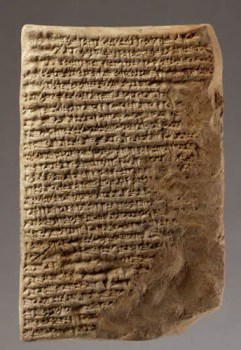
Literacy does its work of transformation by restructuring the cultural and personal economy of memory and installing a self-alienation at the heart of literate identity.

The world of orality is fundamentally evanescent.  Spoken words themselves have begun to pass out of existence before they are fully formed by the speaker’s mouth.  The spoken word is in this way a telling image of oral society; each generation is always already fading into the unremembered past as it inhabits the present.  The accumulated knowledge and wisdom of an oral society exists only as it is remembered by individuals so that each member of the group shares in the cognitive burden of sustaining and transmitting the group’s cultural inheritance.  This work of memory preoccupies the cultural life of oral societies and configures the individual as a node within a network of cultural remembering.  Oral society is thus fundamentally conservative and collective.

Writing disrupts and rearranges this situation by offloading, to a significant degree, the cognitive burden of remembering from the living memory of each individual to the written word.  This work of cognitive offloading generates recurring debates, as we first encounter in Plato, about the proper modes of memory.  These debates reflect the (often unrecognized) force with which new mnenotechnologies impact a society.  As Ong notes, the frozen, lifeless written word is in another, paradoxical sense alive.  It achieves permanence and is “resurrected into limitless living contexts by a limitless number of living readers.”  Furthermore, the “lifeless” written word, by both resourcing and reconfiguring the economy of memory, also injects a new dynamism into literate cultures. It does so by relieving the conservative pressure of cultural remembrance thus encouraging what we might call intellectual entrepreneurship.

This new dynamism is, however, accompanied by various forms of alienation.  Crucially, writing dislodges a portion of one’s memory, a critical aspect of identity, from oneself.  To the extent that identity is constituted by memory, identity must be, to some extent, divided in literate societies.  Ong details the alienating work of writing when he lists fourteen instances of separation effected by writing:

1. Writing separates the known from the knower

2. Writing separates interpretation from data

3. Writing distances the word from sound

4. Writing distances the source of communication from the recipient

5. Writing distances the word from the context of lived experience

6. Due to 5., writing enforces verbal precision unavailable in oral cultures.  (In other words, without the context provided by face-to-face communication, words have to work harder in writing to make meaning clear.  This is why we sometimes feel compelled to use smiley faces in electronic communication — to communicate tone.)

7. Writing separates past from present.

8. Writing separates administration — civil, religious, commercial — from other types of social activities.

9. Writing makes it possible to separate logic from rhetoric.

10. Writing separates academic learning from wisdom.

11. Writing can divide society by splitting verbal communication between a “high” spoken language controlled by writing and a “low” controlled by speech.  (For example, “proper” English is really “written” English, while devalued vulgar and colloquial speech patterns are “spoken” English.)

12. Writing differentiates grapholects, dialect taken over by writing and made into a national language, from other local dialects

13. Writing divides more evidently and effectively as its form becomes more abstract, that is more removed from the world of sound to the world of sight.

14. Writing separates being from time.

By making thought (and so also the self) present to itself, literacy introduces an irreparable fissure into identity and consciousness, but one that is, in Ong’s account, ultimately “humanizing.”  Last word from Ong:

To say writing is artificial is not to condemn it but to praise it . . . By distancing thought, alienating it from its original habitat in sounded words, writing raises consciousness.  Alienation from a natural milieu can be good for us and indeed is in many ways essential for fuller human life.  To live and to understand fully, we need not only proximity but also distance.  This writing provides for, thereby accelerating the evolution of consciousness as nothing else before it does.

Technique, Perception, and Friendship

Ivan Illich

Illich on Ellul

In 1993, at a gathering in honor of Jacques Ellul, Ivan Illich spoke of Ellul’s influence on his own thinking, particularly through Ellul’s theorizing of technique.  Along the way, Illich gives us this intriguing genealogy of his first encounter with Ellul’s work:

La technique entered my existence in 1965 in Santa Barbara, the day when, at Robert Hutchins’s Center, John Wilkinson gave me a copy of The Technological Society that he had just translated, following up on the strong recommendation of Aldous Huxley.

The author of Brave New World clearly found much to admire in Ellul.  Illich goes on to explain the advantage conferred by appropriating Ellul’s analytical concept:

I have adopted this Ellulian concept because it permits me to identify – in education, transport, modern medical and scientific activities – the threshold at which these projects absorb, conceptually and physically, the client into the tool; the threshold where the products of consumption change into things which themselves consume; the threshold where the milieu of technique transforms into numbers those who are entrapped in it; the threshold where technology is decisively transformed into Moloch, the system.

That, of course, is a rather grim analysis of the imperialism of technique, which for Ellul is not simply equated with technology. In The Technological Society, Ellul defines technique as “the totality of methods, rationally arrived at and having absolute efficiency (for a given stage of development) in every field of human activity.”  He goes on explain how “technique enslaves people, while proffering them the mere illusion of freedom, all the while tyrannically conforming them to the demands of the technological society with its complex of artificial operational objectives.”  So the target of Ellul’s criticism was not technology per se, but a society that had reduced human existence to the tyranny of machinic standards of efficiency and production.  In other words, his target was not so much the machines, as the society that reduces persons to machines.

Echoing McLuhan on media as extensions of man, Illich continues in dire vein:

Existence in a society that has become a system finds the senses useless precisely because of the very instruments designed for their extension. One is prevented from touching and embracing reality. Further, one is programmed for interactive communication, one’s whole being is sucked into the system. It is this radical subversion of sensation that humiliates and then replaces perception.  We submit ourselves to fantastic degradations of image and sound consumption in order to anesthetize the pain resulting from having lost reality.

Precisely (and perversely) where we have adopted a tool to connect us with reality, we have lost touch with reality.

It is interesting in the end to note the point to which Illich brings his appreciation of Ellul and his own indictment of technological society:

Therefore, it appears to me that we cannot neglect the disciplined recovery, an asceticism, of a sensual praxis in a society of technogenic mirages. This reclaiming of the senses, this promptitude to obey experience, the chaste look that the Rule of St. Benedict opposes to the cupiditas oculorum (lust of the eyes), seems to me to be the fundamental condition for renouncing that technique which sets up a definitive obstacle to friendship.

One is reminded of the conclusion of Alasdair MacIntyre’s After Virtue in which we are left waiting “not for a Godot, but for another — doubtless very different — St. Benedict.”  MacIntyre hinged his moral philosophy on the recovery of “local forms of community within which civility and the intellectual and moral life can be sustained” — or, with Illich, friendship.

Jacques Ellul

Memory, Knowledge, Identity, Technology

Memory, knowledge, identity, technology — these are intimately bound together and it would be difficult to disentangle one from the others.  What is it to know something if not to remember it?  Beyond the biological facts of my existence what constitutes my identity more significantly than my memory?  What could I remember without technologies including writing, books, pictures, videos, and more?  Or to put it in a more practical way, what degree of panic might ensue if your Facebook profile were suddenly and irrevocably deleted?  Or if your smart phone were to pass into the hands of another?  Of if you lost your flash drive?  Pushing the clock back just a little, we might have similarly asked about the loss of a diary or photo albums.

The connection among these four, particularly memory and technology, is established as early as the Platonic dialogs, most famously the Phaedrus in which Socrates criticizes writing for its harmful effects on internal memory and knowledge.  What we store in written texts (or hard drives, or “the cloud”) we do not remember ourselves and thus do not truly know it.  The form of this debate recurs throughout the subsequent history of technology all the way to the present debates over the relative merits of computers and the Internet for learning and education.  And in these debates it is almost de rigueur to begin by citing Plato’s Phaedrus either the reinstall or dismiss the Socratic critique.  Neil Postman began his book, Technopoly: The Surrender of Culture to Technology, with reference to Phaedrus, and Phaedrus appears as well in Nicholas Carr’s now (in)famous Atlantic essay, “Is Google Making Us Stupid?”.

The rejoinder comes quickly though:  Surely Socrates failed to appreciate the gains in knowledge that writing would make possible.  And what if I offload information to external memory, this simply frees my mind for more significant tasks. There is, of course, an implicit denigration of mere memory in this rebuttal to Socrates.

Yet some tension, some uneasiness remains.  Otherwise the critique would not continue resurfacing and it wouldn’t elicit such strong push back when it did.  In other words, the critique seems to strike at a nerve, a sensitive one at that, and when again we consider the intimate interrelationship of memory with our ideas about knowledge and education and with the formation and maintenance of our identities it is not surprising at all.  A few posts down I cited Illich’s claim that

What anthropologists distinguish as ‘cultures’ the historian of mental spaces might distinguish as different ‘memories.’  The way to recall, to remember, has a history which is, to some degree, distinct from the history of the substance that is remembered.

I’m wondering now whether it might also be true that a history of personal identity or of individuality could be told through a history of memory and its external supports.  Might we be able to argue that individualism is a function of technologies of memory that allow a person to create and sustain his own history apart from that of the larger society?

In any case, memory has captured my attention and fascinating questions are following hard.  What is memory anyway, what is it to remember a name, a look, a person, a fact, a feeling, where something is, how to do something, or simply to do something?  What do we remember when we remember?  How do we remember?  Why do we remember?  And, of course, how have the answers to all of these questions evolved along with the development of technology from the written word to the external hard drive?

On that last note, I wonder if our choice to call a computer’s capacity to store data “memory” has not in turn affected how we think of our own memory.  I’m especially thinking of a flash drive that we hold in hand and equate with stored memory.  In this device I keep my pictures, my documents, my videos, my memories — memory, or a certain conception of it, is objectified, reified.  Is memory merely mental storage?  Or has this metaphor atrophied our understanding of memory?

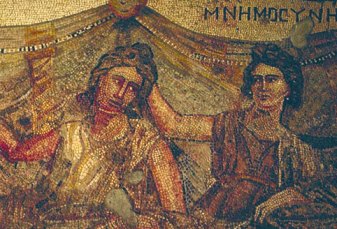
Of course, metaphors for memory are nothing new.  I’m beginning to explore some of these ideas with Paul Ricoeur’s Memory, History, Forgetting, and Ricoeur reminds us that in another Platonic dialog, the Theaetetus, Socrates offers the block of wax in our souls as a metaphor for our memory.  And Socrates suggests, “We may look at it, then, as a gift of Mnemosyne [Memory], the mother of the Muses.” I’ll keep you posted as the Muses urge.


“We like lists because we don’t want to die”

It may not look like much, but that grocery list sitting on the kitchen counter is a faint visual echo of the beginnings of civilization.  At least from a certain angle of vision explicated and illustrated in Umberto Eco’s The Infinity of Lists: An Illustrated Essay (2009).  In a Der Spiegel interview from November 2009, Eco explains,

The list is the origin of culture. It’s part of the history of art and literature. What does culture want? To make infinity comprehensible. It also wants to create order — not always, but often. And how, as a human being, does one face infinity? How does one attempt to grasp the incomprehensible? Through lists, through catalogs, through collections in museums and through encyclopedias and dictionaries.

There is a point at which scholars, philosophers, intellectuals (public or otherwise), critics, etc. — one is temped to list on — reach either a certain age or a certain stature, which it is sometimes hard to tell, when they are able to make simple, direct, and yet curiously ambiguous claims and assertions which, had they been made by a lesser figure, would certainly be dismissed out of hand, but coming from the sage achieve a certain matter-of-fact status and attain the aura of profundity.  So, a list of such from Eco:

  1. “We like lists because we don’t want to die.”
  2. “The essential definition is primitive compared with the list.”
  3. “Lists can be anarchistic.”

In fact, read in context, these make a good deal of sense, or at least one sees how they may make sense.  Then one also attains a certain permission to be blunt:

If you interact with things in your life, everything is constantly changing.  And if nothing changes, you’re an idiot.

In passing Eco also manages to make some interesting claims about the Internet:

With context:

SPIEGEL: But you also said that lists can establish order. So, do both order and anarchy apply? That would make the Internet, and the lists that the search engine Google creates, prefect for you.

Eco: Yes, in the case of Google, both things do converge. Google makes a list, but the minute I look at my Google-generated list, it has already changed. These lists can be dangerous — not for old people like me, who have acquired their knowledge in another way, but for young people, for whom Google is a tragedy. Schools ought to teach the high art of how to be discriminating.

I appreciated Eco’s distinction between modes of knowledge acquisition, which can make all the difference.  Sometimes those who were trained on the older model and subsequently enter the digital world fail to appreciate how their cognitive position and sensibility are different from those who are, as they say, born digital.

One last observation from Eco,

My interests change constantly, and so does my library. By the way, if you constantly change your interests, your library will constantly be saying something different about you.

This along with Eco’s ruminations about lists as a means of holding off the specter of death and creating order from chaos echoed (pun hesitantly intended, although technically, foreshadowed) Nathan Schneider’s excellent “In Defense of The Memory Theater” from some months ago.  I’ve recommended before, and I’ll do so again as my own thinking and interests, along with the books around me, take a turn toward memory.  From Schneider:

Ever since the habit of writing first took hold of me as a teenager, I knew precisely why I did it, and why I did it so compulsively: to hedge against the terror of having a terrible memory. Though still young enough to expect no sympathy, I constantly feel the burden of this handicap. Confirmation of it, and that writing is its cure, I discover every time I pick up something I wrote years, or even months ago. Reading those things puts me in an uncanny state, like a past-life regression. Meanwhile, unrecorded impressions, sayings, old friends, and good books vanish without warning or trace. Some read and write to win eternal life; I would be happy enough just to keep a hold of this one.

Writing birthed lists and lists yielded annals and annals, history — personal and cultural.

Social Media: Good for Groups, Bad for Individuals?

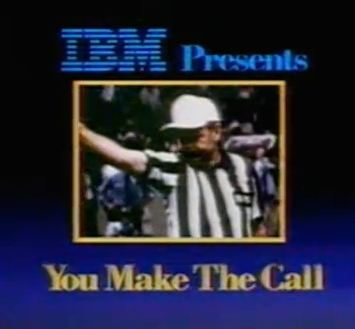
Remember those IBM “You Make the Call” spots during NFL games that used to show you a controversial play and then ask you to make the call before revealing what was in fact the right call?

Well, here’s a variation:

A recent Pew survey has been widely taken to suggest that Internet use doesn’t kill healthy social life after all.

A recent Stanford study suggests to some that social media, Facebook in particular, is making us sad.

You make the call!

Admittedly, this is not exactly an either/or situation, it may even be both/and, I just felt like alluding to the vintage commercial.  (Follow that last link and you’ll also see some vintage Tandy and IBM computers.)

Here’s a little more from each.  Regarding the Pew survey:

Pew found that 80 percent of Internet users participate in groups, as compared with 56 percent of non-Internet users.

Twitter users were the most social. 85 percent of them were involved in group activity offline, followed by 82 percent of social networking users. The results from the survey identify the use of social media and online activities as helpful in the process of disseminating information and engaging group members.

“The virtual world is no longer a separate world from our daily life and lots of Americans are involved in more kinds of groups,” said Rainie.

From the Slate story about the Stanford study:

Facebook is “like being in a play. You make a character,” one teenager tells MIT professor Sherry Turkle in her new book on technology, Alone Together. Turkle writes about the exhaustion felt by teenagers as they constantly tweak their Facebook profiles for maximum cool. She calls this “presentation anxiety,” and suggests that the site’s element of constant performance makes people feel alienated from themselves. (The book’s broader theory is that technology, despite its promises of social connectivity, actually makes us lonelier by preventing true intimacy.)

With that excerpt I’m killing two birds with one stone by pointing you to Sherry Turkle’s most recent work which has drawn considerable attention over the last month or so. See Johah Lehrer’s review here and, in a lighter vein, watch Turkle on The Colbert Report here.

Also of interest in the Slate article is the differentiation between male and female use of Facebook:

Facebook oneupsmanship may have particular implications for women. As Meghan O’Rourke has noted here in Slate, women’s happiness has been at an all-time low in recent years. O’Rourke and two University of Pennsylvania economists who have studied the male-female happiness gap argue that women’s collective discontent may be due to too much choice and second-guessing–unforeseen fallout, they speculate, of the way our roles have evolved over the last half-century. As the economists put it, “The increased opportunity to succeed in many dimensions may have led to an increased likelihood in believing that one’s life is not measuring up.”

If you’re already inclined to compare your own decisions to those of other women and to find yours wanting, believing that others are happier with their choices than they actually are is likely to increase your own sense of inadequacy. And women may be particularly susceptible to the Facebook illusion. For one thing, the site is inhabited by more women than men, and women users tend to be more active on the site, as Forbes has reported. According to a recent study out of the University of Texas at Austin, while men are more likely to use the site to share items related to the news or current events, women tend to use it to engage in personal communication (posting photos, sharing content “related to friends and family”). This may make it especially hard for women to avoid comparisons that make them miserable. (Last fall, for example, the Washington Post ran a piece about the difficulties of infertile women in shielding themselves from the Facebook crowings of pregnant friends.)

Regarding the Pew survey, I’m wondering if it says as much as its proponents take it to say.  I’m not sure it necessarily says much about the quality of the social interaction involved, but more significantly, dividing the population between Internet users and non-Internet users seems less than helpful and may give us nothing deeper than mere correlation.

Regarding the Slate story, find the strong push back in the comment section from the woman who benefited from Facebook during a time of deep depression.  Generalizations will never be without exceptions, of course, and it may be more helpful to think of social media exacerbating rather than causing certain dispositions or emotional states.