Don’t Offload Your Memory Quite Yet: Cognitive Science, Memory, and Education

Google may or may not being making us stupid, but it does appear to render human memory obsolete. By now most of us have probably heard someone suggest that with Google functioning as our reliable and ubiuqitous prosthetic memory, it is no longer necessary to waste time or mental effort memorizing facts. This is usually taken to be a positive development since our brains are now assumed to be free from the menial work of remembering to do the more serious work of creative and critical thinking.

This sounds plausible enough and gains a certain credence from our own experience. Some time ago we began noticing that we no longer know anyone’s phone number. We’re doing well if we can remember our own. Ever since cell phones started storing numbers, we stopped remembering them. And for the most part we’re no worse for it, except, of course, for those instances when we need someone’s number but we can’t access our phones for whatever reason. But those situations tend to be few and far between and on the whole we have little reason to begin memorizing all the numbers in our directories.

We should, however, think twice about extending that line of reasoning much beyond phone numbers. In his 2009 book, Why Don’t Students Like School, Daniel Willingham, a cognitive scientist at the University of Virginia challenges this popular line of reasoning and argues instead for the importance of storing factual knowledge in our long term memory.

Willingham notes that disparaging the need to memorize facts has a long and distinguished history in American education that predates the emergence of the Internet and of Google as a verb form. He cites, for example, J. D. Everett who in 1873 warned that,

There is a great danger in the present day lest science-teaching should degenerate into the accumulation of disconnected facts and unexplained formulae, which burden the memory without cultivating the understanding.

The modern day version of this concern leads to the notion that “instead of learning facts, it’s better to practice critical thinking, to have students work at evaluating all the information available on the Internet rather than trying to commit some small part of it to memory.” Contrary to this fashionable assumption, Willingham argues that that “very processes that teachers care about most — critical thinking processes such as reasoning and problem solving — are intimately intertwined with factual knowledge that is stored in long-term memory (not just found in the environment).”

The problem is that we tend to conceive of thinking analogously to how we imagine a computer works and we abstract processes from data. We treat “critical thinking” as a process that can be taught independently of any specific data or information. On the contrary, according to Willingham, the findings of cognitive science suggest that “[c]ritical thinking processes are tied to background knowledge” and “we must ensure that students acquire background knowledge parallel with practicing critical thinking skills.”

Willingham offers three main points in support of his claim listed here with a few explanatory excerpts:

1. Background knowledge stored in long term memory is essential to reading comprehension

a. it provides vocabulary

b. it allows you to bridge logical gaps that writers leave

c. it allows chunking, which increases room in working memory and thereby makes it easier to tie ideas together

d. it guides the interpretation of ambiguous sentences

2. Background knowledge is necessary for cognitive skills

a. “Memory is the cognitive process of first resort. When faced with a problem, you will first search for a solution in memory …”

b. Chunking facilitated by available knowledge in long term memory enhances reasoning as well as reading comprehension.

c. “Much of what experts tell us they do in the course of thinking about their field requires background knowledge, even if it’s not described that way.”

3. Factual knowledge improves your memory

a. “when you have background knowledge your mind connects the material you’re reading with what you already know about the topic, even if you’re not aware that it’s happening”

b. “having factual knowledge in long-term memory makes it easier to acquire still more factual knowledge”

Among the implications for the classroom that Willingham explores, the following are worth mentioning:

1. “Shallow knowledge is better than no knowledge”: You can’t have deep knowledge about everything, but shallow knowledge of some areas, while not ideal, is better than nothing. It’s at least something to build on and work with.

2. “Do whatever you can to get kids to read”: In Willingham’s view, nothing helps build a wide knowledge base  better than reading and lots of it.

3. “Knowledge must be meaningful”: Memorizing random lists of disconnected facts is not only harder, but ultimately less helpful.

That last point acknowledges that mere rote memorization and incessant drilling can be fruitless and counterproductive. Of course, that much should be obvious. What is no longer obvious, and what Willingham compellingly demonstrates, is that storing up factual knowledge in long term memory is not the enemy of thought, but rather its necessary precondition.

It would appear that the rhetoric of offloaded memory ignores the findings of cognitive science and leads to ineffective educational practice.

__________________________________________________________

Related posts: Offloaded Memory and Its Discontents and The Fog of Life.
“It was impossible to hate”: Presence, Absence, and Graham Greene’s Whiskey Priest

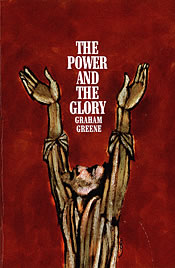
“When you visualize a man or woman carefully, you could always begin to feel pity.”  Or so the nameless priest in Graham Greene’s 1940 novel, The Power and the Glorythought to himself as he sat in a dark, dank, crowded jail cell accosted by a self-righteous woman intent on exposing his unworthiness.

The unnamed priest, however, needed no convincing.  Earlier in the novel we read that,

He was a bad priest, he knew it:  they had a word for his kind — a whiskey priest — but every failure dropped out of his sight and out of mind:  somewhere they accumulated in secret — the rubble of his failures.  One day they would choke up, he supposed, altogether the source of grace.  Until then he carried on, with spells of fear, weariness, with a shamefaced lightness of heart.

The Power and the Glory is set in the Mexican state of Tabasco during the 1930’s when the Red Shirts, a rabidly anti-clerical paramilitary organization, came to power and brutally suppressed the Catholic Church.  Greene’s protagonist, along with Padre Jose, a priest who agreed to marry and forsake his calling in exchange for his life, are the last vestiges of the Church in the state.

Throughout the story the whiskey priest eludes a fanatical police lieutenant who is hell bent on eradicating each and every reminder of the state’s religious past.  “He wanted to destroy everything,” the narrator’s voice explains, “to be alone without any memories at all.”  While evading capture, the nameless priest reluctantly and with an ever-present sense of his worthlessness ministers the sacraments in secret.  He hears confession in the darkness before dawn, he holds a Mass with illicit wine — the Red Shirts also banned alcohol — in dingy jungle huts, and finally he forsakes the promise of safety across the state border to attend to an American convict dying of a gun shot wound that he might be absolved.

Through it all, as author Scott Turrow recently put it, “he emerges as a figure of intense humility and faith, willing to sacrifice himself to attend in secret to the devoted and utterly unaware of his own goodness.”  Not unlike Christ, who in John’s Gospel returns to Jerusalem fully aware that it will cost him his life in order to attend to the dying Lazarus, the priest returns to attend to the dying American knowing that he is to be betrayed to the police and most likely executed.  And indeed, that is the path marked out for him.

In the concluding pages of the novel, after the priest has been unceremoniously executed, an event we witness through the eyes of an English dentist with whom the story had begun, we revisit a number of the families and individuals who along the way had harbored or otherwise interacted with the nameless priest.  In each case, we discover that the priest’s presence among them had been consequential — perhaps ambiguously so, but felt and remembered nonetheless.  This was particularly evident in the case of a young boy whose family had early on sheltered the whiskey priest.  At various points in the novel we listen in as the mother reads to the boy and his sisters an account of the death of a famous Mexican martyr.  The boy had been distracted, unimpressed.  But in the end, when he learns that the shabby priest with the “funny smell” who had been in their very house was also put to death, had now also become a martyr, he has a change of heart.

It brought it home to one — to have had a hero in the house, though it had only been for twenty-four hours.  And he was the last.  There were no more priests and no more heroes.

The priest’s presence, in retrospect, had made the difference.  This appears, from one perspective, to be the central premise of the novel.  By contrast, the oppressive quality of the setting is early on described as a “huge abandonment,” and the antagonist, the hell-bent lieutenant, was marked by the experience of a “vacancy,” and absence.  The priest, tortured by his own failures — often drunk and father of an illegitimate child — cannot quite see the significance of his presence.  He is in his own eyes merely a “fool” who “loves all the wrong things.”  But it is his presence we learn that has made all the difference, that has given hope and sustained faith.

In that prison with which we began, in the darkness, the priest gives profound expression to the significance of presence.

When you visualized a man or woman carefully, you could always begin to feel pity … that was a quality God’s image carried with it … when you saw the lines at the corners of the eyes, the shape of the mouth, how the hair grew, it was impossible to hate.

Greene considered The Power and the Glory to be his best novel.  Critics including John Updike, who wrote the Introduction to the 50th Anniversary Edition, agreed.  It is frequently listed among the best novels of the 20th century.  I read The Power and the Glory while also reflecting on the theme of presence along the lines suggested by Jaron Lanier.  Lanier drew attention to what we might call our presence to ourselves, that is our full engagement in our own experience that was threatened whenever our desire to record and publish our lives through social media led us to fragment our focus and our attention, to become spectators of our own lives.

Reflecting on Greene’s novel provided yet another angle from which to think of presence.  It suggested that our presence to one another may be the most significant gift we can offer.  Alienation and loneliness are still with us.  We speak incessantly of our living in a “connected” age, and indeed it has never been easier to make and maintain connection.  But connection is not presence.   It is true that very often, especially where great distance separates us, a connection is all we can offer — it is better than nothing.  But how often do we fail to give our whole presence to one another when we are separated by feet and inches?  How often do we fail not only to give our own, but to perceive the other’s presence so that we may notice “the lines at the corners of the eyes, the shape of the mouth, how the hair grew”?

Like the unnamed whiskey priest, we may never know what difference our presence will make in the life of another.  What we do know is that our absence, whether literal or effected by our fractured inattentiveness, may in the end contribute to a “huge abandonment.”

The Internet, the Body, and Unconscious Dimensions of Thought, Part II

The Embodied Unconscious

Part Two of Three. Part One.

Ulmer’s project — fashioning a heuristic apparatus that brings the social unconscious partly into view — focuses on the semiotic elements of the socially situated self. Yet, this is only one of the unconscious, or pre-cognitive, dimensions of identity and action. In How We Became Posthuman, Katherine Hayles drew attention to the relationship among embodiment, cognition, and subjectivity.  The group subject emerges, according to Hayles, not only out of the realm of image, symbol, and language, but also out of the matrix of embodied practice.

Ulmer’s unconscious may be labeled the semiotic (or iconic) unconscious.   Adapting Lacan’s psychic schema, Ulmer proposes to map the group subject by recognizing the pattern of recurring signifiers within the four discourses of what Ulmer calls the popcycle (Family, Entertainment, School, Career).   The recurring signifier, analogous to the Lacanian symptom, takes on the role of Guattari’s “existential refrain”: “An implication for electrate identity,” according to Ulmer, “is that a unique refrain, a singularity, may be the clasp that holds together a collectivity (that the nation, so to speak, ‘hangs by a thread’).” The emerging apparatus of electracy allows the group subject to be written, and thus to emerge, at least partially, from its blind spot.

Hayles supplements the semiotic unconscious with what may be called the embodied unconscious.  The embodied unconscious consists of “bodily practices” which have sedimented

into habitual actions and movements, sinking below conscious awareness.   At this level they achieve an inertia that can prove surprisingly resistant to conscious intentions to modify or change them. By their nature, habits do not occupy conscious thought; they are done more or less automatically, as if the knowledge of how to perform the actions resided in ones’ fingers or physical mobility rather than in one’s mind.

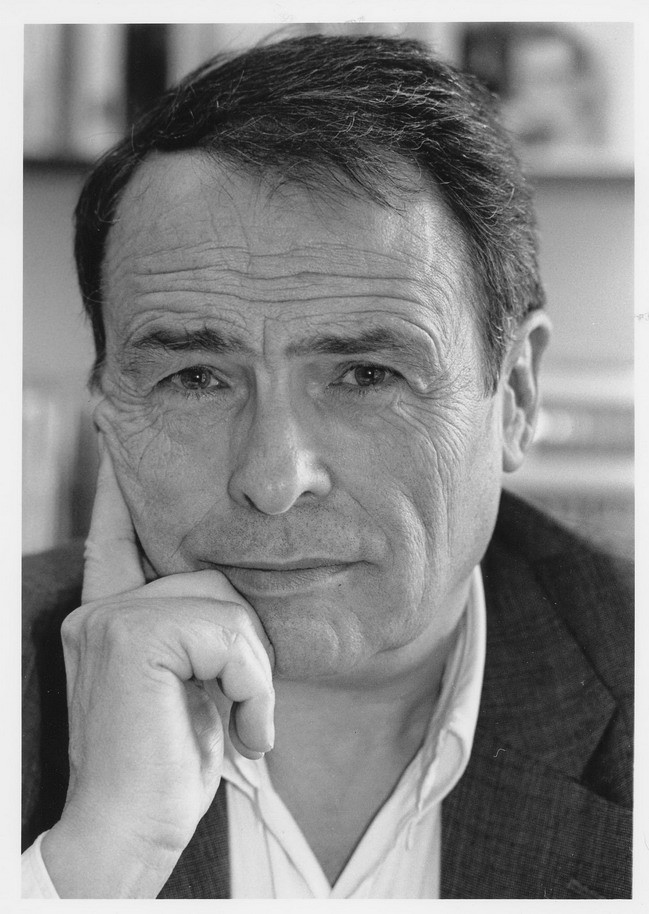
Pierre Bourdieu

In articulating the significance of the embodied unconscious, Hayles draws heavily on the work of French sociologist Pierre Bourdieu.  Bourdieu arrived at his conceptions of practice and embodied knowledge through his study of a group of Berber tribes known as the Kabyle living in North Africa.  Bourdieu observed that the seasonal rituals of the Kabyle conveyed considerable “understanding” about the world, but did so by communicating not “abstractions,” but “patterns of daily life learned by practicing actions until they become habitual.” Habitus, as Bourdieu put it, preserves “a past which survives in the present and tends to perpetuate itself into the future by making itself present in practices structured according to its principles,” and it does so by embedding this knowledge or remembering in the body.

In summarizing Bourdieu’s findings, Hayles concludes that his

work illustrates how embodied knowledge can be structurally elaborate, conceptually coherent, and durably installed without ever having to be cognitively recognized as such . . . The habitus, which is learned, perpetuated, and changed through embodied practices, should not be thought of as a collection of rules but as a series of dispositions and inclinations that are both subject to circumstances and durable enough to pass down through generations.  The habitus is conveyed through the orientation and movement of the body as it traverses cultural spaces and experiences temporal rhythms.

This durable knowledge carried in the body and yielding dispositions and inclinations is transmitted through the ritualized practices of a society.  Ulmer tends to associate embodied knowledge and its modes of acquisition with oral cultures and religious liturgies, consequently this form of subject formation is unfortunately marginalized in his analysis of literate and post-literate societies.  By contrast, Hayles forefronts this form of knowledge and argues for its ongoing significance.  She concludes her discussion of Bourdieu by identifying four key elements of embodied knowledge that emerged from his research:

First, incorporated [or, embodied] knowledge retains improvisational elements that make it contextual rather than abstract, that keep it tied to the circumstances of its instantiation.  Second, it is deeply sedimented into the body and is highly resistant to change.  Third, incorporated knowledge is partly screened from conscious view because it is habitual.  Fourth, because it is contextual, resistant to change, and obscure to the cogitating mind, it has the power to define the boundaries within which conscious thought takes place.

The fourth point is particularly significant in relation to ATH or blindness and Arendt’s call to think what we are doing.  Hayles explicitly links the obscurity of embodied knowledge with the contours within which conscious thought flows.

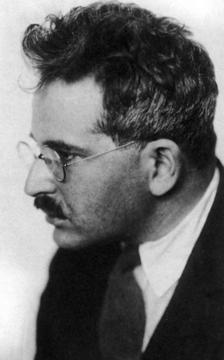
Walter Benjamin

Connecting embodied knowledge with blindness is not intended to disparage embodied knowledge.  In fact, without offloading certain procedures, interactions, and functions to the embodied unconscious, it would be difficult to function at all.  But the benefits of embodied knowledge come at a price.  Here it is helpful to recall Ulmer’s discussion of Walter Benjamin’s notion of the “optical unconscious”:

The capacity of the camera to separate itself from the human physical and mental eye, combined with the theories of psychoanalysis, produced the notion of the ‘optical unconscious’ (Benjamin).  The attitude toward truth as standpoint in the image apparatus of electracy is that clarity is an effect of repression, blindness (ATH).

“Clarity is an effect of repression” is a dictum that applies not only to the optical unconscious, but also to the embodied unconscious.  The benefits of the embodied unconscious come at the cost of installing habitual repression into our experience of the world.  Habituated forms of attention are simultaneously habituated forms of inattention.  Interestingly, the connection between repression and habituation appears in Rosalind Krauss’ analysis cited by Ulmer in his discussion of the optical unconscious:

As Rosalind Krauss explained, applying the poststructural psychoanalysis of Jacques Lacan, the ‘extimate’ inside-outside nature of the human subject installs an opaque obstacle “within the very heart of a diagrammatic clarity that is now a model both of vision’s claims and of vision’s failure . . . . The graph of an automatist visuality would show how the vaunted cognitive transparency of the ‘visual as such’ is not an act of consciousness but the effect of what is repressed:  the effect, that is, of seriality, repetition, the automation.”

Just as we often see through habituated acts of not seeing, we also often act through habituated acts of not thinking.

The Internet, the Body, and Unconscious Dimensions of Thought

Thinking What We Are Doing

Part One of Three (projected).

Writing near the midpoint of the last century, Hannah Arendt worried that we were losing the ability “to think and speak about the things which nevertheless we are able to do.” The advances of science were such that representing what we knew about the world could be done only in the language of mathematics, and efforts to represent this knowledge in a publicly meaningful and accessible manner would become increasingly difficult, if not altogether impossible.  Under such circumstances speech and thought would part company and political life, premised as it is on the possibility of meaningful speech, would be undone.  Consequently, “it would be as though our brain, which constitutes the physical, material condition of our thoughts, were unable to follow what we do, so that from now on we would indeed need artificial machines to do our thinking and speaking.”

Arendt was nearly prescient.  She clearly believed this to be a dystopian scenario that would result in the enslavement of humanity, not so much to our machines, but to one narrow constituent element of our humanity – our “know-how,” that is our ability to make tools.  What Arendt did not imagine was the possibility that digitally, and thus artificially, augmented human thought might avert the very enslavement she foresaw.

On the eve of the 21st century, similar concerns were articulated by Paul Virilio who believed that our technologies, particularly the Internet, created a situation in which a total and integral accident was possible – an accident unlike anything we have heretofore experienced and one that we could not, as of yet, imagine.  Virilio termed this possibility the general accident.  Like Arendt, Virilio believed that the emerging shape of our technological society threatened the possibility of politics; and if politics failed, Virilio claimed, the general accident would be inevitable. Again, like Arendt, Virilio too seems unable to imagine that the way forward may lay through, not against technology, particularly the Internet.

If the concerns expressed by both Arendt and Virilio continue to resonate, it is because the structure of the challenge they articulated remains intact.  The pace of technological development outstrips our ability to think through its attendant social and ethical implications; moreover, the political sphere appears so captivated by the ensuing spectacle that it is ensnared by the very problems we call upon it to solve.  We are confronted, then, with a technologically induced failure of thought and politics, along the lines anticipated by Arendt and Virilio.

Gregory Ulmer is likewise concerned about the challenges presented to our thinking and our politics by technology, specifically the Internet; but Ulmer is more sanguine about the possibility of inventing new forms of thought adequate to our circumstances.  Electracy, according to Ulmer, will be to the digital age what literacy has been to the age of print: an apparatus of thought and practice directed toward the perennial question:  “why do things go wrong?”

Ulmer further elaborates the function of electracy in reference to subjectivity:

If the literate apparatus produced subjectivation in the mode of individual selves organized collectively in democratic nation-states, electracy seems to allow the possibility of a group subjectivation with a self-conscious interface between individual and collective . . .

Ulmer begins Electronic Monuments with a discussion of Paul Virilio’s general accident because, in Ulmer’s view, Virilio has “most forcefully” articulated concerns about “the Internet as the potential source of a general accident.” Unlike Virilio, however, Ulmer believes the best response to the potential of the general accident lies not in opposition to Internet, but through the possibilities created by the Internet.

In The Human Condition, Arendt set for society a very straightforward goal:  “What I propose, therefore, is very simple:  it is nothing more than to think what we are doing.” While Arendt goes on to help the reader understand “what we are doing,” the matter of thinking what we are doing remains an elusive task.

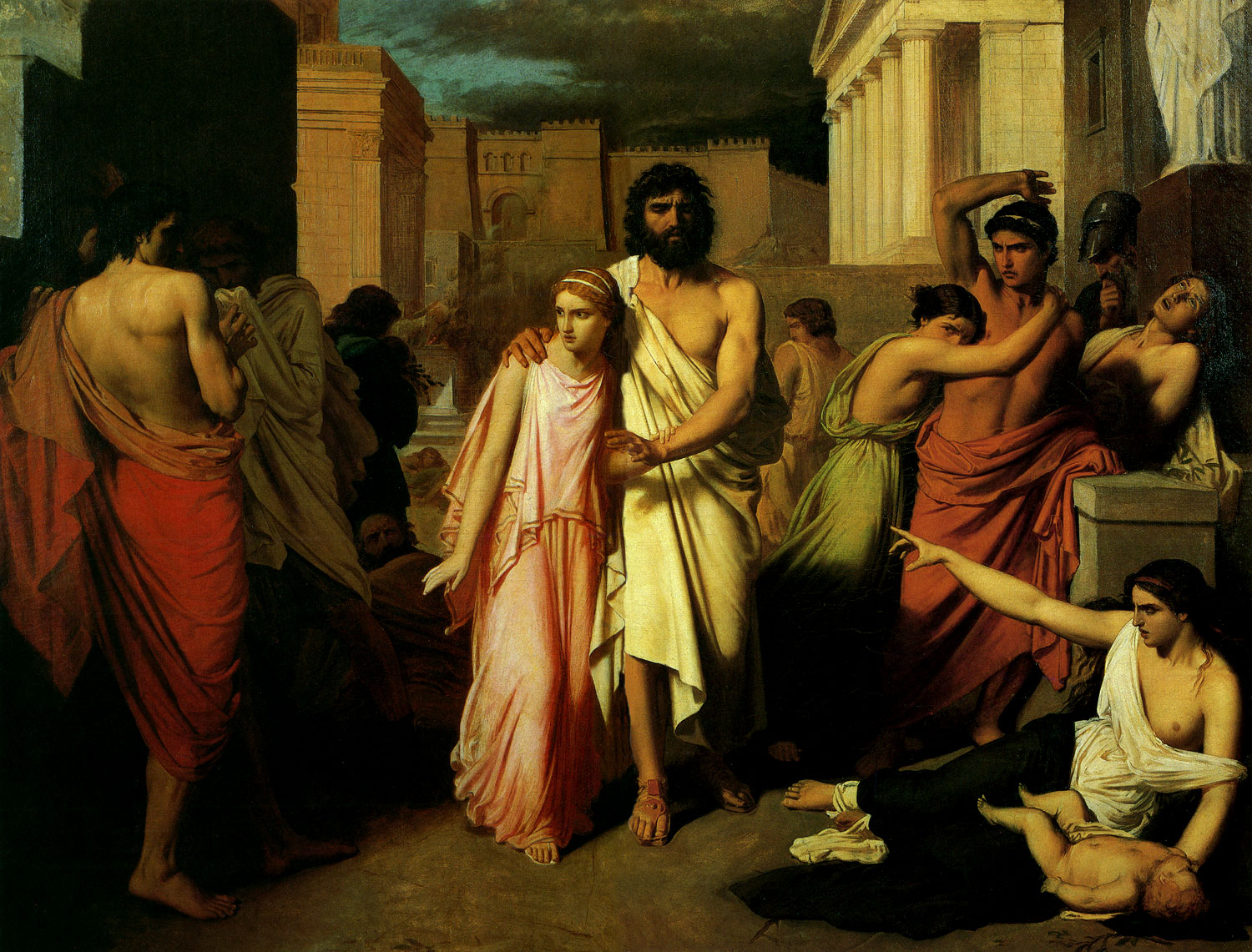
Ulmer attributes our inability to think what we are doing to the blindness that plagues us, both individually and collectively, and he draws on a combination of Greek tragedy and psychoanalysis to frame and theorize this blindness.  Reflecting on Greek tragedy, an “oral-literate hybrid” bridging oral and literate forms of problem recognition, Ulmer explains, “The aspect of tragedy of most interest in our context is (in Greek) ATH (até in lowercase), which means ‘blindness’ or ‘foolishness’ in an individual, and ‘calamity’ or ‘disaster’ in a collectivity.”

The sources of ATH, according to Ulmer, are “those circumstances already in place and into which we are thrown at birth, providing the default moods enforcing in us the institutional construction of identity.” Marshall McLuhan captures a similar point in characteristically pithy fashion when he observes that, “Environments are invisible. Their groundrules, pervasive structure and overall patterns elude easy perception.”

In the concluding chapter of Electronic Monuments, Ulmer further clarifies the concept of ATH with reference to Jacques Lacan’s exposition of Antigone:  “Lacan is interested in ATH as showing that exterior that is at the heart of me, the intersubjective nature of human identity.” Ulmer also refers to the intersubjective nature of human identity in describing the Internet as a “prosthesis of the unconscious (intersubjective) mind.” On more than one occasion, Ulmer identifies this metaphor – the Internet as prosthesis of the unconscious – as one of the key assumptions informing his development of the apparatus of electracy.

Taking Ulmer’s discussions of ATH, intersubjectivity, and the unconscious together, the following picture emerges:  For Ulmer the unconscious is not necessarily a realm of repressed trauma or libidinal desire, but rather is shorthand for the countless, unarticulated ways in which subjectivity is constructed by the social world it inhabits.  From one angle, Ulmer has given Freud, not a semiotic spin as Lacan had done, but a sociological spin.  The unconscious names the group subject – the exteriority at the heart of me.

The Internet is a prosthesis of this unconscious in the sense that it is a virtually limitless digital repository of all of the features of the social world that have imprinted themselves on the subject.  On Youtube, to take one example, a viewer can locate the toy commercial from their childhood that is still vaguely remembered, and then have links provided for a multitude of other more forgotten commercials, themes songs, and cartoons that, once seen, are remembered, and whose significance can be startling. Like T. S. Eliot’s “unknown, unremembered gate” in “Little Gidding,” the Internet operating as a prosthesis of the unconscious allows the user to “arrive where we started/And know the place for the first time.”

This collective element of group subjectivity, until it is made accessible through the practices of electracy Ulmer develops, functions as a blind spot (ATH).  It is a source of judgment and action that remains hidden from conscious thought analogously to the traditional psychoanalytic unconscious.  This blindness, therefore, presents a powerful obstacle to Arendt’s plea, that we think what we are doing.  Ulmer’s project, then, may be understood as an attempt to employ the Internet in an effort to make conscious thought aware of the way in which it has been constructed by the social.

“About suffering they were never wrong”

Musée Des Beaux Arts


About suffering they were never wrong,
The Old Masters: how well they understood
Its human position; how it takes place
While someone else is eating or opening a window or
just walking dully along;
How, when the aged are reverently, passionately waiting
For the miraculous birth, there always must be
Children who did not specially want it to happen, skating
On a pond at the edge of the wood:
They never forgot
That even the dreadful martyrdom must run its course
Anyhow in a corner, some untidy spot
Where the dogs go on with their doggy life and the
torturer’s horse
Scratches its innocent behind on a tree.

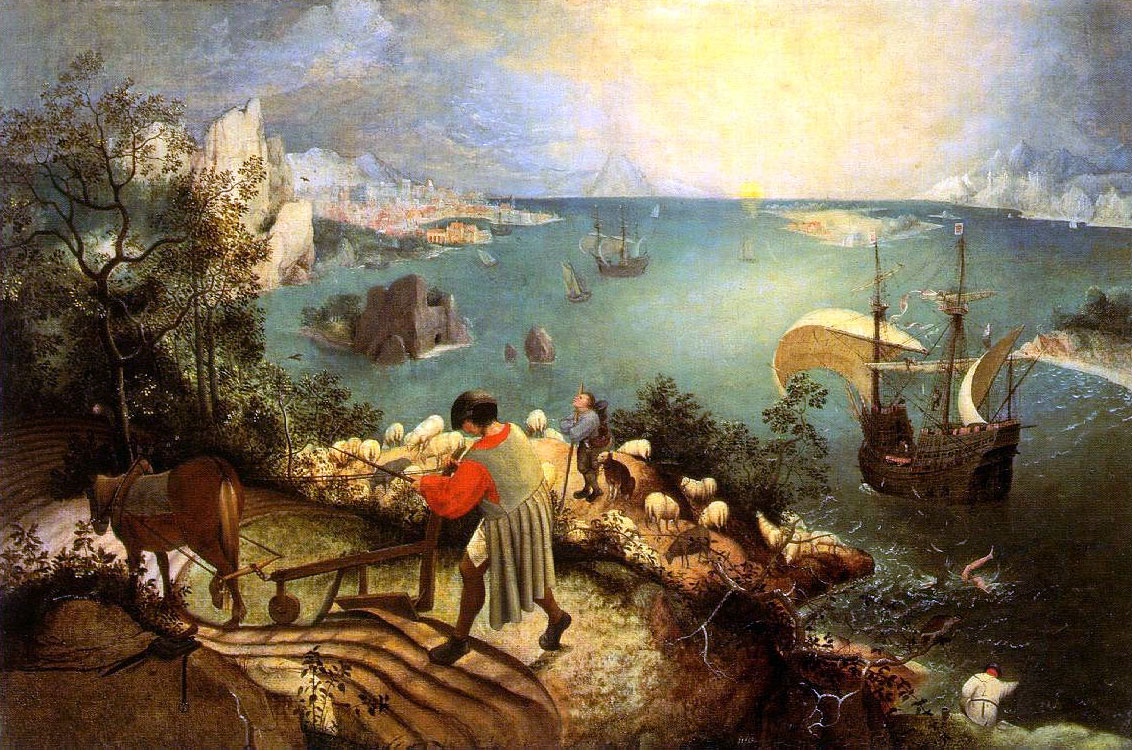
In Brueghel’s Icarus, for instance: how everything
turns away
Quite leisurely from the disaster; the ploughman may
have heard the splash, the forsaken cry,
But for him it was not an important failure; the sun shone
As it had to on the white legs disappearing into the green
Water; and the expensive delicate ship that must have seen
Something amazing, a boy falling out of the sky,
Had somewhere to get to and sailed calmly on.

— by W. H. Auden

Landscape with the Fall of Icarus, Pieter Bruegel