The Simple Life in the Digital Age

America has always been a land of contradictions. At the very least we could say the nation’s history has featured the sometimes creative, sometimes destructive interplay of certain tensions. At least one of these tensions can be traced right back to the earliest European settlers. In New England, Puritans established a “city on a hill,” a community ordered around the realization of a spiritual ideal.  Further south came adventurers, hustlers, and entrepreneurs looking to make their fortune. God and gold, to borrow the title of Walter R. Mead’s account of the Anglo-American contribution to the formation of the modern world, sums it up nicely.  Of course, this is also a rather ancient opposition. But perhaps we could say that never before had these two strands come together in quite the same way to form the double helix of a nation’s DNA.

This tension between spirituality and materialism also overlaps with at least two other tensions that have characterized American culture from its earliest days: The first of these, the tension between communitarianism and individualism, is easy to name. The other, though readily discernible, is a little harder to capture. For now I’m going to label this pair hustle and contemplation and hope that it conveys the dynamic well enough. Think Babbitt and Thoreau.

These pairs simplify a great deal of complexity, and of course they are merely abstractions. In reality, the oppositions are interwoven and mutually dependent. But thus qualified, they nonetheless point to recurring and influential types within American culture. These types, however, have not been balanced and equal. There has always seemed to be a dominant partner in each pairing: materialism, individualism, and hustle. But it would be a mistake to underestimate the influence of spirituality, communitarianism, and contemplation. Perhaps it is best to view them as the counterpoint to the main theme of American culture, together creating the harmony of the whole.

One way of nicely summing up all that is entailed by the counterpoints is to call it the pursuit of the simple life. The phrase sounds quaint, but it worked remarkably well in the hands of historian David E. Shi. In 1985, right in the middle of the decade that was to become synonymous with crass materialism – the same year Madonna released “Material Girl” – Shi published The Simple Life: Plain Living And High Thinking In American Culture. The audacity!

Shi weaves a variegated tapestry of individuals and groups that have advocated the simple life in one form or another throughout American history. Even though he purposely leaves out the Amish, Mennonites, and similar communities, he still is left with a long and diverse list of practitioners. Altogether they represent a wide array of motives animating the quest for the simple life. These include: “a hostility toward luxury and a suspicion of riches, a reverence for nature and a preference for rural over urban ways of life and work, a desire for personal self-reliance through frugality and diligence, a nostalgia for the past and a scepticism toward the claims of modernity, conscientious rather than conspicuous consumption, and an aesthetic taste for the plain and functional.”

This net gathers together Puritans and Quakers, Jeffersonians and Transcendentalists, Agrarians and Hippies, and many more. Perhaps if Shi were to update his work he might include hipsters in the mix. In any case, he would have no shortage of contemporary trends and movements to choose from. None of them dominant, of course, but recognizable and significant counterpoints still.

If I were tasked with updating Shi’s book, for example, I would certainly include a chapter on the critics of the digital age. Not all such critics would fit neatly into the simple life tradition, but I do think a good many would – particularly those who are concerned that the pace and rhythm of digitally augmented life crowds out solitude, silence, and reflection. Think, for example, of the many “slow” movements and advocates (myself included) of digital sabbaths. They would comfortably take their place alongside a many of the individuals and movements in Shi’s account who have taken the personal and social consequences of technological advance as their foil. Thoreau is only the most famous example.

Setting present day critics of digital life in the tradition identified by Shi has a few advantages. For one thing, it reminds us that the challenges posed by digital technologies, while having their particularities, are not entirely novel in character. Long before the dawn of the digital age, individuals struggled to find the right balance between their ideals for the good life and the possibilities and demands created by the emergence of new technologies.

Moreover, we may readily and fruitfully apply some of Shi’s conclusions about the simple life tradition to the contemporary criticisms of life in the digital age.

First, the simple life has always been a minority ethic. “Many Americans have not wanted to lead simple lives,” Shi observes, “and not wanting to is the best reason for not doing so.” But, in his view, this does not diminish the salutary leavening effect of the few on the culture at large.

Yet , Shi concedes, “Proponents of the simple life have frequently been overly nostalgic about the quality of life in olden times, narrowly anti-urban in outlook , and too disdainful of the benefits of prosperity and technology.” Better to embrace the wisdom of Lewis Mumford, “one of the sanest of all the simplifiers” in Shi’s estimation. According to Mumford,

“It is not enough to say, as Rousseau once did, that one has only to reverse all current practice to be right … If our new philosophy is well-grounded we shall not merely react against the ‘air-conditioned nightmare’ of our present culture; we shall also carry into the future many elements of quality that this culture actually embraces.”

Sound advice indeed.

If we are tempted to dismiss the critics for their inconsistencies, however, Shi would have us think again: “When sceptics have had their say, the fact remains that there have been many who have demonstrated that enlightened self-restraint can provide a sensible approach to living that can be fruitfully applied in any era.”

But it is important to remember that the simple life at its best, now as ever, requires a person “willing it for themselves.” Impositions of the simple life will not do. In fact, they are often counterproductive and even destructive. That said, I would add, though Shi does not make this point in his conclusion, that the simple life is perhaps best sustained within a community of practice.

Wisely, Shi also observes, “Simplicity is more aesthetic than ascetic in its approach to good living.” Consequently, it is difficult to lay down precise guidelines for the simple life, digital or otherwise. Moderation takes many forms. And so individuals must deliberately order their priorities “so as to distinguish between the necessary and superfluous, useful and wasteful, beautiful and vulgar,” but no one such ordering will be universally applicable.

Finally, Shi’s hopeful reading of the possibilities offered by the pursuit of the simple life remains resonant:

“And for those with the will to believe in the possibility of the simple life and act accordingly, the rewards can be great. Practitioners can gradually wrest control of their own lives from the manipulative demands of the marketplace and the workplace … Properly interpreted, such a modern simple life informed by its historical tradition can be both socially constructive and personally gratifying.”

Nathan Jurgenson has recently noted that criticisms of digital technologies are often built upon false dichotomies and a lack of historical perspective. In this respect they are no different than criticisms advanced by advocates of the simple life who were also tempted by similar errors. Ultimately, this will not do. Our thinking needs to be well-informed and clear-sighted, and the historical context Shi provides certainly moves us toward that end. At the very least, it reminds us that the quest for simplicity in the digital age had its analog precursors from which we stand to learn a few things.
Networked Momentum, or Why It Can Be So Hard To Opt Out

The NY Times’ Room for Debate forum has taken up the question: “Is Facebook a Fad? Will Our Grandchildren Tweet?” Contributors included Sherry Turkle and Keith Hampton among others. Each offers a quick take on the question of about 300 to 500 words.

In his comments addressing adoption patterns of social media networks, Hampton, a professor of communications at Rutgers, makes the following observation:

“Once critical mass has been reached, not only does the value to participants increase, but the cost of not participating and of discontinuance also increases. It is costly – in that you risk social isolation – to abandon a technology used by the majority of your communication partners.”

When I read this I was immediately reminded of the very useful concept of “technological momentum” articulated by historian of technology Thomas Hughes. I’m going to pull a Jonah Lehrer here and copy and paste a brief description of “technological momentum” from a post a few months back:

“Hughes seeks to stake out a position between technological determinism on the one hand and social constructivism on the other. He finds both accounts ultimately inadequate even though each manages to grasp a part of the whole situation. As a mediating position, Hughes offers the concept of “technological momentum.” By it Hughes seeks to identify the inertia that complex technological systems develop over time. Hughes’ approach is essentially temporal. He finds that the social constructivist approach best explains the behavior of young systems and the technological determinist approach best explains the behavior of mature systems. ‘Technological momentum’ offers a more flexible model that is responsive to the evolution of systems over time.”

Hughes was mostly concerned with what we might call hardware. The power grid was one of his key examples. But Hampton has articulated a social network variation of the principle. It is not enough to talk about social media participation merely in terms of opting in or opting out. For one thing, even those who opt out aren’t really altogether “out” as the folks at Cyborgology have pointed out. For another, one ought to account for the very real costs attached to opting out. These costs constitute an inertial force that can keep users logged on. Perhaps we might call these “sticky” networks.


The Self in the Age of Digital Reproduction

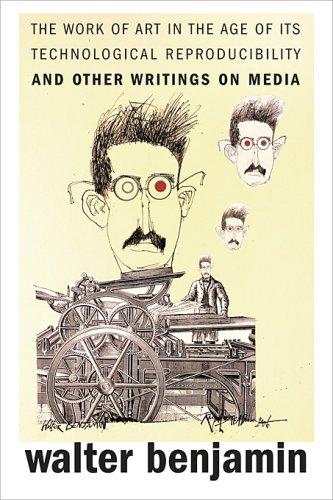
The title suggested itself to me before I had written a word. I picked up Walter Benjamin’s classic essay, “The Work of Art in the Age of Its Technological Reproducibility,”* and in my mind I heard, “The Self in the Age of Its Digital Reproducibility.” I then read through the essay once more with that title in mind to see if there might not be something to the implied analogy. I think there might be.

Of course, what follows is not intended as a strict interpretation and reapplication of the whole of Benjamin’s essay. Instead, it’s a rather liberal, maybe even playful, borrowing of certain contours and outlines of his argument. The borrowing is premised on the assumption that there is a loose analogy between the mechanical reproduction of visual works of art enabled by photography and film, and the reproduction of our personality across a variety of networks enabled by digital technology.

At one point in the essay, Benjamin noted, “commentators had earlier expended much fruitless ingenuity on the question of whether photography was an art – without asking the more fundamental question of whether the invention of photography had not transformed the entire character of art …” Just so. We might say commentators have presently expended much fruitless ingenuity asking about whether this or that digital technology achieved the status of this or that prior analog technology without asking the more fundamental question of whether the invention of digital technology had not transformed the entire character of the field in question. The important question is not, for instance, whether Facebook friendship is real friendship, but how social media has transformed the entire character of relationships. So in this fashion we take Benjamin as our guide letting his criticism suggest lines of inquiry for us.

Benjamin’s essay is best remembered for his discussion of the aura that attended an original work of art before the age of mechanical reproduction. That aura, grounded in the materiality of the work of art, was displaced by the introduction of mechanical reproduction.

“What, then, is the aura?” Benjamin asks. Answer:  “A strange tissue of space and time: the unique apparition of a distance, however near it may be …” And, he adds, “what withers in the age of the technological reproducibility of the work of art is the latter’s aura.”

Aura, to put it more plainly, is a concept that gathers together the authenticity and authority felt in the presence of a work of art. This authenticity and authority of the work of art fail to survive its mechanical (as opposed to manual) reproduction for two principal reasons:

“First, technological reproduction is more independent of the original than is manual reproduction. For example, in photography it can bring out aspects of the original that are accessible only to the lens … but not to the human eye; or it can use certain processes, such as enlargement or slow motion, to record images which escape natural optics altogether. This is the first reason. Second, technological reproduction can place the copy of the original in situations which the original itself cannot attain. Above all, it enables the original to meet the recipient halfway, whether in the form of a photograph or in that of a gramophone record.”

May we speak of the aura that attends a person in “the here and now,” as Benjamin puts it? I would think so. Benjamin himself suggests as much when he discusses the work of the film actor: “The situation can be characterized as follows: for the first time – and this is the effect of film – the human being is placed in a position where he must operate with his whole living person while forgoing its aura. For the aura is bound to his presence in the here and now. There is no facsimile of the aura.”

The analogy I’ve thus far only alluded to is this. Just as mechanical means of reproduction, such as photography, multiplied and distributed an original work or art, likewise do digital technologies, social media most explicitly, multiply and distribute the self. But in so doing they dissolve the aura that attends the person in the flesh and consequently elicit a quest for authenticity.

Consider again the two reasons Benjamin gave for the eclipse of the aura in the face of mechanical reproduction: the independence of the reproduction and its ability to “place the copy in situations which the original itself cannot attain.” The latter of these is most easily reapplied to the digital reproduction of the self. Our social media profiles, for instance, or Skype to take another example, place the self in (multiple, simultaneous) situations that our embodied self cannot attain. But it is the former that may prove most interesting.

Benjamin’s notion of the aura is intertwined with a certain irreducible distance that cannot be collapsed simply by drawing close. Remember his most straightforward definition of aura: “A strange tissue of space and time: the unique apparition of a distance, however near it may be …” The reason for this is that ordinary human vision, even in drawing close, retains an optical inability to penetrate past a certain point. It can only see what it can see, and a manual reproduction cannot improve on that. But a mechanical reproduction can; it can make visible what would remain invisible to the human eye. Imagine for instance what an extreme photographic close-up might reveal about a human face or how high-speed photography may capture a millisecond in time that ordinary human perception would blur into the larger patterns of movement that the unaided human eye is able to perceive.

“Just as the entire mode of existence of human collectives changes over long historical periods,” Benjamin observed, “so too does their mode of perception.” The point then is this: mechanical reproduction, photographs and film, enabled new forms of perception and these new forms of perception effectively neutralized the aura of the original.

Benjamin neatly summed up this dynamic with the notion of the optical unconscious:

“And just as enlargement not merely clarifies what we see indistinctly ‘in any case,’ but brings to light entirely new structures of matter, slow motion not only reveals familiar aspects of movements, but discloses quite unknown aspects within them … Clearly, it is another nature which speaks to the camera as compared to the eye. ‘Other’ above all in the sense that a space informed by human consciousness gives way to a space informed by the unconscious … it is through the camera that we first discover the optical unconscious …”

The camera, in other words, has the ability to bring to the attention of conscious perception what would ordinarily be perceived only at an unconscious level. Benjamin was explicitly pursuing an analogy to the Freudian unconscious. If you prefer to avoid that association, perhaps the term optical non-conscious would suffice. In this way this way this mode of perception may be elided to the bodily forms of intentionality discussed by Merleau-Ponty that are not quite the products of conscious attention. In any case, the capabilities of mechanical reproduction brought to conscious attention what ordinarily escaped it.

So what is the connection to digital reproductions of the self. Well, we might get at it by identifying what could be called the “social unconscious.” Just as photography and film disclosed a real but ordinarily invisible world, might we not also say that digital reproductions of the self materialize real but otherwise invisible relations and mental or emotional states? What else could be the meaning of the “Like” button or the ability to see a visualization of our history with a friend as chronicled on Facebook? Moreover, interactions that before the age of digital reproduction may have passed between two or three persons, now materialize before many more. And while most such interactions would have soon faded into oblivion when they passed out of memory, in the age of digital reproduction they achieve greater durability as well as visibility.

But what are the consequences? Benjamin can help us here as well.

“To an ever-increasing degree, the work reproduced becomes the reproduction of a work designed for reproducibility.” In an age of digital reproduction, the self we are reproducing is increasingly constructed for maximum reproducibility. We live with an eye to the reproductions we will create which we will create with an eye to their being widely reproduced (read, “shared”).

Benjamin also noted the historic tension “between two polarities within the artwork itself … These two poles are the artwork’s cult value and its exhibition value.”  When art was born in the service of magic, the importance of the figures drawn lay in their presence not necessarily their exhibition. By liberating of the work of art from the context of ritual and tradition, mechanical reproduction foregrounded exhibition. In the age of digital reproduction, mere being is incomplete without also being seen. It hasn’t happened if it’s not Facebook official. The private/public distinction is reconfigured for this very reason.

For those keen on registering economic consequences, Benjamin, speaking of the actor before the camera, offers this: “The representation of human beings by means of an apparatus has made possible a highly productive use of the human being’s self-alienation.” Now apply to the person before the apparatus of social-media.

Finally, Benjamin speaking of the human person who will be mechanically reproduced by film, writes:

“While he stands before the apparatus, he knows that in the end he is confronting the masses. It is they who will control him. Those who are not visible, not present while he executes his performance, are precisely the ones who will control it. This invisibility heightens the authority of their control.”

Apply more widely to all who are now engaged in the work of digitally reproducing themselves and cue the quest for authenticity.

____________________________________________________

* I’m drawing on the second version of the essay composed in 1935 and published in Harvard UP’s The Work of Art in the Age of Its Technological Reproducibility and Other Writings on Media (2008)According to the editors, this version “represents the form in which Benjamin originally wished to see the work published.”

Facebook and Loneliness: The Better Question

In 2008, Nick Carr’s article in The Atlantic, “Is Google Making Us Stupid?”, touched off a lively and still ongoing debate about the relative merits of the Internet.  Of course, the title was a provocation and perhaps played a role in generating initial interest in the piece. I’ve often wondered whether that was Carr’s own choice for a title or if an editor with the magazine slapped it on as link bait. In any case, I tend to think it does the essay as a whole a disservice. It suggested a straw man to readers before they read the first word of the article. Having used the piece in a variety of classes that I’ve taught, I’m struck by how often readers respond to the title rather than Carr’s argument in the body of the essay.

In this month’s issue, The Atlantic has once again published a cover story bearing a strikingly similar title — “Is Facebook Making Us Lonely?” by novelist Stephen Marche. I suppose it was too tempting to pass up.

This time around, however, the title is at best generically provocative and more like predictably lame. And, as with Carr’s piece, it threatens to obscure the argument.

Take, for example, the quite interesting response to Marche by sociologist Zeynep Tufekci. In a blog post, she takes on the article’s title more so than the contents of the article. Or so it seems to me. Tufekci emphasizes the need to rely on empirical research and she cites a number of studies that fail to find a causal correlation between social media and loneliness. In fact, studies suggest that on the whole social media users report lower rates of loneliness than non-users.

But as I read (and reread) Marche’s article, I failed to find Marche himself advocating such a causal connection. In fact, at several points Marche is quite clear in denying that social media (since Facebook, like Google in Carr’s article, stands in for a larger reality) causes loneliness. At the outset of the last main section of the article, Marche writes:

“Loneliness is certainly not something that Facebook or Twitter or any of the lesser forms of social media is doing to us. We are doing it to ourselves.”

That seems pretty straightforward to me.

In fact, Marche and Tufekci seem to be in broad agreement. Both agree that individuals have become more isolated over the course of the last few decades. Tufekci cites three studies to that effect:

“We are, on average, more isolated, at least in terms of strong ties. Three separate studies say so–and as we say in social sciences, once is a question, twice is a coincidence, thrice is a finding. (That is the General Social Survey with follow-up here, Pew Internet studieswritten up by Keith Hampton (with others) and a recent study by Matt Brashears).”

Marche makes the same point; in fact, I would suggest that Marche’s essay is really about this broad trend toward loneliness and isolation that predates the rise of social media. It is true that Marche clearly thinks Facebook is less than an ideal antidote to this loneliness and that it engenders certain problematic forms of socialization, but he does not claim that social media is making us lonely. It is the unfortunate title that suggests that.

The more interesting part of Tufekci’s response lies in her notion of cyberasociality which she defines as “the inability or unwillingness of some people to relate to others via social media as they do when physically-present.” Happily, Tufekci links to an unpublished paper in which she lays out her case for the existence of cyberasociality. She draws on an analogy to dyslexia to argue that some people may have an inherent inability to socialize via text based media. As she acknowledges, this is something she is still “working through empirically and conceptually,” but it is certainly an intriguing possibility.

Interestingly, at one point in Marche’s essay he himself appears to acknowledge as much. While discussing the work of Moira Burke — which (again) he himself notes “does not support the assertion that Facebook creates loneliness” — Marche ventures the following introspective confession: “Perhaps it says something about me that I think Facebook is primarily a platform for lonely skulking.” Perhaps. If so, Tufekci may already be working on the theory that explains why.

The real issue, it seems to me, is not whether Facebook makes us lonely, but whether Facebook is reconfiguring our notions of loneliness, sociability, and relationships. These are after all not exactly static concepts. Here is where I think Marche raises some substantial concerns that are unfortunately lost when the debate goes down the path of determining causality.

What Facebook offers is the dream of managing the social and curating the self, and we seem to obsessively take to the task. The asynchronicity of Facebook is rather safe, after all, when compared to the messy and risky dynamics of face-to-face interactions, and we naturally gravitate toward this sort of safety. I suspect this is in part also why we would sometimes rather text than call and, if we do call, why we hope to get sent to voicemail. It seems reasonable to ask whether we will be tempted to take the efficiency and smoothness of our social media interactions as the norm for all forms of social interaction.

One last thought. It seems to me that we should draw a distinction among desires that are bundled together under the notion of loneliness. There is, for example, a distinction between the desire for companionship (and distinctions among varieties of companionship) and the desire simply to be noticed or acknowledged. C. S. Lewis, eloquent as per usual, writes:

“We should hardly dare to ask that any notice be taken of ourselves. But we pine. The sense that in this universe we are treated as strangers, the longing to be acknowledged, to meet with some response, to bridge some chasm that yawns between us and reality, is part of our inconsolable secret.”

Among Facebook’s more problematic aspects, in my estimation, is the manner in which the platform exploits this desire with rather calculated ferocity. That little red notifications icon is our own version of Gatsby’s green light.

Facebook as Rear Window: What Hitchcock and Gadamer Can Teach Us About Online Profiles

In Hitchcock’s 1954 classic, Rear Window, Jimmy Stewart plays a photojournalist named Jeff who is laid up with a broken leg and passes his time observing his neighbors through his apartment’s rear window. The window looks out on a courtyard onto which the rear windows of all the other apartments in the building also open up. It’s a multiscreen gallery for Stewart’s character who reclines in the shadows and becomes engrossed in the lives of his neighbors – the attractive dancer, the lonely woman, the young pianist, the newlyweds, and, most significantly, the unhappy married couple. Increasingly playing the part of the obsessive voyeur, he becomes convinced the disgruntled husband murdered his wife. The film’s plot is driven by Jeff’s determination to prove the man’s guilt.

The film came to my attention again when I received a link to the clip below, which impressively and artfully splices all of the scenes depicting what Jeff sees out of his window. [Update: The video is no longer available.] Serendipitously, I watched the clip not long after reading some comments on Hans-Georg Gadamer’s hermeneutical aesthetics developed in Truth and Method. Naturally, I then thought of Facebook … as one does after watching Hitchcock and reading Gadamer.

Let’s start with Hitchcock. Like the windows in Hitchcock’s film, Facebook profiles offer an opening into a life and one through which others can observe without the observed knowing it. This is classic Facebook behavior. The platform has always abetted and elicited stalker-ish activity from users. This is why one of the most popular of the many spam links that circulate on the social network purports to reveal who has been looking at your profile. If ever such a capability were enabled it would likely lead to a massive reduction in page views for Facebook.

Like Jeff’s character, Facebook users look through the profiles-as-windows at the lives of their virtual neighbors. And as with Jeff, it may begin in a relatively innocent curiosity born of boredom, or it may veer into the obsessive. There is, of course, one glaring difference between the rear windows and Facebook profiles: Stewart’s neighbors were presumably unaware that they were being watched. Facebook users are not only aware they are being watched – they are counting on it.

On Facebook we’re all flâneurs, simultaneously watching and being watched. But we don’t exactly know who is doing the watching and how much watching they’re doing or to what end. The uncanny moment in Rear Window comes when the watcher becomes the watched. Needless to say, such a moment would be equally uncanny where it to unfold online. Yet it is enough that we know we are being watched in general. This alone renders the profile something other than a representation of our life. It becomes itself a presentation. And that is were Gadamer first comes in.

As he develops his hermeneutical aesthetics, Gadamer challenges the representational view of the work of art that understands the work of art as a mere re-presentation of some real thing. On this view, whatever meaning the work of art holds is derivative of the thing it re-presents. Against this view, Gadamer contends that the appearing of the work of art before the participant (for the one who takes in a work of art is never merely a passive observer) constitutes an “event of being.” Meaning inheres in the work of art in itself. It is a presentation, not a re-presentation.

Now think again about a Facebook profile. It may be tempting to understand a profile as a representation of a life or of a personality whose meaning derives from the lived experience of the user who creates the profile. But is this entirely true? It is certainly the case that the online profile is, in a certain sense, grounded in the offline experience of the user. Also, we would do well to resist a digital dualism that abstracts the “real,” offline experience from “virtual,” online experience. Offline and online experience impinge upon one another; it would be misleading to compartmentalize the two.

Yet, there are multiple ways of construing the nature of their enmeshment. One way of resisting digital dualism is to note how the possibility of self-documentation asserts itself in lived experience. I’ve discussed this here on more than a few occasions and Nathan Jurgenson’s notion of “Facebook Eye” captures this dynamic neatly. On this view online profiles impinge upon offline experience by reordering our conscious intentionality – to the person with a social media profile, experience becomes a field of potential self-documentation to be publicized through social media. To the person with a hammer, everything looks like a nail. To the person with a Facebook profile, everything looks like a potential status update. Or alternatively, to the person with a Facebook profile, the question is always “How many ‘likes’ will this get?” But Gadamer offers another complimentary construal.

It begins by noting the presentational character of the online profile. It is not a mere copy of the original life; in its appearing before a profile viewer, it appears on its own terms. It’s meaning is not merely derived from the manner in which it copies life, rather it emerges out of the dynamics of the life as it is presented in the profile. And here is why, as I see it, this does not constitute a digital dualism. Gadamer’s discussion of the work of art as an “event of being” includes what Peter Leithart has called “retroactive ontological consequences” for the thing it refers to in the “real” world.

Leithart interprets Gadamer by reference to landscape painting. When a landscape is painted by Constable, its character has been altered, it is now a “landscape-that-inspires-painting.” When person maintains an online profile, they are now a person-with-a-profile. The landscape painting, Leithart continues, is an “event of being” because it is “an enhancement of the thing itself.” Likewise the online profile, although perhaps enhancement is not necessarily the best word to use here. Moreover Leithart concludes, “every encounter with the real landscape involves a moment of interpretation that is a ‘performance’ of the thing, and after Constable (even for many who are not directly aware of Constable) the interpretive performance is inflected by Constable’s work …” Translated: every encounter with a person-with-a-profile invites acts of interpretation that are inflected by Facebook. Now back to Rear Window to illustrate.

In the film, the windows presented a slice of a life. What Jeff saw was not something other than the lived experience of the people he watched, but the windows did the work of constituting those slices of their lives as something in themselves for Jeff inviting interpretation, not unlike the way a profile presents itself as something in itself for the viewer also inviting the viewer into a work of interpretation. And as we noted, via Gadamer, as a thing in itself the window-as-presentation gives off meaning that has retroactive ontological consequences. If Jeff were to meet any of the people he watched outside of their apartments, his interactions with them would be contoured by his interpretations of their fenestrated (when would I ever have another chance of using that word) presentations.

Likewise, when Facebook users encounter one another offline, their mutual interpretations of one another are loaded with whatever interpretations their profiles have already invited.

Now one final thought. Our presentations always produce more meaning than we intend. This is another way of saying that we are not entirely in control, despite our best efforts, of the manner in which our profile presentations are interpreted. Because they are always partial re-presentations (insofar as they are alluding back to lived experience), our profiles hide while they reveal and thus invite or even demand acts of creative interpretation. These interpretative surpluses, for better or worse, are those that are then brought to bear on our face-to-face encounters.

___________________________________________

An expanded and revised version of this post appeared at The Medias Res.