This is Not a Book

Budget cuts have put over 450 libraries across the UK in jeopardy and consequently launched protests and a vigorous campaign to save the libraries.  Writing in Prospect Magazine, Leo Beneditus suggests that while this is unfortunate, the whole situation is not quite so desperate as the rhetoric of the library enthusiasts make it out to be.  The sky, Benedictus, suggests is not quite falling. Perhaps.  I don’t have a specific point to make here, so much as a few observations:

For one thing, Benedictus is correct to observe,

Listening to a declaration of how wonderful books are (World Book Night, on 5th March, was one recent example), what I hear most loudly is a group of people feeling they have to say so. No one troubles to declare this for computer games.  Instead of making books seem fun, the well-intentioned merely spread a whiff of burning martyr round the act of reading.

Theodor Adorno, Alasdair MacIntyre, and others I’m sure, have pointed out that something has already given way when a culture begins to rationalize its moral code.  Ethics is a sign that moral consensus has already broken down and often amounts to little more than a rear-guard action.  Impassioned defense of the book may likewise signal the passing of an era.

I’m not certain if the subtitle of the article was penned (keyed?) by Benedictus or some editor, but it reads:

It’s a shame some libraries are closing, but this is not the end of civilisation. Quite the opposite.

This line is probably true enough, although “Quite the opposite” is debatable.  But one could justly reply that while it is not the end of civilization per se, it may signal the end of civilization as we know it (or, as we had known it as the transition has been in process for some time now). And this is no small thing.

Benedictus goes on to warn about the “overuse” of books:

One might argue that books offer a better education than games, but they are also more isolating—there are no two-player books—and just as prone to being overused.

It would be hard to imagine what the overuse of books might look like, but I suppose in principle it is possible. But the idea that books are isolating is only partly true.  Reading a book does initially isolate the individual, I’m reminded of Julian Smith’s fantastic music video; but a book, precisely by speaking to our inner self, reminds us that we are, none of us, so isolated that others cannot put words to our experiences.  In this way, books immerse us in solitude only to reconnect us more profoundly with the world around us.  Needless, to say a book may also connect us intimately with the experience of others by providing a window into their experience that is unavailable otherwise.

Later on, speaking of the potential virtue of e-readers, Benedictus suggests that,

Freed from paper in this way, books have a much better chance of becoming cool again.
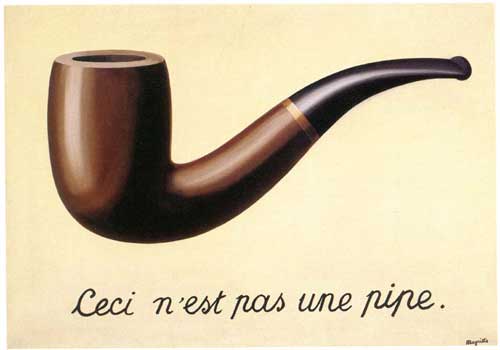
In the first place, the pursuit of “cool,” is always decidedly uncool.  Beside that, though, it is a curious statement to make because it confuses a text for a book.  A book freed from paper (unless you are imagining papyrus or vellum) is an oxymoron.  And this, perhaps, begins to reveal a deeper assumption at play in Benedictus’ essay — materiality is insignificant.  The book as object does not matter. Perhaps what is needed is a work of art along the lines of Magritte’s “This Is Not A Pipe” in order to provoke us into understanding the significance of textual materiality.

Reading is imagined merely as the transfer of immaterial data from one container (book, e-reader, etc.) to another (the human brain).  This seems blind to the significance of the embodied experience involved in reading a book which activates each of our senses in very particular ways, ways an e-reader (regardless of its virtues otherwise) simply cannot.  E-readers, of course, have their own materiality, and that matters as well.

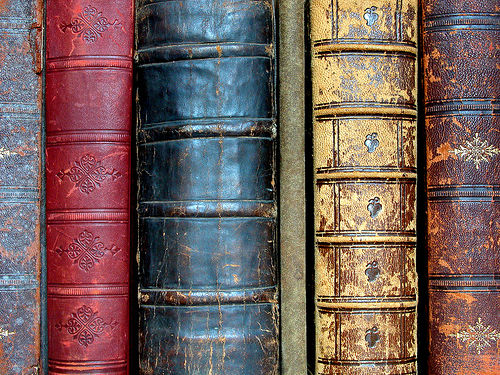
Discounting materiality also ignores the manner in which the book as object, by virtue of its particularity, is the repository of a host of memories and associations.  A book can only be itself and so collects around itself its own unique history; the e-reader is every text it used to read, and thus it is simultaneously none of them.  I remember where and when I bought many of my books.  I remember where I read them and to pick up certain books is to be transported back to different moments in my life.  The book as object, its particular and unique materiality, matters.  This is not to suggest that e-readers have no place and no benefits, but it is to suggest that moving from books to an e-reader is not a transaction without remainder.

A failure to recognize the significance of materiality may also be at play in the willingness to bid adieu to the library.  Benedictus concludes his essay by noting that,

When the children of 2011 look back, they will not see this as the year their local libraries were taken away. This will be the year they all got libraries of their own.

Perhaps, but notice the equivocation.  “Libraries closed” are not the same thing as “libraries of their own.”  The former refers to a material fact, the latter refers vaguely to an assemblage of data.   In any case, when they do look back, if they do, they may also be oblivious to the rich and textured experience of reading that attended those curious relics of a past civilization.

___________________________

Listen to Zadie Smith’s reflections on libraries here.

‘We mustn’t take people for fools’: de Certeau on Reading as Resistance

In The Practice of Everyday Life, French theorist and sometime Jesuit, Michel de Certeau presents an account of individual agency which seeks to nuance Foucault’s exposition of the disciplinary society.  Where certain historical and sociological narratives are inclined to see only passive consumers at the mercy of structural forces, de Certeau wants us to see active users who “make innumerable and infinitesimal transformations of and within the dominant cultural  economy in order to adapt it to their own interests and their own rules” (xiv).  Without denying the existence and significance of “disciplinary technology” and the “microphysics of power,” he also wants to
bring to light the clandestine forms taken by the dispersed, tactical, and make-shift creativity of groups or individuals already caught in the nets of ‘discipline.’  Pushed to their ideal limits, these procedures and ruses of consumers compose the network of an antidiscipline …” (xiv-xv).

Among the anti-disciplinary practices analyzed by de Certeau, we may be surprised to find reading.  And reading is of particular significance as a practice because,

From TV to newspapers, from advertising to all sorts of mercantile epiphanies, our society is characterized by a cancerous growth of vision, measuring everything by its ability to show or be shown and transmuting communication into a visual journey.  It is a sort of epic of the eye and of the impulse to read (xxi).

Bear in mind that de Certeau is writing in the early 1980’s, well before the advent of digital technologies we now take for granted which have only accelerated and accentuated (certain forms of) reading and the visual.  Given his eclectic account of what constitutes reading, however, de Certeau’s analysis is well-positioned to retain its relevance.

Reading, in the very broad sense employed by de Certeau, may appear to be in its very nature a quintessentially  passive activity, a kind of thoughtless consumption.  This could not be further from the truth:

In reality, the activity of reading has on the contrary all the characteristics of a silent production:  the drift across the page, the metamorphosis of the text effected by the wandering eyes of the reader, the improvisation and expectation of meanings inferred from a few words, leaps over written spaces in an ephemeral dance.  [The reader] insinuates into another person’s text the ruses of pleasure and appropriation; he poaches on it, is transported into it, pluralizes himself in it like the internal rumblings of one’s body.  (xxi)

The movement of the reader’s world into the author’s place “makes the text habitable, like a rented apartment.  It transforms another person’s property into a space borrowed for a moment by a transient” (xxi).  Later in the book, de Certeau returns to this theme of reading (consumption) as transience, especially in contrast to writing (production):

Far from being writers – founders of their own place, heirs of the peasants of earlier ages now working on the soil of language, diggers of wells and builders of houses – readers are travelers; they move across lands belonging to someone else, like nomads poaching their way across fields they did not write, despoiling the wealth of Egypt to enjoy it themselves …. Reading takes no measures against the erosion of time (one forgets oneself and also forgets), it does not keep what it acquires, or it does so poorly, and each of the places through which it passes is a repetition of the lost paradise.

Indeed, reading has no place:  Barthes reads Proust in Stendhal’s text …. [The reader’s] place is not here or there, one or the other, but neither the one nor the other, simultaneously inside and outside, dissolving both by mixing them together, associating texts like funerary statues that he awakens and hosts, but never owns.  In that way, he also escapes from the law of each text in particular, and from that of the social milieu. (174)

The placelessness of reading and the tactics it evokes from the reader, if I understand de Certeau, free the reader from the law-like dominance of any one text and, by extension, society itself, which can be read as a book.  In the Middle Ages, de Certeau notes early on, the text was a book, today it is a “whole society made into a book” (xxii).  Later on he adds, “This text was formerly found at school.  Today, the text is society itself.  It takes urbanistic, industrial, commercial, or televised forms” (167).

The tactics of reading become the strategies of non-conformity.  The consumer is not merely a passive recipient, she is an active user that evades the pressures of conformity, even if subtly and evasively.  This analysis elides nicely with the conditions of the digital age, but should now be updated to account for the vast democratization of the means of writing/production that digital technologies and the Internet have enabled.  What happens to the strategies of resistance developed and deployed under the conditions of the mass market when we enter into the diversified field of digital media?  Do the implicit and tacit tactics become explicitly instantiated under the new conditions?  Does the underground and invisible now turn into the mainstream and visible?  Did the silent tactics of reading guide the evolution of digital practices?

And one last word, for now, from de Certeau.  In debates about the consequences of the Internet, it may be too often assumed that users are merely passive pawns at the disposal of massive and often invisible forces, whether of the medium itself or the commercial powers that profit from the medium. As he counseled his contemporaries, de Certeau may have counseled us:

… it is always good to remind ourselves that we mustn’t take people for fools (176).

The (Un)Naturalness of Privacy

Andrew Keen is not an Internet enthusiast, at least not since the emergence of Web 2.0.  That much has been clear since his 2007 book The Cult of the Amateur: How Today’s Internet is Killing Our Culture and his 2006 essay equating Web 2.0 with Marxism in The Weekly Standard, a publication in which such an equation is less than flattering.  More recently, Keen has taken on all things social in a Wired UK article, “Your Life Torn Open: Sharing is a Trap.”

Now, I’m all for a good critique and lampoon of the excesses of social media, really, but Keen may have allowed his disdain to get the better of him and veered into unwarranted, misanthropic excess.  From the closing paragraph:

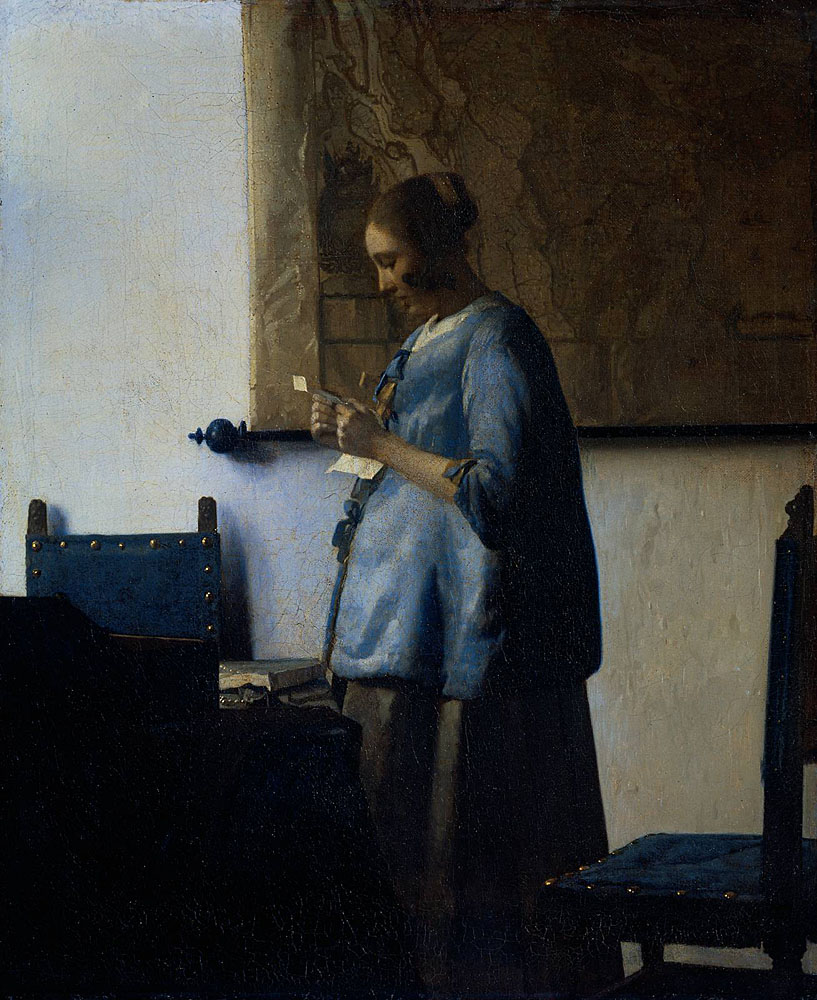
Today’s digital social network is a trap. Today’s cult of the social, peddled by an unholy alliance of Silicon Valley entrepreneurs and communitarian idealists, is rooted in a misunderstanding of the human condition. The truth is that we aren’t naturally social beings. Instead, as Vermeer reminds us in The Woman in Blue, human happiness is really about being left alone. …. What if the digital revolution, because of its disregard for the right of individual privacy, becomes a new dark ages? And what if all that is left of individual privacy by the end of the 21st century exists in museums alongside Vermeer’s Woman in Blue? Then what?

“Human happiness is really about being left alone” and “The truth is that we aren’t naturally social beings”? Striking statements, and almost certainly wrong. It seems rather that the vast majority of human beings long for, and sometimes despair of never finding, meaningful and enduring relationships with other human beings. That human flourishing is conditioned on the right balance of the private and the social, individuality and relationship, seems closer to the mark. And while I suppose one could be raised by wolves in legends and stories, I’d like to know how infants would survive biologically in isolation from other human beings.  On this count, better stick with Aristotle.  The family, the clan, the tribe, the city — these are closer to the ‘natural’ units of human existence.

The most ironic aspect of these claims is Keen’s use of Vermeer’s “Woman in Blue” or, more precisely, “Woman in Blue Reading a Letter,” to illustrate them.  That she is reading a letter is germane to the point at issue here which is the naturalness of privacy.  Contrary to Keen’s assertion of the natural primacy of privacy, it is closer to the truth to correlate privacy with literacy, particularly silent reading (which has not always been the norm), and the advent of printing.  Changing socio-economic conditions also factor into the rise of modern notions of privacy and the individual.  Notions formalized by Locke and Hobbes who enshrine the  atomized individual as the foundation of society, notably, with founding myths which are entirely a-historical.

In The Vineyard of the Text, Ivan Illich, citing George Steiner, suggests this mutual complicity of reading and privacy:

According to Steiner, to belong to ‘the age of the book’ meant to own the means of reading.  The book was a domestic object; it was accessible at will for re-reading.  The age presupposed private space and the recognition of the right to periods of silence, as well as the existence of echo-chambers such as journals, academies, or coffee circles.

Likewise, Walter Ong, drawing on Eric Havelock, explains that

By separating the knower from the known, writing makes possible increasingly articulate introspectivity, opening the psyche as never before not only to the external objective world quite distinct from itself but also to the interior self agaisnt whom the objective world is set.

Privacy emerges from the dynamics of literacy.  The more widespread literacy becomes, as for example with the printing press, the more widespread and normalized the modern sense of privacy becomes.  What Keen is bemoaning is the collapse of the experience privacy wrought by print culture.  I do think there is something to mourn there, but to speak of its “naturalness” misconstrues the situation and seems to beget a rather sociopathic view human nature.

Finally, it is also telling that Vermeer’s woman is reading a letter.  Letters, after all, are a social genre; letter writing is a form of social life.  To be sure, it is a very different form of social life than what the social web offers, but it is social.  And were we not social beings we would not, as Auden puts its, “count some days and long for certain letters.” The Woman in Blue Reading a Letter reminds us that privacy is bound to literate culture and human beings are bound to one another.

_____________________________________________________________

Updates:  To reinforce that it is a balance we are after, also consider this article in yesterday’s Boston Globe, “The Power of Lonely.” Excerpt:

But an emerging body of research is suggesting that spending time alone, if done right, can be good for us — that certain tasks and thought processes are best carried out without anyone else around, and that even the most socially motivated among us should regularly be taking time to ourselves if we want to have fully developed personalities, and be capable of focus and creative thinking.

My attention has also been drawn to an upcoming documentary for which Andrew Keen was interviewed.  PressPausePlay will be premiering at South By Southwest and addresses the issues of creativity and art in the digital world.  Here’s  a preview featuring Andrew Keen:

“Darkness Gathers Around the Book”

“I read and I daydream …. My reading is thus a sort of impertinent absence.  Is reading an exercise in ubiquity?”  An initial, indeed initiatory, experience:  to read is to be elsewhere, where they are not, in another world; it is to constitute a secret scene, a place one can enter and leave when one wishes; to create dark corners into which no one can see within an existence subjected to technocratic transparency and that implacable light that, in Genet’s work, materializes the hell of social alienation.  Marguertie Duras has noted:  “Perhaps one always reads in the dark …. Reading depends on the obscurity of the night.  Even if one reads in broad daylight, outside, darkness gathers around the book.”

— From Michel de Certeau’s The Practice of Everyday Life, Chapter 12, “Reading as Poaching” (173).  The initial quote is from Guy Rosolato’s Essais sur le symbolique.

“We like lists because we don’t want to die”

It may not look like much, but that grocery list sitting on the kitchen counter is a faint visual echo of the beginnings of civilization.  At least from a certain angle of vision explicated and illustrated in Umberto Eco’s The Infinity of Lists: An Illustrated Essay (2009).  In a Der Spiegel interview from November 2009, Eco explains,

The list is the origin of culture. It’s part of the history of art and literature. What does culture want? To make infinity comprehensible. It also wants to create order — not always, but often. And how, as a human being, does one face infinity? How does one attempt to grasp the incomprehensible? Through lists, through catalogs, through collections in museums and through encyclopedias and dictionaries.

There is a point at which scholars, philosophers, intellectuals (public or otherwise), critics, etc. — one is temped to list on — reach either a certain age or a certain stature, which it is sometimes hard to tell, when they are able to make simple, direct, and yet curiously ambiguous claims and assertions which, had they been made by a lesser figure, would certainly be dismissed out of hand, but coming from the sage achieve a certain matter-of-fact status and attain the aura of profundity.  So, a list of such from Eco:

  1. “We like lists because we don’t want to die.”
  2. “The essential definition is primitive compared with the list.”
  3. “Lists can be anarchistic.”

In fact, read in context, these make a good deal of sense, or at least one sees how they may make sense.  Then one also attains a certain permission to be blunt:

If you interact with things in your life, everything is constantly changing.  And if nothing changes, you’re an idiot.

In passing Eco also manages to make some interesting claims about the Internet:

With context:

SPIEGEL: But you also said that lists can establish order. So, do both order and anarchy apply? That would make the Internet, and the lists that the search engine Google creates, prefect for you.

Eco: Yes, in the case of Google, both things do converge. Google makes a list, but the minute I look at my Google-generated list, it has already changed. These lists can be dangerous — not for old people like me, who have acquired their knowledge in another way, but for young people, for whom Google is a tragedy. Schools ought to teach the high art of how to be discriminating.

I appreciated Eco’s distinction between modes of knowledge acquisition, which can make all the difference.  Sometimes those who were trained on the older model and subsequently enter the digital world fail to appreciate how their cognitive position and sensibility are different from those who are, as they say, born digital.

One last observation from Eco,

My interests change constantly, and so does my library. By the way, if you constantly change your interests, your library will constantly be saying something different about you.

This along with Eco’s ruminations about lists as a means of holding off the specter of death and creating order from chaos echoed (pun hesitantly intended, although technically, foreshadowed) Nathan Schneider’s excellent “In Defense of The Memory Theater” from some months ago.  I’ve recommended before, and I’ll do so again as my own thinking and interests, along with the books around me, take a turn toward memory.  From Schneider:

Ever since the habit of writing first took hold of me as a teenager, I knew precisely why I did it, and why I did it so compulsively: to hedge against the terror of having a terrible memory. Though still young enough to expect no sympathy, I constantly feel the burden of this handicap. Confirmation of it, and that writing is its cure, I discover every time I pick up something I wrote years, or even months ago. Reading those things puts me in an uncanny state, like a past-life regression. Meanwhile, unrecorded impressions, sayings, old friends, and good books vanish without warning or trace. Some read and write to win eternal life; I would be happy enough just to keep a hold of this one.

Writing birthed lists and lists yielded annals and annals, history — personal and cultural.