The Technological Sublime, Alive and Well

Natural wonders, lightning storms, tornadoes, sunsets — we sometimes describe the experience of these sorts of natural phenomenon as experiences of the sublime. They leave us in awe and render us speechless if only for a moment. There is a long tradition of reflection about the nature of the sublime experience going back at least to the eighteenth century. Kant and Burke in particular are often taken as starting points for the discussion. The sublime in Burke’s view was tinged with a certain terror, and for Kant the ability of human reason to take in and domesticate the sublime was a testament to its power.

More recently historian David Nye has argued that it is not only nature that inspires sublime experiences, our modern technologies also have the ability to elicit similar reactions of wonder, awe, and not a little trepidation. In American Technological Sublime, Nye argued that these experiences of the technological sublime have been especially characteristic of American society and have amounted to a kind of civil religion. They have at least been an integral part of the American civil religion. These experiences were more than moments of profound personal experience. They were moments that forged the collective national character. They were rituals of solidarity.

The first railroads, the first massive industrial factories, the electrified cityscapes, the Hoover Dam, the atomic bomb — all of these and more have inspired sublime experiences in those who first witnessed their appearance. One is reminded as well of Henry Adams’ famous account of the massive Corliss engine that powered the Philadelphia Centennial Exposition in 1876 and led Adams to compare the place of the dynamo in modern society to the place of the Virgin Mary in medieval society.

In more recent history the space program has supplied most instances of the technological sublime. Nye describes rocket launches at Cape Caneveral as quasi-religious events: “the event is less a matter of spectatorship than a pilgrimage to a shrine where a technological miracle is confidently expected.” In his account of the launch of Apollo 11, Nye describes Norman Mailer’s experience of the event. Mailer came as a skeptic, bent on resisting the allure of the event. He was determined not to be caught up in the fervor and devotion of the crowd of pilgrims. And yet … When the rocket launched and the earth began to rumble and the sound caught up with the sight, Mailer found himself saying over and over again, “Oh, my God! oh my God! oh, my God! oh my God!” That is the power of the technological sublime.

I write all of this today because yesterday Americans in Florida and the Washington D. C. area got an experience of the technological sublime. The space shuttle Discovery whose launches had been occasion for numerous pilgrimages to the Cape, especially as the shuttle program wound down, took her final voyage mounted on a specially fitted 747. If you were able to catch a glimpse of the spectacle, perhaps you know experientially what Nye theorized. If you were not able to see the sight in person, you have only to read the new stories, personal accounts, and, yes, tweets to conclude that the technological sublime is alive and well, if perhaps increasingly rare.

The technological marvel, the national pride, the sense of solidarity, the awe, the pride, the wave of emotion, the patriotic fervor abetted by the military jet accompanying the shuttle on its final voyage — you can read all of it on the faces of the spectators and in the nature of the pictures that made their way around the news outlets and blogs.

In the midst of it all, however, there was a sense of nostalgia as well. Of course, part of that nostalgia arises from the fact that this was a final voyage, and as such it recalled to mind all of the previous voyages, including those that ended in tragedy. But perhaps the nostalgia also arose from a tacit realization (if such a thing is possible) of the absence of such experiences from our more common and ordinary encounters with technology. In his final chapter, Nye describes the transition to what he calls the “consumer’s sublime” typified by Las Vegas and Disneyland. “The epiphany,” Nye writes, “has been reduced to a rush of simulations, in an escape from the very work, rationality, and domination that once were embodied in the American technological sublime.”

Put that way, one wonders whether it is not on the whole better that the American technological sublime is waning. And yet when one experiences its “melancholy, long withdrawing roar,” perhaps it is only natural to feel a tinge of sadness.

_________________________________________________________________________

My thanks to Christopher Friend for the excellent images posted below.

You can see additional photo-documentation of the technological sublime here, here, and here.

Image courtesy of Chris Friend
Image courtesy of Chris Friend.

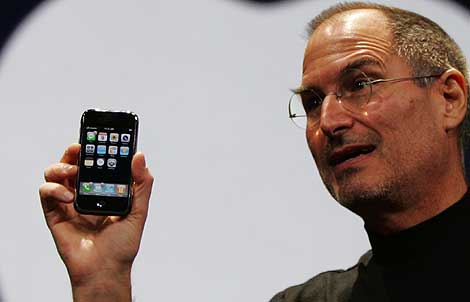
Love, Beauty, and Design: What Steve Jobs Understood

It’s been nearly a week without a post and that largely due to some unexpected travel occasioned by less than happy circumstances. And now that I sit down to write again, it is under the shadow of more sad circumstances. It would be hard to have missed the news of Steve Jobs’ death last night. It poured in from every conceivable medium. I got it first from a friend’s Facebook status, and then from nearly every Facebook status and countless tweets and retweets. This morning my Google Reader was dominated by stories, articles, essays, and posts about Jobs and his legacy.

In one of those articles, Steven Levy’s reflections on Jobs’ life for Wired, I came across this intriguing passage that carried a great deal of wisdom:

Jobs usually had little interest in public self-analysis, but every so often he’d drop a clue to what made him tick. Once he recalled for me some of the long summers of his youth. I’m a big believer in boredom,” he told me. Boredom allows one to indulge in curiosity, he explained, and “out of curiosity comes everything.” The man who popularized personal computers and smartphones — machines that would draw our attention like a flame attracts gnats — worried about the future of boredom. “All the [technology] stuff is wonderful, but having nothing to do can be wonderful, too.”

I’m certain that you will come across countless other lines from Jobs in the coming days; many, I’m sure, will be taken from his now legendary 2005 commencement address at Stanford.

I have come rather late into the Apple fold, I’m typing this on my first Apple computer which was purchased just two months ago. But for longer than that I’ve been fascinated by the cult that has grown around Apple products over the last decade or so (perhaps longer, I’m not certain how to judge the years between Jobs’ two stints with the company in this regard). It is an uncanny phenomenon that has been noted and commented on many times. In recent months news outlets have run reports on studies that link the regard users have for Apple products with the same parts of the brain that have been related to religious experiences and to feelings of love.

It seems reasonably clear that Apple has tapped into something deeper than mere satisfaction with a consumer product. It also seems reasonably clear that the reactions to Steve Jobs’ untimely passing are at least in part wrapped up with the attachment users feel to the products he made possible. At least one Facebook status I read noted how odd it was to feel sadness for the passing of a man one had never met. This is not, of course, a previously unheard of phenomenon; from time to time the death of some public figure generates this sense of sadness and loss.

But it is not exactly common either. Numerous public figures die each year and most occasion little more than a mention and a sigh. Then there are those individuals whose passing generates grief and sorrow that ripples out far beyond the circle of family and friends who had known the person firsthand. Examples are not hard to come by: Abraham Lincoln, John Kennedy, Martin Luther King Jr., Marilyn Monroe, Elvis Presley, Princess Diana, Michael Jackson. I’m sure the list can be populated with other examples easily enough. The lives of all of these were ended prematurely and tragically, and they all managed to form emotional ties, each in their own way, with those who mourned their passing.

Now we may safely add Steve Jobs to this list and this raises some interesting questions. How does he fit in with this group and the others who may be added to their number? What was the source of the emotional bond? Whatever we might think of his genius, his vision, his determination — none of these seem to me to account for the emotional bond. The bond, it would seem, was not with the person of Steve Jobs in the same way that it was with the other individuals whose deaths spurred widespread and heartfelt public mourning.

The emotional bond, rather, is with the objects Steve Jobs envisioned and produced. The bond has been transferred to the man as the embodiment of our love affair with the products. It would not take long to confirm this anecdotally on Twitter. At both the announcement of his resignation in August and now his death, my Twitter feed was populated by mentions of how the products Jobs produced changed lives along with notes about how the very message of appreciation was made possible by an Apple product. This itself is an important index of our age.

And if we were to inquire further, we might note that the genius of his products lay finally in design. Jobs stands apart from both great inventors of the past and great corporate figures of the past. He was some blend of the two, to be sure, but added to the alchemy was a dash of the artist as well.

Apple’s success lay not only in its innovation, but also in its aesthetic. The heart is not so pragmatic that it loves what merely works. It loves beauty, and Jobs seems to have known that the consumer would flock to beautifully designed products. The beauty, of course, is of a certain character — minimalist, functional, clean — but it is a recognizable and appealing aesthetic.

It did not hurt either that Jobs moved Apple products into a symbiotic relationship with other objects of love, music and personal relationships. Music is itself a transcendent source of beauty and love. We love our music, and Jobs tapped that love when he made the iPod. Our love also flows naturally to our family and friends, and with the iPhone Jobs created a product that effortlessly mediated those relationships along with our music. Add to this the manner in which the “Touch” revolution Apple products initiated appropriated the visceral and embodied nature of our loves and affections and you begin to understand Jobs’ genius.

He seemed to have understood this above all else: the consumer was not the rational optimizer of classical economic theory. The consumer, who after all was a human being, was a lover and the lover loves the beautiful.

McLuhan: 100

The medium is the message … five words, plump and alliterative though they may be, are wildly inadequate … he was born in Edmonton, Alberta on July 21, 1911 … He speaks in canned riddles … Speech as organized stutter is based on time. What does speech do to space? … “Clear prose indicates the absence of thought” … Watching McLuhan, you can’t quite decide whether he was a genius or just had a screw loose … he gave us language that made “media” into a thing …

It feels wistful to imagine a time when people didn’t go about their daily routine with the assumption that at any moment another massive media technology will be dumped on us by some geek in California … “I’m going to be a computer when I grow up” …

“What if he is right”? … “Instead of the book as a fixed package of repeatable and uniform character suited to the market with pricing, the book is increasingly taking on the character of a service … and the book as an information service is tailor-made and custom-built” … First of all – and I’m sorry to have to repeat this disclaimer – I’m not advocating anything … “The next medium, whatever it is – it may be the extension of consciousness – will include television as its content, not as its environment” …

an alchemical mix of his vast historical and literary knowledge, his bombastic personality and a range of behaviors we might now place on the very mild end of the autistic spectrum … McLuhan’s mind was probably situated at the mild end of the autism spectrum. He also suffered from a couple of major cerebral traumas …

First, that McLuhan never made arguments, only assertions … a fixture of culture both nerd and pop, which are increasingly the same thing. He is the patron saint of Wired … what mattered was merely the fact that you were watching TV. The act of analysing the content of TV – or of other mediums – is either sentimental or it’s beside the point … Annie Hallthe fastest brain of anyone I have ever met, and I never knew whether what he was saying was profound or garbage… He wanted his words to knock readers out of their intellectual comfort zones, to get them to entertain the possibility that their accepted patterns of perception might need reordering ..McLuhan was an information canary …

“He writes by paradox — that makes him hard to read (or hard on the reader),” wrote McLuhan … he loved Chesterton’s rhetorical flourishes, imbibed his playfulness, turned his impulse to try out new combinations of ideas into the hallmark of the McLuhan method … He became a daily Mass-goer …

There is absolutely no inevitability … what will be the psychic fallout of these technologies on our inner lives? … Like Marx and Freud, he was an intellectual agitator, a conceptual mind expander, the yeast in the dough …  James Joyce and Ezra Pound especially … The web. The web, with its feeds and flows and rivers and streams … That kaleidoscopic, almost psychedelic style … In that Playboy interview … a celebrity-seeking charlatan …

lost all hope “that the world might become a better place with new technology” …  people who classify McLuhan as a techno-utopian aren’t simply making stuff up … Resenting a new technology will not halt its progress … Many people seem to think that if you talk about something recent, you’re in favor of it … And so eschatological hope appears as nothing more than an early manifestation of cyber-utopianism … Look at what these media are doing to our souls … “Once we have surrendered our senses and nervous systems to the private manipulation of those who would try to benefit by taking a lease on our eyes and ears and nerves, we don’t really have any rights left” …

Your question reflects the usual panic of people confronted with unexplored technologies. I’m not saying such panic isn’t justified … merely that such reactions are useless and distracting … “Man the food-gatherer reappears incongruously as information-gatherer” … But an understanding of media’s effects constitutes a civil defense against media fallout … someone who didn’t just have strong ideas but who invented a whole new way of talking … all a teacher can ever do is get people to think …

outlived his fame … he died in a state of wordlessness …

That’s what McLuhan did.

_______________________________________________________________________

In case it is not apparent, only a very few of these words are mine.  Sources:

Webs and whirligigs:  Marshall McLuhan in his time and ours by Megan Garber
Why McLuhan’s chilling vision still matters today by Douglas Coupland
McLuhan at 100 and McLuhan on the Cloud by Nicholas Carr
Why Bother With Marshall McLuhan by Alan Jacobs
Divine Inspiration by Jeet Heer
Marshall McLuhan:  Escape into Understanding by W. Terrence Gordon
McLuhan, Chesterton, and the Pursuit of Joy
McLuhan as Teacher by Walter Ong

Kindles, Books, and Half-hearted Endorsements of the New

Megan McArdle on the Kindle and the Book:

The Kindle was only released in November of 2007, just three-and-a-half years ago.  By 2009, Kindle book sales briefly surpassed print sales on the day after Christmas.  In July of 2010, the eBook format overtook hardcovers, and six months later, it surpassed paperbacks.

Today, according to Amazon, eBooks have surpassed print books entirely; they are selling more Kindle editions than they are selling from all of their print formats combined.  Since April 1st, they’ve sold 105 Kindle books for every 100 print editions.

She is not surprised and this is part of the reason why:

And like many Kindle owners, I’ve found that I buy more books than I used to.  The impulse purchases are now completely irresistible: I can have the new memoir about someone’s dead tax cheat of a husband right this instant, rather than waiting two whole days . . . by which time, I’ll have forgotten about the Washingtonian excerpt that made me want to read it.

Score another one for the frictionless life and disposable reality.

She concludes:

I’m pretty sure the print book’s days are numbered for anything except specialty applications.  The die-hards will cling for a while, but ultimately, book buyers are already an extremely affluent group, and the convenience in acquiring, porting, and storing your library simply overwhelms the drawbacks, especially as Amazon has introduced innovations like eBook lending.

But wait, there is a tinge of melancholy:

… it will change a lot of the dynamics of life for book people.  My first adult books were pulled from my parents’ giant trunk of mystery novels, and the shelves in their bedrooms–will there be a family Kindle account, and will they be able to control access to the juicy stuff?  Peter and I are already wondering if we shouldn’t merge our Amazon account, but do I really want my archives cluttered up with his comic books and movie tomes?  Does he want to have to scroll through a long line of trashy police procedurals?  What will happen to the pleasures of pulling a random book from the shelves of a home where you are a weekend guest?

Not too worry, it was only momentary:

They’ll be replaced by other pleasures, like instant gratification.  And it’s probably more gain than loss.

Or was it:

But I’m just a little bit sad, all the same.

Why do we feel compelled to ratify what are surely trivial pleasures, if pleasures at all, while suppressing our instinctive regret for the passing of deeper more substantives pleasures?  This is not an indictment of the Kindle, nor a defense of the book.  I’m just intrigued by the recurring “this is better, yes its better, it must be better it’s new and the old is passing, it must pass” feel that attaches to pieces like this.  Who exactly is being convinced?

_____________________________________________

H/T to Mr. Greenwald for passing the McArdle post along.

Studied Responses: Reactions to bin Laden’s Death

Image: CNN Belief Blog

In the moments, hours, and days following the announcement of Osama bin Laden’s death I was repeatedly struck by the amount of attention paid to the manner in which Americans were responding to his death.  Almost immediately I began to pick up notes of concerned introspection about the response (e.g., the jubilant crowds gathered at the White House and Ground Zero), and what ought to be the appropriate response.

This introspection appears to have been most pronounced within religious circles.  At Christianity Today, Sarah Pulliam Bailey gathered together Tweets from a number of evangelical Christian leaders and bloggers addressing the question, “How should Christians respond to Osama bin Laden’s death?”  A sizable comment thread formed below the post.  At the religion and media web site, Get Religion, in a post titled “Churches respond to Osama’s death,” we get another round of links to church leaders writing about the appropriate response to the killing of bin Laden.

The topic, however, was also prominent in the more mainstream media.  NPR, for example, ran a short piece titled “Is It Wrong to Celebrate Bin Laden’s Death” and another piece focused on bin Laden’s death titled “Is Celebrating Death Appropriate?”  In the former story we get the following odd piece of reflection:

Laura Cunningham, a 22-year-old Manhattan reveler — gripping a Budweiser in her hand and sitting atop the shoulders of a friend — was part of the crowd at ground zero in the wee hours Monday. As people around her chanted “U-S-A,” Cunningham was struck by the emotional response. She told New York Observer: “It’s weird to celebrate someone’s death. It’s not exactly what we’re here to celebrate, but it’s wonderful that people are happy.”

I say “odd,” because it is not clear that this young lady knew what or why she was celebrating.  “But it’s wonderful that people are happy”?  What?

The NY Times also ran a story titled, “Celebrating a Death: Ugly, Maybe, but Only Human.”  And, finally, in case you are interested, Noam Chomsky would also like you to know about his reaction to Osama’s death, although I imagine you can guess.  Additionally, at CNN’s Belief Blog, you can read “Survey:  Most Americans say its wrong to celebrate bin Laden’s death,” and Stephen Prothero’s reflections on the aforementioned survey.  You get the idea.

So all of this strikes me as rather interesting.  For one thing, I can’t really imagine this sort of self-awareness permeating the responses of previous generations to historical events of this sort.  Of course, this may be because this event is sui generis, although I doubt that is quite right.  It seems rather another instance of the self-reflexiveness and self-reference that has become a characteristic of our society.  I might push this further by noting that this post just adds another layer, another mirror, as I reflect on the reflections.  My usual explanation for this hypertrophied self-awareness is the collapse of taken-for-granted social structures and customs and the correlated rise of the liberated, spontaneous self.  The spontaneous self as it turns out is not that spontaneous; rather it is performed.  Performance is studied and aware of itself; conscious of its every response.  Naturally then, we are asking at the cultural level whether our “spontaneous” celebrations were appropriate.  Did we play this part right?

This posture seems to me to lack a certain degree of integrity, in the sense that our way of being in the world is not integrated; very little comes naturally, our actions all feel rather artificial.  Perhaps especially at those times when we most wish we could just be fully in the moment, we rather feel a certain anxiety about feeling the right way — are we feeling the way we are supposed to be feeling, etc.  However, the integrated self is also somewhat opaque to itself; it is capable of acting literally without thought, and thus perhaps thoughtlessly.

I’ll resist the temptation to provide a concluding paragraph that wraps things up neatly with a fresh insight.  More of an aspiration than a temptation, I suppose, if the insight just isn’t there.