Facebook and Loneliness: The Better Question

In 2008, Nick Carr’s article in The Atlantic, “Is Google Making Us Stupid?”, touched off a lively and still ongoing debate about the relative merits of the Internet.  Of course, the title was a provocation and perhaps played a role in generating initial interest in the piece. I’ve often wondered whether that was Carr’s own choice for a title or if an editor with the magazine slapped it on as link bait. In any case, I tend to think it does the essay as a whole a disservice. It suggested a straw man to readers before they read the first word of the article. Having used the piece in a variety of classes that I’ve taught, I’m struck by how often readers respond to the title rather than Carr’s argument in the body of the essay.

In this month’s issue, The Atlantic has once again published a cover story bearing a strikingly similar title — “Is Facebook Making Us Lonely?” by novelist Stephen Marche. I suppose it was too tempting to pass up.

This time around, however, the title is at best generically provocative and more like predictably lame. And, as with Carr’s piece, it threatens to obscure the argument.

Take, for example, the quite interesting response to Marche by sociologist Zeynep Tufekci. In a blog post, she takes on the article’s title more so than the contents of the article. Or so it seems to me. Tufekci emphasizes the need to rely on empirical research and she cites a number of studies that fail to find a causal correlation between social media and loneliness. In fact, studies suggest that on the whole social media users report lower rates of loneliness than non-users.

But as I read (and reread) Marche’s article, I failed to find Marche himself advocating such a causal connection. In fact, at several points Marche is quite clear in denying that social media (since Facebook, like Google in Carr’s article, stands in for a larger reality) causes loneliness. At the outset of the last main section of the article, Marche writes:

“Loneliness is certainly not something that Facebook or Twitter or any of the lesser forms of social media is doing to us. We are doing it to ourselves.”

That seems pretty straightforward to me.

In fact, Marche and Tufekci seem to be in broad agreement. Both agree that individuals have become more isolated over the course of the last few decades. Tufekci cites three studies to that effect:

“We are, on average, more isolated, at least in terms of strong ties. Three separate studies say so–and as we say in social sciences, once is a question, twice is a coincidence, thrice is a finding. (That is the General Social Survey with follow-up here, Pew Internet studieswritten up by Keith Hampton (with others) and a recent study by Matt Brashears).”

Marche makes the same point; in fact, I would suggest that Marche’s essay is really about this broad trend toward loneliness and isolation that predates the rise of social media. It is true that Marche clearly thinks Facebook is less than an ideal antidote to this loneliness and that it engenders certain problematic forms of socialization, but he does not claim that social media is making us lonely. It is the unfortunate title that suggests that.

The more interesting part of Tufekci’s response lies in her notion of cyberasociality which she defines as “the inability or unwillingness of some people to relate to others via social media as they do when physically-present.” Happily, Tufekci links to an unpublished paper in which she lays out her case for the existence of cyberasociality. She draws on an analogy to dyslexia to argue that some people may have an inherent inability to socialize via text based media. As she acknowledges, this is something she is still “working through empirically and conceptually,” but it is certainly an intriguing possibility.

Interestingly, at one point in Marche’s essay he himself appears to acknowledge as much. While discussing the work of Moira Burke — which (again) he himself notes “does not support the assertion that Facebook creates loneliness” — Marche ventures the following introspective confession: “Perhaps it says something about me that I think Facebook is primarily a platform for lonely skulking.” Perhaps. If so, Tufekci may already be working on the theory that explains why.

The real issue, it seems to me, is not whether Facebook makes us lonely, but whether Facebook is reconfiguring our notions of loneliness, sociability, and relationships. These are after all not exactly static concepts. Here is where I think Marche raises some substantial concerns that are unfortunately lost when the debate goes down the path of determining causality.

What Facebook offers is the dream of managing the social and curating the self, and we seem to obsessively take to the task. The asynchronicity of Facebook is rather safe, after all, when compared to the messy and risky dynamics of face-to-face interactions, and we naturally gravitate toward this sort of safety. I suspect this is in part also why we would sometimes rather text than call and, if we do call, why we hope to get sent to voicemail. It seems reasonable to ask whether we will be tempted to take the efficiency and smoothness of our social media interactions as the norm for all forms of social interaction.

One last thought. It seems to me that we should draw a distinction among desires that are bundled together under the notion of loneliness. There is, for example, a distinction between the desire for companionship (and distinctions among varieties of companionship) and the desire simply to be noticed or acknowledged. C. S. Lewis, eloquent as per usual, writes:

“We should hardly dare to ask that any notice be taken of ourselves. But we pine. The sense that in this universe we are treated as strangers, the longing to be acknowledged, to meet with some response, to bridge some chasm that yawns between us and reality, is part of our inconsolable secret.”

Among Facebook’s more problematic aspects, in my estimation, is the manner in which the platform exploits this desire with rather calculated ferocity. That little red notifications icon is our own version of Gatsby’s green light.


Facebook as Rear Window: What Hitchcock and Gadamer Can Teach Us About Online Profiles

In Hitchcock’s 1954 classic, Rear Window, Jimmy Stewart plays a photojournalist named Jeff who is laid up with a broken leg and passes his time observing his neighbors through his apartment’s rear window. The window looks out on a courtyard onto which the rear windows of all the other apartments in the building also open up. It’s a multiscreen gallery for Stewart’s character who reclines in the shadows and becomes engrossed in the lives of his neighbors – the attractive dancer, the lonely woman, the young pianist, the newlyweds, and, most significantly, the unhappy married couple. Increasingly playing the part of the obsessive voyeur, he becomes convinced the disgruntled husband murdered his wife. The film’s plot is driven by Jeff’s determination to prove the man’s guilt.

The film came to my attention again when I received a link to the clip below, which impressively and artfully splices all of the scenes depicting what Jeff sees out of his window. [Update: The video is no longer available.] Serendipitously, I watched the clip not long after reading some comments on Hans-Georg Gadamer’s hermeneutical aesthetics developed in Truth and Method. Naturally, I then thought of Facebook … as one does after watching Hitchcock and reading Gadamer.

Let’s start with Hitchcock. Like the windows in Hitchcock’s film, Facebook profiles offer an opening into a life and one through which others can observe without the observed knowing it. This is classic Facebook behavior. The platform has always abetted and elicited stalker-ish activity from users. This is why one of the most popular of the many spam links that circulate on the social network purports to reveal who has been looking at your profile. If ever such a capability were enabled it would likely lead to a massive reduction in page views for Facebook.

Like Jeff’s character, Facebook users look through the profiles-as-windows at the lives of their virtual neighbors. And as with Jeff, it may begin in a relatively innocent curiosity born of boredom, or it may veer into the obsessive. There is, of course, one glaring difference between the rear windows and Facebook profiles: Stewart’s neighbors were presumably unaware that they were being watched. Facebook users are not only aware they are being watched – they are counting on it.

On Facebook we’re all flâneurs, simultaneously watching and being watched. But we don’t exactly know who is doing the watching and how much watching they’re doing or to what end. The uncanny moment in Rear Window comes when the watcher becomes the watched. Needless to say, such a moment would be equally uncanny where it to unfold online. Yet it is enough that we know we are being watched in general. This alone renders the profile something other than a representation of our life. It becomes itself a presentation. And that is were Gadamer first comes in.

As he develops his hermeneutical aesthetics, Gadamer challenges the representational view of the work of art that understands the work of art as a mere re-presentation of some real thing. On this view, whatever meaning the work of art holds is derivative of the thing it re-presents. Against this view, Gadamer contends that the appearing of the work of art before the participant (for the one who takes in a work of art is never merely a passive observer) constitutes an “event of being.” Meaning inheres in the work of art in itself. It is a presentation, not a re-presentation.

Now think again about a Facebook profile. It may be tempting to understand a profile as a representation of a life or of a personality whose meaning derives from the lived experience of the user who creates the profile. But is this entirely true? It is certainly the case that the online profile is, in a certain sense, grounded in the offline experience of the user. Also, we would do well to resist a digital dualism that abstracts the “real,” offline experience from “virtual,” online experience. Offline and online experience impinge upon one another; it would be misleading to compartmentalize the two.

Yet, there are multiple ways of construing the nature of their enmeshment. One way of resisting digital dualism is to note how the possibility of self-documentation asserts itself in lived experience. I’ve discussed this here on more than a few occasions and Nathan Jurgenson’s notion of “Facebook Eye” captures this dynamic neatly. On this view online profiles impinge upon offline experience by reordering our conscious intentionality – to the person with a social media profile, experience becomes a field of potential self-documentation to be publicized through social media. To the person with a hammer, everything looks like a nail. To the person with a Facebook profile, everything looks like a potential status update. Or alternatively, to the person with a Facebook profile, the question is always “How many ‘likes’ will this get?” But Gadamer offers another complimentary construal.

It begins by noting the presentational character of the online profile. It is not a mere copy of the original life; in its appearing before a profile viewer, it appears on its own terms. It’s meaning is not merely derived from the manner in which it copies life, rather it emerges out of the dynamics of the life as it is presented in the profile. And here is why, as I see it, this does not constitute a digital dualism. Gadamer’s discussion of the work of art as an “event of being” includes what Peter Leithart has called “retroactive ontological consequences” for the thing it refers to in the “real” world.

Leithart interprets Gadamer by reference to landscape painting. When a landscape is painted by Constable, its character has been altered, it is now a “landscape-that-inspires-painting.” When person maintains an online profile, they are now a person-with-a-profile. The landscape painting, Leithart continues, is an “event of being” because it is “an enhancement of the thing itself.” Likewise the online profile, although perhaps enhancement is not necessarily the best word to use here. Moreover Leithart concludes, “every encounter with the real landscape involves a moment of interpretation that is a ‘performance’ of the thing, and after Constable (even for many who are not directly aware of Constable) the interpretive performance is inflected by Constable’s work …” Translated: every encounter with a person-with-a-profile invites acts of interpretation that are inflected by Facebook. Now back to Rear Window to illustrate.

In the film, the windows presented a slice of a life. What Jeff saw was not something other than the lived experience of the people he watched, but the windows did the work of constituting those slices of their lives as something in themselves for Jeff inviting interpretation, not unlike the way a profile presents itself as something in itself for the viewer also inviting the viewer into a work of interpretation. And as we noted, via Gadamer, as a thing in itself the window-as-presentation gives off meaning that has retroactive ontological consequences. If Jeff were to meet any of the people he watched outside of their apartments, his interactions with them would be contoured by his interpretations of their fenestrated (when would I ever have another chance of using that word) presentations.

Likewise, when Facebook users encounter one another offline, their mutual interpretations of one another are loaded with whatever interpretations their profiles have already invited.

Now one final thought. Our presentations always produce more meaning than we intend. This is another way of saying that we are not entirely in control, despite our best efforts, of the manner in which our profile presentations are interpreted. Because they are always partial re-presentations (insofar as they are alluding back to lived experience), our profiles hide while they reveal and thus invite or even demand acts of creative interpretation. These interpretative surpluses, for better or worse, are those that are then brought to bear on our face-to-face encounters.

___________________________________________

An expanded and revised version of this post appeared at The Medias Res.

There Can Be Only One: Google+ Takes On Facebook

You are most likely not one of the favored few who have been invited to take Google’s new social networking platform out for a spin and neither am I,  but now we get a glimpse of what Google has been up to. When it does go live,  Google+ will open a new front in the battle against Facebook, and one that appears more promising than the ill-fated Google Buzz.

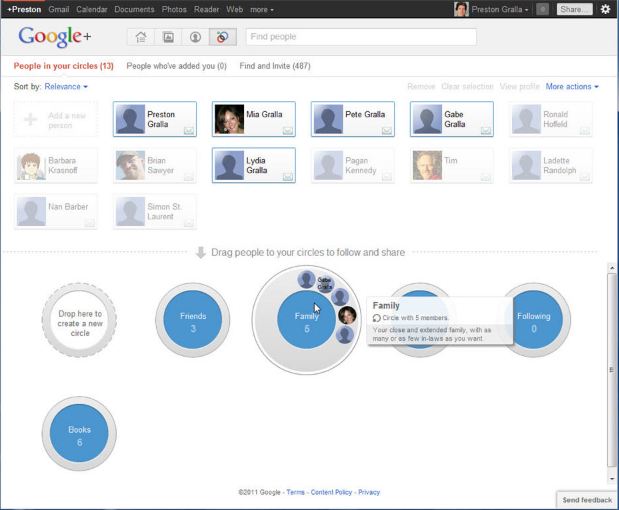
The Google+ experience is in large measure reminiscent of Facebook with at least one major exception:  Circles.   Facebook’s glaring weakness is its insistence that you indiscriminately present the same persona to every one of your “friends,” a list which may include your best friend from childhood, your ex-girlfriend, your boss, your co-workers, your grandmother, and that kid that lived down the street when you were growing up.  Amusingly, Zuckerberg turns moral philosopher on this point and declares that maintaining more than one online identity signals a lack of integrity.  Google+ more sensibly assumes that not all human relationships are created equal and that our social media experience ought to acknowledge that reality.  It allows you to create Circles into which you can drag and drop names from your contact list.  Whenever you post a picture or a link or a comment, you may designate which Circles will be able to see what you have posted. In other words, it lets you effectively manage the presentation of your self to your multifaceted social media audience.  Google+ appears to have thus solved Facebook’s George Costanza problem:  colliding worlds.

Facebook has gestured in this direction with Groups and Friend lists, but this remains an awkward experience, perhaps because it is at odds with the logic at the core of Facebook’s DNA.  Google+, having taken note of the rumblings of discontent with Facebook’s at times cavalier attitude toward privacy,  also allows users to permanently delete their information from Google’s servers and otherwise presents a more privacy-friendly front.

Even with these features aimed at exposing Facebook’s weaknesses and recent news about kinks in Facebook’s armor, Google+ is not expected to challenge Facebook’s social media supremacy.  Inertia is the main obstacle to the success of Google+.  Many users have committed an immense amount of data to their Facebook profiles and Facebook has worked hard to integrate itself into the whole online experience of its users.  Additionally, Facebook has more or less become a memory archive for many of its users and we don’t easily part with our memory.  Most significantly, perhaps, Google+ starts from a position of relative weakness as far as social media platforms are concerned — it has few users.  Most people will, for a long time to come, more readily find those they know on Facebook.

That said, Facebook’s early success against Myspace was predicated on a certain exclusivity.  It may be that an early disadvantage — relatively few members — may present itself as an important advantage in the eyes of enough people to generate momentum for Google+.  It is also hard to tell how many would-be social media users have been kept at bay by Facebook’s shortcoming and will now venture into social media waters given the refinements offered by Google+.  Casual Facebook users may also find it relatively painless to make a move.

Hard to tell from here, as is most of the future, but I wouldn’t be too surprised if Google+ significantly eroded Facebook’s base. Despite, my Highlander-esque title, the most likely outcome may be that both platforms co-exist by appealing to different sets of sensibilities, priorities, and expectations.

Mark Zuckerberg, Moral Philosopher of Identity

In a recent blog post, Steve Cheney bemoans the ongoing progress that Facebook is making toward becoming the ambient background of the Internet.  Specifically, he is concerned that Facebook is killing your authenticity:

… now Facebook’s sheer scale is pushing it in a new direction, one that encroaches on your authenticity.

Facebook is no longer a social network. They stopped being one long before the movie. Facebook is really a huge broadcast platform. Everything that happens between its walls is one degree away from being public, one massive auditorium filled with everyone you’ve ever met, most of whom you haven’t seen or spoken to in years.

Cheney’s post was triggered by the recent adoption of Facebook commenting by a number of large websites, a move that builds on the earlier integration of the “Like” button into almost every commercial, news, and entertainment site of note as part of Facebook’s “Open Graph” platform.  The trajectory here seems fairly clear.  Facebook is forging a global internet identity for you, one that it owns, of course, and with which it stands to make a fair bit of money.

Helpfully, Cheney did not frame his complaint within a denial of the basically social nature of human beings along the lines suggested by Andrew Keen not too long ago.  On the contrary, Cheney acknowledges our social impulses and is concerned that one singular online identity will not do justice to the complexity of human personality and truly social interaction.  One indiscriminate identity will result in one inauthentic and shallow identity that will inhibit rather than promote meaningful sociability.

“A George divided against itself cannot stand!”

The George in question is, of course, the character of George Costanza on Seinfeld.  In one of the more memorable exchanges from the remarkably memorable series, George explains what would happen if Relationship George were to come into contact with Independent George – Independent George would be no more.  We can relate to George in this situation because most of us maintain a handful of different personas that we cycle through as we navigate our way through life.  There are elements of our personality we reveal in some settings that we do not disclose in others; we present some aspects of our selves to certain people and not to others.  When for some reason these roles come into contact with one another it is possible that a little tension and confusion may ensue.  No news here.

In the early days of the Internet, when a kind of felicitous anarchy seemed to reign, it was fashionable to view the anonymity of the web as a playhouse of identity.  Individuals were able to try on and experiment with all sorts of identities — for better or for ill —  with relative safety and little worry of being found out.  It would have been unthinkable that one single and fully transparent identity would mark us across our Internet experience.

But that is exactly the trajectory we have been on for the last several years and this increases the odds of our many worlds colliding occasionally leading us to experience the kind of existential crisis that George’s histrionics embodied.  When our worlds collide, we too begin to sense that we might be losing our independent self, or the ability to control what people see and hear of us, control of what we might call our public identities.  We have a more difficult time calibrating our public personas to fit specific audiences and tasks.

Take for example the awkwardness and angst that arose when parents began joining Facebook and attempted to “friend” their children.  A Washington Post story on the topic from September 2008 cited protest groups formed in response with less than subtle names such as “What Happens in College Stays in College: Keep Parents Off Facebook!”  The author noted that it might seem odd that a “generation accustomed to sharing everything online” and with little or no apparent awareness of the distinction between private and public becomes apoplectic when merely two more people gain access to their already remarkably public personas.  But this misses the point.  What was at stake, of course, was control over who knew what.  The students experienced exactly what George did – their worlds collided and their anxiety reflected the increasing difficulty of controlling their public identity.

The ubiquity of one dominant social media platform makes it harder to exercise effective control over the presentation of our identities.  Mark Zuckerberg, moral philosopher that he is, rather conveniently believes,

You have one identity… The days of you having a different image for your work friends or co-workers and for the other people you know are probably coming to an end pretty quickly… Having two identities for yourself is an example of a lack of integrity.

Facebook’s near monopoly on social networking has reigned in the proliferation of profiles and, if fact, studies suggest that a Facebook profile tracks fairly closely to the truth about a person.  But there is still the question of who sees that more or less truthful public approximation of our personality and how much they see.  Furthermore, should Facebook, or any social media site be in the business of compelling people to live with integrity, particularly while profiting from the enforcement of this integrity?  More importantly, is it really integrity that is being forced upon us?  Or, to put it another way, does the maintenance of various personas necessarily entail a morally problematic lack of integrity? Is duplicity the only reason why we would withhold some aspect of our personality in certain circumstances?

Authentic and meaningful relationships typically depend upon the natural evolution of interpersonal trust and confidence.  Demanding immediate and equal transparency across the board works against the natural progression of social interaction.  Pace Mr. Zuckerberg, there are good reasons why we don’t reveal ourselves in equal measure to everyone and in all circumstances that have nothing to do with a lack of integrity.