Nathaniel Hawthorne Anticipates McLuhan and de Chardin

Those familiar with Marshall McLuhan will remember his view, and it was not his alone, that our technologies are fundamentally extensions of ourselves. And in McLuhan’s view, electric technologies were extensions of our nervous system. So, for example, In Understanding Media, McLuhan writes:

“With the arrival of electric technology, man extended, or set outside himself, a live model of the central nervous system itself.” (65)

“When information moves at the speed of signals in the central nervous system, man is confronted with the obsolescence of all earlier forms of acceleration, such as road and rail. What emerges is a total field of inclusive awareness.” (143)

“It is a principle aspect of the electric age that it establishes a global network that has much of the character of our central nervous system. Our central nervous system is not merely an electric network, but it constitutes a single unified field of experience.” (460-461)

Those familiar with McLuhan will also know not only that McLuhan was a Roman Catholic (recent essay on that score here), but that he was influenced by the thought of a relatively fringe Catholic paleontologist and theologian/philosopher, Teilhard de Chardin, who, in The Future of Man, spoke of technology creating “a nervous system for humanity … a single, organized, unbroken membrane over the earth … a stupendous thinking machine.”

As it turns out, McLuhan and de Chardin were trading in a metaphor/analogy that had even older roots. At the outset of his fascinating (if your into this sort of stuff) study Electrifying America, David E. Nye cites the following passage from Nathaniel Hawthorne’s The House of Seven Gables, in which the character Clifford exclaims,

“Then there is electricity, the demon, the angel, the mighty physical power, the all-pervading intelligence!” … “Is it a fact — or have i dreamt it — that, by means of electricity, the world of matter has become a great nerve, vibrating thousands of miles in a breathless point of time? Rather, the round globe is a vast head, a brain, instinct with intelligence! Or, shall we say, it is itself a thought, nothing but a thought, and no longer the substance which we deemed it!”

Hawthorne’s novel, in case you’re wondering, dates from 1851.

Weekend Reading, 9/23/11

Happy first day of fall, particularly for those of you who live in parts of the country where that is not merely a calendrical fact, but an existential one as well.

“Facebook Boldly Annexes the Web” by Ben Elowitz at All Things D: There are occasionally rumbling about Facebooks fall from grace, for example around the release of Google+ and whenever Facebook changes its layout, as it did a few days ago, or stumbles on privacy. Elowitz, however, believes Facebook is just getting started on the path to redefining the Web. (Beware, there is a good deal of hype to cut through.)

“Rethinking Chesterton” by Jay Parini in the The Chronicle of Higher Education: Nice piece on Chesterton, his wonder at life, good cheer, adroit mind, and enduring significance. As you may have noticed if you’ve been dropping in for awhile, you’ll have noticed that I think rather highly of Chesterton, and I keep good company in doing so.

“Tempest in an Inkpot” by Graham T. Beck in The Morning News: Another take on the (ir)relevance of cursive script. Good on the recent history of handwriting and its entanglement with technology all along the way. Seems to suggest that this entanglement means we ought not care too much about the eclipse of cursive, I tend to think the contrary is true. May write more about this at some point.

“The Unsung Sense: How Smell Rules Your Life” by Catherine de Lange at New Scientist: Interesting piece on our sense of smell, including its relation to memory. “Our sense of smell may even help us to pick up on the emotional state of those around us. This idea has been highly controversial …”

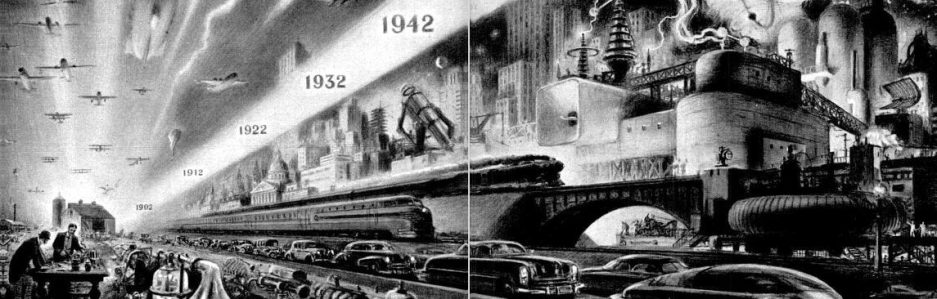
This isn’t exactly recent, but check out this older post on the 1939 World’s Fair for two video clips of General Motor’s Futurama exhibit complete with narration. The exhibit depicted the “wonder-world of 1960” as a grand, utopian vision of the future. Fascinating. “Man continually strives to replace the old with the new.”

Update: The World’s Fair videos linked above appear no longer to be available. Take a look at this Wired story from last year for the videos along with a number of color photographs from the event.

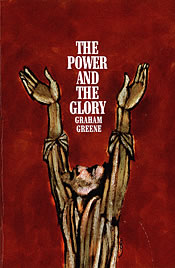
“It was impossible to hate”: Presence, Absence, and Graham Greene’s Whiskey Priest

“When you visualize a man or woman carefully, you could always begin to feel pity.”  Or so the nameless priest in Graham Greene’s 1940 novel, The Power and the Glorythought to himself as he sat in a dark, dank, crowded jail cell accosted by a self-righteous woman intent on exposing his unworthiness.

The unnamed priest, however, needed no convincing.  Earlier in the novel we read that,

He was a bad priest, he knew it:  they had a word for his kind — a whiskey priest — but every failure dropped out of his sight and out of mind:  somewhere they accumulated in secret — the rubble of his failures.  One day they would choke up, he supposed, altogether the source of grace.  Until then he carried on, with spells of fear, weariness, with a shamefaced lightness of heart.

The Power and the Glory is set in the Mexican state of Tabasco during the 1930’s when the Red Shirts, a rabidly anti-clerical paramilitary organization, came to power and brutally suppressed the Catholic Church.  Greene’s protagonist, along with Padre Jose, a priest who agreed to marry and forsake his calling in exchange for his life, are the last vestiges of the Church in the state.

Throughout the story the whiskey priest eludes a fanatical police lieutenant who is hell bent on eradicating each and every reminder of the state’s religious past.  “He wanted to destroy everything,” the narrator’s voice explains, “to be alone without any memories at all.”  While evading capture, the nameless priest reluctantly and with an ever-present sense of his worthlessness ministers the sacraments in secret.  He hears confession in the darkness before dawn, he holds a Mass with illicit wine — the Red Shirts also banned alcohol — in dingy jungle huts, and finally he forsakes the promise of safety across the state border to attend to an American convict dying of a gun shot wound that he might be absolved.

Through it all, as author Scott Turrow recently put it, “he emerges as a figure of intense humility and faith, willing to sacrifice himself to attend in secret to the devoted and utterly unaware of his own goodness.”  Not unlike Christ, who in John’s Gospel returns to Jerusalem fully aware that it will cost him his life in order to attend to the dying Lazarus, the priest returns to attend to the dying American knowing that he is to be betrayed to the police and most likely executed.  And indeed, that is the path marked out for him.

In the concluding pages of the novel, after the priest has been unceremoniously executed, an event we witness through the eyes of an English dentist with whom the story had begun, we revisit a number of the families and individuals who along the way had harbored or otherwise interacted with the nameless priest.  In each case, we discover that the priest’s presence among them had been consequential — perhaps ambiguously so, but felt and remembered nonetheless.  This was particularly evident in the case of a young boy whose family had early on sheltered the whiskey priest.  At various points in the novel we listen in as the mother reads to the boy and his sisters an account of the death of a famous Mexican martyr.  The boy had been distracted, unimpressed.  But in the end, when he learns that the shabby priest with the “funny smell” who had been in their very house was also put to death, had now also become a martyr, he has a change of heart.

It brought it home to one — to have had a hero in the house, though it had only been for twenty-four hours.  And he was the last.  There were no more priests and no more heroes.

The priest’s presence, in retrospect, had made the difference.  This appears, from one perspective, to be the central premise of the novel.  By contrast, the oppressive quality of the setting is early on described as a “huge abandonment,” and the antagonist, the hell-bent lieutenant, was marked by the experience of a “vacancy,” and absence.  The priest, tortured by his own failures — often drunk and father of an illegitimate child — cannot quite see the significance of his presence.  He is in his own eyes merely a “fool” who “loves all the wrong things.”  But it is his presence we learn that has made all the difference, that has given hope and sustained faith.

In that prison with which we began, in the darkness, the priest gives profound expression to the significance of presence.

When you visualized a man or woman carefully, you could always begin to feel pity … that was a quality God’s image carried with it … when you saw the lines at the corners of the eyes, the shape of the mouth, how the hair grew, it was impossible to hate.

Greene considered The Power and the Glory to be his best novel.  Critics including John Updike, who wrote the Introduction to the 50th Anniversary Edition, agreed.  It is frequently listed among the best novels of the 20th century.  I read The Power and the Glory while also reflecting on the theme of presence along the lines suggested by Jaron Lanier.  Lanier drew attention to what we might call our presence to ourselves, that is our full engagement in our own experience that was threatened whenever our desire to record and publish our lives through social media led us to fragment our focus and our attention, to become spectators of our own lives.

Reflecting on Greene’s novel provided yet another angle from which to think of presence.  It suggested that our presence to one another may be the most significant gift we can offer.  Alienation and loneliness are still with us.  We speak incessantly of our living in a “connected” age, and indeed it has never been easier to make and maintain connection.  But connection is not presence.   It is true that very often, especially where great distance separates us, a connection is all we can offer — it is better than nothing.  But how often do we fail to give our whole presence to one another when we are separated by feet and inches?  How often do we fail not only to give our own, but to perceive the other’s presence so that we may notice “the lines at the corners of the eyes, the shape of the mouth, how the hair grew”?

Like the unnamed whiskey priest, we may never know what difference our presence will make in the life of another.  What we do know is that our absence, whether literal or effected by our fractured inattentiveness, may in the end contribute to a “huge abandonment.”

The Internet, the Body, and Unconscious Dimensions of Thought

Thinking What We Are Doing

Part One of Three (projected).

Writing near the midpoint of the last century, Hannah Arendt worried that we were losing the ability “to think and speak about the things which nevertheless we are able to do.” The advances of science were such that representing what we knew about the world could be done only in the language of mathematics, and efforts to represent this knowledge in a publicly meaningful and accessible manner would become increasingly difficult, if not altogether impossible.  Under such circumstances speech and thought would part company and political life, premised as it is on the possibility of meaningful speech, would be undone.  Consequently, “it would be as though our brain, which constitutes the physical, material condition of our thoughts, were unable to follow what we do, so that from now on we would indeed need artificial machines to do our thinking and speaking.”

Arendt was nearly prescient.  She clearly believed this to be a dystopian scenario that would result in the enslavement of humanity, not so much to our machines, but to one narrow constituent element of our humanity – our “know-how,” that is our ability to make tools.  What Arendt did not imagine was the possibility that digitally, and thus artificially, augmented human thought might avert the very enslavement she foresaw.

On the eve of the 21st century, similar concerns were articulated by Paul Virilio who believed that our technologies, particularly the Internet, created a situation in which a total and integral accident was possible – an accident unlike anything we have heretofore experienced and one that we could not, as of yet, imagine.  Virilio termed this possibility the general accident.  Like Arendt, Virilio believed that the emerging shape of our technological society threatened the possibility of politics; and if politics failed, Virilio claimed, the general accident would be inevitable. Again, like Arendt, Virilio too seems unable to imagine that the way forward may lay through, not against technology, particularly the Internet.

If the concerns expressed by both Arendt and Virilio continue to resonate, it is because the structure of the challenge they articulated remains intact.  The pace of technological development outstrips our ability to think through its attendant social and ethical implications; moreover, the political sphere appears so captivated by the ensuing spectacle that it is ensnared by the very problems we call upon it to solve.  We are confronted, then, with a technologically induced failure of thought and politics, along the lines anticipated by Arendt and Virilio.

Gregory Ulmer is likewise concerned about the challenges presented to our thinking and our politics by technology, specifically the Internet; but Ulmer is more sanguine about the possibility of inventing new forms of thought adequate to our circumstances.  Electracy, according to Ulmer, will be to the digital age what literacy has been to the age of print: an apparatus of thought and practice directed toward the perennial question:  “why do things go wrong?”

Ulmer further elaborates the function of electracy in reference to subjectivity:

If the literate apparatus produced subjectivation in the mode of individual selves organized collectively in democratic nation-states, electracy seems to allow the possibility of a group subjectivation with a self-conscious interface between individual and collective . . .

Ulmer begins Electronic Monuments with a discussion of Paul Virilio’s general accident because, in Ulmer’s view, Virilio has “most forcefully” articulated concerns about “the Internet as the potential source of a general accident.” Unlike Virilio, however, Ulmer believes the best response to the potential of the general accident lies not in opposition to Internet, but through the possibilities created by the Internet.

In The Human Condition, Arendt set for society a very straightforward goal:  “What I propose, therefore, is very simple:  it is nothing more than to think what we are doing.” While Arendt goes on to help the reader understand “what we are doing,” the matter of thinking what we are doing remains an elusive task.

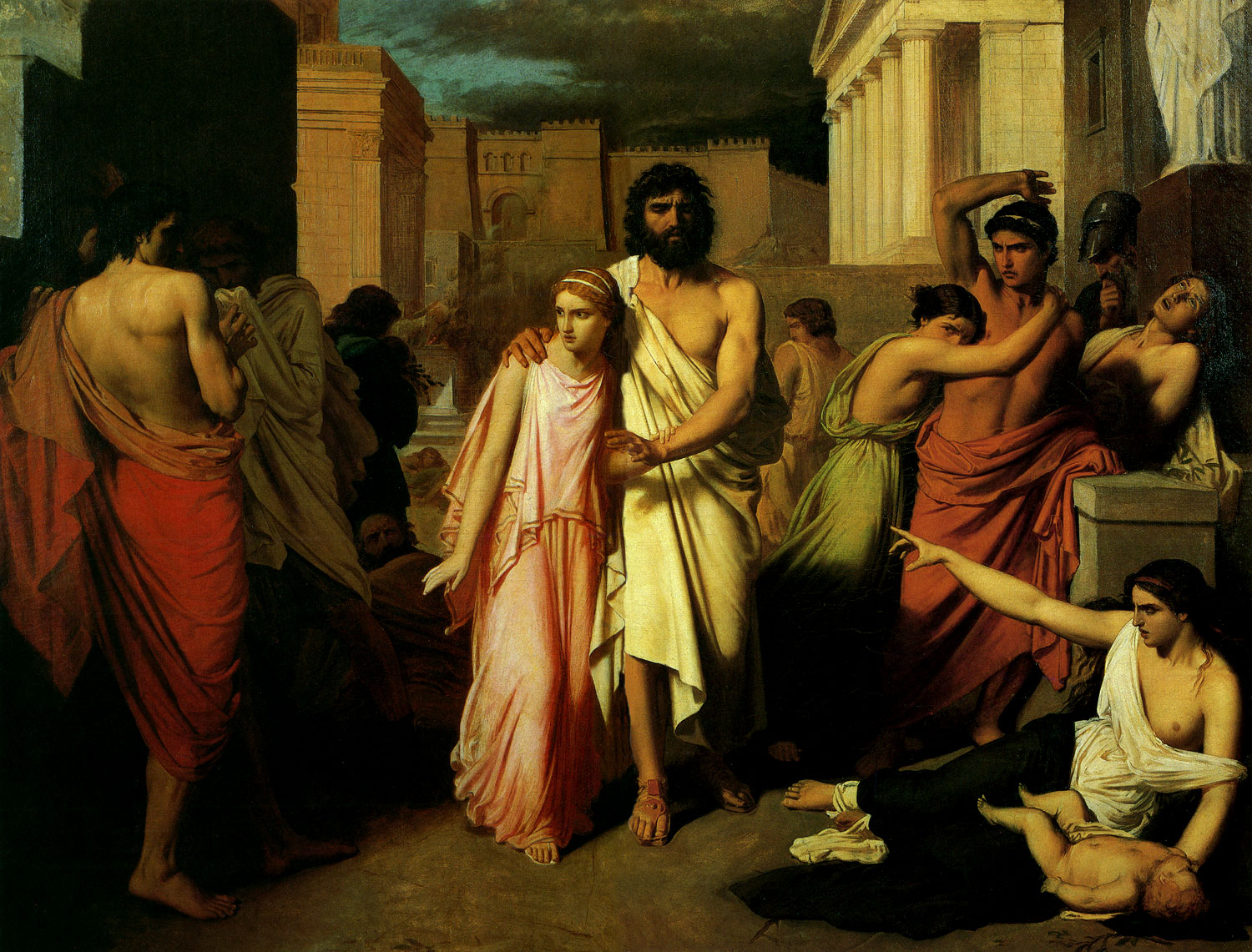
Ulmer attributes our inability to think what we are doing to the blindness that plagues us, both individually and collectively, and he draws on a combination of Greek tragedy and psychoanalysis to frame and theorize this blindness.  Reflecting on Greek tragedy, an “oral-literate hybrid” bridging oral and literate forms of problem recognition, Ulmer explains, “The aspect of tragedy of most interest in our context is (in Greek) ATH (até in lowercase), which means ‘blindness’ or ‘foolishness’ in an individual, and ‘calamity’ or ‘disaster’ in a collectivity.”

The sources of ATH, according to Ulmer, are “those circumstances already in place and into which we are thrown at birth, providing the default moods enforcing in us the institutional construction of identity.” Marshall McLuhan captures a similar point in characteristically pithy fashion when he observes that, “Environments are invisible. Their groundrules, pervasive structure and overall patterns elude easy perception.”

In the concluding chapter of Electronic Monuments, Ulmer further clarifies the concept of ATH with reference to Jacques Lacan’s exposition of Antigone:  “Lacan is interested in ATH as showing that exterior that is at the heart of me, the intersubjective nature of human identity.” Ulmer also refers to the intersubjective nature of human identity in describing the Internet as a “prosthesis of the unconscious (intersubjective) mind.” On more than one occasion, Ulmer identifies this metaphor – the Internet as prosthesis of the unconscious – as one of the key assumptions informing his development of the apparatus of electracy.

Taking Ulmer’s discussions of ATH, intersubjectivity, and the unconscious together, the following picture emerges:  For Ulmer the unconscious is not necessarily a realm of repressed trauma or libidinal desire, but rather is shorthand for the countless, unarticulated ways in which subjectivity is constructed by the social world it inhabits.  From one angle, Ulmer has given Freud, not a semiotic spin as Lacan had done, but a sociological spin.  The unconscious names the group subject – the exteriority at the heart of me.

The Internet is a prosthesis of this unconscious in the sense that it is a virtually limitless digital repository of all of the features of the social world that have imprinted themselves on the subject.  On Youtube, to take one example, a viewer can locate the toy commercial from their childhood that is still vaguely remembered, and then have links provided for a multitude of other more forgotten commercials, themes songs, and cartoons that, once seen, are remembered, and whose significance can be startling. Like T. S. Eliot’s “unknown, unremembered gate” in “Little Gidding,” the Internet operating as a prosthesis of the unconscious allows the user to “arrive where we started/And know the place for the first time.”

This collective element of group subjectivity, until it is made accessible through the practices of electracy Ulmer develops, functions as a blind spot (ATH).  It is a source of judgment and action that remains hidden from conscious thought analogously to the traditional psychoanalytic unconscious.  This blindness, therefore, presents a powerful obstacle to Arendt’s plea, that we think what we are doing.  Ulmer’s project, then, may be understood as an attempt to employ the Internet in an effort to make conscious thought aware of the way in which it has been constructed by the social.
“About suffering they were never wrong”

Musée Des Beaux Arts


About suffering they were never wrong,
The Old Masters: how well they understood
Its human position; how it takes place
While someone else is eating or opening a window or
just walking dully along;
How, when the aged are reverently, passionately waiting
For the miraculous birth, there always must be
Children who did not specially want it to happen, skating
On a pond at the edge of the wood:
They never forgot
That even the dreadful martyrdom must run its course
Anyhow in a corner, some untidy spot
Where the dogs go on with their doggy life and the
torturer’s horse
Scratches its innocent behind on a tree.

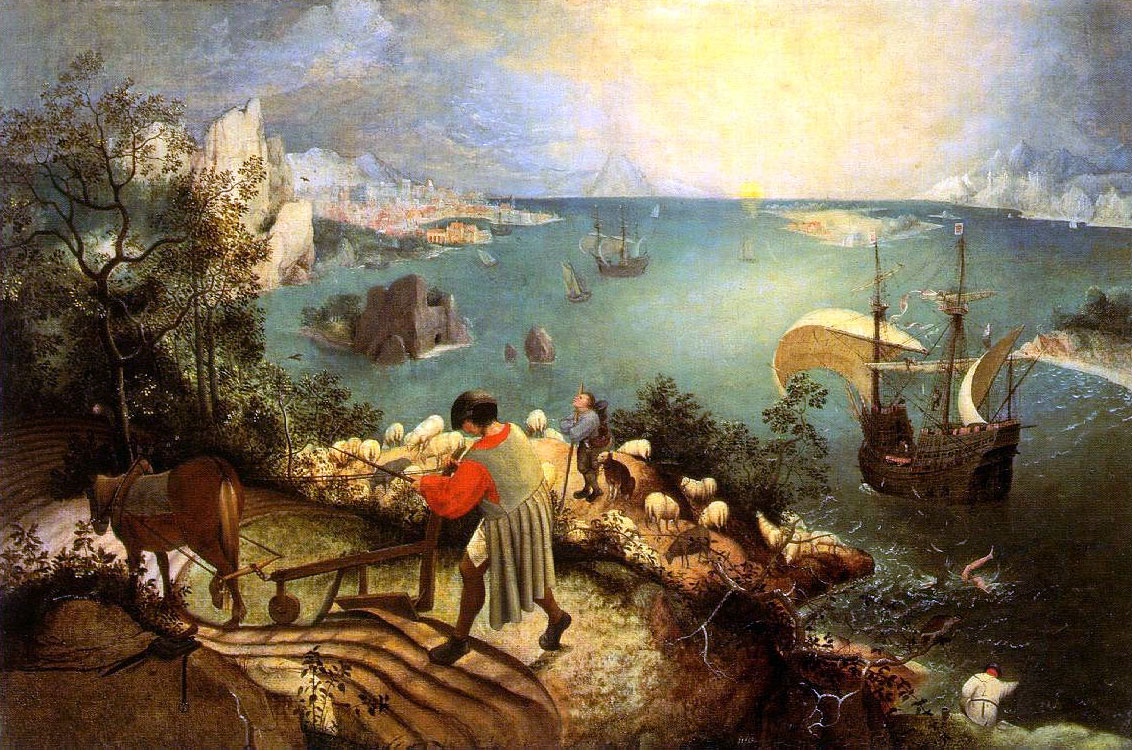
In Brueghel’s Icarus, for instance: how everything
turns away
Quite leisurely from the disaster; the ploughman may
have heard the splash, the forsaken cry,
But for him it was not an important failure; the sun shone
As it had to on the white legs disappearing into the green
Water; and the expensive delicate ship that must have seen
Something amazing, a boy falling out of the sky,
Had somewhere to get to and sailed calmly on.

— by W. H. Auden

Landscape with the Fall of Icarus, Pieter Bruegel