A few days ago, I noted, thanks to a WordPress reminder, that The Frailest Thing had turned thee. I had little idea what I was doing when I started blogging, and wasn’t even very clear on why I was doing so. I had just started my graduate program in earnest, so I was reading a good bit and, in part at least, I thought it would be useful to process the ideas I was engaging by writing about them. Because I was devoting myself to course work, I was also out of the classroom for the first time in ten years, and the teacher in me wanted to keeping teaching somehow.
So I began blogging and have kept it up these three years and counting.
Forty-six essays are gathered into eight chapters:
1. Technology Criticism
2. Technology Has a History
3. Technology and Memory
4. Technology and the Body
5. Ethics, Religion, and Technology
6. Being Online
7. Our Mediated Lives
8. Miscellany
Not surprisingly, these chapters represent fairly well the major areas of interest that have animated my writing.
Right now, the e-book is only available through Gumroad. Of course, feel free to share the link: https://gumroad.com/l/UQBM. You will receive four file formats (PDF, .epub, .mobi, .azw3). The .mobi file will work best with your Kindle. Some formatting issues are holding up availability through Amazon, but it should also be available there in the next couple of days for those who find that more convenient.
Each of the essays can be found in some form online, but I have revised many of them to correct obvious errors, improve the quality of the prose, and make them read more naturally as stand-alone pieces. Nonetheless, the substance remains freely available through this site.
Convenience and a few improvements aside, those of you who have been reading along with me for some time will not find much you haven’t seen before. You might then consider Gumroad something akin to a tip jar!
Finally, because I would not presume they would see it otherwise, I’d like to share the Acknowledgements section here:
Each of these essays first appeared in some form on The Frailest Thing, a blog that I launched in the summer of 2010. I’m not sure how long the blogging venture would have lasted were it not for the encouragement of readers along the way. I’m especially grateful for those who through their kind words, generous linking, and invitations to write for their publications have given my writing a wider audience than it would’ve had otherwise. On that score, my thanks especially to Adam Thierer, Nathan Jurgenson, Rob Horning, Emily Anne Smith, Alan Jacobs, Nick Carr, Cheri Lucas Rowlands, Matthew Lee Anderson, and Evan Selinger.
But I must also acknowledge a small cadre of friends who read and engaged with my earliest offerings when there was no other audience of which to speak. JT, Kevin, Justin, Mark, David, Randy – Cheers!
And, of course, my thanks and love to my wife, Sarah, who has patiently tolerated and supported my online scribblings these three years.
Deo Gratias
My thanks, of course, are owed to all of you who have stopped by along the way. While it may sound sappy and trite, I have to say there is still something quite humbling about the fact that when I offer up my words, which is to say something of my self, there are those who come around and take the time to read them.
There is a sense in which I’ve written for myself. The writing has helped me in my effort to understand, or, as Hannah Arendt put, “think what we are doing.” It is no small thing to me that in making that process public, some have found a thing or two of some value.
I’ve not been able to track down the source, but somewhere Marshall McLuhan wrote, “Publication is a self-invasion of privacy. The more the data banks record about each one of us, the less we exist.”
The unfolding NSA scandal has brought privacy front and center. A great deal is being written right now about the ideal of privacy, the threats facing it from government activities, and how it might best be defended. Conor Friedersdorf, for instance, worries that our government has built “all the infrastructure a tyrant would need.” At this juncture, the concerns seem to me neither exaggerated nor conspiratorial.
Interestingly, there also seems to be a current of opinion that fails to see what all the fuss is about. Part of this current stems from the idea that if you’ve got nothing to hide, there’s nothing to worry about. There’s an excerpt from Daniel J. Solove’s 2011 book on just this line of reasoning in the Chronicle of Higher Ed that is worth reading (link via Alan Jacobs).
Others are simply willing to trade privacy for security. In a short suggestive post on creative ambiguity with regards to privacy and government surveillance, Tyler Cowen concedes, “People may even be fine with that level of spying, if they think it means fewer successful terror attacks.” “But,” he immediately adds, “if they acquiesce to the previous level of spying too openly, the level of spying on them will get worse. Which they do not want.”
Maybe.
I wonder whether we are not witnessing the long foretold end of western modernity’s ideal of privacy. That sort of claim always comes off as a bit hyperbolic, but it’s not altogether misguided. If we grant that the notion of individual privacy as we’ve known it is not a naturally given value but rather a historically situated concept, then it’s worth considering both what factors gave rise to the concept and how changing sociological conditions might undermine its plausibility.
Media ecologists have been addressing these questions for quite awhile. They’ve argued that privacy, as we understand (understood?) it, emerged as a consequence of the kind of reading facilitated by print. Privacy, in their view, is the concern of a certain type of individual consciousness that arises as a by-product of the interiority fostered by reading. Print, in these accounts, is sometimes credited with an unwieldy set of effects which include the emergence of Protestantism, modern democracy, the Enlightenment, and the modern idea of the individual. That print literacy is the sole cause of these developments is almost certainly not the case; that it is implicated in each is almost certainly true.
This was the view, for example, advanced by Walter Ong in Orality and Literacy. “[W]riting makes possible increasingly articulate introspectivity,” Ong explains, “opening the psyche as never before not only to the external objective world quite distinct from itself but also to the interior self against whom the objective world is set.” Further on he wrote,
Print was also a major factor in the development of the sense of personal privacy that marks modern society. It produced books smaller and more portable than those common in a manuscript culture, setting the stage psychologically for solo reading in a quiet corner, and eventually for completely silent reading. In manuscript culture and hence in early print culture, reading had tended to be a social activity, one person reading to others in a group. As Steiner … has suggested, private reading demands a home spacious enough to provide for individual isolation and quiet.
This last point draws architecture into the discussion as Aaron Bady noted in his 2011 essay for MIT Review, “World Without Walls”:
Brandeis and Warren were concerned with the kind of privacy that could be afforded by walls: even where no actual walls protected activities from being seen or heard, the idea of walls informed the legal concept of a reasonable expectation of privacy. It still does … But contemporary threats to privacy increasingly come from a kind of information flow for which the paradigm of walls is not merely insufficient but beside the point.
This argument was also made by Marshall McLuhan who, like his student Ong, linked it to the “coming of the book.” For his part, Ong concluded “print encouraged human beings to think of their own interior conscious and unconscious resources as more and more thing-like, impersonal and religiously neutral. Print encouraged the mind to sense that its possessions were held in some sort of inert mental space.” Presumably, then, the accompanying assumption is that this thing-like inert mental space is something to be guarded and shielded from intrusion.
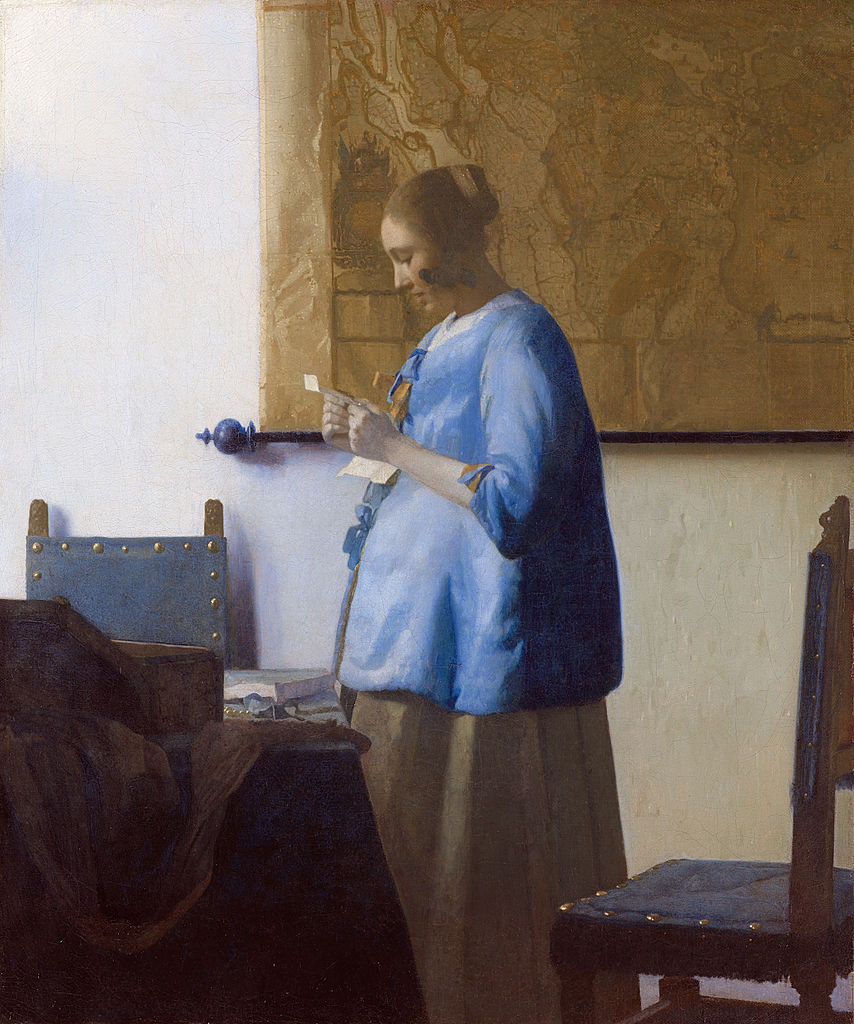
While it is a letter, not a book that she reads, Vermeer’s Woman in Blue has always seemed to me a fitting visual illustration of this media ecological perspective on the idea of privacy. The question all of this begs is obvious: What does the decline of the age of print entail for the idea of privacy? What happens when we enter what McLuhan called the “electric age” and Ong called the age of “secondary orality,” or what we might now call the “digital age”?
McLuhan and Ong seemed to think that the notion of privacy would be radically reconfigured, if not abandoned altogether. One could easily read the rise of social media as further evidence in defense of their conclusion. The public/private divide has been endlessly blurred. Sharing and disclosure is expected. So much so that those who do not acquiesce to the regime of voluntary and pervasive self-disclosure raise suspicions and may be judged sociopathic.
Perhaps, then, privacy is a habit of thought we may have fallen out of. This possibility was explored in an extreme fashion by Josh Harris, the dot-com era Internet pioneer who subjected himself, and willing others, to unblinking surveillance. The experiment in prophetic sociology was documented by director Ondi Timoner in the film We Live in Public.
The film is offered as a cautionary tale. Harris suffered an emotional and mental breakdown as a consequences of his experimental life. On the film’s website, Timoner added this about Harris’ girlfriend who had enthusiastically signed up for the project: “She just couldn’t be intimate in public. And I think that’s one of the important lessons in life; the Internet, as wonderful as it is, is not an intimate medium. It’s just not. If you want to keep something intimate and if you want to keep something sacred, you probably shouldn’t post it.”
This caught my attention because it introduced the idea of intimacy rather than, or in addition to, that of privacy. As Solove argued in the piece mentioned above, we eliminate the rich complexity of all that is gathered under the idea of privacy when we reduce it to secrecy or the ability to conceal socially marginalized behaviors. Privacy, as Timoner suggests, can also be understood as the pre-condition of intimacy, and, just to be clear, this should be understood as more than mere sexual intimacy.
The reduction of intimacy to sexuality recalls the popular mis-reading of the Fall narrative in the Hebrew Bible. The description of the Edenic paradise concludes – unexpectedly until familiarity has taught you to expect it – with the narrator’s passing observation that the primordial pair where naked and unashamed. A comment on sexual innocence, perhaps, but much more I think. It spoke to a radical and fearless transparency born of pure guilelessness. The innocence was total and so, then, was the openness and intimacy.
Of course, the point of the story is to set up the next tragic scene in which innocence is lost and the immediate instinct is to cover their nakedness. Total transparency is now experienced as total vulnerability, and this is the world in which we live. Intimacy of every kind is no longer a given. It must emerge alongside hard-earned trust, heroic acts of forgiveness, and self-sacrificing love. And perhaps with this realization we run up against the challenge of our digital self-publicity and the risks posed by perpetual surveillance. The space for a full-fledged flourishing of the human person is being both surrendered and withdrawn. The voluntarily and involuntarily public self, is a self that operates under conditions which undermine the possibility of its own well-being.
But, this is also why I believe Bady is on to something when he writes, “Privacy has a surprising resilience: always being killed, it never quite dies.” It is why I’m not convinced that we could entirely reduce all that is entailed in the notion of privacy to a function of print literacy. If something that answers to the name of privacy is a condition of our human flourishing in our decidedly un-Edenic condition, then one hopes we will not relinquish it entirely to either the imperatives of digital culture or the machinations of the state. It is, admittedly, a tempered hope.
Carl Mitcham’s“Three Ways of Being-With Technology” opens with the following claim: “In any serious discussion of issues associated with technology and humanity there readily arises a general question about the primary member in this relationship.” A bit further on, he adds:
“This is, of course, a chicken-and-egg question, one not subject to any straightforward or unqualified answer. But it is not therefore insignificant, nor is it enough to propose as some kind of synthesis that there is simply a mutual relationship between the two, that humanity and technology are always found together. Mutual relationship is not some one thing; mutual relationships take many different forms. There are, for instance, mutualities of parent and child, of husband and wife, of citizens, and so forth. Humanity and technology can be found together in more than one way. Rather than argue the primacy of one or the other factor or the cliché of mutuality in the humanity-technology relationship, I propose to outline three forms the relationship itself can take, three ways of being-with technology.”
The first thing that came to mind when I read this paragraph was the digital dualism debate. One could, for instance, substitute the human-technology pair above with the online-offline pair and retain the sense of the paragraph. Once mutuality is established, the next, more interesting move is to explore the different forms this mutual relationship takes.
As far as the human-technology relationship is concerned, the three ways of being-with technology that Mitcham outlines are ancient skepticism, Renaissance/Enlightenment optimism, and Romantic uneasiness. I suspect you might already have a pretty good idea of how Mitcham fills out those categories. (The chart below gives a decent summary.) Perhaps this being-with model could also serve to illuminate the online-offline relationship. Might it be useful, in similar fashion, to outline the forms the online-offline relationship takes?
One other thought: It seems to me that what I’ve been describing as a “Borg Complex” could be understood as a being-with relationship of the sort that Mitcham describes. The “resistance is futile,” adapt or die rhetoric is what led me to identify this rhetoric as a Borg Complex, but the symptoms I’ve compiled also suggest something more expansive than this techno-fatalist attitude. They encompass an entire posture toward the human-technology relationship — one that has certain affinities with Mitcham’s Renaissance/Enlightenment optimism, but departs from it as well.
So, looking at this chart, I’m wondering if it might not be updated with a category that accounts for the Borg Complex and then also one that accounts for what Leo Marx has called postmodern pessimism.
I’ll leave these considerations with you this afternoon. More thoughts along these lines may be forthcoming in the not-too-distant future.
I coined the term “Borg Complex” on a whim, and, though I’ve written on the concept a handful of times, nowhere have I presented a clear, straightforward description. That’s what this post provides — a quick, one-stop guide to the Borg Complex.
What is a Borg Complex?
A Borg Complex is exhibited by technologists, writers, and pundits who explicitly assert or implicitly assume that resistance to technology is futile. The name is derived from the Borg, a cybernetic alien race in the Star Trek universe that announces to their victims some variation of the following: “We will add your biological and technological distinctiveness to our own. Resistance is futile.”
For example:
“In fifty years, if not much sooner, half of the roughly 4,500 colleges and universities now operating in the United States will have ceased to exist. The technology driving this change is already at work, and nothing can stop it.” (Nathan Harden)
“It may be hard to believe, but before the end of this century, 70 percent of today’s occupations will likewise be replaced by automation. Yes, dear reader, even you will have your job taken away by machines. In other words, robot replacement is just a matter of time.” (Kevin Kelly)
“I’ve used [Google Glass] a little bit myself and – I’m making a firm prediction – in as little as three years from now I am not going to be looking out at the world with glasses that don’t have augmented information on them. It’s going to seem barbaric to not have that stuff.” (Phil Libin)
What are some other symptoms of a Borg Complex?
These symptoms may occur singly, or in combination:
1. Makes grandiose, but unsupported claims for technology
Of MOOCs: “Nothing has more potential to lift more people out of poverty — by providing them an affordable education to get a job or improve in the job they have. Nothing has more potential to unlock a billion more brains to solve the world’s biggest problems.”
2. Uses the term Luddite a-historically and as a casual slur
”But [P2P apps are] considerably less popular among city regulators, whose reactions recall Ned Ludd’s response to the automated loom.”
3. Pays lip service to, but ultimately dismisses genuine concerns
“This is going to add a huge amount of new kinds of risks. But as a species, we simply must take these risks, to continue advancing, to use all available resources to their maximum.”
4. Equates resistance or caution to reactionary nostalgia
“There’s no reason to cling to our old ways. It’s time to ask: What can science learn from Google?”
5. Starkly and matter-of-factly frames the case for assimilation
“There is a new world unfolding and everyone will have to adapt.”
6. Announces the bleak future for those who refuse to assimilate
“Technology can greatly enhance religious practice. Groups that restrict and fear it participate in their own demise.”
7. Expresses contemptuous disregard for past cultural achievements
“I don’t really give a shit if literary novels go away.”
8. Refers to historical antecedents solely to dismiss present concerns
“… the novel as we know it today is only a 200-year-old construct. And now we’re getting new forms of entertainment, new forms of popular culture.”
Is there more than one form a Borg Complex may take?
Yes. There is temperamental variation ranging from the cheery to the embittered. There is also variation regarding the envisioned future that ranges from utopian to dystopian. Finally, there are different degrees of zeal as well ranging from resignation to militancy. Basically, this means a Borg Complex may manifest itself in someone who thinks resistance is futile and is pissed about it, indifferently resigned to it, evangelistically thrilled by it, or some other combination of these options. So as an example, take some one like Kevin Kelly. He is cheery, utopian, and not particularly militant about it. This is, I suppose, a best case scenario.
What causes a Borg Complex?
Causes, of course, is not the right word here; but we can point to certain sources. A Borg Complex may stem from a philosophical commitment to technological determinism, the idea that technology drives history. This philosophical commitment to technological determinism may also at times be mingled with a quasi-religious faith in the envisioned techno-upotian future. The quasi-religious form of the Borg Complex can be particularly pernicious since it understands resistance to be heretical and immoral. A Borg Complex may also stem from something more banal: self-interest, usually of the commercial variety. Apathy may also lead to a Borg Complex, as may a supposedly hard-nosed, commonsense pragmatism.
Aren’t Borg Complex claims usually right?
A Borg Complex diagnosis does not necessarily invalidate the claims being made; it is primarily the identification a rhetorical stance and the uses to which it is put. That said, examining Borg Complex rhetoric leads naturally to the question of technological determinism. It’s worth noting that historians of technology have posed serious challenges to the notion of technological determinism. Historical contingencies abound and there are always choices to be made. The appearance of inevitability is a trick played by our tendency to make a neat story out of the past. Even if some Borg Complex claims prove true, it is worth asking why and whether Borg Complex assumption did not act as self-fulfilling prophecies.
What does it matter?
Marshall McLuhan once said, “There is absolutely no inevitability as long as there is a willingness to contemplate what is happening.” The handwaving rhetoric that I’ve called a Borg Complex is resolutely opposed to just such contemplation when it comes to technology and its consequences. We need more thinking, not less, and Borg Complex rhetoric is typically deployed to stop rather than advance discussion. What’s more, Borg Comlex rhetoric also amounts to a refusal of responsibility. We cannot, after all, be held responsible for what is inevitable. Naming and identifying Borg Complex rhetoric matters only insofar as it promotes careful thinking and responsible action.
In June of last year, I read an article which strongly urged religious institutions to adapt to new communication technologies. Adapt or die, the author seemed to say; or, better yet, resistance is futile. This is when it occurred to me that there was an identifiable rhetoric that could be usefully labeled a “Borg Complex.” Labels have their limits, of course, but when you have a name for something it becomes easier to identify and analyze.
I’m persuaded of the usefulness of this particular label because, at the very least, it draws attention to rhetoric that shuts down debate and discussion about technology. In it’s worst forms this rhetoric is disingenuous and coercive. Even when it is not deployed maliciously, it oversimplifies genuine complexity and prevents us from imagining the full range of possibilities with regards to our use of technology.
The label also raises some interesting historical, philosophical, and ethical questions about technology. How far back can we find this kind of rhetoric? To what ends is this rhetoric put? Apart from rhetorical considerations, what do we make of the technological determinism implied? What does the history of technology tells us about the claims of inevitability? What sorts of options and choices are genuinely available when a technology appears?
In order to continue thinking through these questions and to draw attention to this rhetoric, I’ve started a Tumblr blog cataloging instances of the Borg Complex and related material. You can check it out here: The Borg Complex. And, naturally, I’m soliciting your help. If you come across cases of the Borg Complex, past or present, I invite you to send those in. Contact information is listed in the About This Blog page.




 L.M. Sacasas