Strangers to Ourselves

For reasons that I probably do not myself fully understand, I am endlessly intrigued by discussions of the ever elusive state of being we call authenticity. At least part of the intrigue lies in how a discussion of authenticity can ensnare within itself philosophical, sociological, technological, and even religious considerations. It makes for lively and stimulating discussion in other words. Authenticity talk is intriguing as well because it may be under its guise that the ancient debate about what constitutes a good life and the venerable quest to “know thyself” survive today.

Both of these considerations also suggest a serious difficulty presented by authenticity talk: the word authenticity, as it is commonly used, masks a complex and diverse set of concepts. This complexity and diversity threatens to introduce a slippery equivocation into what might otherwise be well-intended conversations and debates. At least this has been my experience. But then again, discussing what exactly authenticity is is part of what makes such discussions lively and interesting.

My own thinking about authenticity is sporadic and owes more to serendipity than to any conscientious scholarly endeavor. For example, most recently, from no particular quarter, the following question formulated itself in my mind: What is the problem to which authenticity is the answer?

There is nothing particularly insightful about this question, but it did get me thinking about the whole set of ideas from a different angle. The meandering mental path that subsequently unfolded led me to identify this problem as some sort of psychic rupture or dissonance. We don’t think  of authenticity at all unless we think of it as a problem, and it presents itself as a problem at the very time it enters our conscious awareness. It is a problem tied to our awareness of ourselves as selves.

There are many interesting paths that unfold from that point, but I want to offer this one subsequent stab at defining what we (sometimes) mean by authenticity: Authenticity is a seamless continuity between the self, time, and place. It is a sense of complete at-homeness in the world. For this reason, then, we might see nostalgia as another manifestation of the problem of authenticity. Nostalgia — first in its literal sense as longing for spatial home, and then its more contemporary form as longing for a home in time — is a symptom of the rupture in the continuity between self, time, and place that generates an awareness of the self as a problem to be solved, an awareness that constitutes the problem of authenticity.

Framing the discussion as matter of at-homeness (or a lack thereof) recalled to my mind the work of the medical doctor turned novelist cum philosopher, Walker Percy. Percy went from being a diagnostician of physical maladies to one of existential maladies. With his acute Pascalian eye, Percy made a literary career of diagnosing the modern self’s inability to understand itself. This was the theme of his send-off of the self-help genre, Lost in the Cosmos: The Last Self-Help Book.

Percy chose the following passage from Nietzsche as an epigraph for Lost in the Cosmos:

“We are unknown, we knowers, to ourselves … Of necessity we remain strangers to ourselves, we understand ourselves not, in our selves we are bound to be mistaken, for each of us holds good to all eternity the motto, ‘Each is the farthest away from himself’—as far as ourselves are concerned we are not knowers.”

A little further on, in his inventory of possible “selfs” (or should that be “sevles”), Percy offered this description of the lost self:

“With the passing of the cosmological myths and the fading of Christianity as a guarantor of the identity of the self, the self becomes dislocated, … is both cut loose and imprisoned by its own freedom, yet imprisoned by a curious and paradoxical bondage like a Chinese handcuff, so that the very attempts to free itself, e.g., by ever more refined techniques for the pursuit of happiness, only tighten the bondage and distance the self ever farther from the very world it wishes to inhabit as its homeland …. Every advance in an objective understanding of the Cosmos and in its technological control further distances the self from the Cosmos precisely in the degree of the advance—so that in the end the self becomes a space-bound ghost which roams the very Cosmos it understands perfectly.”

Percy was writing in 1983. Centuries earlier, St. Augustine wrote, “I have been made a question to myself.” The problem of authenticity is much older than we sometimes realize. Perhaps we might say that it is a perpetually possible problem that is more or less actualized given certain historical or psychological conditions. Perhaps the problem of authenticity is not a problem at all, but as C.S. Lewis once wrote of nostalgia, the “truest index of our real situation.”
Conjuring Ghosts: Digital Technology and the Past

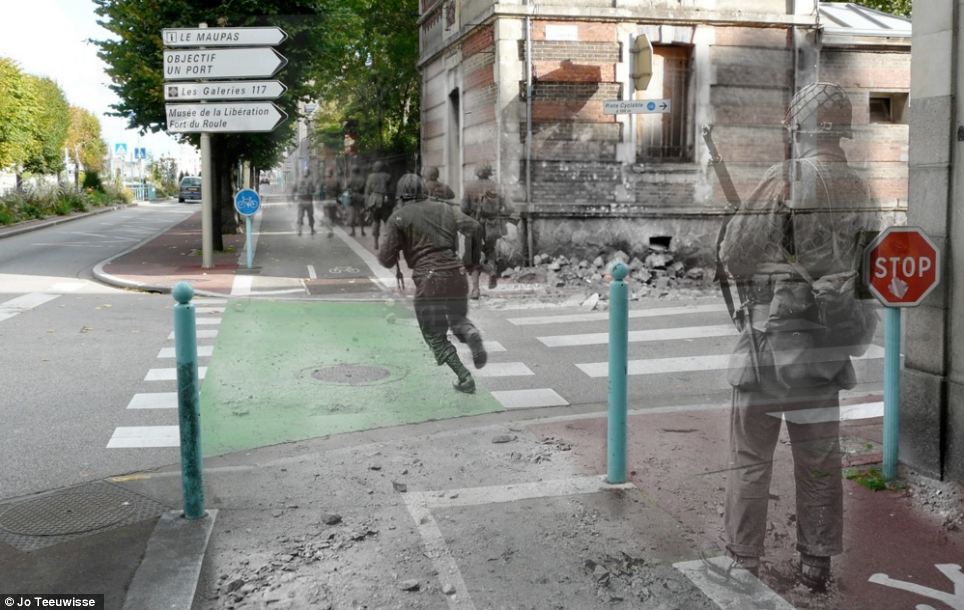
Late last month, I ran across a set of images created by Jo Teeuwisse superimposing scenes from World War II over images of those same places today. The effect has been universally described as haunting, and rightly so. The images also present a rather interesting form of augmented reality. If you’ve hung around this blog for awhile, you may have noticed that memory and place are two recurring themes. Naturally, these images caught my attention. Unfortunately, time constraints being what they are, I never did get around to writing about them.

Fortunately, Miranda Ward has. At Cyborgology, she has written a characteristically intelligent and well-crafted meditation on the images, “On Technology, Memory and Place.” She concludes on this note:

“So technology can do much to harness the power of place – to make memory increasingly social, to represent “the shared experience of bodies co-located in space” – and I think it should: I think this is part of the joy of it. But perhaps we also need to think about preserving the utterly private relationship with place – and what this preservation will look like in a “geo-optimized” world.”

Click through and read the whole.

While reading Ward’s piece, and since first seeing these images, a few related items came to mind.

Back in February, Jason Farman wrote a piece in The Atlantic that reflected on how mobile technology altered our experience of places. Farman discussed one app by the Museum of London that allowed users to see images from London’s past superimposed over the present scene in much the same manner as Teeuwisse’s photographs. Farman was optimistic about what mobile devices can do for our experience of places:

“While none of these practices may seem unique to our digital age – stories have been attached to place throughout history – the ability to connect innumerable narratives to a single site is something that other media haven’t been able to effectively accomplish.”

At the time, I wrote a post in response which leaned a good deal on Michel de Certeau’s reflections on walking the city (it’s a passage I’ve come back to again and again). De Certeau’s writing on this theme is especially pertinent to the photographs that inspired Ward’s essay. In fact, these photographs and the Museum of London app discussed by Farman might be seen as tools to materialize the invisible realities evocatively identified by de Certeau.

Here’s how I then summarized de Certeau on haunted places:

Places have a way of absorbing and bearing memories that they then relinquish, bidden or unbidden. The context of walking and moving about spaces leads de Certeau to describe memory as “a sort of anti-museum:  it is not localizable.”  Where museums gather pieces and artifacts in one location, our memories have dispersed themselves across the landscape, they colonize.  Here a memory by that tree, there a  memory in that house.  De Certeau develops a notion of a veiled remembered reality that lies beneath the visible experience of space.

Places are made up of “moving layers.”  We point, de Certeau says, here and there and say things like, “Here, there used to be a bakery” or “That’s where old lady Dupuis used to live.”  We point to a present place only to evoke an absent reality:  “the places people live in are like the presences of diverse absences.”  Only part of what we point to is there physically; but we’re pointing as well to the invisible, to what can’t be seen by anyone else, which begins to hint at a certain loneliness that attends to memory.

Reality is already augmented.  It is freighted with our memories, it comes alive with distant echoes and fleeting images.

Digitally augmented reality functions analogously to what we might call the mentally augmented reality  that de Certeau invokes. Digital augmentation also reminds us that places are haunted by memories of what happened there, sometimes to very few, but often to countless many. The digital tools Farman describes bring to light the hauntedness of places. They unveil the ghosts that linger by this place and that.

This remains, as evidenced in Ward’s post, a very useful metaphor by which to think about technologies that allow us to conjure the ghosts of the past. As to the question that Ward comes back to on more than one occasion — So what? — I’m not entirely sure. In response to Farman’s essay, I offered up this alternative de Certeau-ian perspective:

Perhaps I am guilty, as Farman puts it, of “fetishizing certain ways of gaining depth.” But I am taken by  de Certeau’s conception of walking as a kind of enunciation that artfully actualizes a multitude of possibilities in much the same way that the act of speaking actualizes the countless possibilities latent in language. Like speaking, then, walking, that is inhabiting a space is a language with its own rhetoric. Like rhetoric proper, the art of being in a place depends upon an acute attentiveness to opportunities offered by the space and a deft, improvised actualization of those possibilities. It is this art of being in a place that constitutes a meaningful and memorable augmentation of reality.

What strikes me now about this conclusion is that it distinguished between an embodied interaction with a place and a strictly mental/visual interaction. These need not be mutually exclusive, of course. But perhaps it is worth noting that by there nature, apps and photographs that bring the past into the present forefront the visual, and the visual is only one way of knowing a place.

While I have been writing this, I have had next to this tab another with the text of W.H. Auden’s “Musée Des Beaux Arts.” This has been coincidental, but now it strikes me as serendipitous. The poem  goes like this:

About suffering they were never wrong,
The Old Masters: how well they understood
Its human position; how it takes place
While someone else is eating or opening a window or
just walking dully along;
How, when the aged are reverently, passionately waiting
For the miraculous birth, there always must be
Children who did not specially want it to happen, skating
On a pond at the edge of the wood:
They never forgot
That even the dreadful martyrdom must run its course
Anyhow in a corner, some untidy spot
Where the dogs go on with their doggy life and the
torturer’s horse
Scratches its innocent behind on a tree.

In Brueghel’s Icarus, for instance: how everything
turns away
Quite leisurely from the disaster; the ploughman may
have heard the splash, the forsaken cry,
But for him it was not an important failure; the sun shone
As it had to on the white legs disappearing into the green
Water; and the expensive delicate ship that must have seen
Something amazing, a boy falling out of the sky,
Had somewhere to get to and sailed calmly on.

With this poem, Auden reflected (via Bruegel’s painting, “Landscape with the Fall of Icarus”) on how suffering often unfolded unnoticed, unremarked upon, and, we might now add, unremembered. The photographs with which we began have the effect of inverting this dynamic. Now we, the living, take note. We can see what then may have passed while someone was dully walking along. It is now we who are the unnoticed ones. The past is there present before our eyes and we can see it, but it is silent with respect to us. It now walks dully on as we make our way, looking, perhaps, to anchor our ephemeral present in its weightiness. But alas they are just ghosts, and the anchor does not hold.

“A World Full of People Just Livin’ To Be Heard”

I don’t ordinarily take my cues from John Mellencamp lyrics, but … consider:

“A million young poets
Screamin’ out their words
To a world full of people
Just livin’ to be heard”

The story of modernity could be neatly arranged around the theme of voice. As modernity unfolded, more and more people found a way to be heard; they found their voice, often at great cost and sacrifice. Protestantism gave a voice to the laity. Democratic movements gave a voice to the citizen. Labor movements gave a voice to the worker. The woman’s movement gave a voice to women. Further examples come readily to mind, but you get the point. And along the way certain technologies played a critical role in this expansion and proliferation of voice. One need only consider print’s relationship to the Reformation and the Enlightenment.

Of course, this way of telling the story will strike some as rather whiggish, and perhaps rightly so. It is simplistic, certainly. And yet it does seem plain enough that more people, and a greater diversity of people, now have not only the freedom to speak, but the means to do so as well.

Much of the rhetoric that surrounded the advent of the World Wide Web, particularly in its 2.0 iteration, triumphantly characterized the Internet as the consummation of this trajectory of empowerment. It was wildly utopian rhetoric; and although the utopian hope has not yet been realized, it is nonetheless true that blogs and social media have at least made it possible for a very great number of people to speak publicly, and sometimes with great (if ephemeral) consequence.

More significantly, it seems to me, the use of social media nurtures the impulse to speak. The platforms by their very design encourage users to speak often and continually. They feature mechanisms of response that act not unlike little Pavlovian pellets of affirmation to keep us speaking in the hopes that Likes and retweets and comments will follow.

We are all learning to “speak in memes,” as Nathan Jurgenson has recently put it. What is most significant about this may be the assumption that we will speak. We are conditioning our speech to fit the medium, but that we will speak is no longer in question.

Fine. Well and good. Speak, and speak truthfully and boldly — at least interestingly.

But what about hearing and listening? While we have been vigorously enlarging our voices, we appear to have neglected the art of listening. We want to be heard, of course, but are we as intent on listening? Do we desire to understand as ardently as we desire to be understood?

There is an art to listening, one might even say that it is a kind of virtue. At the very least it requires certain virtues. Patience certainly, and humility as well. One might even say courage, for what you learn when you listen may very well threaten beliefs and convictions that are very dear and defining. In any case, listening is not easy or even natural. It is a discipline. It must be cultivated with great care and it requires, to some degree, a willingness to still the impulse to speak.

It requires as well a wanton disregard for the pace of Internet time. Internet time demands near instantaneous responses; but listening sometimes takes more time than that afforded by the meme cycle.

Often listening depends on silence and deep, unbroken attentiveness.

Listening, honest listening happens when there is tacit permission to be silent in response. Otherwise, listening is overwhelmed by the pressure to formulate a response. And, of course, if, while I am ostensibly listening, I am only thinking about what to say in response, I’m probably not really listening — more like reloading.

“We’re living to be heard” — I suspect there is something rather profound about that observation. Perhaps Mellencamp spoke better than he knew. It seems to me though, that those who would be heard ought also to hear. We have our voices, but only if we learn to listen in equal measure will this ever mean a thing.

The Path A Decent Person Inevitably Takes

Identity and authenticity have been recent topics of discussion here, and they probably will be again. I am especially interested in technology’s role in shaping our identity and rendering authenticity elusive. I don’t think these are insignificant concerns, but today I was reminded that theoretical explorations of identity and authenticity are something of a luxury afforded those who enjoy relative peace and affluence.

I came by this reminder as I read Elisabeth Sifton and Fritz Stern’s moving essay in The New York Review of Books on the life and death of Dietrich Bonhoeffer and Hans von Dohnanyi. Their story is summed up in the opening paragraphs:

“We are concerned here with two exceptional men who from the start of the Third Reich opposed the Nazi outrages: the scarcely known lawyer Hans von Dohnanyi and his brother-in-law, the well-known pastor Dietrich Bonhoeffer. Dohnanyi recorded Nazi crimes, helped victims, did his best to sabotage Nazi policies, and eventually helped plot Hitler’s removal; Bonhoeffer fought the Nazis’ efforts to control the German Protestant churches. For both men the regime’s treatment of Jews was of singular importance. Holocaust literature is vast and the literature on German resistance scant, yet the lives and deaths of the two men show us important links between them.

Dohnanyi and Bonhoeffer became close friends, especially after Dohnanyi drew his brother-in-law into active resistance against the regime. And their remarkable family deserves recognition, too, since its principled support was indispensable to their efforts. But Dohnanyi and Bonhoeffer ended in defeat: they were arrested in April 1943 and then murdered, on Hitler’s express orders, just weeks before Hitler’s suicide and Germany’s surrender.”

I encourage you read the whole thing. I trust you will find it a needed antidote to the scourge of cynicism, irony, and despair that often seems to plague us. It reminded me that even where darkness threatens to snuff out hope and goodness, not all lights flicker and fade. It also brought to mind something C. S. Lewis wrote that has stuck with me ever since I first read it years ago:

“In King Lear (III:vii) there is a man who is such a minor character that Shakespeare has not given him even a name: he is merely “First Servant.” All the characters around him-Regan, Cornwall, and Edmund-have fine long-term plans. They think they know how the story is going to end, and they are quite wrong. The servant has no such delusions. He has no notion how the play is going to go. But he understands the present scene. He sees an abomination (the blinding of old Gloucester) taking place. He will not stand it. His sword is out and pointed at his master’s breast in a moment: then Regan stabs him dead from behind. That is his whole part: eight lines all told. But if it were real life and not a play, that is the part it would be best to have acted.”

When the Nazi’s came to power, Bonhoeffer was encouraged to leave Germany and he came to America for a time. But while safe and comfortable in New York, he was not at peace:

“I must live through this difficult period of our national history with the Christian people of Germany…. Christians in Germany are going to face the terrible alternative of either willing the defeat of their nation in order that Christian civilization may survive, or willing the victory of their nation and thereby destroying our civilization. I know which of these alternatives I must choose.”

You need not share Bonhoeffer’s faith to recognize the measure of courage that was involved in such a choice. And, it seems to me, that whatever we come to think of identity and authenticity, it must reckon with such a choice.

Elisabeth Sifton and Fritz Stern concluded:

“One truth we can affirm: Hitler had no greater, more courageous, and more admirable enemies than Hans von Dohnanyi and Dietrich Bonhoeffer. Both men and those closest to them deserve to be remembered and honored. Dohnanyi summed up their work and spirit with apt simplicity when he said that they were ‘on the path that a decent person inevitably takes.’ So few traveled that path—anywhere.”

“The path that a decent person inevitably takes” — may we all strive for such decency.

Psychological Warfare Via Text Message

Psychological warfare has been around for a long time. Alexander the Great reportedly ordered his armorers to fashion breastplates that would fit men eight to ten feet tall. He then left these behind where opposing forces would stumble upon them and be led to believe they were facing an army of giants.

During the age of print, leaflets were a favorite means of psychological warfare. During the Franco-Prussian War, they were dropped by French balloons over Prussian soldiers with the following message:

“Paris defies the enemy. The whole of France rallies. Death to the invaders. Foolish people, shall we always throttle one another for the pleasure and proudness of Kings? Glory and conquest are crimes; defeat brings hate and desire for vengeance. Only one war is just and holy; that of independence.”

More recently, during World War I, over 50 million leaflets were dropped by the Allies urging the Germans to surrender. Leaflets were also dropped by the millions during World War II. The text of one of these leaflets read as follows:

“We, the Allied heavy bombers, do not cause you any immediate harm.We leave that to the strafing machineguns of our fighters.  We fly into Germany 30,000 feet above your head.  Your foxholes are not our targets.We aim for the factories which produce your ammunition, the railroads which carry your supplies, and the bridges which connect you with your home…We force you to fight with your back against a paralyzed Rhineland.Think of the destruction, every time we four-engined bombers come over.And we will be back soon.  You’ll be hearing from us.”

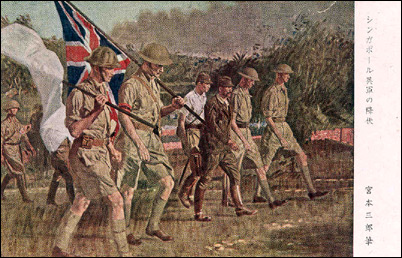
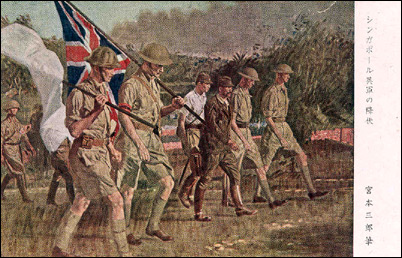
The Japanese also used leaflets to similar effect. The image below is of a Japanese leaflet dropped over British forces in Malaysia.

The text accompanying the image read:

“The fall of Singapore – The East Asian fortress under the intrusion of the British for more than a century – fell on Showa 15th year, the 2nd month, on the 17th day at 6:40 p.m. In a single file, bearing white flags, the British officers of the Malayan Command approached our mighty army to surrender. From the right: Commanding Officer Malaya, Lieutenant General Percival; Chief of the General Staff, Brigadier General Torrance; Staff officer, Colonel Sugita; Interpreter, Ling-zhuan; Chief Administrator of the British High Command, Malaya, Major General Newbiggen, who is holding the Union Jack; and Captain Wylde who serves as interpreter.”

Similar leaflets continue to be in use.

Aircraft equipped with loud speakers have also been used in the service of psychological warfare. During the course of their Indochinese wars, French planes broadcast the following to the Vietminh:

“Compatriots! You have planted a tree! The time has come for you to pick the fruit. V.M. wants to take this fruit away from you.”

“V.M. Soldiers! Today the Air Force, tomorrow, the tanks!”

“Working people, today the Air Force, tomorrow the guns, the machine-guns, the mortars and the mines. Leave your jobs and go back home!”

Radio, likewise, has been used to similar effect. During World War II, Mildred Gillars, also known as “Axis Sally” among the troops, broadcast radio programs intended to demoralize American soldiers. “Home Sweet Home Hour,” for example, was designed to instill homesickness among American soldiers.

To this history, the regime of Syrian President Bashar Assad now adds a new entry: the text message. Targeting Syrian rebels, the regime sent a mass text message to cell phones throughout the country with the message: “Game over.”

They appear to have embraced the limits of the medium and perhaps something of the video game ethos as well. Sadly, for the thousands who have lost their lives and the thousands more who have been displaced, the Syrian uprising has hardly been a game.