“Concerning social memory in particular, we may note that images of the past commonly legitimate a present social order. It is an implicit rule that participants in any social order must presuppose a shared memory. To the extent that their memories of a society’s past diverge, to that extent its members can share neither experiences nor assumptions. The effect is seen perhaps most obviously when communication across generations is impeded by different sets of memories. Across generations, different sets of memories, frequently in the shape of implicit background narratives, will encounter each other; so that, although physically present to one another in a particular setting, the different generations may remain mentally and emotionally insulated, the memories of one generation locked irretrievably, as it were, in the brains and bodies of that generation …
… images of the past and recollected knowledge of the past … are conveyed and sustained by (more or less ritual) performances …
I believe, furthermore, that the solution to the question posed above — how is the memory of groups conveyed and sustained? — involves bring these two things (recollection and bodies) together …
If there is such a thing as social memory … we are likely to find it in commemorative ceremonies; but commemorative ceremonies prove to be commemorative only in so far as they are performative; performativity cannot be thought without a concept of habit; and habit cannot be thought without a notion of bodily automatisms.”
Connerton’s observations, further developed throughout the rest of the book, raise interesting questions about the kind of social order that the personalization and digitization of memory yields. If Connerton is correct in his claim that a social order rests upon shared memory and that this memory is fundamentally embodied in a quasi-liturgical mode, what becomes of the social order when the memories we most obviously sustain are strictly personal and digitized?
As Connerton also notes in his introduction, this is not merely a technical question, it is also a political question. If social order hinges on social memory, then, to paraphrase Alasdair MacIntyre, it is worth asking, “Whose memory, which order?”
In 1903, E. M. Forster imagined the future. Teleconferencing, instant global communication, and televisions all make an appearance. Forster envisioned a networked world in which every person lived physically isolated from, yet at the same time, mechanically connected to every other person. Humanity had driven itself under ground and each person lived in a habitation like the one Forster describes at the start of his story, The Machine Stops:
Imagine, if you can, a small room, hexagonal in shape, like the cell of a bee. It is lighted neither by window nor by lamp, yet it is filled with a soft radiance. There are no apertures for ventilation, yet the air is fresh. There are no musical instruments, and yet, at the moment that my meditation opens, this room is throbbing with melodious sounds. An armchair is in the centre, by its side a reading-desk-that is all the furniture. And in the armchair there sits a swaddled lump of flesh-a woman, about five feet high, with a face as white as a fungus. It is to her that the little room belongs.
The action begins when the woman is contacted by her son who lives on the other side of the globe. His call is taken as a great inconvenience because it requires the mother to silence the music, dim the lights, and disconnect from the flow of networked communication. The constant wall of sound and sight is the norm, and the woman must press the “isolation knob” in order to speak exclusively with one person. We discover that this person to person communication takes place with the help of a device which projects a holographic image of the other person. The son, we learn, wants to see the mother face to face, and in the following exchange we begin to recognize the nature of the third main character in the story, The Machine:
“I want to see you not through the Machine,” said Kuno. “I want to speak to you not through the wearisome Machine.”
“Oh, hush!” said his mother, vaguely shocked. “You mustn”t say anything against the Machine.”
“Why not?”
“One mustn”t.”
“You talk as if a god had made the Machine,” cried the other. “I believe that you pray to it when you are unhappy. Men made it, do not forget that. Great men, but men. The Machine is much, but it is not everything. I see something like you in this plate, but I do not see you. I hear something like you through this telephone, but I do not hear you.”
In the world Forster has created ideas rule; physicality is taken as a great encumbrance. Explaining why she would rather not travel to see her son, the mother whose name we learn is Vashti, explains, “I dislike seeing the horrible brown earth, and the sea, and the stars when it is dark. I get no ideas in an air- ship.” And it is the ideas that everyone is after.
Each day they awake, they are bathed automatically, they are fed artificial food, and they tap into the network in search of ideas. They gather virtually for “lectures” to hear about ideas; Vashti herself delivers lectures on the history of music. When the artificial day is done, a bed emerges so that they may sleep and do it all over again tomorrow. People rarely emerge from their cocoons where everything is brought to them and from which they may communicate with everyone else. The “clumsy system of public gatherings had been long since abandoned” and while an earlier age made machines to take people to things, this age had learned the real purpose of machines was to bring things to people. They were “funny old days, when men went for change of air instead of changing the air in their rooms!”
Finally unable to convince Vashti to make the journey, the son disconnects, Vashti re-enters the flow of networked communication, and “all the accumulations of the last three minutes burst upon her.” Time goes on and Vashti carries on, delivering lectures and searching for ideas, all from her armchair. Meanwhile the “Machine hummed eternally,” yet no one noticed the noise for they had heard it from birth. Vashti, finally moved by a tempered maternal compassion, decides that she must go to see her son. It would not be hard since a system of airships still ran across the globe. Few ever used it, however, “for, thanks to the advance of science, the earth was exactly alike all over … What was the good of going to Peking when it was just like Shrewsbury?”
Travel in the airships exposed people to more physical stimulation than they were used to and it was taken as a great annoyance. The glimmer of light from the sun or the stars, the sight of others, god forbid the touch of others, and the smell – it was all nearly unbearable. Vashti regretted her decision, but pressed on. As she glides over the earth the narrator informs us that “all the old literature, with its praise of Nature, and its fear of Nature, rang false as the prattle of a child.”
As the story unfolds we come to understand that the Machine and the book that explains how to use the Machine to satisfy every need are treated with nearly religious veneration even though religion had long since been exposed as a superstition. Occasionally, the characters in the story break into liturgical exchanges:
How we have advanced, thanks to the Machine!”
“How we have advanced, thanks to the Machine!” said Vashti.
“How we have advanced, thanks to the Machine!” echoed the passenger …
Passing over one place and then another, Vashti sighs, “No ideas here.” Later she looks again, “They were crossing a golden sea, in which lay many small islands and one peninsula. She repeated, ‘No ideas here,’ and hid Greece behind a metal blind.”
When Vashti finally arrives at her son’s room, he informs her that he had been to the surface. Strictly speaking this was not forbidden and one could request a respirator with which to travel momentarily to the outside world whose air was taken to be unbreathable. The son, however, had found his own way out through an old ventilation shaft, and because of his impudence he was now being threatened with homelessness. Homelessness, we later learn, was akin to a death sentence imposed by exposure and abandonment on the earth’s surface.
The story goes on to its stirring climax, which the title already suggests, but I will not give away anymore of the plot here. Take an hour or so and read the whole thing for yourself. It is thought provoking and entertaining in equal measure. Like most dystopian visions of the future, it is exaggerated. And like Orwell’s 1984, the evil lies in a centralized, authoritarian power represented by the Machine and its Committee. But in a Huxleyean mode, it is a power that humanity has acquiesced to in its pursuit of comfort and its flight from material reality.
The body is the victim in Forster’s tale. The body has been starved while the mind has been indulged. The senses have atrophied in a world of ideas, or we might say, of Information. Even sex is uninteresting, having been reduced to merely a proscribed and mechanical act for the sake of propagating the race. At one point the narrator informs us that, “by these days it was a demerit to be muscular.” In one of the more striking exchanges in the story, the son tells of his first experience with genuine physical activity:
You know that we have lost the sense of space. We say “space is annihilated”, but we have annihilated not space, but the sense thereof. We have lost a part of ourselves. I determined to recover it, and I began by walking up and down the platform of the railway outside my room. Up and down, until I was tired, and so did recapture the meaning of “Near” and “Far”. “Near” is a place to which I can get quickly on my feet, not a place to which the train or the air-ship will take me quickly. “Far” is a place to which I cannot get quickly on my feet; the vomitory is “far”, though I could be there in thirty-eight seconds by summoning the train. Man is the measure. That was my first lesson. Man’s feet are the measure for distance, his hands are the measure for ownership, his body is the measure for all that is lovable and desirable and strong.
This is a remarkable passage for the way that it insists that our embodied experience is an essential component of our apprehension of reality. It anticipates the later philosophical work of Maurice Merleau-Ponty and the even later cognitive science that has revealed the degree to which our thinking and experience of reality depends on our embodied interactions with the world and with others. Forster’s imagined world, however, was a Cartesian paradise. Ideas and abstractions reigned. The further removed from experience and the more abstract an idea could become, the better:
Those who still wanted to know what the earth was like had after all only to listen to some gramophone, or to look into some cinematophote. And even the lecturers acquiesced when they found that a lecture on the sea was none the less stimulating when compiled out of other lectures that had already been delivered on the same subject. “Beware of first- hand ideas!” exclaimed one of the most advanced of them.
Contemporary readers, as you may have already guessed, tend to read the Machine as a prescient allegory of the Internet. It is not a perfect allegory for, among other reasons, Forster’s network is not quite wireless, but it is remarkably suggestive nonetheless. Most striking perhaps is the degree of dependence upon the network of telecommunications exhibited by all of the characters except the son, as well as the ubiquity of the Machine’s stimulation represented by the constant, unnoticed hum. As he approaches the surface, the son explains,
The light helped me for a little, and then came darkness and, worse still, silence which pierced my ears like a sword. The Machine hums! Did you know that? Its hum penetrates our blood, and may even guide our thoughts. Who knows! I was getting beyond its power.
Many will also be jolted into startled recognition by the degree of agency that was handed over to the Machine. In a passage that reminds us of The Matrix, we read:
We created the Machine, to do our will, but we cannot make it do our will now. It was robbed us of the sense of space and of the sense of touch, it has blurred every human relation and narrowed down love to a carnal act, it has paralysed our bodies and our wills, and now it compels us to worship it. The Machine develops – but not on our lies. The Machine proceeds – but not to our goal. We only exist as the blood corpuscles that course through its arteries, and if it could work without us, it would let us die.
Later on we also catch a warning about the alienation from humanity and the exploitation of nature, all in the name of efficiency:
Year by year it was served with increased efficiency and decreased intelligence. The better a man knew his own duties upon it, the less he understood the duties of his neighbour, and in all the world there was not one who understood the monster as a whole … Humanity, in its desire for comfort, had over-reached itself. It had exploited the riches of nature too far. Quietly and complacently, it was sinking into decadence, and progress had come to mean the progress of the Machine.
Still tempted to go on telling more of the story, I’ll content myself by leaving you with this last line:
“Quicker,” he gasped, “I am dying – but we touch, we talk, not through the Machine.” He kissed her. “We have come back to our own. We die, but we have recaptured life …”
Now go read the rest, and then take a walk outside and hug someone — not necessarily in that order.
Budget cuts have put over 450 libraries across the UK in jeopardy and consequently launched protests and a vigorous campaign to save the libraries. Writing in Prospect Magazine, Leo Beneditus suggests that while this is unfortunate, the whole situation is not quite so desperate as the rhetoric of the library enthusiasts make it out to be. The sky, Benedictus, suggests is not quite falling. Perhaps. I don’t have a specific point to make here, so much as a few observations:
For one thing, Benedictus is correct to observe,
Listening to a declaration of how wonderful books are (World Book Night, on 5th March, was one recent example), what I hear most loudly is a group of people feeling they have to say so. No one troubles to declare this for computer games. Instead of making books seem fun, the well-intentioned merely spread a whiff of burning martyr round the act of reading.
Theodor Adorno, Alasdair MacIntyre, and others I’m sure, have pointed out that something has already given way when a culture begins to rationalize its moral code. Ethics is a sign that moral consensus has already broken down and often amounts to little more than a rear-guard action. Impassioned defense of the book may likewise signal the passing of an era.
I’m not certain if the subtitle of the article was penned (keyed?) by Benedictus or some editor, but it reads:
It’s a shame some libraries are closing, but this is not the end of civilisation. Quite the opposite.
This line is probably true enough, although “Quite the opposite” is debatable. But one could justly reply that while it is not the end of civilization per se, it may signal the end of civilization as we know it (or, as we had known it as the transition has been in process for some time now). And this is no small thing.
Benedictus goes on to warn about the “overuse” of books:
One might argue that books offer a better education than games, but they are also more isolating—there are no two-player books—and just as prone to being overused.
It would be hard to imagine what the overuse of books might look like, but I suppose in principle it is possible. But the idea that books are isolating is only partly true. Reading a book does initially isolate the individual, I’m reminded of Julian Smith’s fantastic music video; but a book, precisely by speaking to our inner self, reminds us that we are, none of us, so isolated that others cannot put words to our experiences. In this way, books immerse us in solitude only to reconnect us more profoundly with the world around us. Needless, to say a book may also connect us intimately with the experience of others by providing a window into their experience that is unavailable otherwise.
Later on, speaking of the potential virtue of e-readers, Benedictus suggests that,
Freed from paper in this way, books have a much better chance of becoming cool again.
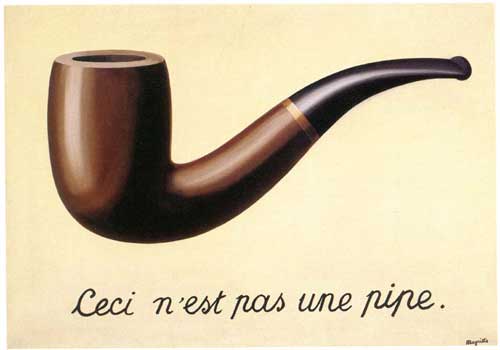
In the first place, the pursuit of “cool,” is always decidedly uncool. Beside that, though, it is a curious statement to make because it confuses a text for a book. A book freed from paper (unless you are imagining papyrus or vellum) is an oxymoron. And this, perhaps, begins to reveal a deeper assumption at play in Benedictus’ essay — materiality is insignificant. The book as object does not matter. Perhaps what is needed is a work of art along the lines of Magritte’s “This Is Not A Pipe” in order to provoke us into understanding the significance of textual materiality.
Reading is imagined merely as the transfer of immaterial data from one container (book, e-reader, etc.) to another (the human brain). This seems blind to the significance of the embodied experience involved in reading a book which activates each of our senses in very particular ways, ways an e-reader (regardless of its virtues otherwise) simply cannot. E-readers, of course, have their own materiality, and that matters as well.
Discounting materiality also ignores the manner in which the book as object, by virtue of its particularity, is the repository of a host of memories and associations. A book can only be itself and so collects around itself its own unique history; the e-reader is every text it used to read, and thus it is simultaneously none of them. I remember where and when I bought many of my books. I remember where I read them and to pick up certain books is to be transported back to different moments in my life. The book as object, its particular and unique materiality, matters. This is not to suggest that e-readers have no place and no benefits, but it is to suggest that moving from books to an e-reader is not a transaction without remainder.
A failure to recognize the significance of materiality may also be at play in the willingness to bid adieu to the library. Benedictus concludes his essay by noting that,
When the children of 2011 look back, they will not see this as the year their local libraries were taken away. This will be the year they all got libraries of their own.
Perhaps, but notice the equivocation. “Libraries closed” are not the same thing as “libraries of their own.” The former refers to a material fact, the latter refers vaguely to an assemblage of data. In any case, when they do look back, if they do, they may also be oblivious to the rich and textured experience of reading that attended those curious relics of a past civilization.
___________________________
Listen to Zadie Smith’s reflections on libraries here.
The key, Powers, said, is to create gaps between these periods of connectedness. Just as white space on a page draws attention to what is most visually important, digital white space can help us focus on those ideas that take some time to formulate.
Digital white space is nice metaphor and Powers’ himself ran with it in a blog post on his site. In case you missed it, you can listen to Powers’ discussing his very sensible approach to digital life with Jerry Brito in an interview we mentioned here a few months ago.
White space, however, may become increasingly hard to find. Marshall Kirkpatrick discusses Chetan Sharma’s vision of an uber-connected world in, “How 50 Billion Connected Devices Could Transform Brand Marketing & Everyday life.” These devices will include not only smart phones and tablet PCs, but also cereal boxes. What do you do with a connected cereal box, you ask?
“With a cereal box? You’ll communicate about health related issues, add social elements, easy ordering. A brand can build a direct relationship with the consumer without relying on retail stores. Look at the aftermarket, 30% of the diapers ordered are now ordered online. There’s no reason why that can’t happen on other objects. I think the chance for the brand to interact with consumers directly is huge.
Earlier Sharma explained, regarding the uber-connectivity he envsions:
This is where it needs to go and will go in 10 years, making everyday experiences much better and friction free. If a person has a desire to learn or shop or engage in social interaction, it’s right there. Beyond just doing things on televisions and cell phones, you’ll be able to do these things on a wall anywhere. It’s about reducing friction. You can accomplish any given task today with 50 different steps but this future of connected devices is all about making things much easier.
Good luck finding that white space. No really, good luck, because we need that white space.
After reading this last piece, I vaguely remembered a movie that gave us a picture of this frictionless world, and then it came to me:
Our’s is an age of anxiety, at least it seems to feel that way to many. Of course, this is far from an original observation. Among the several works taking this phrase as a title is W. H. Auden’s post-war poem, The Age of Anxiety, first published as the world emerged from the shadows of war into the disconcerting light of the nuclear age. Since then anxiety has settled in as a permanent feature of the American cultural and psychic landscape.
Is the United States more prone to higher levels of anxiety than other nations?
Put simply, we are. Perhaps the most puzzling statistics are the ones that reveal that we’re significantly more anxious than countries in the developing world, many of which report only a fraction of the diagnosable cases of anxiety that we do. One of the reasons for this is that the people in many of these third-world nations are more accustomed to dealing with uncertainty and unpredictability. I talk about this a fair amount in the book, but lack of control is really the archenemy of anxiety. It’s its biggest trigger.
That explains the disparity in anxiety levels between the United States and the developing world, but why are we more anxious than, say, your average European nation?
It’s hard to pinpoint an answer, but I think Americans have become extremely vulnerable to the pressures of the 21st century. For the past 50 years, we’ve been getting progressively more anxious in good economic times and bad, so we can’t even blame it on the recession.
Clark goes on to suggest three factors contributing to our “deteriorating” psychic state:
“The first is a simple matter of social disconnection. As we spend more time with our electronic devices than we do with our neighbors, we lose our physical sense of community. Social isolation flies in the face of our evolutionary history.”
“The second major cause is the information overload that we’re experiencing with the Internet and the 24-hour media cycle. We’re all aware of it, but I’m not sure we realize how big an impact it’s having on our brains.”
“The third explanation can be attributed to what one psychologist refers to as a culture of “feel goodism” — the idea that we shouldn’t ever have to be upset and that all our negative emotions can be neutralized with a pill. This to me feels like a distinctly American phenomenon.”
Clark seems to lay a good bit of the blame, if we may call it blame, for our anxiety on technology that paradoxically disconnects us and connects us too much. This diagnosis will ring true and self-evident to some, but I suspect others will take issue, particularly for the exclusion of other significant social and cultural factors that predate the advent of digital media. After all, social disconnection has a long history. We may be talking much less on the phone, but Freud noted long ago that the wonder of being able to hear a loved one’s voice over the telephone was a slight salve for the condition that necessitated it to begin with, that is the loved one’s absence.
But regardless the causes, anxious we are, and quite clearly we are interested in doing something about it which quite often amounts to popping a pill. While that may sometimes be a necessary and helpful remedy, I’d like to also pass along a prescription written by Sven Birkerts in his recent essay, “The Mother of Possibilities”: Idleness.
While admitting that Idleness, as he is envisioning it, is a difficult concept to pin down, Birkerts suggests that,
Idleness is what supervenes on those too few occasions when we allow our pace to slacken and merge with the rhythms of the natural day, when we manage to thwart the impulse to plan forward to the next thing and instead look—idly, with nascent curiosity—at what is immediately in front of us …
Birkerts leisurely traces the tradition of idleness from the Greeks to the much too harried present via pastoral and lyric poetry, Milton, Montaigne, the Romantics, Baudelaire, Proust, Benjamin, and Camus, to name a few. It is a pleasant jaunt. Along the way we find Montaigne claiming, “It seemed to me that I could do my mind no greater favor than to allow it, in idleness, to entertain itself.” And according to Birkerts,
Through the figure of the flâneur—via the writing of critic and philosopher Walter Benjamin—the idle state was given a platform, elevated from a species of indolence to something more like a cognitive stance, an ethos. Benjamin’s idea is basically that the true picture of things—certainly of urban experience—is perhaps best gathered from diverse, often seemingly tangential, perceptions, and that the dutiful, linear-thinking rationalist is less able to fathom the immensely complex reality around him than the untethered flâneur, who may very well take it by ambush.
Yet Idleness has its enemies, not least of which is a bad reputation to which Birkerts addresses himself early on, but also the pace of modernity, and yes, alas, distraction, which is not to be confused for Idleness proper.
The spaces and the physical movements of work and play are often nearly identical now, and our commerce with the world, our work life, is far more sedentary and cognitive than ever before. Purposeful doing is now shadowed at every step with the possibilities of distraction. How do we conceive of idleness in this new context? Are we indulging it every time we switch from a work-related document to a quick perusal of emails, or to surf through a few favorite shopping sites? Does distraction eked out in the immediate space of duty count—or is it just a sop thrown to the tyrant stealing most of our good hours?
We are a task oriented people, equipped with lists and planners, goals and objectives, action points and plans. Productivity is our mantra. Distraction pour into our work and our plans, but it has not introduced Idleness; it has rather elided work and play, labor and leisure by their convergence upon the devices that are now instruments of both.
But here again we feel the anxiety rising and with it, perversely, the guilt. Birkerts remedy:
The mind alert but not shunted along a set track, the impulses not pegged to any productivity. The motionless bobber, the hand trailing in the water, the shifting shapes of the clouds overhead. Idleness is the mother of possibility, which is as much as necessity the mother of inventiveness … “In wildness is the preservation of the world,” wrote Thoreau. In idleness, the corollary maxim might run, is the salvaging of the inner life.


 , Steve Myers
 , first published as the world emerged from the shadows of war into the disconcerting light of the nuclear age. Since then anxiety has settled in as a permanent feature of the American cultural and psychic landscape.
 , talked about anxiety in the United States:
 L.M. Sacasas