Your Click Will Have Come From the Heart

wyd-rio-2013

For the first time since 1517, when Martin Luther kicked off the Protestant Reformation, indulgences are in the news. As the start of the Roman Catholic Church’s 28th annual World Youth Day in Rio de Janeiro drew near, it was widely reported that Pope Francis had decreed the granting of special indulgences for those who took part in the event. A decree of this sort would not ordinarily garner any media attention, but this particular decree contained an unprecedented measure. Indulgences were offered even to those who followed the event on social media.

Perhaps a little background is in order here. In Roman Catholic theology, Purgatory is where those who are ultimately on their way to Heaven go to satisfy all of the temporal punishment they’ve got coming and otherwise get spiritually prepared to enter Heaven. This is where indulgences come in.

The Church, as a conduit of God’s grace, may issue indulgences to reduce one’s time in Purgatory. Indulgences are premised on the notion that while most of us end up in the red when the moral account of our lives is taken, saints, martyrs, the Virgin, etc. ended up in the black. Their abundance of moral virtue constitutes a Treasury of Merit on which the Church can draw in order to help out those who are still paying up in Purgatory. Indulgences, then, are not, as they are sometimes portrayed in the press, a “get out of Hell free” card. They are more like a fast-pass through Purgatory.

That early modern religious, political, and cultural revolution we call the Protestant Reformation was kicked off when a German monk named Martin Luther posted 95 Theses for disputation on the door of a church in Wittenberg. Luther took aim at the practice of selling indulgences to fill the Church’s more literal treasury. He was particularly scandalized by the abuses of the notoriously unscrupulous Johann Tetzel. Think of Tetzel as a late medieval version of the worst stereotype of a contemporary televangelist. Luther set out to shut Tetzel and his ilk down, and the rest, as they say, is history.

While the practice of selling indulgences was banned by the Church shortly after Luther’s day, the Catholic Church still offers indulgences for particular works of piety. And that brings us back to Francis’ offer of indulgences to those who participate in World Youth Day celebrations. Here is the portion of the decree that has made a story out of these indulgences:

Those faithful who are legitimately prevented may obtain the Plenary Indulgence as long as, having fulfilled the usual conditions — spiritual, sacramental and of prayer — with the intention of filial submission to the Roman Pontiff, they participate in spirit in the sacred functions on the specific days, and as long as they follow these same rites and devotional practices via television and radio or, always with the proper devotion, through the new means of social communication; …

The “new means of social communication” have been widely reduced to Twitter in accounts of this story. Following the Pope’s tweets (@Pontifex) during the week is one way of virtually participating in the event. The faithful may also watch live streaming video through web-portals set up by the Vatican or keep up on Facebook and Pinterest.

Claudio Maria Celli, president of the pontifical council for social communications, was quick to clarify the intent of the decree. “Get it out of your heads straight away,” Celli explained to the media, “that this is in any way mechanical, that you just need to click on the internet in a few days’ time to get a plenary indulgence.”

As the text of the decree makes clear, the “usual conditions” apply. Believers must be properly motivated and they must see to the ordinary means of grace offered by the Church: confession, penance, and prayer. And there’s also that line, almost entirely neglected in media reports, about being “legitimately prevented” from attending. But Celli seemed particularly determined to prevent any misunderstanding on account of the inclusion of digital media:

You don’t get the indulgence the way you get a coffee from a vending machine. There’s no counter handing out certificates. To put it another way, it won’t be sufficient to attend the mass in Rio online, follow the Pope on your iPad or visit Pope2You.net. These are only tools that are available to believers. What really matters is that the Pope’s tweets from Brazil, or the photos of World Youth Day that will be posted on Pinterest, should bear authentic spiritual fruit in the hearts of each one of us.

Protestants are usually taken to be more technologically savvy than the Catholic Church. After all, while the Catholic Church was weighing the moral hazards of the printing press, Protestants took to it enthusiastically and used it to spread their message across Europe. It is also true that American evangelicals have been especially keen on appropriating new media to spread the good news. As Henry Jenkins, a scholar of new media, put it,

Evangelical Christians have been key innovators in their use of emerging media technologies, tapping every available channel in their effort to spread the Gospel around the world. I often tell students that the history of new media has been shaped again and again by four key innovative groups – evangelists, pornographers, advertisers, and politicians, each of whom is constantly looking for new ways to interface with their public.

But this way of telling the story, centered as it is on print and the communication of a message, may be obscuring the fuller account of the Catholic Church’s relationship to media technology. It may be, in fact, that the Catholic Church is well-positioned, given its particular forms of spirituality, to flourish in an age of digital media.

Making that case convincingly is a book-length project, but, allowing for some rough-and-ready generalizations, here’s the shorter version. It starts with recognizing that Francis’ decision to extend indulgences to those who are not physically present in Rio is not without precedent. This strikingly 21st century development has a medieval antecedent.

If you’ve ever visited a Roman Catholic Church, you’ve likely seen the Way of the Cross (sometimes called the Stations of the Cross): a series of images depicting scenes from the final hours of Jesus’ life. There are fourteen stations including, for example, his condemnation before Pilate, the laying of the cross on his shoulders, three falls on the way to the site of the crucifixion, and culminating with his body being laid in the tomb. Catholics may earn indulgences by prayerfully traversing the Way of the Cross.

What makes this a precedent to Francis’ decree is that the Way of the Cross represented by images – carved, painted, sculptured, engraved, etc. – in local churches was a way of making a virtual pilgrimage to these same places in Jerusalem. Since at least the fourth century, Christians prized a visit to the Holy Land, but, as you can easily imagine, that journey was not cheap or comfortable, nor was it entirely safe. By the late medieval period, the Way of the Cross was appearing in churches across Europe as a concession to those unable to travel to Jerusalem.

While the precise history of the Way of the Cross is a bit murky, it is clear that the regularizing of the virtual pilgrimage transpired under the auspices of the Franciscan Order. This is not entirely surprising given the Franciscan Order’s traditional care for the poor, those least likely to make the physical pilgrimage. It also makes it rather fitting that it is Pope Francis – who took his papal title from St. Francis of Assisi, the founder of the Franciscan Order – who first legitimized social media as a vehicle of indulgences.

What’s interesting about this connection is that Catholic theology had grappled with the notion of virtual presence long before the advent of electronic or digital media. And this leads to one of those egregious generalizations: Protestant piety was wedded to words (printed words particularly) and while Catholic piety was historically comfortable with a wider range of media (images especially).

This means that Protestants have understood media primarily as a means of communicating information, and Catholics, while obviously aware of media as a means of communicating information, have also (tacitly perhaps) understood media as a means of communicating presence. Along with the Way of the Cross, consider the prominence of images, icons, and statues of Jesus, Mary, and the saints in Catholic piety. These images, whatever shape they take, are reverenced in as much as they mediate the presence of the “prototypes” which they represent.

Without claiming that the printed book created Protestantism, we could argue that in a media environment dominated by print, Protestant forms of piety enjoy a heightened plausibility. Print privileges message over presence. But high bandwidth digital media, combining audio and image, have become more than conduits of information, they increasingly channel presence and may thus be more hospitable to Catholic spirituality. Conversely, digital media may present intriguing challenges to traditional forms of Protestant spirituality.

It’s not surprising, then, that Pope Francis has seen fit to sanction digital media as legitimate tools of spirituality for Catholics. As Fr Paolo Padrini, a Catholic scholar of new media, put it, digital media allow for “Sharing, acting in unison, despite the obstacle of distance. But it will still be real participation and that is why you will obtain the indulgence. Above all because your click will have come from the heart.”
Et in Facebook ego

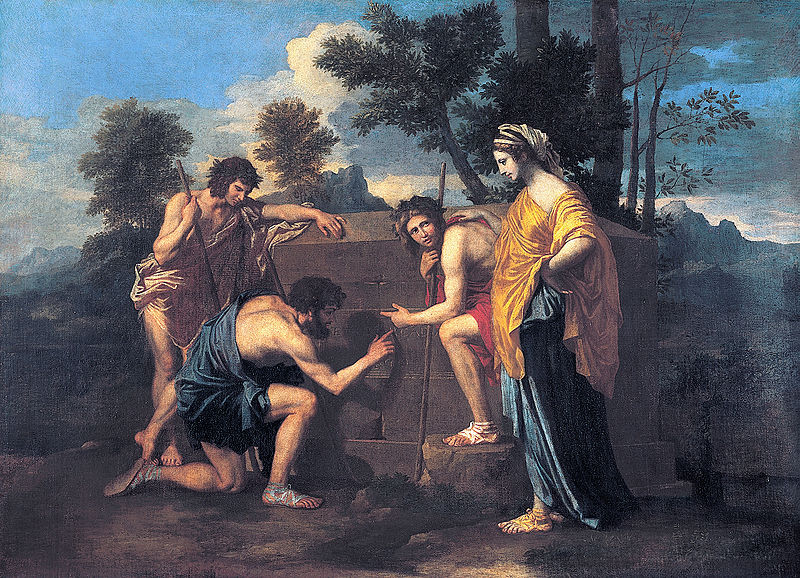
In Nicolas Poussin’s mid-seventeenth century painting, Et in Arcadia ego, shepherds have stumbled upon an ancient tomb on which the titular words are inscribed. Understood to be the voice of death, the Latin phrase may be roughly translated, “Even in Arcadia there am I.” Because Arcadia had come to symbolize a mythic pastoral paradise, the painting suggested the ubiquity of death. To the shepherds, the tomb was a momento mori: a reminder of the inescapability of death.

Nicolas Poussin, Et in Arcadia ego, 1637-38

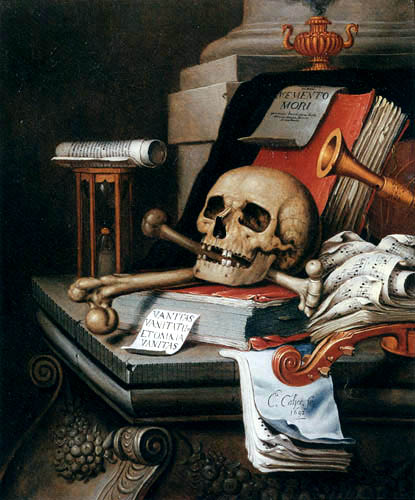
Poussin was not alone among artists of the period in addressing the certainty of death. During the seventeenth and eighteenth century, vanitas art flourished. The designation stems from the Latin phrase vanitas vanitatum omni vanitas, a recurring refrain throughout the biblical book of Ecclesiastes:  “vanity of vanities, all is vanity.” Paintings in the genre were still lifes depicting an assortment of objects which represented all of that we might pursue in this life. In their midst, however, one would also find a skull and an hour glass:  symbols of death and the brevity of life. The idea, of course, was to encourage people to make the most of their living years.

Edwart Collier, 1690

For the most part, we don’t go in for this sort of thing anymore. Few people, if any, operate under the delusion that we might escape death (excepting the Singularity folks I guess), but we do a pretty good job of forgetting what we know about death. We keep death out of sight and, hence, out of mind. We’re certainly not going out of our way to remind ourselves of death’s inevitability. And, who knows, maybe that’s for the better. Maybe all of those skulls and hourglasses were morbidly unhealthy. I honestly don’t know.

But while vanitas art has gone out of fashion, a new class of memento mori has emerged: the social media profile.

I’m one of those on again, off again Facebook users. Lately, I’ve been on again, and recently I noticed one of those birthday reminders Facebook places in the left hand column where it puts all of the things Facebook would like you to do and click on. It was for a high school friend whom I had not spoken to in over eight years. It was in that respect a very typical Facebook friendship:  the sort that probably wouldn’t exist at all any longer were it not for Facebook. And that’s not necessarily a knock on the platform. I appreciate being able to maintain at least a minimal connection with people I’d once been quite close to. In this case, though, it demonstrated just how weak those ties can be.

Upon clicking over to their profile, I read a few odd birthday notes, and very quickly it became obvious that my high school friend had died over a year ago. It was a shock, of course. It had happened while I was off of Facebook and news had not reached me by any other channel. But there it was. Out of nowhere and without warning my browser was haunted by the very real presence of death. Momento mori.

Just a few days prior I logged on to Facebook and was greeted by the tragic news that a former student had unexpectedly passed away. Because we had several mutual connections, photographs of the young man found their way into my news feed for several days. It was odd and disconcerting and terribly sad all at once. I don’t know what I think of social media mourning. It makes me uneasy, but I won’t criticize what might bring others solace. In any case, it is, like death itself, an unavoidable reality of our social media experience. Death is no digital dualist.

Facebook sometimes feels like a modern-day Arcadia. It is a carefully cultivated space in which life appears Edenic. The pictures are beautiful, the events exciting, the face are always smiling, the children always amusing, the couples always adoring. Certain studies even suggest that comparing our own experience to these immaculately curated slices of life leads to envy, discontent, and unhappiness. Naturally … if we assume that these slices of life are comprehensive representations of the lives people lead. Of course, they are not.

But there, alongside the pets and witty status updates and wedding pictures and birth announcements, we will increasingly find our social media platforms haunted by the digital, disembodied presence of the dead.

In that dreary opening chapter of The Scarlett Letter, Hawthorne wrote, “The founders of a new colony, whatever Utopia of human virtue and happiness they might originally project, have invariably recognized it among their earliest practical necessities to allot a portion of the virgin soil as a cemetery, and another portion as the site of a prison.”

And so it is with our digital utopias, our virtual Arcadias.

Et in Facebook ego.

Thinking and Its Rhetorical Enemies

In one short post, Alan Jacobs targeted several Borg Complex symptoms. The post was triggered by his frustration with an xkcd comic which simply strung together a series of concerns about technological developments expressed in the late 19th and early 20th century. The implicit message was abundantly clear: “Wasn’t that silly and misguided? Of course it was. Now stop your complaining about technology today.”

Jacobs raised four salient points in response:

1. “Why do we just assume that their concerns were senseless?”

2. While we may endorse the trade-offs new technologies entail, “it would be ridiculous to say that no trade has been made.”

3. “Moreover, even if people were wrong to fear certain technologies in the past, that says absolutely nothing about whether people who fear certain other technologies today are right or wrong.”

4. This sort of thing presents “an easy excuse not to think about things that need to be thought about.”

Exactly right on all counts.

In partial response to Jacobs’ question, I’d suggest that when living memory of a lost state of affairs also perishes, so to does the existential force of the loss and its plausibility. What we know is that life went on – here we are after all – and that seems to be the only bright line of consequence. All that is established by this, of course, is that we eventually acclimated to the new state of affairs. That we eventually get used to a state of affairs tells us nothing about its quality or desirability, nor that of the state of affairs that was displaced. To assume that it does is a future-tense extension of the naturalistic fallacy: simply because something comes to be the case, it does not follow that it ought to be the case.

The second point above recalls Neil Postman’s discussion of (yes, you guessed it) Phaedrus, Plato’s famous dialog in which Socrates tells the story of Thamus and Theuth. The god Theuth presents Thamus, king of Egypt, with a number of inventions including writing. Theuth is understandably excited about his creations, but Thamus is less sanguine. He warns that writing, among other things, will destroy memory. Learning to cite this story and dismiss it scornfully must be the first thing they teach you in tech-punditry school. But, as Jacobs points out, Thamus was not wrong. Here is Postman’s take:

“[Thamus’ error] is not in his claim that writing will damage memory and create false wisdom. It is demonstrable that writing has had such an effect. Thamus’ error is in his believing that writing will be a burden to society and nothing but a burden. For all his wisdom, he fails to imagine what writing’s benefits might be, which, as we know, have been considerable.”

“Every technology,” Postman goes on to say, “is both a burden and a blessing; not either-or, but this-and-that.” Those who see only blessing Postman labels “zealous Zeuths, one-eyed prophets who see only what new technologies can do and are incapable of imagining what they will undo.” Postman grants, of course, that there are also one-eyed prophets who speak only of the burdens of technology. It is best then to open both eyes.

Jacobs’ third point reminds us that the one-eyed prophets of technological blessing, those who dismiss the silly fears of previous generations, take Chicken Little as their normative story: the sky never, ever falls. As I’ve written before, the tale of the boy who cried wolf serves better. Even if earlier alarms proved false, it does not follow that the wolf never comes.

Finally, it is the fourth point that bears reiterating most emphatically. We need to think more, not less. It is that simple. There are many problems with Borg Complex rhetoric; that it undermines thinking and judgement may be the most disturbing and damaging.

The Tourist and the Pilgrim: Essays on Life and Technology in the Digital Age

A few days ago, I noted, thanks to a WordPress reminder, that The Frailest Thing had turned thee. I had little idea what I was doing when I started blogging, and wasn’t even very clear on why I was doing so. I had just started my graduate program in earnest, so I was reading a good bit and, in part at least, I thought it would be useful to process the ideas I was engaging by writing about them. Because I was devoting myself to course work, I was also out of the classroom for the first time in ten years, and the teacher in me wanted to keeping teaching somehow.

So I began blogging and have kept it up these three years and counting.

The best of these three years of writing is, I’m happy to announce, now available in an e-book titled, The Tourist and the Pilgrim: Essays on Life and Technology in the Digital Age.

Forty-six essays are gathered into eight chapters:

1. Technology Criticism
2. Technology Has a History
3. Technology and Memory
4. Technology and the Body
5. Ethics, Religion, and Technology
6. Being Online
7. Our Mediated Lives
8. Miscellany

Not surprisingly, these chapters represent fairly well the major areas of interest that have animated my writing.

Right now, the e-book is only available through Gumroad. Of course, feel free to share the link: https://gumroad.com/l/UQBM. You will receive four file formats (PDF, .epub, .mobi, .azw3). The .mobi file will work best with your Kindle. Some formatting issues are holding up availability through Amazon, but it should also be available there in the next couple of days for those who find that more convenient.

Each of the essays can be found in some form online, but I have revised many of them to correct obvious errors, improve the quality of the prose, and make them read more naturally as stand-alone pieces. Nonetheless, the substance remains freely available through this site.

Convenience and a few improvements aside, those of you who have been reading along with me for some time will not find much you haven’t seen before. You might then consider Gumroad something akin to a tip jar!

Finally, because I would not presume they would see it otherwise, I’d like to share the Acknowledgements section here:

Each of these essays first appeared in some form on The Frailest Thing, a blog that I launched in the summer of 2010. I’m not sure how long the blogging venture would have lasted were it not for the encouragement of readers along the way. I’m especially grateful for those who through their kind words, generous linking, and invitations to write for their publications have given my writing a wider audience than it would’ve had otherwise. On that score, my thanks especially to Adam Thierer, Nathan Jurgenson, Rob Horning, Emily Anne Smith, Alan Jacobs, Nick Carr, Cheri Lucas Rowlands, Matthew Lee Anderson, and Evan Selinger.

But I must also acknowledge a small cadre of friends who read and engaged with my earliest offerings when there was no other audience of which to speak. JT, Kevin, Justin, Mark, David, Randy – Cheers!

And, of course, my thanks and love to my wife, Sarah, who has patiently tolerated and supported my online scribblings these three years.

Deo Gratias

My thanks, of course, are owed to all of you who have stopped by along the way. While it may sound sappy and trite, I have to say there is still something quite humbling about the fact that when I offer up my words, which is to say something of my self, there are those who come around and take the time to read them.

There is a sense in which I’ve written for myself. The writing has helped me in my effort to understand, or, as Hannah Arendt put, “think what we are doing.” It is no small thing to me that in making that process public, some have found a thing or two of some value.

Cheers!

cropped-picture-0062.jpg

Perspectives on Privacy and Human Flourishing

I’ve not been able to track down the source, but somewhere Marshall McLuhan wrote, “Publication is a self-invasion of privacy. The more the data banks record about each one of us, the less we exist.”

The unfolding NSA scandal has brought privacy front and center. A great deal is being written right now about the ideal of privacy, the threats facing it from government activities, and how it might best be defended. Conor Friedersdorf, for instance, worries that our government has built “all the infrastructure a tyrant would need.” At this juncture, the concerns seem to me neither exaggerated nor conspiratorial.

Interestingly, there also seems to be a current of opinion that fails to see what all the fuss is about. Part of this current stems from the idea that if you’ve got nothing to hide, there’s nothing to worry about. There’s an excerpt from Daniel J. Solove’s 2011 book on just this line of reasoning in the Chronicle of Higher Ed that is worth reading (link via Alan Jacobs).

Others are simply willing to trade privacy for security. In a short suggestive post on creative ambiguity with regards to privacy and government surveillance, Tyler Cowen concedes, “People may even be fine with that level of spying, if they think it means fewer successful terror attacks.”  “But,” he immediately adds, “if they acquiesce to the previous level of spying too openly, the level of spying on them will get worse.  Which they do not want.”

Maybe.

I wonder whether we are not witnessing the long foretold end of western modernity’s ideal of privacy. That sort of claim always comes off as a bit hyperbolic, but it’s not altogether misguided. If we grant that the notion of individual privacy as we’ve known it is not a naturally given value but rather a historically situated concept, then it’s worth considering both what factors gave rise to the concept and how changing sociological conditions might undermine its plausibility.

Media ecologists have been addressing these questions for quite awhile. They’ve argued that privacy, as we understand (understood?) it, emerged as a consequence of the kind of reading facilitated by print. Privacy, in their view, is the concern of a certain type of individual consciousness that arises as a by-product of the interiority fostered by reading. Print, in these accounts, is sometimes credited with an unwieldy set of effects which include the emergence of Protestantism, modern democracy, the Enlightenment, and the modern idea of the individual. That print literacy is the sole cause of these developments is almost certainly not the case; that it is implicated in each is almost certainly true.

This was the view, for example, advanced by Walter Ong in Orality and Literacy. “[W]riting makes possible increasingly articulate introspectivity,” Ong explains, “opening the psyche as never before not only to the external objective world quite distinct from itself but also to the interior self against whom the objective world is set.” Further on he wrote,

Print was also a major factor in the development of the sense of personal privacy that marks modern society. It produced books smaller and more portable than those common in a manuscript culture, setting the stage psychologically for solo reading in a quiet corner, and eventually for completely silent reading. In manuscript culture and hence in early print culture, reading had tended to be a social activity, one person reading to others in a group. As Steiner … has suggested, private reading demands a home spacious enough to provide for individual isolation and quiet.

This last point draws architecture into the discussion as Aaron Bady noted in his 2011 essay for MIT Review, “World Without Walls”:

Brandeis and Warren were concerned with the kind of privacy that could be afforded by walls: even where no actual walls protected activities from being seen or heard, the idea of walls informed the legal concept of a reasonable expectation of privacy. It still does … But contemporary threats to privacy increasingly come from a kind of information flow for which the paradigm of walls is not merely insufficient but beside the point.

This argument was also made by Marshall McLuhan who, like his student Ong, linked it to the “coming of the book.” For his part, Ong concluded “print encouraged human beings to think of their own interior conscious and unconscious resources as more and more thing-like, impersonal and religiously neutral. Print encouraged the mind to sense that its possessions were held in some sort of inert mental space.” Presumably, then, the accompanying assumption is that this thing-like inert mental space is something to be guarded and shielded from intrusion.

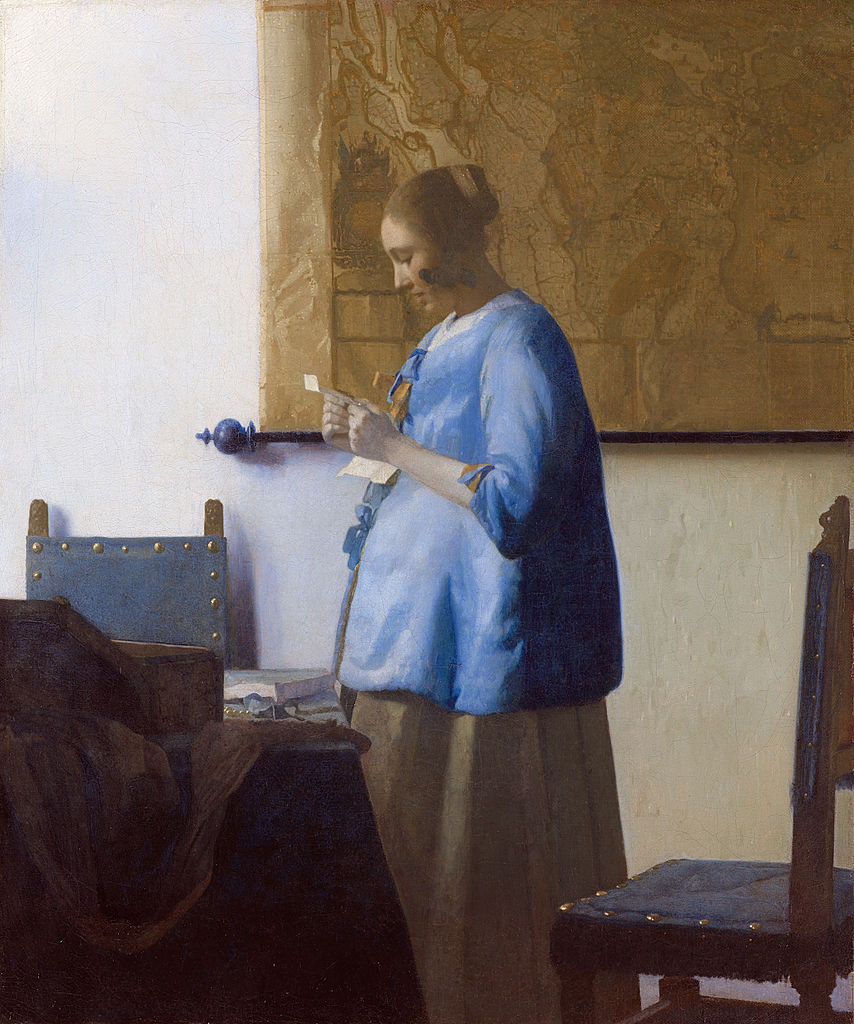
854px-Vermeer,_Johannes_-_Woman_reading_a_letter_-_ca._1662-1663While it is a letter, not a book that she reads, Vermeer’s Woman in Blue has always seemed to me a fitting visual illustration of this media ecological perspective on the idea of privacy. The question all of this begs is obvious: What does the decline of the age of print entail for the idea of privacy? What happens when we enter what McLuhan called the “electric age” and Ong called the age of “secondary orality,” or what we might now call the “digital age”?

McLuhan and Ong seemed to think that the notion of privacy would be radically reconfigured, if not abandoned altogether. One could easily read the rise of social media as further evidence in defense of their conclusion. The public/private divide has been endlessly blurred. Sharing and disclosure is expected. So much so that those who do not acquiesce to the regime of voluntary and pervasive self-disclosure raise suspicions and may be judged sociopathic.

Perhaps, then, privacy is a habit of thought we may have fallen out of. This possibility was explored in an extreme fashion by Josh Harris, the dot-com era Internet pioneer who subjected himself, and willing others, to unblinking surveillance. The experiment in prophetic sociology was documented by director Ondi Timoner in the film We Live in Public.

The film is offered as a cautionary tale. Harris suffered an emotional and mental breakdown as a consequences of his experimental life. On the film’s website, Timoner added this about Harris’ girlfriend who had enthusiastically signed up for the project:  “She just couldn’t be intimate in public. And I think that’s one of the important lessons in life; the Internet, as wonderful as it is, is not an intimate medium. It’s just not. If you want to keep something intimate and if you want to keep something sacred, you probably shouldn’t post it.”

This caught my attention because it introduced the idea of intimacy rather than, or in addition to, that of privacy. As Solove argued in the piece mentioned above, we eliminate the rich complexity of all that is gathered under the idea of privacy when we reduce it to secrecy or the ability to conceal socially marginalized behaviors. Privacy, as Timoner suggests, can also be understood as the pre-condition of intimacy, and, just to be clear, this should be understood as more than mere sexual intimacy.

The reduction of intimacy to sexuality recalls the popular mis-reading of the Fall narrative in the Hebrew Bible. The description of the Edenic paradise concludes – unexpectedly until familiarity has taught you to expect it – with the narrator’s passing observation that the primordial pair where naked and unashamed. A comment on sexual innocence, perhaps, but much more I think. It spoke to a radical and fearless transparency born of pure guilelessness. The innocence was total and so, then, was the openness and intimacy.

Of course, the point of the story is to set up the next tragic scene in which innocence is lost and the immediate instinct is to cover their nakedness. Total transparency is now experienced as total vulnerability, and this is the world in which we live. Intimacy of every kind is no longer a given. It must emerge alongside hard-earned trust, heroic acts of forgiveness, and self-sacrificing love. And perhaps with this realization we run up against the challenge of our digital self-publicity and the risks posed by perpetual surveillance. The space for a full-fledged flourishing of the human person is being both surrendered and withdrawn. The voluntarily and involuntarily public self, is a self that operates under conditions which undermine the possibility of its own well-being.

But, this is also why I believe Bady is on to something when he writes, “Privacy has a surprising resilience: always being killed, it never quite dies.” It is why I’m not convinced that we could entirely reduce all that is entailed in the notion of privacy to a function of print literacy. If something that answers to the name of privacy is a condition of our human flourishing in our decidedly un-Edenic condition, then one hopes we will not relinquish it entirely to either the imperatives of digital culture or the machinations of the state. It is, admittedly, a tempered hope.