
Why Did Curiosity’s Landing Generate So Much Attention?

Take a look at the image to the right. Care to guess what you’re looking at?

I might very well be wrong, but I imagine that more than a few people would guess that they are looking at an image of Curiosity during its descent stage onto the surface of Mars — there’s the chute and there’s the capsule. This would be a reasonable conjecture, but also an incorrect one.

The image is of another rover, Phoenix, making its final descent onto the surface of Mars on May 25, 2008. Remember that one? I didn’t. It was, as it turns out, the first time the landing of one spacecraft on the surface of a planet was photographed by another spacecraft.

Now, I don’t want to make too much of my own forgetfulness or inattentiveness, but I was surprised to learn that Curiosity’s successful landing was the sixth such success in NASA’s history.

Viking 1 and Viking 2 each landed on Mars in 1976. The Mars Pathfinder and its rover, Sojourner landed in 1997. Two rovers, Spirit and Opportunity, landed in 2004. And finally, Phoenix, landed in 2007. (Check out a great info graphic of missions to Mars here. H/T Jeremy Antley.)

I’ve been a low-level space geek since I was child, and so I wasn’t entirely oblivious to this history. But being reminded of it did make the publicity surrounding Curiosity, well, curious.

Why was it that Curiosity’s landing was received with such fanfare? And why was it that it evoked such a powerful emotional response when previous landings, recent and impressive, had not?

Naturally, I took to Twitter with my query. Now, I don’t have nearly enough followers to make this as fruitful a venture as it might be for others, but, thanks to some retweets, it did return a few interesting suggestions.

Here was my initial tweet:

My suggestions were arrived at as follows. Size? Curiosity was by far the largest such vehicle. Degree of difficulty? Given its size, landing the rover safely necessitated an ingenious and elaborate multi-stage landing system. Trailer? I was referring to the dramatically titled video produced by NASA, “Seven Minutes of Terror,” depicting Curiosity’s planned descent. Social media? Well, for starters, Curiosity has its own twitter feed: MarsCuriosity.

So what kind of responses did I get? A few suggested what one person neatly summed up as “Space shuttle ennui.” In other words, Curiosity stepped in to fill a gap created by the retirement of the space shuttles — the last voyage of which tapped the technological sublime.

Relatedly, it was suggested that Curiosity filled a void created by the absence of any inspiring visions for our future in relation to space, or perhaps for any future.

Others pointed to some variation of the suggestions I offered. The complexity of the skycrane, social media coverage of the landing, and NASA’s improved self-promotion.

All of these seem to have some role to play in creating the event that was Curiosity’s landing — the “Seven Minutes of Terror” video hooked me — but I’m not sure that any of these alone, or even all of them together satisfactorily explain the phenomenon.

Here’s my take as it stands: It mostly is a case of the distinctly American technological sublime. This actually draws both streams of responses together: those that focused on the filling up of some collectively felt absence and those that emphasized the sophistication of the technology involved. David Nye’s account of the American technological sublime included both the existential experience of a technology that left one in awe and a participation in what amounted to a (Durkheimian) civil religion.

As a civil religious experience, the technological sublime provided a sense of national identity, purpose, and destiny. Experiences of the technological sublime — whether seeing the first railroads or the first electrified cityscapes, standing before the Hoover Dam, or witnessing a Saturn V launch, to name a few instances — forged the collective national character. They were rituals of solidarity. They inspired confidence in what we could accomplish and, therefore, hope for the future.

It could be argued that we are a nation casting about for renewed unity and sense of purpose. There is a felt need for what the technological sublime had supplied earlier generations of Americans. The consumer technologies which surround us today, impressive as they are in many respects, don’t quite have the capacity to elicit the sublime experience. In part, because they merely (and “merely” is not  quite the right word there) enhance or repackage what earlier technologies had first accomplished long ago. The latest cell phone technology can never compete with the experience of hearing a voice over the telephone for the first time, for example.

Curiosity stepped into this fractured and disillusioned cultural milieu and it was dynamic and extraordinary enough to evoke the sublime response. Remember the tears that flowed at mission control. It was the right technology, at the right time. And social media supplied the sense of collective experience so critical to its civil religious function.

So now your thoughts. Did you tune in to the live feed from mission control? Did you give Curiosity more attention than you usually would to the space program? Were you moved by the whole thing? Did you notice that this was the case for others even if wasn’t quite your reaction? Pure media hype? Sheer awesomeness? To what does Curiosity owe its vaunted status?

Maybe its all just Curiosity’s WALL•E-esque anthropomorphic charm. Or, am I the only one that sees that?

Curiosity and Wonder

I was up during the wee hours of Monday morning to watch NASA’s live feed of mission control as Curiosity made its way to the surface of Mars. I’d been turned on to the whole affair by the “Seven Minutes of Terror” video that made the rounds in the weeks leading up to the landing. The video described all that had to go just right for Curiosity to land safely. If it worked, it would be a marvel. And, as we all know, it did and it was.

Watching the whole affair unfold, I was struck by the drama of it all — the suspense, the elation, the tears, the euphoria. It was fascinating on multiple levels: On its own terms as a triumph of engineering and ingenuity, as a media event generating memes as it unfolded (notably the Mohawk guy), as a rekindler of awe and wonder, and as a skirmish in the war of science and religion some are determined to wage.

I found the last of these particularly interesting, and perhaps a bit misguided. Take, for example, this tweet which appears to have brought its author a burst of Twitter-fame:

Just after the landing, I added my own tweet to the explosion of commentary: “Interplanetary Technological Sublime.” Needless, to say it was not retweeted 16,000+ times. I was alluding to what historian of technology David Nye has termed the American technological sublime. It is the sense of quasi-religious (and quite often not so quasi-) awe that has attended the life of technology in the United States.

One might also have drawn a connection to the religion of technology as it was chronicled by the late David Noble. Whatever we might conclude philosophically about their relationship, historically technology and religion have been entangled with one another. And the entanglement has quite often been anything but adversarial.

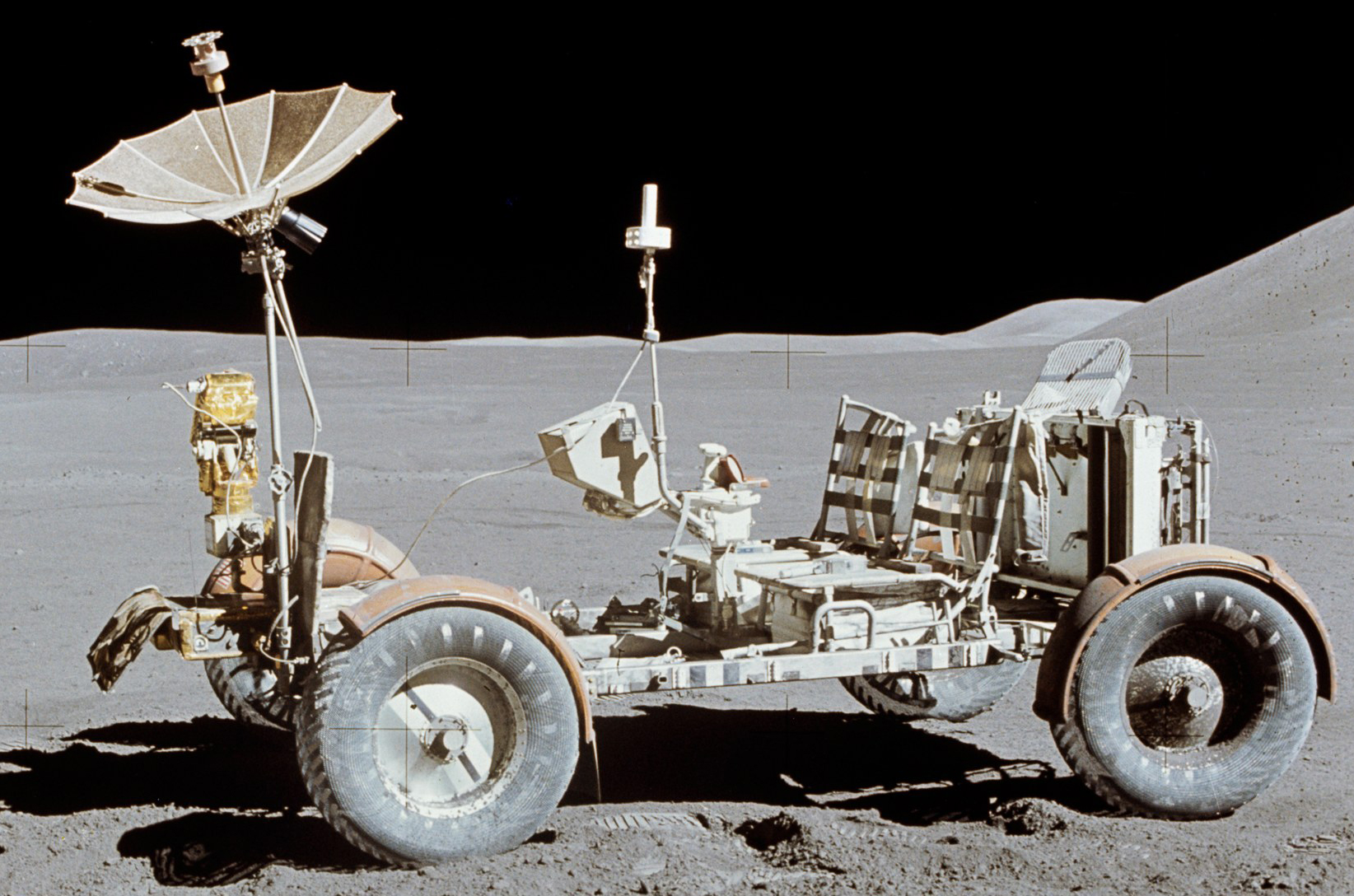
In a recent post at The Atlantic, Rebecca Rosen noted this entanglement in the arena of space exploration. Noble, in his chapter on the technology of religion as exemplified by the American space program, provides a multitude of further instances in addition to those related by Rosen. The chapter would surprise, and perhaps scandalize readers who were not already aware of the history. One example: When NASA recently confirmed that five of the six flags left by American astronauts on the moon still stood, they might also have checked to see if the Bible left sitting on the Apollo 15 lunar rover was still intact. See photo below:

At the conclusion of her post, Rosen wrote, “There is perhaps nothing more human than the curiosity that compels exploration. But paired with that curiosity is a search for meaning — we don’t want to know just what is out there, we want to turn it into something with a story, something with sense.”

Curiosity — it gets us back to where we started. Curiosity, the quest to understand, the search for life, wonder at the mind’s apprehension of the universe — whatever else we conclude about these things, it would be mistaken to draw too sharp a distinction between the techno-scientific and the religious impulses. Historically, at least, the line has not been as sharp as we may suppose.

Wonder and awe lie near the heart of both pursuits — or else, why would we cry.

The Tech-Savvy Amish

It would be impossible to find human cultures that were not also tool-using cultures. For as long as there have been human beings there has also been technology. This is undeniable – it is also a rather banal observation too often deployed to undermine any critical discussion of specific technologies.

Since humans have always been technological creatures, cyborgs as it is fashionable to say, then we shouldn’t bother with critical reflection—or so the implicit argument goes. Making this sort of claim is a symptom of what I’ve called the Borg Complex: “Resistance is futile, Luddite.” Used in this way, the Luddite label is handy shorthand for “backward, hypocritical, ignorant reactionary.”

Excepting the Unabomber, however, most critics of technology are not interested in abolishing “technology”; nor are they so unsophisticated as to not recognize the necessary entanglement of the human and the technological. They are, however, searching for an elusive harmony or equilibrium between the technological and their vision of the life well lived. This vision will vary from person to person and from community to community, and so the elusive harmony is elusive in part because there is no default configuration that is timelessly and universally applicable.

In earlier times when technological change proceeded at a less frenetic pace, equilibrium might have been achieved and sustained by a particular society for the span of several generations. In such cases, it would not have been incumbent on each individual to work out their relationship to technology for themselves. In fact, they could hardly have conceived of the need to do so. It would have been for them as taken for granted a facet of life as the rising and setting of the sun. There would have been no experience of future shock.

But when the pace of technological change precludes the possibility of arriving at a settled social-technical configuration that may be passed down from one generation to the next, then technology becomes a thing to be thought of and fretted over. It presents itself as a problem to be addressed. We wonder about its consequences and we worry about it effects. And this is as one would expect. It is a symptom of the liquidity of modern life.

Even the Amish, often and mistakenly taken to be Luddites par excellence, are not exempt from this state of perpetual negotiation. In fact, the Amish are paradigmatically modern in that they have made the need to think about technology a defining feature of their culture. That they do so with extreme deliberateness and with so strong a preference for the conservation of their way of life only superficially distinguishes them from the rest of American society. In their consciousness of technology and its consequences, the Amish have more in common with the rest of us than any of us do with members of pre-modern society.

What does distinguish the Amish from the rest of American society is their unwillingness to refuse responsibility for the deployment of technology and their willingness to pay the necessary costs required to realize their vision of human flourishing. Members of their community that we might think of as designated early adopters sample all manner of new technology to judge whether or not it can be adopted without undermining their values or disrupting their communal life. Based on these criteria, the community decides which technology to adopt, under what circumstances, and within which parameters.

The Amish live in the same world that we do and are as aware of new technologies as the rest of us. But while technological momentum has taken root within most of American culture rendering the notion of technological determinism plausible, the Amish have succeeded in creating philosophical momentum. That is, they have institutionalized technological criticism which has substituted for the absence of change as a stabilizing factor. And it seems to me that this makes the Amish just about the most tech-savvy group of people around.

Update: By the way, “Nearly 250,000 Amish live in the U.S. and Canada, and the population is expected to exceed 1 million around 2050.”

Image via Wikicommons

Weaponized Consumption

Boycotts and procotts are by now commonplace and predictable, the skirmishes involving a certain fast-food chain being only the latest prominent instance. This got me thinking about the boycotting impulse, particularly when it is aligned with social issues. It seems to reflect the breakdown of public reason. What I have in mind is the situation described by Alasdair MacIntyre in the opening of After VirtueUnable to reasonably debate differences in a consequential manner because of the absence of a broadly shared narrative of what constitutes the good life, it would seem that we are left with acts of will. Of course, in a consumer society what other form could such action take than marketplace transactions. Perhaps we can describe it as the commodification of public debate. Like war, boycotting is politics by other means. It is weaponized consumption.

Seven Minutes of Terror

I don’t post too much about space technology, but this is worth noting. NASA has released a video, “Seven Minutes of Terror,” dramatizing the landing of the Curiosity rover onto the surface of Mars. It’s a remarkable sequence of maneuvers that will take Curiosity from 13,000 MPH to 0 MPH in those harrowing seven minutes. Of course, the flight is unmanned and so the terror will be wholly on the side of the engineers, scientists, programmers, etc. who will be watching anxiously as their $2.5 billion  mission to Mars makes its final descent on August 6.