Mindfulness Is Not Merely Subtraction

Mindfulness is not merely negation, subtraction, or reduction.

This was the thought that occurred to me as I read Miranda Ward’s reflections on her inadvertent break from the Internet, which concluded with the following observation:

“Why can’t we at least acknowledge that, with or without the internet, we still have to work hard, fight distraction, fight depression, and succumb, every once in awhile, to paralysing self-doubt? So it was nice, while I was on holiday, not to have any mobile phone reception. It’s also nice to be able to video chat with my 86-year-old grandmother in California. Disconnected, connected, whatever: I’m still fallible.”

Indeed, we are all fallible. If we assume that merely withdrawing from certain facets of digital life will by itself render us supremely attentive and mindful individuals, then we are certainly in for a rather disheartening disappointment.

That said, I do think the little word merely is essential. Mindfulness is more, not less than what I’ve called attentional austerity. To put it otherwise, attentional austerity is a necessary, but not sufficient cause of mindfulness. It’s not a matter of starving attention, but training and directing it.

Ordinarily, mindfulness is a habituated response, not a spontaneous reaction. Habituated responses arise out of our practices. If our online practices undermine mindfulness, then moderating these practices becomes part of the solution.

Learning to establish and abide by certain limits is, after all, an indispensable discipline. But imposing limits for their own sake is at best unhelpful and at worst destructive. Limits, as Wendell Berry has written, are best understood as “inducements to formal elaboration and elegance, to fullness of relationship and meaning.” They are for something. 

Mindfulness must be for something. It is about fostering a certain kind of attention and learning to deploy it toward certain ends and not others. 

While doing whatever we call the Twitter equivalent of eavesdropping on an exchange centered on David Foster Wallace and the idea of mindfulness, I was reminded of Wallace’s Kenyon College commencement address in which he makes the following observation:

“The really important kind of freedom involves attention, and awareness, and discipline, and effort, and being able truly to care about other people and to sacrifice for them, over and over, in myriad petty little unsexy ways, every day. That is real freedom. The alternative is unconsciousness, the default-setting, the ‘rat race’ — the constant gnawing sense of having had and lost some infinite thing.”

Mindfulness, in Wallace’s view, is about redirecting our attention toward others; and not only toward others, but toward others as ends in themselves (to put a Kantian spin on it). This latter qualification is necessary because we very often direct our attention upon others, but only for the sake of having ourselves reflected back to us.

There are, of course, other legitimate ends toward which mindfulness may aspire. The point is this: We ought not to be for or against the Internet in itself. We ought to be for the kind of loving mindfulness Wallace advocates — to take one example — and then we ought to measure our practices, all of them, online or off, by how well they support such loving mindfulness.
For Your Consideration – 2

“How Google and Apple’s digital mapping is mapping us”:

“The map is mapping us,” says Martin Dodge, a senior lecturer in human geography at Manchester University. “I’m not paranoid, but I am quite suspicious and cynical about products that appear to be innocent and neutral, but that are actually vacuuming up all kinds of behavioural and attitudinal data.”

“The Whole In Our Thinking About Augmented Reality”:

“… while Team Augmented Reality does a great job of explaining the enmeshment of ‘online’ and ‘offline’, and what the difference between ‘online’ and ‘offline’ isn’t, we need to do a much better job of explaining clearly what the difference between ‘online’ and ‘offline’ actually is.”

“Impatience As Digital Virtue”:

“Apple isn’t selling a fantasy but instead asks us to literally change — intellectually and emotionally — our default relationship with information.”

“The New Furby Review: Absolute Horror”: No, seriously, read this. Quite entertaining.

“Furby actually makes you want to hurt it somehow—if only it had feelings—so that you can punish it for existing. You begin to feel like a wrathful deity.”

“Generation Smartphone: The smartphone’s role as constant companion, helper, coach, and guardian has only just begun”:

“But the SmartPhone 20.0 won’t be just a high-tech baby monitor. Rather, the device or smart mobile devices like it will serve as nanny, nurse, or golf caddy—the perfect assistant for people of all ages. If you think that people can’t seem to make a move without consulting their phones today, well, you ain’t seen nothing yet.”

Update — More on Google maps from Alexis Madrigal here: “How Google Builds Its Maps—and What It Means for the Future of Everything.”


The Road Makes All the Difference

“There is a subtle but fundamental difference between finding direction … and ambiently knowing direction.” This was Evgeny Morozov’s recent encapsulation of Tristan Gooley’s The Natural Navigator. According to Gooley, natural navigation, that is navigation by the signs nature yields, is a dying art, and its passing constitutes a genuine loss.

Even if you’ve not read The Natural Navigator, or Morozov’s review, your thoughts have probably already wandered toward the GPS devices we rely on to help us find direction. It’s a commonplace to note how GPS has changed our relationship to travel and place. In “GPS and the End of the Road,” Ari Schulman writes of the GPS user: “he checks first with the device to find out where he is, and only second with the place in front of him to find out what here is.” One may even be tempted to conclude that GPS has done to our awareness of place what cell phones did to our recall of phone numbers.

(Of course, this is not a brief against GPS, much less against maps and compasses and street signs. These have their place, of course. And there are a number of other qualifications which could be offered, but I’ll trust to your generosity as readers and assume that these are understood.)

From the perspective of natural navigation, however, GPS is just one of many technologies designed to help us find our way that simultaneously undermine the possibility that we might also come to know our way or, we might add, our place. Navigational devices, after all, enter into our phenomenological experience of place and do so in a way that is not without consequence.

When I plug an address into a GPS device, I expect one thing: an efficient and unambiguous set of directions to get me from where I am to where I want to go. My attention is distributed between the device and the features of the place. The journey is eclipsed, the places in between become merely space traversed. In this respect, GPS becomes a sign of the age in its struggle to consider anything but the accomplishment of ends with little regard for the means by which the ends are accomplished. We seem to forget, in other words, that there are goods attending the particular path by which a goal is pursued that are independent of the accomplishment of that goal.

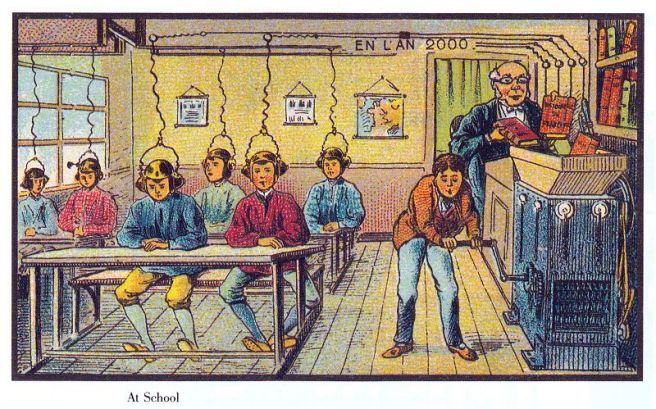
It’s a frame of mind demanded, or to put it in less tech-derministic terms, encouraged by myths of technological progress. If I am to enthusiastically embrace every new technology, I must first come to believe that means or media matter little so long as the end is accomplished. A letter is a call is an email is a text message. Consider this late nineteenth century French cartoon imagining the year 2000 (via Explore):

From our vantage point, of course, this seems silly … but only in execution, not intent. Our more sophisticated dream replaces the odd contraption with the Google chip. Both err in believing that education is reducible to the transfer of data. The means are inconsequential and interchangeable, the end is all that matters, and it is a vastly diminished end at that.

Natural navigation and GPS may both get us where we want to go, but how they accomplish this end makes all the difference. With the former, we come to know the place as place and are drawn into more intimate relationship with it. We become more attentive to the particulars of our environment. We might even find that a certain affection insinuates itself into our experience of the place. Affective aspects of our being are awakened in response. When a new technology promises to deliver greater efficiency by eliminating some heretofore essential element of human involvement, I would bet that it also effects an analogous alienation. In such cases, then, we have been carelessly trading away rich and rewarding aspects of human experience.

Sometimes it is the road itself that makes all the difference.

For Your Consideration

In the recent past, I might have been tempted to write a blog post about these. As things stand, I’ll merely point you to them.

“Valley of God” in the Financial Times — Faith in Silicon Valley. In to be taken in both senses. File under religion of technology.

“He stopped going to church. Instead, he went to the computer – “there was this thing called Google” – and started researching theories of evolution to recast his understanding of the world. After the terrorist attacks of September 11 2001, he discovered the potential to organise political activists on the internet. And when he got sick again, he credited the internet with saving his life. He replaced his faith in the Christian God of his childhood with faith in technology.”

“Making the Land Our Own” in American Scientist — A review of American Georgics: Writings on Farming, Culture, and the Land. Opening:

“Forty-eight years ago in his groundbreaking book, The Machine in the Garden: Technology and the Pastoral Ideal in America, historian Leo Marx cited Thomas Jefferson to illuminate the tension between farming and industry that has characterized land use in the United States for more than two centuries.”

“Computer Literacy and the Cybernetic Dream” — Short lecture by Ivan Illich delivered in 1987. Interesting throughout.

“With great pains she has trained her inner Descartes and her inner Pascal to watch each other: to balance mind and body, spirit and flesh, logic and feeling.”

“When I think of the glazing which the screen brings out in the eyes of its user, my entrails rebel when somebody says that screen and eye are ‘facing’ each other.”

Attentional Austerity

A couple of weeks ago I read Cheri Lucas’ “Instapaper and My Ideal Intellectual State” with a certain empathetic resignation. Lucas was finding that a new work situation made it increasingly difficult to keep up with the daily torrent of online information coming through all the usual channels — Twitter, RSS feeds, etc. She looked to Instapaper as a way of keeping up a semblance of keeping up, but to no avail. Instapaper quickly became a repository of what might have been read in some ideal world. A site of aspirational knowledge, a kind of Pinterest for the mind (without all the graphical flair).

I get it. This is where I now live too. I haven’t posted in over two weeks. For those of you who have recently started following The Frailest Thing thanks to the whole toilet paper thing — well, first of all, welcome and thank you. Secondly, I have ordinarily kept up a better clip. Right now it seems to me that the best I’ll be able to do is something like a post each week. Perhaps as things get a bit more routinized, I’ll be able to pick up the pace.

Or maybe not. I’m beginning to think that perhaps a post per week is a pretty good pace to aim for. I’ve been impressed again by the preciousness of attention. Because I have less time to devote to the Sisyphian task of keeping up with the daily digital deluge, I’m becoming increasingly draconian in deciding what deserves my attention. I’m ruthlessly ignoring whole swaths of Twitter-time and savagely gutting my RSS feed.

(As Nick Carr pointed out some time ago, the problem isn’t filter failure. My filters work wonderfully. Everyday they collect swaths of interesting, stimulating, entertaining material. It’s just too much.)

I told some students recently that the most important skill they may ever learn is that of wisely deploying their attention. For the most part we seem to do so carelessly, hearkening every call upon our attention with Pavlovian alacrity. It’s a ruinous habit, better to be misers with our attention.

In other words, we need to impose a regime of attentional austerity to counter continuous partial attention, the default mode arising out of our media environment.

It’s sometimes assumed that in the world the Internet created, those who excel at multi-tasking and endlessly partitioning their attention will have the advantage. I’m not so sure. It rather seems like we are turning our digital devices into horcruxes of the mind. Instead, I’m betting the advantage will go to the person who is able to cancel out the noise and focus with ferocity.