The Path A Decent Person Inevitably Takes

Identity and authenticity have been recent topics of discussion here, and they probably will be again. I am especially interested in technology’s role in shaping our identity and rendering authenticity elusive. I don’t think these are insignificant concerns, but today I was reminded that theoretical explorations of identity and authenticity are something of a luxury afforded those who enjoy relative peace and affluence.

I came by this reminder as I read Elisabeth Sifton and Fritz Stern’s moving essay in The New York Review of Books on the life and death of Dietrich Bonhoeffer and Hans von Dohnanyi. Their story is summed up in the opening paragraphs:

“We are concerned here with two exceptional men who from the start of the Third Reich opposed the Nazi outrages: the scarcely known lawyer Hans von Dohnanyi and his brother-in-law, the well-known pastor Dietrich Bonhoeffer. Dohnanyi recorded Nazi crimes, helped victims, did his best to sabotage Nazi policies, and eventually helped plot Hitler’s removal; Bonhoeffer fought the Nazis’ efforts to control the German Protestant churches. For both men the regime’s treatment of Jews was of singular importance. Holocaust literature is vast and the literature on German resistance scant, yet the lives and deaths of the two men show us important links between them.

Dohnanyi and Bonhoeffer became close friends, especially after Dohnanyi drew his brother-in-law into active resistance against the regime. And their remarkable family deserves recognition, too, since its principled support was indispensable to their efforts. But Dohnanyi and Bonhoeffer ended in defeat: they were arrested in April 1943 and then murdered, on Hitler’s express orders, just weeks before Hitler’s suicide and Germany’s surrender.”

I encourage you read the whole thing. I trust you will find it a needed antidote to the scourge of cynicism, irony, and despair that often seems to plague us. It reminded me that even where darkness threatens to snuff out hope and goodness, not all lights flicker and fade. It also brought to mind something C. S. Lewis wrote that has stuck with me ever since I first read it years ago:

“In King Lear (III:vii) there is a man who is such a minor character that Shakespeare has not given him even a name: he is merely “First Servant.” All the characters around him-Regan, Cornwall, and Edmund-have fine long-term plans. They think they know how the story is going to end, and they are quite wrong. The servant has no such delusions. He has no notion how the play is going to go. But he understands the present scene. He sees an abomination (the blinding of old Gloucester) taking place. He will not stand it. His sword is out and pointed at his master’s breast in a moment: then Regan stabs him dead from behind. That is his whole part: eight lines all told. But if it were real life and not a play, that is the part it would be best to have acted.”

When the Nazi’s came to power, Bonhoeffer was encouraged to leave Germany and he came to America for a time. But while safe and comfortable in New York, he was not at peace:

“I must live through this difficult period of our national history with the Christian people of Germany…. Christians in Germany are going to face the terrible alternative of either willing the defeat of their nation in order that Christian civilization may survive, or willing the victory of their nation and thereby destroying our civilization. I know which of these alternatives I must choose.”

You need not share Bonhoeffer’s faith to recognize the measure of courage that was involved in such a choice. And, it seems to me, that whatever we come to think of identity and authenticity, it must reckon with such a choice.

Elisabeth Sifton and Fritz Stern concluded:

“One truth we can affirm: Hitler had no greater, more courageous, and more admirable enemies than Hans von Dohnanyi and Dietrich Bonhoeffer. Both men and those closest to them deserve to be remembered and honored. Dohnanyi summed up their work and spirit with apt simplicity when he said that they were ‘on the path that a decent person inevitably takes.’ So few traveled that path—anywhere.”

“The path that a decent person inevitably takes” — may we all strive for such decency.
The Question Regarding Authenticity

Since writing Friday’s post and benefiting from the subsequent exchange with Nathan Jurgenson I’ve come across a handful of items that have kept me thinking about identity and authenticity.

I’m still thinking, but I thought I’d gather some of these items here and, in Linda Richman fashion, invite you to “discuss among yourselves.”

In a blog post at The American Scholar, William Deresiewicz makes a number of an interesting observations:

“Genuinevintageauthentic: these are the words that signify spiritual value now for us, and constitute the tokens of our status competition. We hunger for the real to fill us up, and by the real we mean the old or the traditional: anything that isn’t us. The highest praise we can give that lamp or sideboard is that it looks like the kind of thing that’s been in someone’s family for generations, and that’s exactly the illusion that we pay for those objects to give us: the illusion of lineage, continuity, rootedness, memory. Modernity is constant movement, within lives and between generations, a constant shedding and forgetting. We value things that give us the sense of being embedded in space and time, even if we have to buy someone else’s memories, or visit other people’s histories, to get it.”

And …

“Buddy, if it’s a choice, it’s not an identity. Identity is not a suit of clothes you take on and off. It’s a skin; it sticks to you whether you like it or not. It’s what other people call you—people with the same identity, people with different ones—not what you decide to consider yourself. History gives it to you, not some kind of “search.” But identity now has become a matter not of belonging or community, both of which are gone, but of, precisely, authenticity.”

He concludes:

“So what’s the answer? Just assent to your life. You’re middle class? You’re white? You’re Western? So what? That’s just as real as anything else. ‘We seek other conditions,’ Montaigne said, ‘because we do not understand the use of our own.'”

Regarding community and tradition, consider the following observation by W. H. Auden:

“The old pre-industrial community and culture are gone and cannot be brought back. Nor is it desirable that they should be. They were too unjust, too squalid, and too custom-bound. Virtues which were once nursed unconsciously by the forces of nature must now be recovered and fostered by a deliberate effort of the will and the intelligence. In the future, societies will not grow of themselves. They will be either made consciously or decay.”

Is the question of authenticity correlated to the “deliberate effort” and conscious making Auden calls for?

Thanks to Alan Jacobs for both of those. And thanks to Rob Horning for the following from Simon Reynolds:

“You don’t have to be an antiquated Romantic or old-fashioned early 20th-century-style Modernist to find this input/output version of creativity unappealing. Surely the artist or writer is more than just a switch for the relay of information flows, the cross-referencing of sources and coordinates? What is missed out in the recreativity model is the body: the artist as a physical being, someone whose life and personal history has left them marked with a singular set of desires and aversions. There is also the little matter of will: bubbling up from within, that profoundly inegalitarian drive to stand out, to assert oneself in the face of anonymity and death. It’s this aspect of embodiment and ego that gets downgraded in digital culture, which tends to reduce us to the textual: a receiver/transmitter of data, a node in the network.”

Is the question of authenticity the revenge of the supposedly de-centered self?

Speaking of Romantics, or their near kin, here is Emerson:

“A boy is in the parlour what the pit is in the playhouse; independent, irresponsible, looking out from his corner on such people and facts as pass by, he tries and sentences them on their merits, in the swift, summary way of boys, as good, bad, interesting, silly, eloquent, troublesome.  He cumbers himself never about consequences, about  interests: he gives an independent, genuine verdict.  You must court him: he does not court you.  But the man is, as it were, clapped into jail by his consciousness. As soon as he has once acted or spoken with eclat, he is a committed person, watched by the sympathy or the hatred of hundreds, whose affections must now enter into his account. There is no Lethe for this.”

Is authenticity just another word for the lost innocence of childhood?

Low-tech Practices and Identity

Hipsters, low tech, and the quest for authenticity — what do we make of the interplay among these three phenomena? In two recent posts at Cyborgology, P. J. Rey and Nathan Jurgenson addressed this question in an exchange of overlapping perspectives with competing points of emphasis. I encourage you to read each piece, but here is how I would characterize their respective arguments.

Rey, for his part, advanced the thesis that hipster fixation on lo-tech gear is mostly about achieving a sense of mastery over technology, a mastery that is mostly unattainable over more complex contemporary technology. This mastery also affirms a sense of individuality and independence. Rey concludes:

“The hipster low-tech fantasy–”the dream of the 1890s“–is one of escape from the complex socio-technical systems that we are highly dependent on but have little control over. It is a fantasy of achieving the most radical expression of individual agency: the opt-out.”

In his response, Jurgenson argues that Rey is focusing on the wrong thing. To put in Aristotelian terms, the retro-tech is accidental, identity construction is the essence. The really important dynamic is  not the hipster fixation on low-tech, but rather the imperative to construct an authentic, individual identity. Of course, shifting to Hegel-ese, the contradiction that constructs the desire is the inherent inauthenticity of constructed identities; the goal, under the conditions it is pursued, is unattainable.

Reading these two posts, particularly Rey’s initial offering, I was reminded of categories employed by the philosopher of technology Albert Borgmann. Borgmann, whose thinking about technology arises from his engagement with Martin Heidegger, distinguishes between devices and focal things. Here’s the difference as I explained it in an earlier post:

Writing about technological culture, Borgmann distinguished between devices characterized by a “commodious,” accessible surface and a hidden, opaque machinery below the surface on the one hand and what he calls focal things on the other.  Devices are in turn coupled with consumption and focal things are paired with focal practices.  Focal things and practices, according to Borgmann, “gather our world and radiate significance in ways that contrast with the diversion and distraction afforded by commodities.”  In short, we merely use devices while we engage with focal things.

With those distinctions in mind, Borgmann continues, “Generally, a focal thing is concrete and of commanding presence.”   A commanding presence or reality is later opposed to “a pliable or disposable reality.”  Further on still, Borgmann writes, “Material culture in the advanced industrial democracies spans a spectrum from commanding to disposable reality.  The former reality calls forth a life of engagement that is oriented within the physical and social world.  The latter induces a life of distraction that is isolated from the environment and from other people.”  On that last point, bear in mind that Borgmann is writing in the early 2000s before the onset of social media.

Borgmann’s categories enjoy some interesting points of contact with Rey’s analysis. The notion of a  commodious device, for example, that presents what we might call a user-friendly surface while hiding an inaccessible complexity below that surface tracks with Rey’s sense that hipsters have turned to low-tech in order to engage with technologies over which a certain degree of mastery can be achieved.

The objects in themselves are not, therefore, mere signifiers in a what is essentially the work of identity construction as I take Jurgenson to argue. Not too long ago I offered a few disorganized reflections on the sources of the modern imperative to construct one’s identity. This imperative arises, in part, from the erosion of traditional social structures that functioned as anchors for the self. It is a by-product of the solidity of the premodern world dissolving into the liquidity of the postmodern, to borrow Bauman’s metaphor. That said, it would be a mistake to conclude that we are always involved in the work of identity construction in equal measure. In fact, I think this is where Borgmann’s phenomenological analysis of the commanding presence of focal things may prove most useful.

Borgmann, if I understand him correctly, distinguishes between focal things and devices mostly on the basis of the sort of engagement they require. Simply put, a focal thing demands more of one’s self than a device. We are mere users of devices, focal things invite us to become practitioners. The paradigmatic focal thing for Borgmann is a musical instrument, and this example is particularly instructive.

It is possible for a musician to have the experience of losing themselves in the act of playing a musical instrument. In other words, in such focal practices the imperative to construct one’s identity is counteracted by the very nature of the focal thing and its attendant practice. It is, of course, possible to argue, and in fact very likely, that the pursuit of musical skill is itself an instance of identity creation. But the nature of the practice itself, if the testimony of practitioners may be trusted, finally resists that impulse. We might imagine the same to be true for a wide range of practices, particularly as one approaches a level of expertise in the practice and find themselves “in the flow,” which is to say in a state of almost non-conscious action. This state, phenomenologically, would appear to be the polar opposite of the hyper-self-consciousness that the performance of identity assumes.

I should add that such practices are not necessarily limited to the low-tech or the analog. I imagine that for the expert coder or computer programmer, for example, may find themselves similarly taken in by their work.

I am reminded once again of a passage in Conrad’s Heart of Darkness:

“It was a great comfort to turn from that chap to . . . the battered, twisted, ruined, tin-pot steamboat. . . . I had expended enough hard work on her to make me love her. No influential friend would have served me better. She had given me a chance to come out a bit—to find out what I could do. No, I don’t like work. I had rather laze about and think of all the fine things that can be done. I don’t like work—no man does—but I like what is in the work,—the chance to find yourself. Your own reality—for yourself, not for others—what no other man can ever know.”

Conrad’s Marlow captures neatly the dynamic of Borgmann’s focal things and practices. They are not finally about the performance of an identity, and they may even allow for an entirely different approach to the matter of identity. As Marlow puts it, he values what is in the work, namely “the chance to find yourself.”

It is the desire expressed by the lyrics of what might possibly be a rather hipster-ish band, The Head and the Heart:

“I wish I was a slave to an age-old trade.
Like ridin’ around on railcars and workin’ long days.”

My interest in these matters, however, is not tied to an exploration of the hipster psyche. In the limited case of the hipster, Jurgenson may very well be right, it is all performance all the way down. But I believe that Rey is also right in focusing on the low-tech objects that are the paraphernalia of hipster culture. They are not insignificant in themselves even if the hipsters have stumbled upon this reality accidentally.

Happily, the world is populated by more than hipsters and it includes those who find in their analog and low-tech practices something more than an opportunity to perform a particular identity, they find a respite, momentary perhaps, from the imperative to perform. Moreover, it is not mastery that they are after, but rather a certain form of engagement with the world that is its own reward.

____________________________________________

Update: Some further thoughts on authenticity here.

For Your Consideration – 5

“How to Make Almost Anything: The Digital Fabrication Revolution”:

“Digital fabrication consists of much more than 3-D printing. It is an evolving suite of capabilities to turn data into things and things into data. Many years of research remain to complete this vision, but the revolution is already well under way. The collective challenge is to answer the central question it poses: How will we live, learn, work, and play when anyone can make anything, anywhere?”

It Ain’t Necessarily So: How much do evolutionary stories reveal about the mind?“:

“Today’s biologists tend to be cautious about labelling any trait an evolutionary adaptation—that is, one that spread through a population because it provided a reproductive advantage. It’s a concept that is easily abused, and often “invoked to resolve problems that do not exist,” the late George Williams, an influential evolutionary biologist, warned. When it comes to studying ourselves, though, such admonitions are hard to heed. So strong is the temptation to explain our minds by evolutionary “Just So Stories,” Stephen Jay Gould argued in 1978, that a lack of hard evidence for them is frequently overlooked …”

“The Crisis in Higher Education”: Nick Carr on MOOCs.

“Is it different this time? Has technology at last advanced to the point where the revolutionary promise of distance learning can be fulfilled? We don’t yet know; the fervor surrounding MOOCs makes it easy to forget that they’re still in their infancy. But even at this early juncture, the strengths and weaknesses of this radically new form of education are coming into focus.”

Carr continued his exploration of MOOCs with blog posts here, here, and here — all worth reading.

“Hipsters and Low-Tech” and “Hipstertechnoauthenticity”: At Cyborgology, P. J. Rey and Nathan Jurgenson exchange views on hipsters, authenticity, and low-tech. Good comment threads on both posts as well. From Rey’s post:

“Thus, nostalgia for the low-tech/lo-fi/analog is really nostalgia for a time when technology could be mastered–a time when you could fix your own car or bike, a time when you pop open the back of a camera and intuitively understand how it works, a time when you knew where your food came from and how it was prepared, a time when the circuits in electronic were large enough to be visible and an average person could figure out how to repair, replace, hack, and even build them, a time when a device was yours to open and when warranties end-user agreement didn’t micro-manage how used your own property. In short, the appeal of low-tech is it affirms our sense of independence and individuality.”

“Reach Out and Touch Someone: Technology and the Promise of Intimacy”:

“It seems to me that we have moved on, for better or worse, into an age where interactivity is deeply ingrained in our daily lives and that we have the power to make these interactions, these technologies, meaningful. We ignore technological advances at our own risk, I think, but we do not have to succumb to them blindly. We can set the rules. We can make them live up to their promises. That is our job as artists, thinkers and humans. The utopian future promised in the CISCO and Bell Companies advertisements is only ever as real as we make it.”

“Quantum Computing Simplified”: Tall order, not badly executed.

“Quantum computing is based on quantum mechanical concepts. To understand quantum mechanics, we need to shrink down to the size of atoms and molecules. We need to understand how the atoms (or molecules) interact, what causes them to interact, and why they interact. We need to understand the rules or laws of quantum mechanics just like understanding the laws or rules of Chess.”

Psychological Warfare Via Text Message

Psychological warfare has been around for a long time. Alexander the Great reportedly ordered his armorers to fashion breastplates that would fit men eight to ten feet tall. He then left these behind where opposing forces would stumble upon them and be led to believe they were facing an army of giants.

During the age of print, leaflets were a favorite means of psychological warfare. During the Franco-Prussian War, they were dropped by French balloons over Prussian soldiers with the following message:

“Paris defies the enemy. The whole of France rallies. Death to the invaders. Foolish people, shall we always throttle one another for the pleasure and proudness of Kings? Glory and conquest are crimes; defeat brings hate and desire for vengeance. Only one war is just and holy; that of independence.”

More recently, during World War I, over 50 million leaflets were dropped by the Allies urging the Germans to surrender. Leaflets were also dropped by the millions during World War II. The text of one of these leaflets read as follows:

“We, the Allied heavy bombers, do not cause you any immediate harm.We leave that to the strafing machineguns of our fighters.  We fly into Germany 30,000 feet above your head.  Your foxholes are not our targets.We aim for the factories which produce your ammunition, the railroads which carry your supplies, and the bridges which connect you with your home…We force you to fight with your back against a paralyzed Rhineland.Think of the destruction, every time we four-engined bombers come over.And we will be back soon.  You’ll be hearing from us.”

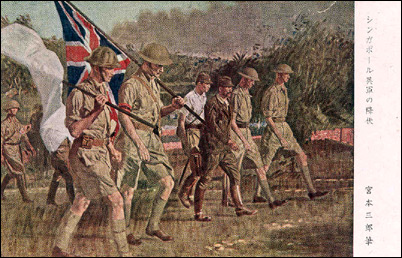
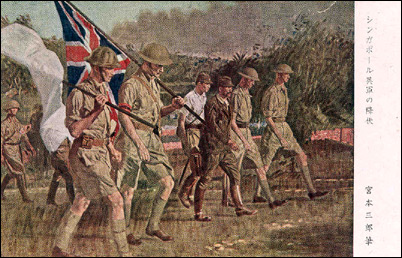
The Japanese also used leaflets to similar effect. The image below is of a Japanese leaflet dropped over British forces in Malaysia.

The text accompanying the image read:

“The fall of Singapore – The East Asian fortress under the intrusion of the British for more than a century – fell on Showa 15th year, the 2nd month, on the 17th day at 6:40 p.m. In a single file, bearing white flags, the British officers of the Malayan Command approached our mighty army to surrender. From the right: Commanding Officer Malaya, Lieutenant General Percival; Chief of the General Staff, Brigadier General Torrance; Staff officer, Colonel Sugita; Interpreter, Ling-zhuan; Chief Administrator of the British High Command, Malaya, Major General Newbiggen, who is holding the Union Jack; and Captain Wylde who serves as interpreter.”

Similar leaflets continue to be in use.

Aircraft equipped with loud speakers have also been used in the service of psychological warfare. During the course of their Indochinese wars, French planes broadcast the following to the Vietminh:

“Compatriots! You have planted a tree! The time has come for you to pick the fruit. V.M. wants to take this fruit away from you.”

“V.M. Soldiers! Today the Air Force, tomorrow, the tanks!”

“Working people, today the Air Force, tomorrow the guns, the machine-guns, the mortars and the mines. Leave your jobs and go back home!”

Radio, likewise, has been used to similar effect. During World War II, Mildred Gillars, also known as “Axis Sally” among the troops, broadcast radio programs intended to demoralize American soldiers. “Home Sweet Home Hour,” for example, was designed to instill homesickness among American soldiers.

To this history, the regime of Syrian President Bashar Assad now adds a new entry: the text message. Targeting Syrian rebels, the regime sent a mass text message to cell phones throughout the country with the message: “Game over.”

They appear to have embraced the limits of the medium and perhaps something of the video game ethos as well. Sadly, for the thousands who have lost their lives and the thousands more who have been displaced, the Syrian uprising has hardly been a game.