The Integrity of Offline Practices

In Technology Matters, historian David Nye distinguished between the knowledge we might gain of a tool by “reading” it as if it were a text and the knowledge that would arise from using the tool. It is the distinction between conceptual knowledge and embodied knowledge or knowledge that we can articulate (e.g., what is the capital of Argentina)  and knowledge that we simply carry in our bodies (e.g., how to type).

To illustrate this distinction, Nye used the American axe as an example:

“The slightly bent form of an American axe handle, when grasped, becomes an extension of the arms. To know such a tool it is not enough merely to look at it: one must sense its balance, swing it, and feel its blade sink into a log. Anyone who has used an axe retains a sense of its heft, the arc of its swing, and its sound. As with a baseball bat or an axe, every tool is known through the body. We develop a feel for it. In contrast, when one is only looking at an axe, it becomes a text that can be analyzed and placed in a cultural context.”

This was well put and instructive. When I recently came across a short essay called “Axe worship” by Bella Bathurst that described the joys of chopping wood, I recalled the passage above from Nye and went on to read the essay with interest piqued.

Bathurst did not disappoint. The essay was just the right length for what it aimed to do and was written in just the right tone. It also included two paragraphs in particular that nicely captured the joy of wood chopping. Here’s the first:

“Personally, I just like chopping for its own sake. There’s something warming about the ritual of it and the sense of provision. Place, stand, breathe, swing, cut. Watching the wood. Watching the radial splits out from the centre, marking the place to bring the axe down, waiting for the faint exhalation of scent from the wood as it falls. Like cooking, it provides a sense of sufficiency and delight but, unlike cooking, log-chopping has a particular rhythm to it, like a form of active meditation. You do, very literally, get into the swing of it.”

And then there was this:

“The point and the pleasure of chopping logs is that it is just me and a stone-age tool. Standing there in the shed in a deep layer of sawdust and chippings, I can hear the birds and the river and the changing note of the blade as it strikes different ages and sizes of timber. I can sense the rhythm of my own work and the difference between old wood and new.”

This resonated with me. Unlike Bathurst, I don’t live in a place that necessitates the chopping of wood for fires to keep warm by. But I have exerted myself in other physical tasks which yielded not entirely dissimilar experiences. But even as Bathurst words were resonating, I was thinking to myself, “I bet Nathan Jurgenson would file this under “IRL Fetish.'”

(IRL – “in real life” – Fetish, you may remember, is Jurgenson’s name for what he takes to be the unseemly valorization of offline, non-digitally mediated activities. Sherry Turkle’s reflective stroll on the shores of Cape Cod was Jurgenson’s paradigmatic case.)

But then I realized something: Bathurst doesn’t mention digital technology at all. She did not frame her experience as an escape or respite from the tyranny of the digital. There was no angst about the hyper-connected life. It was simply a meditation on the joys of swinging an axe. So, then, can it be classified as an instance of “IRL Fetish” if it makes no mention of digital technology?

I wouldn’t think so. This sort of experience appears to be altogether un-preoccupied with the discontents of digital technology. It is not that we can claim that some thought of the digital world never entered Bathurst’s mind — how could we know anyway — but that even if it did (to note that this would make a good online essay for example) it appears to have done so unproblematically.

Bathurst’s account of her experience strikes me, in fact, as another example of a practice which offers, in Joseph Conrad’s words, “a chance to find yourself.” It is a practice in which we might become absorbed, and one that offers the particular pleasures of working against the resistance presented by the material world and the satisfaction that comes from having done so successfully toward some end.

These practices and the pleasures they yield have an integrity of their own that are not necessarily coupled with digital technology (although they may sometimes be justly contrasted to digital technology). What they offer are goods in themselves irrespective of their relationship (or non-relationship) to digital technologies. We should, in other words, engage in these sorts of practices for their own sake, not merely as antidotes or countermeasures to digital mediation.

Perhaps we do such practices and experiences a disservice, those of us who do highlight their significance in light of digital realities, when we discuss them only as such. Ironically, we may, in doing so, be granting digital technology undue prominence, as if these other practices were significant only as modes of resistance to digitally mediated life. Such is not the case.

Hilaire Belloc noted the following long before the advent of digital technology:

“… the most important cause of this feeling of satisfaction is that you are doing what the human race has done for thousands upon thousands of years … Whatever is buried right into our blood from immemorial habit, that we must be certain to do if we are to be fairly happy (of course no grown man or woman can really be very happy for long — but I mean reasonably happy), and, what is more important, decent and secure of our souls. Thus one should from time to time hunt animals, or at the very least shoot at a mark; one should always drink some kind of fermented liquor with one’s food – and especially deeply upon great feast-days; one should go out on the water from time to time; and one should dance on occasions; and one should sing in chorus. For all these things man has done since God put him in a garden and his eyes first became troubled with a soul. Similarly some teacher or ranter or other, whose name I forget, said lately one very wise thing at least, which was that every man should do a little work with his hands.”

Written today this may have “IRL Fetish” written all over it. Written, as it was, in the early 20th century, it is a reminder that advocating such practices and experiences need not necessarily be an act of escapism or fetishizing. It might simply be an honest recognition of what has long been uncontroversially true about human experience. Or, as Freud reportedly put it, sometimes a cigar is just a cigar.

For Your Consideration – 8

(Although I assume that this sort of thing goes without saying these days, I thought I should nonetheless throw out the typical reminder that linking below does not necessarily imply wholesale endorsement.)

“Loss and Gain, or the Fate of the Book”:

“Whether the book survives or not, I am firmly of the opinion that itought to survive, and nothing will convince me otherwise. The heart has its beliefs that evidence knows not of. For me, to browse in a bookshop, especially a second-hand one, will forever be superior to browsing on the internet precisely because chance plays a much larger part in it. There are few greater delights than entirely by chance to come across something not only fascinating in itself, but that establishes a quite unexpected connection with something else. The imagination is stimulated in a way that the more logical connections of the Internet cannot match; the Internet will make people literal-minded …

To refuse to use the new technology in the hope of preserving old pleasures will not work because to do so would be no more authentic or honest than Marie Antoinette playing shepherdess. The regret is genuine; the refusal is not.”

“Out of Touch: E-reading isn’t reading”:

“New research continues to emphasize the importance of mind wandering for learning. It turns out that not paying attention is one of the best ways of discovering new ideas. Reading books, whether silently or aloud, remains one of the most efficient means of enabling such errant thinking. As our bodies rest, our minds begin to work in a different way. New connections, new pathways, and sharp turns are being made as we meander our way through the book, but also away from it. There is no way to tell if anyone is actually paying attention anymore as I read, including myself. This seems to be one of the great benefits of reading aloud, that you can think of something else while you do it. We may be holding the book together, but our minds are no doubt far apart by now. The fairy tale is the first story of childhood because it tells of such leaving behind (parents and home), of entering the dreamscape of the woods—and the mind. It tells of the crooked path of change. How can one know where reading books ends and dreaming in books begins?”

“Kill the Password: Why a String of Characters Can’t Protect Us Anymore”:

“This summer, hackers destroyed my entire digital life in the span of an hour. My Apple, Twitter, and Gmail passwords were all robust—seven, 10, and 19 characters, respectively, all alphanumeric, some with symbols thrown in as well—but the three accounts were linked, so once the hackers had conned their way into one, they had them all. They really just wanted my Twitter handle: @mat. As a three-letter username, it’s considered prestigious. And to delay me from getting it back, they used my Apple account to wipe every one of my devices, my iPhone and iPad and MacBook, deleting all my messages and documents and every picture I’d ever taken of my 18-month-old daughter. Since that awful day, I’ve devoted myself to researching the world of online security. And what I have found is utterly terrifying.”

“Google Now: behind the predictive future of search”:

“In a single app, the company has combined its latest technologies: voice search that understands speech like a human brain, knowledge of real-world entities, a (somewhat creepy) understanding of who and where you are, and most of all its expertise at ranking information. Google has taken all of that and turned it into an interesting and sometimes useful feature, but if you look closely you can see that it’s more than just a feature, it’s a beta test for the future.”

“Gamer’s Paradise: Worshipping At The iOS Altar”:

“Game designer and academic Ian Bogost says the iPhone is a bit like a rosary. I have this way of refreshing my Twitter feed even when it doesn’t need reading, thumbing the touchscreen with a tactile pull-and-release, a sort of nervous lozenging that makes a popping noise when I let go.”

“How to Live Without Irony”:

“The ironic life is certainly a provisional answer to the problems of too much comfort, too much history and too many choices, but it is my firm conviction that this mode of living is not viable and conceals within it many social and political risks.”

“The Science and Art of Listening”:

“Hearing, in short, is easy. You and every other vertebrate that hasn’t suffered some genetic, developmental or environmental accident have been doing it for hundreds of millions of years. It’s your life line, your alarm system, your way to escape danger and pass on your genes. But listening, really listening, is hard when potential distractions are leaping into your ears every fifty-thousandth of a second — and pathways in your brain are just waiting to interrupt your focus to warn you of any potential dangers.

Listening is a skill that we’re in danger of losing in a world of digital distraction and information overload.”

“Axe worship”:

“Personally, I just like chopping for its own sake. There’s something warming about the ritual of it and the sense of provision. Place, stand, breathe, swing, cut. Watching the wood. Watching the radial splits out from the centre, marking the place to bring the axe down, waiting for the faint exhalation of scent from the wood as it falls. Like cooking, it provides a sense of sufficiency and delight but, unlike cooking, log-chopping has a particular rhythm to it, like a form of active meditation. You do, very literally, get into the swing of it.”

Strangers to Ourselves

For reasons that I probably do not myself fully understand, I am endlessly intrigued by discussions of the ever elusive state of being we call authenticity. At least part of the intrigue lies in how a discussion of authenticity can ensnare within itself philosophical, sociological, technological, and even religious considerations. It makes for lively and stimulating discussion in other words. Authenticity talk is intriguing as well because it may be under its guise that the ancient debate about what constitutes a good life and the venerable quest to “know thyself” survive today.

Both of these considerations also suggest a serious difficulty presented by authenticity talk: the word authenticity, as it is commonly used, masks a complex and diverse set of concepts. This complexity and diversity threatens to introduce a slippery equivocation into what might otherwise be well-intended conversations and debates. At least this has been my experience. But then again, discussing what exactly authenticity is is part of what makes such discussions lively and interesting.

My own thinking about authenticity is sporadic and owes more to serendipity than to any conscientious scholarly endeavor. For example, most recently, from no particular quarter, the following question formulated itself in my mind: What is the problem to which authenticity is the answer?

There is nothing particularly insightful about this question, but it did get me thinking about the whole set of ideas from a different angle. The meandering mental path that subsequently unfolded led me to identify this problem as some sort of psychic rupture or dissonance. We don’t think  of authenticity at all unless we think of it as a problem, and it presents itself as a problem at the very time it enters our conscious awareness. It is a problem tied to our awareness of ourselves as selves.

There are many interesting paths that unfold from that point, but I want to offer this one subsequent stab at defining what we (sometimes) mean by authenticity: Authenticity is a seamless continuity between the self, time, and place. It is a sense of complete at-homeness in the world. For this reason, then, we might see nostalgia as another manifestation of the problem of authenticity. Nostalgia — first in its literal sense as longing for spatial home, and then its more contemporary form as longing for a home in time — is a symptom of the rupture in the continuity between self, time, and place that generates an awareness of the self as a problem to be solved, an awareness that constitutes the problem of authenticity.

Framing the discussion as matter of at-homeness (or a lack thereof) recalled to my mind the work of the medical doctor turned novelist cum philosopher, Walker Percy. Percy went from being a diagnostician of physical maladies to one of existential maladies. With his acute Pascalian eye, Percy made a literary career of diagnosing the modern self’s inability to understand itself. This was the theme of his send-off of the self-help genre, Lost in the Cosmos: The Last Self-Help Book.

Percy chose the following passage from Nietzsche as an epigraph for Lost in the Cosmos:

“We are unknown, we knowers, to ourselves … Of necessity we remain strangers to ourselves, we understand ourselves not, in our selves we are bound to be mistaken, for each of us holds good to all eternity the motto, ‘Each is the farthest away from himself’—as far as ourselves are concerned we are not knowers.”

A little further on, in his inventory of possible “selfs” (or should that be “sevles”), Percy offered this description of the lost self:

“With the passing of the cosmological myths and the fading of Christianity as a guarantor of the identity of the self, the self becomes dislocated, … is both cut loose and imprisoned by its own freedom, yet imprisoned by a curious and paradoxical bondage like a Chinese handcuff, so that the very attempts to free itself, e.g., by ever more refined techniques for the pursuit of happiness, only tighten the bondage and distance the self ever farther from the very world it wishes to inhabit as its homeland …. Every advance in an objective understanding of the Cosmos and in its technological control further distances the self from the Cosmos precisely in the degree of the advance—so that in the end the self becomes a space-bound ghost which roams the very Cosmos it understands perfectly.”

Percy was writing in 1983. Centuries earlier, St. Augustine wrote, “I have been made a question to myself.” The problem of authenticity is much older than we sometimes realize. Perhaps we might say that it is a perpetually possible problem that is more or less actualized given certain historical or psychological conditions. Perhaps the problem of authenticity is not a problem at all, but as C.S. Lewis once wrote of nostalgia, the “truest index of our real situation.”

Conjuring Ghosts: Digital Technology and the Past

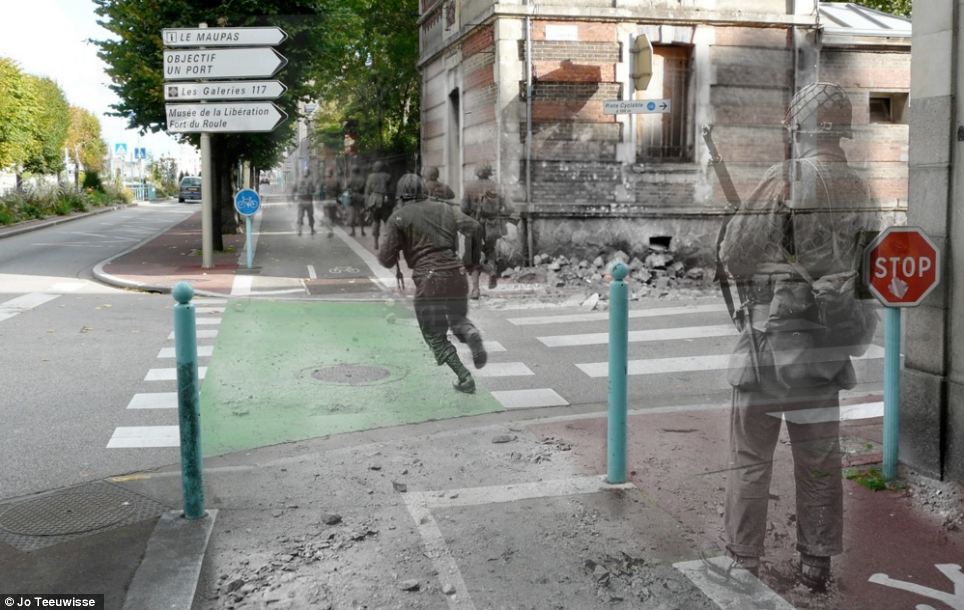
Late last month, I ran across a set of images created by Jo Teeuwisse superimposing scenes from World War II over images of those same places today. The effect has been universally described as haunting, and rightly so. The images also present a rather interesting form of augmented reality. If you’ve hung around this blog for awhile, you may have noticed that memory and place are two recurring themes. Naturally, these images caught my attention. Unfortunately, time constraints being what they are, I never did get around to writing about them.

Fortunately, Miranda Ward has. At Cyborgology, she has written a characteristically intelligent and well-crafted meditation on the images, “On Technology, Memory and Place.” She concludes on this note:

“So technology can do much to harness the power of place – to make memory increasingly social, to represent “the shared experience of bodies co-located in space” – and I think it should: I think this is part of the joy of it. But perhaps we also need to think about preserving the utterly private relationship with place – and what this preservation will look like in a “geo-optimized” world.”

Click through and read the whole.

While reading Ward’s piece, and since first seeing these images, a few related items came to mind.

Back in February, Jason Farman wrote a piece in The Atlantic that reflected on how mobile technology altered our experience of places. Farman discussed one app by the Museum of London that allowed users to see images from London’s past superimposed over the present scene in much the same manner as Teeuwisse’s photographs. Farman was optimistic about what mobile devices can do for our experience of places:

“While none of these practices may seem unique to our digital age – stories have been attached to place throughout history – the ability to connect innumerable narratives to a single site is something that other media haven’t been able to effectively accomplish.”

At the time, I wrote a post in response which leaned a good deal on Michel de Certeau’s reflections on walking the city (it’s a passage I’ve come back to again and again). De Certeau’s writing on this theme is especially pertinent to the photographs that inspired Ward’s essay. In fact, these photographs and the Museum of London app discussed by Farman might be seen as tools to materialize the invisible realities evocatively identified by de Certeau.

Here’s how I then summarized de Certeau on haunted places:

Places have a way of absorbing and bearing memories that they then relinquish, bidden or unbidden. The context of walking and moving about spaces leads de Certeau to describe memory as “a sort of anti-museum:  it is not localizable.”  Where museums gather pieces and artifacts in one location, our memories have dispersed themselves across the landscape, they colonize.  Here a memory by that tree, there a  memory in that house.  De Certeau develops a notion of a veiled remembered reality that lies beneath the visible experience of space.

Places are made up of “moving layers.”  We point, de Certeau says, here and there and say things like, “Here, there used to be a bakery” or “That’s where old lady Dupuis used to live.”  We point to a present place only to evoke an absent reality:  “the places people live in are like the presences of diverse absences.”  Only part of what we point to is there physically; but we’re pointing as well to the invisible, to what can’t be seen by anyone else, which begins to hint at a certain loneliness that attends to memory.

Reality is already augmented.  It is freighted with our memories, it comes alive with distant echoes and fleeting images.

Digitally augmented reality functions analogously to what we might call the mentally augmented reality  that de Certeau invokes. Digital augmentation also reminds us that places are haunted by memories of what happened there, sometimes to very few, but often to countless many. The digital tools Farman describes bring to light the hauntedness of places. They unveil the ghosts that linger by this place and that.

This remains, as evidenced in Ward’s post, a very useful metaphor by which to think about technologies that allow us to conjure the ghosts of the past. As to the question that Ward comes back to on more than one occasion — So what? — I’m not entirely sure. In response to Farman’s essay, I offered up this alternative de Certeau-ian perspective:

Perhaps I am guilty, as Farman puts it, of “fetishizing certain ways of gaining depth.” But I am taken by  de Certeau’s conception of walking as a kind of enunciation that artfully actualizes a multitude of possibilities in much the same way that the act of speaking actualizes the countless possibilities latent in language. Like speaking, then, walking, that is inhabiting a space is a language with its own rhetoric. Like rhetoric proper, the art of being in a place depends upon an acute attentiveness to opportunities offered by the space and a deft, improvised actualization of those possibilities. It is this art of being in a place that constitutes a meaningful and memorable augmentation of reality.

What strikes me now about this conclusion is that it distinguished between an embodied interaction with a place and a strictly mental/visual interaction. These need not be mutually exclusive, of course. But perhaps it is worth noting that by there nature, apps and photographs that bring the past into the present forefront the visual, and the visual is only one way of knowing a place.

While I have been writing this, I have had next to this tab another with the text of W.H. Auden’s “Musée Des Beaux Arts.” This has been coincidental, but now it strikes me as serendipitous. The poem  goes like this:

About suffering they were never wrong,
The Old Masters: how well they understood
Its human position; how it takes place
While someone else is eating or opening a window or
just walking dully along;
How, when the aged are reverently, passionately waiting
For the miraculous birth, there always must be
Children who did not specially want it to happen, skating
On a pond at the edge of the wood:
They never forgot
That even the dreadful martyrdom must run its course
Anyhow in a corner, some untidy spot
Where the dogs go on with their doggy life and the
torturer’s horse
Scratches its innocent behind on a tree.

In Brueghel’s Icarus, for instance: how everything
turns away
Quite leisurely from the disaster; the ploughman may
have heard the splash, the forsaken cry,
But for him it was not an important failure; the sun shone
As it had to on the white legs disappearing into the green
Water; and the expensive delicate ship that must have seen
Something amazing, a boy falling out of the sky,
Had somewhere to get to and sailed calmly on.

With this poem, Auden reflected (via Bruegel’s painting, “Landscape with the Fall of Icarus”) on how suffering often unfolded unnoticed, unremarked upon, and, we might now add, unremembered. The photographs with which we began have the effect of inverting this dynamic. Now we, the living, take note. We can see what then may have passed while someone was dully walking along. It is now we who are the unnoticed ones. The past is there present before our eyes and we can see it, but it is silent with respect to us. It now walks dully on as we make our way, looking, perhaps, to anchor our ephemeral present in its weightiness. But alas they are just ghosts, and the anchor does not hold.

For Your Consideration – 7

“Welcome to the Future Nauseous”: Some jargon and neologisms, but interesting perspective.

“We aren’t being hit by Future Shock. We are going to be hit by Future Nausea.  You’re not going to be knocked out cold. You’re just going to throw up in some existential sense of the word. I’d like to prepare. I wish some science fiction writers would write a few nauseating stories.”

“The World Is Not Enough: Google and the Future of Augmented Reality”:

“It is The Future. You wake up at dawn and fumble on the bedstand for your (Google) Glass. Peering out at the world through transparent screens, what do you see?”

“Speaking in Memes”:

“We’ve developed a kind of meme literacy, a habit of intuiting in real time the potential virality of a speech act — to hear retweets inside words.”

“A Sense of Place”:

“The digital and the physical world are interacting ever more closely. The rapidly declining cost of communications and computing power has already wrought huge changes in the way people go about their daily lives. Digital maps and guides will affect the way people behave in the physical world and bring about yet more changes. The digital and the physical are becoming one.”

How We Talk About Media Refusal, Part 1: “Addiction”:

“This is the first of a series of three posts I’ll be doing in Flow about the topic of “media refusal,” which I define as the active and conscious rejection of a media technology or platform by its potential users. In these posts, I’ll be discussing how popular discourse tends to frame practices of media refusal and what implications these frames might have for the way we understand our participation in media culture.”

“What Words Are Worth”:

“The humanities, encountered primarily in the high school and college years, teach students to recognize a significant question, to make crucial distinctions in the articulation of its terms, to draw consequential conclusions, to assess conclusions in human terms, and to communicate the procedures and results of inquiry. These are all elements necessary for the making of right meaning, and meaning is a singularly powerful shaper of deeds.”