Perspectives on Privacy and Human Flourishing

I’ve not been able to track down the source, but somewhere Marshall McLuhan wrote, “Publication is a self-invasion of privacy. The more the data banks record about each one of us, the less we exist.”

The unfolding NSA scandal has brought privacy front and center. A great deal is being written right now about the ideal of privacy, the threats facing it from government activities, and how it might best be defended. Conor Friedersdorf, for instance, worries that our government has built “all the infrastructure a tyrant would need.” At this juncture, the concerns seem to me neither exaggerated nor conspiratorial.

Interestingly, there also seems to be a current of opinion that fails to see what all the fuss is about. Part of this current stems from the idea that if you’ve got nothing to hide, there’s nothing to worry about. There’s an excerpt from Daniel J. Solove’s 2011 book on just this line of reasoning in the Chronicle of Higher Ed that is worth reading (link via Alan Jacobs).

Others are simply willing to trade privacy for security. In a short suggestive post on creative ambiguity with regards to privacy and government surveillance, Tyler Cowen concedes, “People may even be fine with that level of spying, if they think it means fewer successful terror attacks.”  “But,” he immediately adds, “if they acquiesce to the previous level of spying too openly, the level of spying on them will get worse.  Which they do not want.”

Maybe.

I wonder whether we are not witnessing the long foretold end of western modernity’s ideal of privacy. That sort of claim always comes off as a bit hyperbolic, but it’s not altogether misguided. If we grant that the notion of individual privacy as we’ve known it is not a naturally given value but rather a historically situated concept, then it’s worth considering both what factors gave rise to the concept and how changing sociological conditions might undermine its plausibility.

Media ecologists have been addressing these questions for quite awhile. They’ve argued that privacy, as we understand (understood?) it, emerged as a consequence of the kind of reading facilitated by print. Privacy, in their view, is the concern of a certain type of individual consciousness that arises as a by-product of the interiority fostered by reading. Print, in these accounts, is sometimes credited with an unwieldy set of effects which include the emergence of Protestantism, modern democracy, the Enlightenment, and the modern idea of the individual. That print literacy is the sole cause of these developments is almost certainly not the case; that it is implicated in each is almost certainly true.

This was the view, for example, advanced by Walter Ong in Orality and Literacy. “[W]riting makes possible increasingly articulate introspectivity,” Ong explains, “opening the psyche as never before not only to the external objective world quite distinct from itself but also to the interior self against whom the objective world is set.” Further on he wrote,

Print was also a major factor in the development of the sense of personal privacy that marks modern society. It produced books smaller and more portable than those common in a manuscript culture, setting the stage psychologically for solo reading in a quiet corner, and eventually for completely silent reading. In manuscript culture and hence in early print culture, reading had tended to be a social activity, one person reading to others in a group. As Steiner … has suggested, private reading demands a home spacious enough to provide for individual isolation and quiet.

This last point draws architecture into the discussion as Aaron Bady noted in his 2011 essay for MIT Review, “World Without Walls”:

Brandeis and Warren were concerned with the kind of privacy that could be afforded by walls: even where no actual walls protected activities from being seen or heard, the idea of walls informed the legal concept of a reasonable expectation of privacy. It still does … But contemporary threats to privacy increasingly come from a kind of information flow for which the paradigm of walls is not merely insufficient but beside the point.

This argument was also made by Marshall McLuhan who, like his student Ong, linked it to the “coming of the book.” For his part, Ong concluded “print encouraged human beings to think of their own interior conscious and unconscious resources as more and more thing-like, impersonal and religiously neutral. Print encouraged the mind to sense that its possessions were held in some sort of inert mental space.” Presumably, then, the accompanying assumption is that this thing-like inert mental space is something to be guarded and shielded from intrusion.
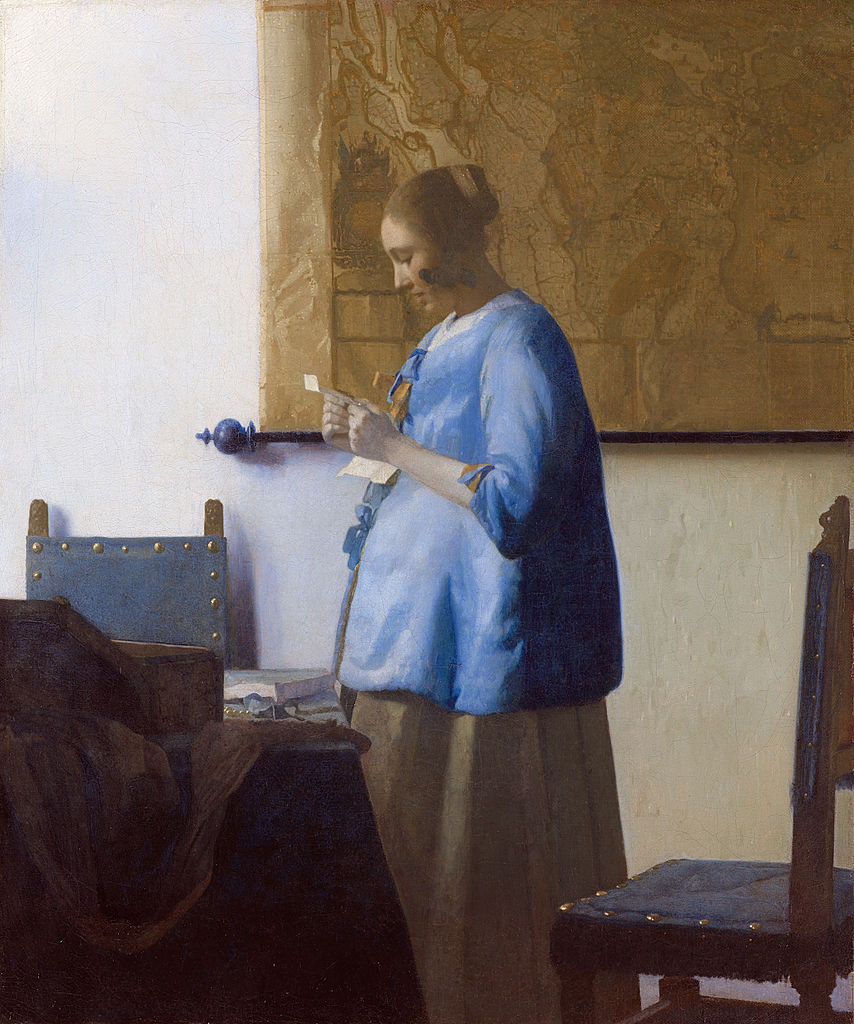
854px-Vermeer,_Johannes_-_Woman_reading_a_letter_-_ca._1662-1663While it is a letter, not a book that she reads, Vermeer’s Woman in Blue has always seemed to me a fitting visual illustration of this media ecological perspective on the idea of privacy. The question all of this begs is obvious: What does the decline of the age of print entail for the idea of privacy? What happens when we enter what McLuhan called the “electric age” and Ong called the age of “secondary orality,” or what we might now call the “digital age”?

McLuhan and Ong seemed to think that the notion of privacy would be radically reconfigured, if not abandoned altogether. One could easily read the rise of social media as further evidence in defense of their conclusion. The public/private divide has been endlessly blurred. Sharing and disclosure is expected. So much so that those who do not acquiesce to the regime of voluntary and pervasive self-disclosure raise suspicions and may be judged sociopathic.

Perhaps, then, privacy is a habit of thought we may have fallen out of. This possibility was explored in an extreme fashion by Josh Harris, the dot-com era Internet pioneer who subjected himself, and willing others, to unblinking surveillance. The experiment in prophetic sociology was documented by director Ondi Timoner in the film We Live in Public.

The film is offered as a cautionary tale. Harris suffered an emotional and mental breakdown as a consequences of his experimental life. On the film’s website, Timoner added this about Harris’ girlfriend who had enthusiastically signed up for the project:  “She just couldn’t be intimate in public. And I think that’s one of the important lessons in life; the Internet, as wonderful as it is, is not an intimate medium. It’s just not. If you want to keep something intimate and if you want to keep something sacred, you probably shouldn’t post it.”

This caught my attention because it introduced the idea of intimacy rather than, or in addition to, that of privacy. As Solove argued in the piece mentioned above, we eliminate the rich complexity of all that is gathered under the idea of privacy when we reduce it to secrecy or the ability to conceal socially marginalized behaviors. Privacy, as Timoner suggests, can also be understood as the pre-condition of intimacy, and, just to be clear, this should be understood as more than mere sexual intimacy.

The reduction of intimacy to sexuality recalls the popular mis-reading of the Fall narrative in the Hebrew Bible. The description of the Edenic paradise concludes – unexpectedly until familiarity has taught you to expect it – with the narrator’s passing observation that the primordial pair where naked and unashamed. A comment on sexual innocence, perhaps, but much more I think. It spoke to a radical and fearless transparency born of pure guilelessness. The innocence was total and so, then, was the openness and intimacy.

Of course, the point of the story is to set up the next tragic scene in which innocence is lost and the immediate instinct is to cover their nakedness. Total transparency is now experienced as total vulnerability, and this is the world in which we live. Intimacy of every kind is no longer a given. It must emerge alongside hard-earned trust, heroic acts of forgiveness, and self-sacrificing love. And perhaps with this realization we run up against the challenge of our digital self-publicity and the risks posed by perpetual surveillance. The space for a full-fledged flourishing of the human person is being both surrendered and withdrawn. The voluntarily and involuntarily public self, is a self that operates under conditions which undermine the possibility of its own well-being.

But, this is also why I believe Bady is on to something when he writes, “Privacy has a surprising resilience: always being killed, it never quite dies.” It is why I’m not convinced that we could entirely reduce all that is entailed in the notion of privacy to a function of print literacy. If something that answers to the name of privacy is a condition of our human flourishing in our decidedly un-Edenic condition, then one hopes we will not relinquish it entirely to either the imperatives of digital culture or the machinations of the state. It is, admittedly, a tempered hope.

In the works …

For some time now I’ve entertained the idea of compiling some of what I’ve written here over the last three years and turning it into an e-book. In part, I’m motivated by the desire to give the work I’ve put into this blog a more finished and enduring form – or, at least what would feel like a more finished and enduring form. I’ve also been intrigued by the process of putting together an e-book and thought it might be interesting to experiment with it. And, of course, it would be disingenuous of me if I didn’t also admit that I’ve wondered whether putting together an e-book might not help finance what remains of grad school. My expectations on that count are, I assure you, quite modest. In any case, entertain the idea is pretty much all I had done with it. Until recently that is.

I’ve been inspired by Jeremy Antley to finally undertake the project. Jeremy is a thoughtful and articulate scholar of Russian history, games, and digital culture who blogs at The Peasant Muse and has written for some of the same online venues I’ve contributed to over the last couple of years. His post on the process of putting together an e-book was tremendously helpful and made the whole thing seem easy enough for me to give a it whirl. I picked up his book at Amazon, and you can also find it at gumroad.

So I’ve been working on a collection I’m tentatively titling The Tourist and the Pilgrim: Essays on Life in a Digital Age. I’m hoping to make it available in the next few days. All of what will be gathered therein, at least in its original form, has been and will remain freely available on this site. But those of you who would appreciate a collection of the better work that’s passed through these pages and an opportunity to support that work, stay tuned, it’s forthcoming.

Update:

One more, possibly oddball thought. I imagine this is the sort of thing a publisher would traditionally do, so this might be a little weird, but, whatever, these are weird times: If you’ve been reading The Frailest Thing for awhile and would be interested in giving me a “back cover blurb” sort of endorsement drop me an email at LMSacasas at gmail dot com. Cheers!

The Frailest Thing Turns Three

WordPress has kindly informed me that today marks the third anniversary of The Frailest Thing.

Just moments ago, I mentioned to a fellow grad student that maintaining this blog has been more beneficial than much of my “official” grad school duties – more than beneficial, it has been a pleasure.

Thanks for reading.


Society of the Spectator

You’ve likely heard or read about Ingrid Loyau-Kennett. She is the woman who calmly conversed with the two men who had just murdered a British soldier on the streets of London  for the nearly 20 minutes it took police to arrive on the scene. If you’ve not, you can read about the whole incident in this profile of Loyau-Kennet that appeared in The Guardian (link via ayjay).

I was particularly struck by the closing paragraphs:

Loyau-Kennett is deeply concerned, she says, about the direction modern society is headed. “I prefer the values of the past than the non-values of today, where most people don’t seem to give a damn about others.” The events of last Wednesday have magnified her feelings. She has particular disdain for some of the people who stood by recording on their phones, refusing to offer help.

“It annoyed me to see those people with mobile phones filming,” she says. “They were doing it for money, with the idea of selling the footage. I was annoyed at what must be in their heads that they just wanted to watch and record the unhappiness of others. And then there was the stupidity of the mothers who had stopped there with their kids. The man could have reached them in five seconds if he’d run at them. It would never cross my mind to show a heavily bleeding body to my kids.”

If people were scared, she ponders, why didn’t they just run away? That’s an understandable reaction, she says. “It’s a horrible mentality that some people have these days. I think we have this culture now – maybe started by things like soap operas – where we have this unhealthy curiosity about other people’s lives. You shouldn’t just be there watching like it’s on TV. By only watching they are actually interfering. Do something useful. Don’t just stand there. Move away.”

Thoughts? What do we make of her analysis? Is this a symptom of what Debord famously called the “society of the spectacle”? Or better, is this a symptom of the evolution of the society of the spectacle into the society of the documenting spectator?

The Ethics of Ethical Tools

In a passage I’m rather fond of, T.S. Eliot wrote of “the endless cycle of idea and action, Endless invention, endless experiment.” How one reads those few words might reveal a good bit about that person’s posture toward technology. If you read it triumphantly, then odds are you are on the whole at peace with the world wrought by modern technology. Eliot, naturally, intended them a bit more gloomily. Endless invention and endless experiment partake in our growing ignorance that brings us nearer to death and no nearer to God. It prompts his well-known series of questions,

“Where is the Life we have lost in living?
Where is the wisdom we have lost in knowledge?
Where is the knowledge we have lost in information?

Whatever you make of the relative merits of endless invention and endless experiment, the former at least is built into the technological project. Melvin Kranzberg captured this reality in the second of his six laws of technology. Reversing the cliché, Kranzberg’s second law reads, “Invention is the mother of necessity.” “Every technical innovation,” he explains, “seems to require additional technical advances in order to make it fully effective.”

And that is a relatively cheery way of putting it. We might simply say that technology creates as many problems as it solves. Naturally, we then turn to additional technologies to solve those problems. Endless invention, endless experiment – for better and for worse. All of this said, consider Blokket.

Blokket is a stylish pouch woven of nylon and silver thread designed to block cell phone signals. (That its name happens to sound as if it were a profane Nordic expression of exasperation is a felicitous coincidence as far as I can tell.)  As one write-up puts it, “once you slip your smartphone in, there will be no calls, texts, or notifications to alert you to activities happening outside arm’s reach.” In the same article, Chelsea Briganti, one of the lead designers, explains Blokket’s usefulness: “Blokket helps people engage in the present moment by providing interludes of relief from technology.”

I don’t know about you, but my initial response to this was decidedly … mixed. As I’ve written before, I’m very much on the side of those who urge us to give our attention, so far as we are able, to those fellow human beings in our immediate presence. Moreover, that attention can be as delicate and tenuous as it is precious.

There are, of course, perfectly reasonable extenuating circumstances. If, for example, your dear friend, who has been out of touch for weeks, is calling from Burkina Faso where she is an aid worker, then, please, by all means take the call. If, while we are talking baseball over beers, your ailing grandmother, wherever she might be, wants to hear the sound of your voice, please do oblige. If, while we are hiking the Appalachian Trail, I am bit by a rattlesnake, then, yes, I release you to check your smartphone for the appropriate first aid protocol. All of that should go without saying.

But otherwise, I’m of the party that finds the recent Facebook Home ad campaign … what is the word … grotesque. Or, as Evan Selinger more eloquently put it, “Social media — including self-indulgent interfaces like Home — only gets in the way of us being genuinely responsive to and responsible for others if we let it undermine ethical effort in maintaining meaningful connections. It only diminishes our characters and true social networks if we treat Selfish Girl as a role model rather than a tragically misguided soul.”

Attention is a precious resource these days, and we need to be better at directing it ethically rather than self-servingly or even efficiently. Incidentally, making that point is a perfectly good excuse to include a short film rendering a relevant portion of David Foster Wallace’s Kenyon College address (see below).

So I am naturally inclined to appreciate a product that markets itself as an aid to the humane deployment of attention. Good for them. Of course, another response soon arises from the more cynical recesses of my consciousness. Do we really need to buy what amounts to a fashion accessory in order to behave like minimally decent human beings? Are we so pathetic that we have to enlist the help of ethical props in order achieve the mere baseline of civilized action? Isn’t this merely the aestheticization and commodification of decency?

Well, maybe. As my cynicism subsides, I consider the fact that we are rarely as good as we want to be. Many seem not to want to be good at all, but that is a separate problem. I know, from my own experience, that when the moment comes to act on the principles I embrace, I don’t always follow through. I know what is right in the abstract, but when it comes time to act concretely, I appear to forget. Of course, I am not really forgetting. I am simply heeding other motives and desires, which at that moment override my desire to act generously or selflessly.

Our wills are divided. Certain philosophers have talked about this reality in terms of desires and second order desires. Second order desires are understood to be desires about our desires. Applied to the present case, we may find ourselves desiring to momentarily ignore the person we are with in order to check our smartphone for no good reason. But our better self wishes that we didn’t feel that desire. Our better self knows better and it rues that urge to do otherwise. That better self expresses the second order desire that we would not desire to fiddle with our smartphone at all. But alas we do, and our better self does not always win the battle of our divided wills.

This is not a new problem. St. Paul complains in one of his letters, “I do not understand my own actions. For I do not do what I want, but I do the very thing I hate … I have the desire to do what is right, but not the ability to carry it out. For I do not do the good I want, but the evil I do not want is what I keep on doing.”

The most famous illustration is typically drawn from Homer’s Odyssey in which Odysseus both knows that he should not heed the Siren’s song and that, when the moment comes, he most likely will. So he takes precautions: he plugs the ears of his crew, and then he has them tie him to the mast of his ship. In other words, while his better, wiser self is in charge he makes provisions to bind his weaker self.

A more recent illustration was supplied offhandedly by tech critic Evgeny Morozov in an interview. Here is how he describes the lengths to which he must go in order to moderate his use of the Internet:

“I have bought myself a type of laptop from which it was very easy to remove the Wi-Fi card – so when I go to a coffee shop or the library I have no way to get online. However, at home I have cable connection. So I bought a safe with a timed combination lock. It is basically the most useful artefact in my life. I lock my phone and my router cable in my safe so I’m completely free from any interruption and I can spend the entire day, weekend or week reading and writing. … To circumvent my safe I have to open a panel with a screwdriver, so I have to hide all my screwdrivers in the safe as well. So I would have to leave home to buy a screwdriver – the time and cost of doing this is what stops me.”

Morozov’s safe is another instance of Odysseus’ mast. Other examples could be easily supplied. Perhaps you have a few of your own. We wish that we had the strength of will to simply act how we know we ought to act, but alas we do not (and this for a whole host of reasons). The whole notion of a sense of duty, now rather regrettably out of fashion, was premised on the honest recognition that, apart from a sense of duty, we would not always spontaneously act in the most morally appropriate fashion.

Without digressing too much further, though, it would seem that if the choice is between, on the one hand, acting decently with the help of some extension of our will or ethical prosthetic, or, on the other, not acting decently at all, then let us embrace the extension of our will. Buy yourself a Blokket and slip your phone inside straightaway.

Yet … I can’t quite still that little voice inside of me that says, “Wouldn’t it be better still if you would just become the sort of person that didn’t need such extensions of the will?”

I think the answer to that question is, probably, yes. The question arises from that nagging sense that extensions of the will, well-intentioned and effective though they may be, feel as if they are a waving of the white-flag of moral surrender. But it need not be that at all, and this is where the write-up I cited earlier registers an important point. It appears that when the design company field tested Blokket, they found that, in the article’s words, “using the pouch actually helped to create new habits; users found themselves comfortably making the decision to keep interactions face to face and in the flesh.”

This warms my Aristotelian heart.

Simplistically stated, Aristotle’s theory of virtue is premised on the cultivation of habits that then become inner dispositions. In other words, if you know what the right thing to do is, but you don’t always act on that knowledge, then figure out a way of making that action habitual – by an extension of the will for example – and when that habit is internalized, you will then act on it instinctively as a matter of character.

Within this framework then, extensions of the will are not so much white flags of moral surrender as they are training wheels that will eventually be discarded.

That is all very neat and tidy. In the trenches of our moral lives, it is admittedly quite a bit messier than that. But all in all, it is not a bad way (even if it is incomplete) to think about our moral formation. If nothing else, something like Blokket is a step in the direction of mindfulness. That silly little pouch will at least make us conscious of the stakes. It is a token to remind us of what we know is the better way to be with others. We may not always choose that way – how hard is it to slip the phone out of the pouch anyway – but at the very least we will have a small obstacle to arrest the automatic and unthinking selfishness that is, for many of us, our habitual default.

[UPDATE: The video I refer to above has apparently been taken due to copyright issues. Here is a link to the audio of commencement address on which the video was based.]