Don’t Be a Relay in the Network

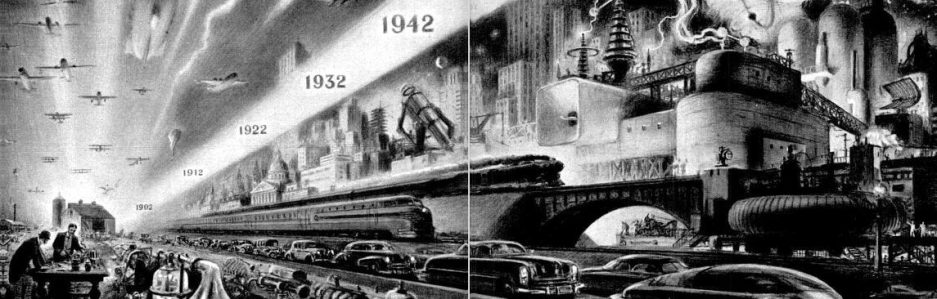
Back when the Machine was the dominant technological symbol, a metaphor arose to articulate the fear that individual significance was being sacrificed to large-scale, impersonal social forces: it was the fear of becoming “a cog in the machine.”

The metaphor is in need of an update.

This train of thought (speaking of archaic metaphors) began when I read the following paragraph from Leon Wieseltier’s recent commencement address at Brandeis University:

In the digital universe, knowledge is reduced to the status of information. Who will any longer remember that knowledge is to information as art is to kitsch-–that information is the most inferior kind of knowledge, because it is the most external? A great Jewish thinker of the early Middle Ages wondered why God, if He wanted us to know the truth about everything, did not simply tell us the truth about everything. His wise answer was that if we were merely told what we need to know, we would not, strictly speaking, know it. Knowledge can be acquired only over time and only by method.

It was that last phrase that stayed with me: knowledge can only be acquired by time and method. I was already in fundamental agreement with Wieseltier’s distinction between information and knowledge, and his prescription of time and method as the path toward knowledge also seemed just about right.

It also seemed quite different than what ordinarily characterized my daily encounter with digital information. For the most part, I’m doing well if I keep on top of all that comes my way each day through a variety of digital channels and then pass along – via this blog, Twitter, FB, or now Tumblr – items that I think are, or ought to be of interest to the respective audiences on each of those platforms. Blog, reblog. Like, share. Tweet, retweet. Etc., etc., etc.

Read, then discard or pass along. Repeat. That’s my default method. It’s not, I suspect, what Wieseltier had in mind. There is, given the sheer volume of information one takes in, a veneer of learnedness to these habits. But there is, in fact, very little thought involved, or judgment. Time under these circumstances is not experienced as the pre-condition of knowledge, it is rather the enemy of relevance. The meme-cycle, like the news-cycle is unforgivingly brief. And method – understood as the deliberate, sustained, and, yes, methodical pursuit of deep understanding of a given topic – is likewise out of step with the rhythms of digital information.

Of course, there is nothing about digital technology that demands or necessitate’s this kind of relationship to information or knowledge. But while it is not demanded or necessitated, it is facilitated and encouraged. It is always easier to attune oneself to the dominant rhythms than it is to serve as the counterpoint. And what the dominant rhythm of digital culture encourages is not that we be cogs in the machine, but rather relays in the network.

We are relays in a massive network of digital information. Information comes to me and I send it out to you and you pass it along to someone else, and so on, day in and day out, moment by moment. In certain circles it might even be put this way: we are neurons within a global mind. But, of course, there is no global mind in any meaningful sense that we should care about. It is a clever, fictive metaphor bandied about by pseudo-mystical techno-utopians.

The minds that matter are yours and mine, and their health requires that we resist the imperatives of digital culture and re-inject time and method into our encounters with information. It begins, I think, with a simple “No” to the impulse to quickly skim-read and either share or discard. May be even prior to this, we must also renounce the tacit pressure to keep up with it all (as if that were possible anyway) and the fear of missing out. And this should be followed by a willingness to invest deep attentiveness, further research, and even contemplation over time to those matters that call for it. Needless to say, not all information justifies this sort of cognitive investment. But all of us should be able to transition from the nearly passive reception and transmission of information to genuine knowledge when it is warranted.

At their best, digital technologies offer tremendous resources to the life of the mind, but only if we cultivate the discipline to use these technologies against their own grain.
Et in Facebook ego

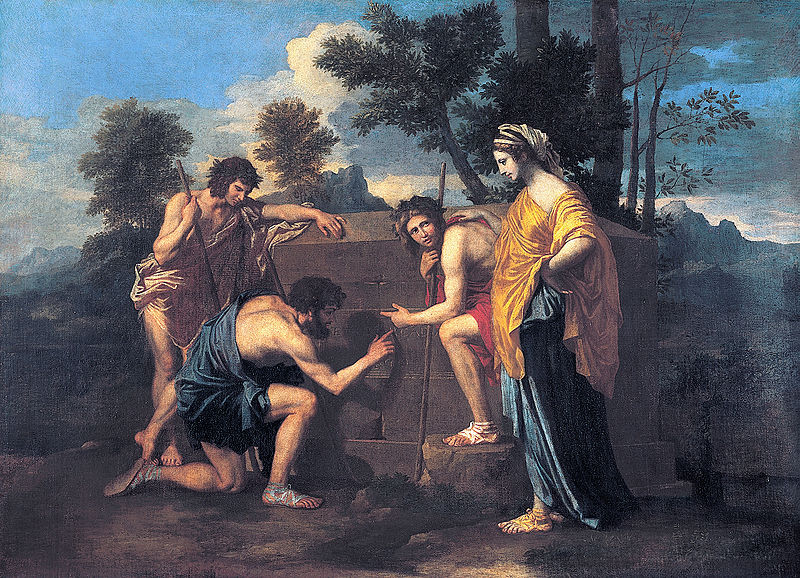
In Nicolas Poussin’s mid-seventeenth century painting, Et in Arcadia ego, shepherds have stumbled upon an ancient tomb on which the titular words are inscribed. Understood to be the voice of death, the Latin phrase may be roughly translated, “Even in Arcadia there am I.” Because Arcadia had come to symbolize a mythic pastoral paradise, the painting suggested the ubiquity of death. To the shepherds, the tomb was a momento mori: a reminder of the inescapability of death.

Nicolas Poussin, Et in Arcadia ego, 1637-38

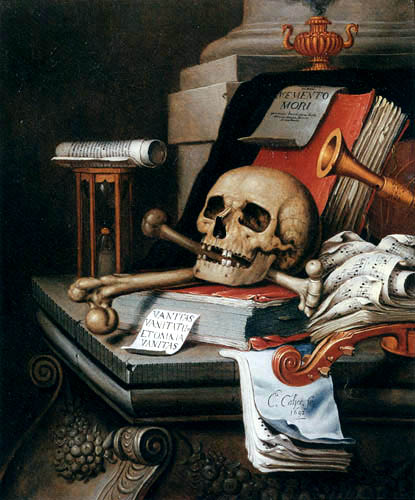
Poussin was not alone among artists of the period in addressing the certainty of death. During the seventeenth and eighteenth century, vanitas art flourished. The designation stems from the Latin phrase vanitas vanitatum omni vanitas, a recurring refrain throughout the biblical book of Ecclesiastes:  “vanity of vanities, all is vanity.” Paintings in the genre were still lifes depicting an assortment of objects which represented all of that we might pursue in this life. In their midst, however, one would also find a skull and an hour glass:  symbols of death and the brevity of life. The idea, of course, was to encourage people to make the most of their living years.

Edwart Collier, 1690

For the most part, we don’t go in for this sort of thing anymore. Few people, if any, operate under the delusion that we might escape death (excepting the Singularity folks I guess), but we do a pretty good job of forgetting what we know about death. We keep death out of sight and, hence, out of mind. We’re certainly not going out of our way to remind ourselves of death’s inevitability. And, who knows, maybe that’s for the better. Maybe all of those skulls and hourglasses were morbidly unhealthy. I honestly don’t know.

But while vanitas art has gone out of fashion, a new class of memento mori has emerged: the social media profile.

I’m one of those on again, off again Facebook users. Lately, I’ve been on again, and recently I noticed one of those birthday reminders Facebook places in the left hand column where it puts all of the things Facebook would like you to do and click on. It was for a high school friend whom I had not spoken to in over eight years. It was in that respect a very typical Facebook friendship:  the sort that probably wouldn’t exist at all any longer were it not for Facebook. And that’s not necessarily a knock on the platform. I appreciate being able to maintain at least a minimal connection with people I’d once been quite close to. In this case, though, it demonstrated just how weak those ties can be.

Upon clicking over to their profile, I read a few odd birthday notes, and very quickly it became obvious that my high school friend had died over a year ago. It was a shock, of course. It had happened while I was off of Facebook and news had not reached me by any other channel. But there it was. Out of nowhere and without warning my browser was haunted by the very real presence of death. Momento mori.

Just a few days prior I logged on to Facebook and was greeted by the tragic news that a former student had unexpectedly passed away. Because we had several mutual connections, photographs of the young man found their way into my news feed for several days. It was odd and disconcerting and terribly sad all at once. I don’t know what I think of social media mourning. It makes me uneasy, but I won’t criticize what might bring others solace. In any case, it is, like death itself, an unavoidable reality of our social media experience. Death is no digital dualist.

Facebook sometimes feels like a modern-day Arcadia. It is a carefully cultivated space in which life appears Edenic. The pictures are beautiful, the events exciting, the face are always smiling, the children always amusing, the couples always adoring. Certain studies even suggest that comparing our own experience to these immaculately curated slices of life leads to envy, discontent, and unhappiness. Naturally … if we assume that these slices of life are comprehensive representations of the lives people lead. Of course, they are not.

But there, alongside the pets and witty status updates and wedding pictures and birth announcements, we will increasingly find our social media platforms haunted by the digital, disembodied presence of the dead.

In that dreary opening chapter of The Scarlett Letter, Hawthorne wrote, “The founders of a new colony, whatever Utopia of human virtue and happiness they might originally project, have invariably recognized it among their earliest practical necessities to allot a portion of the virgin soil as a cemetery, and another portion as the site of a prison.”

And so it is with our digital utopias, our virtual Arcadias.

Et in Facebook ego.

Thinking and Its Rhetorical Enemies

In one short post, Alan Jacobs targeted several Borg Complex symptoms. The post was triggered by his frustration with an xkcd comic which simply strung together a series of concerns about technological developments expressed in the late 19th and early 20th century. The implicit message was abundantly clear: “Wasn’t that silly and misguided? Of course it was. Now stop your complaining about technology today.”

Jacobs raised four salient points in response:

1. “Why do we just assume that their concerns were senseless?”

2. While we may endorse the trade-offs new technologies entail, “it would be ridiculous to say that no trade has been made.”

3. “Moreover, even if people were wrong to fear certain technologies in the past, that says absolutely nothing about whether people who fear certain other technologies today are right or wrong.”

4. This sort of thing presents “an easy excuse not to think about things that need to be thought about.”

Exactly right on all counts.

In partial response to Jacobs’ question, I’d suggest that when living memory of a lost state of affairs also perishes, so to does the existential force of the loss and its plausibility. What we know is that life went on – here we are after all – and that seems to be the only bright line of consequence. All that is established by this, of course, is that we eventually acclimated to the new state of affairs. That we eventually get used to a state of affairs tells us nothing about its quality or desirability, nor that of the state of affairs that was displaced. To assume that it does is a future-tense extension of the naturalistic fallacy: simply because something comes to be the case, it does not follow that it ought to be the case.

The second point above recalls Neil Postman’s discussion of (yes, you guessed it) Phaedrus, Plato’s famous dialog in which Socrates tells the story of Thamus and Theuth. The god Theuth presents Thamus, king of Egypt, with a number of inventions including writing. Theuth is understandably excited about his creations, but Thamus is less sanguine. He warns that writing, among other things, will destroy memory. Learning to cite this story and dismiss it scornfully must be the first thing they teach you in tech-punditry school. But, as Jacobs points out, Thamus was not wrong. Here is Postman’s take:

“[Thamus’ error] is not in his claim that writing will damage memory and create false wisdom. It is demonstrable that writing has had such an effect. Thamus’ error is in his believing that writing will be a burden to society and nothing but a burden. For all his wisdom, he fails to imagine what writing’s benefits might be, which, as we know, have been considerable.”

“Every technology,” Postman goes on to say, “is both a burden and a blessing; not either-or, but this-and-that.” Those who see only blessing Postman labels “zealous Zeuths, one-eyed prophets who see only what new technologies can do and are incapable of imagining what they will undo.” Postman grants, of course, that there are also one-eyed prophets who speak only of the burdens of technology. It is best then to open both eyes.

Jacobs’ third point reminds us that the one-eyed prophets of technological blessing, those who dismiss the silly fears of previous generations, take Chicken Little as their normative story: the sky never, ever falls. As I’ve written before, the tale of the boy who cried wolf serves better. Even if earlier alarms proved false, it does not follow that the wolf never comes.

Finally, it is the fourth point that bears reiterating most emphatically. We need to think more, not less. It is that simple. There are many problems with Borg Complex rhetoric; that it undermines thinking and judgement may be the most disturbing and damaging.

Kindling

The Tourist and the Pilgrim is now available through the Kindle Store.

I’m grateful to those of you who’ve picked up a copy and spread the word.

A couple of observations: First, you all are generous. Almost everyone who’s picked up a copy at Gumroad has paid more than the asking price. Secondly, if you refine the category sufficiently, it’s apparently not that hard to crack a top 100 list on Amazon, at least temporarily.

rank

Also, thanks for your patience as I do some self-promotion. I can barely stand it myself, but if I’ve put the thing together, I should at least make sure people know it’s out there.

UPDATE: Well, we’re movin’ on up …

ranking

The Tourist and the Pilgrim: Essays on Life and Technology in the Digital Age

A few days ago, I noted, thanks to a WordPress reminder, that The Frailest Thing had turned thee. I had little idea what I was doing when I started blogging, and wasn’t even very clear on why I was doing so. I had just started my graduate program in earnest, so I was reading a good bit and, in part at least, I thought it would be useful to process the ideas I was engaging by writing about them. Because I was devoting myself to course work, I was also out of the classroom for the first time in ten years, and the teacher in me wanted to keeping teaching somehow.

So I began blogging and have kept it up these three years and counting.

The best of these three years of writing is, I’m happy to announce, now available in an e-book titled, The Tourist and the Pilgrim: Essays on Life and Technology in the Digital Age.

Forty-six essays are gathered into eight chapters:

1. Technology Criticism
2. Technology Has a History
3. Technology and Memory
4. Technology and the Body
5. Ethics, Religion, and Technology
6. Being Online
7. Our Mediated Lives
8. Miscellany

Not surprisingly, these chapters represent fairly well the major areas of interest that have animated my writing.

Right now, the e-book is only available through Gumroad. Of course, feel free to share the link: https://gumroad.com/l/UQBM. You will receive four file formats (PDF, .epub, .mobi, .azw3). The .mobi file will work best with your Kindle. Some formatting issues are holding up availability through Amazon, but it should also be available there in the next couple of days for those who find that more convenient.

Each of the essays can be found in some form online, but I have revised many of them to correct obvious errors, improve the quality of the prose, and make them read more naturally as stand-alone pieces. Nonetheless, the substance remains freely available through this site.

Convenience and a few improvements aside, those of you who have been reading along with me for some time will not find much you haven’t seen before. You might then consider Gumroad something akin to a tip jar!

Finally, because I would not presume they would see it otherwise, I’d like to share the Acknowledgements section here:

Each of these essays first appeared in some form on The Frailest Thing, a blog that I launched in the summer of 2010. I’m not sure how long the blogging venture would have lasted were it not for the encouragement of readers along the way. I’m especially grateful for those who through their kind words, generous linking, and invitations to write for their publications have given my writing a wider audience than it would’ve had otherwise. On that score, my thanks especially to Adam Thierer, Nathan Jurgenson, Rob Horning, Emily Anne Smith, Alan Jacobs, Nick Carr, Cheri Lucas Rowlands, Matthew Lee Anderson, and Evan Selinger.

But I must also acknowledge a small cadre of friends who read and engaged with my earliest offerings when there was no other audience of which to speak. JT, Kevin, Justin, Mark, David, Randy – Cheers!

And, of course, my thanks and love to my wife, Sarah, who has patiently tolerated and supported my online scribblings these three years.

Deo Gratias

My thanks, of course, are owed to all of you who have stopped by along the way. While it may sound sappy and trite, I have to say there is still something quite humbling about the fact that when I offer up my words, which is to say something of my self, there are those who come around and take the time to read them.

There is a sense in which I’ve written for myself. The writing has helped me in my effort to understand, or, as Hannah Arendt put, “think what we are doing.” It is no small thing to me that in making that process public, some have found a thing or two of some value.

Cheers!

cropped-picture-0062.jpg

