Google Glass: Technology as Symbol

[Note: This post first appeared on Medium in July. At the time, I mentioned it on this blog and provided a link. I’m now republishing the post here in its entirety.] 

Sometimes a cigar is just a cigar, Freud reportedly quipped, and sometimes technology is just a tool. But sometimes it becomes something more. Sometimes technology takes on symbolic, or even religious significance.

In 1900, Paris welcomed the new century by hosting the Exposition Universelle. It was, like other expostions and worlds’ fairs before it, a showcase of both cultural achievement and technological innovation. One of the most popular exhibits at the Exposition was the Palace of Electricity which displayed a series of massive dynamos powering all the other exhibition halls.Among the millions of visitors that came through the Palace of Electricity, there was an American, the historian and cultural critic Henry Adams, who published a memorable account of his experience. Adams was awestruck by the whirling dynamos and, perhaps because he had recently visited the cathedral at Chartres, he drew an evocative comparison between the dynamo and the power of the Virgin in medieval society. Speaking in the third person, Adams wrote,

As he grew accustomed to the great gallery of machines, he began to feel the forty-foot dynamos as a moral force, much as the early Christians felt the Cross. The planet itself seemed less impressive, in its old-fashioned, deliberate, annual or daily revolution, than this huge wheel, revolving within arm’s length at some vertiginous speed, and barely murmuring — scarcely humming an audible warning to stand a hair’s-breadth further for respect of power — while it would not wake the baby lying close against its frame. Before the end, one began to pray to it; inherited instinct taught the natural expression of man before silent and infinite force.

Writing in the early 1970s, Harvey Cox revisited Adams’ meditation on the Virgin and the Dynamo and concluded that Adams saw “what so many commentators on technology since then have missed. He saw that the dynamo … was not only a forty-foot tool man could use to help him on his way, it was also a forty-foot-high symbol of where he wanted to go.”

Cox looked around American society in the early 70s, and wondered how Adams would read the symbolic value of the automobile, the jet plane, the hydrogen bomb, or a space capsule. These too had become symbols of the age and they invited a semiology of the “symbolism of technology.”

“Technological artifacts become symbols,” Cox wrote, “when they are ‘iconized,’ when they release emotions incommensurate with their mere utility, when they arouse hopes and fears only indirectly related to their use, when they begin to provide elements for the mapping of cognitive experience.”

Take the airplane, for example. In his classic study, The Winged Gospel: America’s Romance with Aviation, Joseph Corn summarized a remarkable article that appeared in 1916 about the future of flight. In it, the author predicted trans-oceanic flights by 1930 and, by 1970,the emergence of “traffic rules of the air” necessitated by the heavy volume of airplane traffic. Then the timeline leaps forward to the year 3000. At this point “superhumans” would’ve evolved and they would “live in the upper stratas of the atmosphere and never come down to earth at all.” By the year 10000, “two distinct types of human beings” would have appeared: “Alti-man” and “ground man.” Alti-man would live his entire life in the sky and would have no body, he would be an “ethereal” being that would “swim” in the sky like we swim in the ocean.

As Corn put it, “Alti-man was nothing if not a god. He epitomized the winged gospel’s greatest hope: mere mortals, mounted on self-made mechanical wings, might fly free of all earthly contraints and become angelic and divine.”

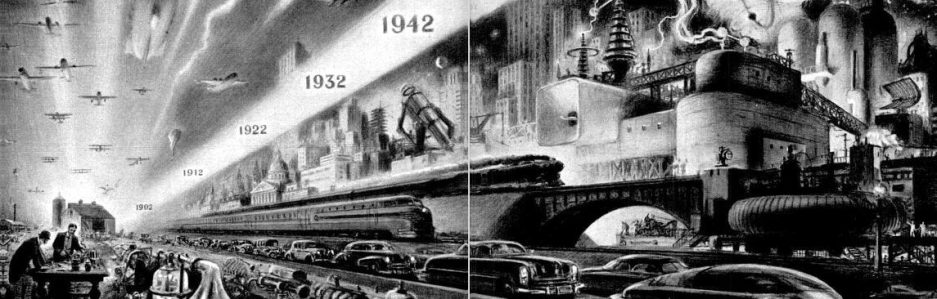
This may all sound tremendously hoaky to our ears, but Corn’s book is full of only slightly less implausible aspirations that attached themselves to the airplane throughout the early and mid-twentieth century. And it wasn’t just the airplane. In American Technological Sublime, historian David Nye chronicled the near-religious reverence and ritual that gathered around the railroad, the first skyscrapers, the electrified cityscape, the Hoover Dam, atomic bombs, and Saturn V rockets.

Taking an even broader historical perspective, the late David Noble argued that the modern technological project has always been shot through with religious and quasi-spiritual aspirations. He traced what he called the “religion of technology” back from the late medieval era through pioneering early modern scientists to artificial intelligence and genetic engineering.

The symbolism of technology, however, does not always crystalize society’s hopes and ambitions. To borrow Cox’s phrasing, it does not always embody where we want to go. Sometimes it is a symbol of fears and anxieties. In The Machine in the Garden, for instance, Leo Marx meticulously detailed how the locomotive became a symbol that collected the fears and anxieties generated by the industrial revolution in nineteenth century America.

As late as 1901, long since the railroad had become an ordinary aspect of American life, novelist Frank Norris describes it in The Octopus as “a terror of steam and steal,” a “symbol of vast power, huge, terrible, flinging the echo of its thunder, over all the reaches of the valley,” and a “leviathan, with tentacles of steel clutching into the soil, the soulless Force, the iron-hearted Power, the monster, the Collussus, the Octopus.”

The sublime experience accompanying the atomic bomb also inspired fear and trepidation. This response was most famously put into words by Rober Oppenheimer when, after the detonation of the first atomic bomb, he quoted the Bhagavad Gita: “I am become Death, the destroyer of worlds.”

This duality is not surprising given what we know about religious symbols generally. Drawing on sociologist Emile Durkheim, Cox noted that sacred symbols “are characterized by a high degree of power and ofambiguity. They arouse dread and gratitude, terror and rapture. The more central and powerful a symbol is for a culture the more vivid the ambiguity becomes.” The symbolism of technology shares this interplay between power and ambiguity. Our most powerful technologies both promise salvation and threaten destruction.

So what are the symbolic technologies of our time? The recent farewell tour by the space shuttle fleet evoked something approaching Nye’s technological sublime, and so too did Curiosity’s successful Mars landing. Neither of these, however, seem to rise to the level of technological symbolism described by Cox. They are momentarily awe-inspiring, but they are not quite symbols. The Singularity movement certainly does contain strong strands of Noble’s “religion of technology,” and it explicitly promises one of humanity’s long sought after dreams, immortality. But the movement’s ambitions do not easily coalesce around one particular technology or artifact that could collect its force into a symbol.

Here’s my candidate: Google Glass.

I can’t think of another recent technology whose roll-out has occasioned such a strong and visceral backlash. You need only scroll through a few months worth of posts at Stop the Cyborgs to get a feel for how all manner of fears and anxieties have gathered around Glass. Here are some recent post titles:

Google Won’t Allow Face Recognition on Glass Yet

Überveillance | Think of it as big brother on the inside looking out

Consent is not enough: Privacy Self-Management and the Consent Dilemmas

Stigmatised | Face recognition as human branding

The World of Flawed Data and Killer Algorithms is Upon Us…

Google Glass; Making Life Efficient Through Privacy Invasion

Glass has appeared at a moment already fraught with anxiety about privacy, and that was the case even before recent revelations about the extent and ubiquity of NSA surveillance. In other words, just when the fear of being watched, monitored, or otherwise documented has swelled, along comes a new technology in the shape of glasses, our most recognizable ocular technology, that aptly serves as an iconic representation of those fears. If our phones and browsers are windows into our lives, Glass threatens to make our gaze and the gaze of the watchers one and the same.

But remember the dual nature of potent symbols: we have other fears to which Glass may present itself as a remedy. We fear missing out on what transpires online, and Glass promises to bring the Internet right in front of our eyes so we will never have to miss anything again. We fear experiences may pass by without our documenting them, and Glass promises the power to document our experience pervasively. If we fear being watched, Glass at least allows us to feel as if we can join the watchers. And behind these particular fears are more primal, longstanding fears: the fear of loneliness and isolation, the fear of death, the fear of insecurity and vulnerability. Glass answers to these as well.

Interestingly, the website I cited earlier was not called, “Stop Google Glass”; it was called, “Stop the Cyborgs.” Perhaps Google Glass is the icon the Singularity project has been looking for. Glass is not quite an implant, but something about its proximity to the body or about how it promises to fade from view and become the interface through which our consciousness experiences reality … something about it suggests the blurring of the line between human and machine. Perhaps that is the greatest fear and highest aspiration of our age. The fears of those who would preserve humanity as they know it, and the aspirations of those who are prepared, as they see it, to trascend humanity are embodied in Glass.

Long before he visited the Exposition Universelle, Henry Adams wrote to his brother:

You may think all this nonsense, but I tell you these are great times. Man has mounted science and is now run away with. I firmly believe that before many centuries more, science will be the master of man. The engines he will have invented will be beyond his strength to control. Some day science may have the existence of mankind in its power, and the human race commit suicide by blowing up the world.

We might think all that nonsense, but it wasn’t that long ago that fears of a nuclear winter gripped our collective imagination. More recently, other technological scenarios have fueled our popular cultural nightmares: biogenetically cultivated global epidemics, robot apocalypses, or climate catastrophes. In each case, the things we have made “become Death, destroyer of worlds.” With Glass, the fear is not that we will blow up the world or unleash a global catastrophe. It is that we will simply innovate the humanity out of ourselves. Remembering how the story turned out, we might put the temptation this way: If we will place Glass before our eyes, they will be opened, and we will become as gods.

Of course, reading the symbolism of technology is not quite like reading palms or tea leaves. The symbols necessitate no particular future in themselves. But they are cultural indicators and as such they reveal something about us, and that is valuable enough.
A Hedgehog in a Fox’s World

I’m ordinarily reluctant to complain. This is partly a function of personality and partly a matter of conviction. I’m reticent by nature, and I tend to think that most complaining tends to be petty, self-serving, unhelpful, and tiresome.

That said, I’ve found myself complaining recently. I’m thinking of two separate incidents in the last week or so. In one exchange, I wrote to a friend that I was “Well enough, in that stretched-so-thin-people-can-probably-see-through-me kind of way.” In another conversation, I admitted that what annoyed me about my present situation, the situation that I’ve found myself in for the past few years, was that I was attempting to do so many things simultaneously I could do none of them well.

I teach in a couple of different settings, I’m trying to make my way through a graduate program, I’ve got a writing project that’s taken me much too long to complete, and I’d like to be a half-way decent husband. I could list other demands, but you get the idea. And, of course, those of you with children are reading this and saying, “Just you wait.” And that’s the thing: most people “feel my pain.” What I’m describing seems to be what it feels like to be alive for most people I know.

I was reminded of Isaiah Berlin’s famous discussion of the fox and the hedgehog. Expounding on an ancient Greek saying — “the fox knows many things, the hedgehog knows one big thing” — Berlin went on to characterize thinkers as either foxes or hedgehogs. Plato, Hegel, Nietzsche, for example, were hedgehogs; they had one big idea by which they interpreted the whole of experience. Aristotle, Montaigne, and Goethe were foxes; they were more attuned to the multifarious particularities of experience.

Berlin had intellectual styles in mind, but, if I may re-apply the proverb to the realm of action in everyday life, I find myself wanting to be a hedgehog. I want to do one thing and do it well. Instead, I find myself having to be a fox.

The more I thought about it, the more it seemed to me that this was, in fact, a pretty good way of thinking about the character of contemporary life and competing responses to the dynamics of digital culture.

Clearly, there are forces at play that predate the advent of digital technologies. In fact, part of the unsettled, constantly shifting quality of life I’m getting at is what sociologist Zygmunt Bauman has called “liquid modernity.” The solid structures of pre-modern, and even early modern society, have in our late-modern (postmodern, if you prefer) times given way to flux, uncertainty, and instability. (If you survey the titles of Bauman’s books over the last decade or so, you’ll quickly notice that Bauman has something of the hedgehog in him.)

The pace, structure, and dynamism of digital communication technologies have augmented these trends and brought their demands to bear on an ever larger portion of lived experience. In other words, multi-tasking, continuous partial attention, our skimming way of thinking, the horcrux-y character of our digital devices, the distraction/attention debates — all of this can be summed up by saying that we are living in a time where foxes are more likely to flourish than hedgehogs. Or, put more temperately, we are living in a time where foxes are more likely to feel at home than hedgehogs. This is great for foxes, of course, and may they prosper.

But what if you’re a hedgehog?

You cope and make due, of course. I don’t, after all, mean to complain.

Borg Complex Alert!

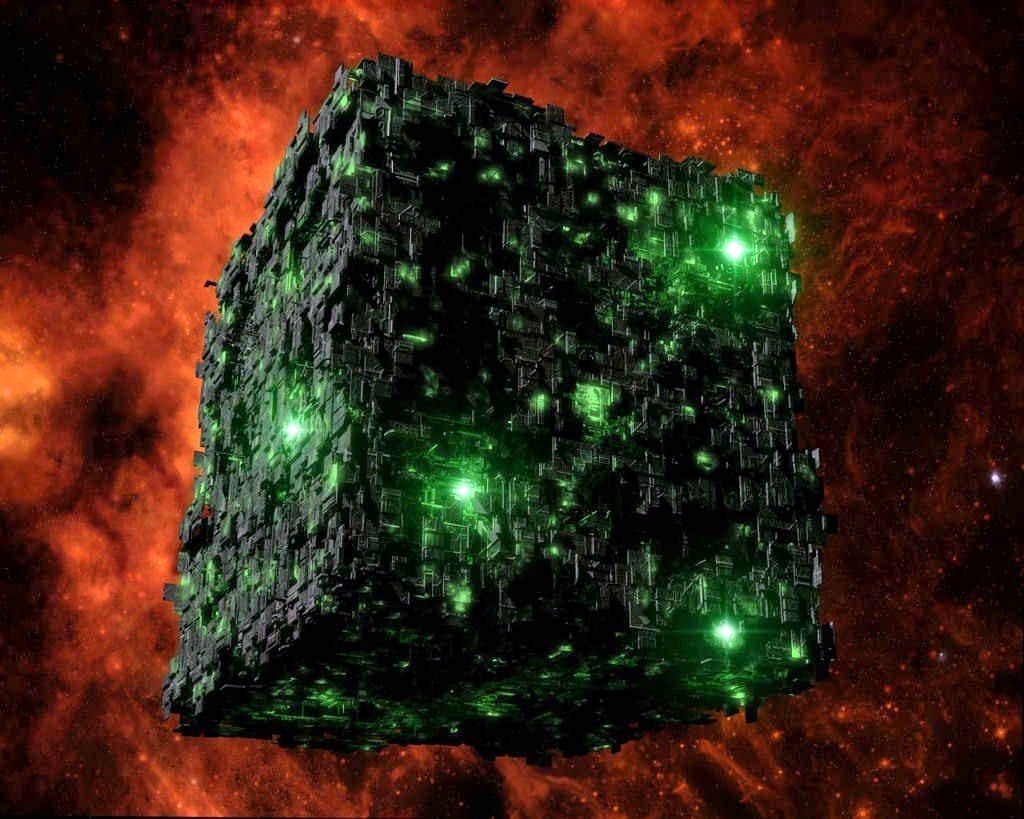
BorgIt’s been a while since I’ve had occasion to point out a Borg Complex case, but the folks at Google have seen fit to help me remedy that situation.

At MIT’s EmTech conference last Thursday, the head of the display division at Google-X, Mary Lou Jepsen, gave us a few gems.

Speaking of Google Glass and its successors, Jepsen explained, “It’s basically a way of amplifying you. I’ve thought for many years that a laptop is an extension of my mind. Why not have it closer to my mind, and on me all the time?”

Why not, indeed.

In any case, her division is hard at work. They are “maybe sleeping three hours a night to bring the technology forward.”

“It’s coming,” she added. “I don’t think it’s stoppable.” Then why, I ask, lose so much sleep over it. One really ought not wear oneself ragged over something that’s bound to come to pass inevitably.

But, as per Mr. Brin’s directives, she wasn’t saying much about what exactly was coming. Whatever the next iteration of wearable computing looks like, Jepsen tells us “you become addicted to the speed of it, and it lets you do more fast and easily.”

Concerns? Never you mind. Remember Mr. Schmidts’s comforting assurances: “Our goal is to make the world better. We’ll take the criticism along the way, but criticisms are inevitably from people who are afraid of change or who have not figured out that there will be an adaptation of society to it.”

Silly fearful critics. Don’t they know resistance is futile, society will be assimi … er … will adapt.

The Assassin and the Camera

It’s not uncommon to hear someone say that they were haunted by an image, often an old photograph. It is a figurative and evocative expression. To say that an image is haunting is to say that the image has lodged itself in the mind like a ghost might stubbornly take up residence in a house, or that it has somehow gotten a hold of the imagination and in the imagination lives on as a spectral after-image. When we speak of images of the deceased, of course, the language of haunting approaches its literal meaning. In these photographs, the dead enjoy an afterlife in the imagination.

Lewis Powell

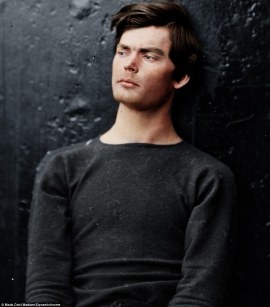
I’ve lately been haunted myself by one such photograph. It is a well-known image of Lewis Powell, the man hung for his failed attempt to assassinate Secretary of State William Seward. On the same night that John Wilkes Booth murdered the president, Powell was to kill the secretary of state and their co-conspirator, George Atzerodt, was to kill Vice-President Andrew Johnson. Atzerodt failed to attempt the assassination altogether. Powell followed through, and, although Seward survived, he inflicted tremendous suffering on the Seward household.

I came upon the haunting image of Powell in a series of recently colorized Civil War photographs, and I was immediately captivated by the apparent modernity of the image. Nineteenth century photographs tend to have a distinct feel, one that clearly announces the distant “pastness” of what they have captured. That they are ordinarily black-and-white only partially explains this effect. More significantly, the effect is communicated by the look of the people in the photographs. It’s not the look of their physical appearance, though; rather, it’s the “look” of their personality.

There is distinct subjectivity—or, perhaps, lack thereof—that emerges from these old photographs. There is something in the eyes that suggests a way of being in the world that is foreign and impenetrable. The camera is itself a double cause of this dissonance. First, the subjects seem unsure of how to position themselves before the camera; they are still unsettled, it seems, by the photographic technique. They seem to be wrestling with the camera’s gaze. They are too aware of it. It has rendered them objects, and they’ve not yet managed to negotiate the terms under which they may recover their status as subjects in their own right. In short, they had not yet grown comfortable playing themselves before the camera, with the self-alienated stance that such performance entails.

But then there is this image of Powell, which looks as if it could have been taken yesterday and posted on Instagram. The gap in consciousness seems entirely closed. The “pastness” is eclipsed. Was this merely a result of his clean-shaven, youthful air? Was it the temporal ambiguity of his clothing or of the way he wore his hair? Or was Powell on to something that his contemporaries had not yet grasped? Did he hold some clue about the evolution of modern consciousness? I went in search of an answer, and I found that the first person I turned to had been there already.

Death on Film

"He is dead, and he is going to die ..."
“He is dead, and he is going to die …”

Roland Barthes’ discussion of death and photography in Camera Lucida: Reflections on Photography has achieved canonical status, and I turned to his analysis in order to shed light on my experience of this particular image that was so weighted with death. I soon discovered that an image of Powell appears in Camera Lucida. It is not the same image that grabbed my attention, but a similar photograph taken at the same time. In this photograph, Powell is looking at the camera, the manacles that bind his hands are visible, but still the modernity of expression persists.

Barthes was taken by the way that a photograph suggests both the “that-has-been” and the “this-will-die” aspects of a photographic subject. His most famous discussion of this dual gesture involved a photograph of his mother, which does not appear in the book. But a shot of Powell is used to illustrate a very similar point. It is captioned, “He is dead, and he is going to die …” The photograph simultaneously witnesses to three related realities. Powell was; he is no more; and, in the moment captured by this photograph, he is on his way to death.

Barthes also borrowed two Latin words for his analysis: studium and punctum. The studium of a photograph is its ostensible subject matter and what we might imagine the photographer seeks to convey through the photograph. The punctum by contrast is the aspect that “pricks” or “wounds” the viewer. The experience of the punctum is wholly subjective. It is the aspect that disturbs the studium and jars the viewer. Regarding the Powell photograph, Barthes writes,

“The photograph is handsome, as is the boy: that is the studium. But the punctum is: he is going to die. I read at the same time: this will be and this has been; I observe with horror an anterior future of which death is the stake. By giving me the absolute past of the pose, the photograph tells me death in the future. What pricks me is the discovery of this equivalence.”

In my own experience, the studium was already the awareness of Powell’s impending death. The punctum was the modernity of Powell’s subjectivity. Still eager to account for the photograph’s effect, I turned from Barthes to historical sources that might shed light on the photographs.

The Gardner Photographs

The night of the assassination attempt, Powell entered the Seward residence claiming that he was asked to deliver medicine for Seward. When Seward’s son, Frederick, told Powell that he would take the medicine to his father, Powell handed it over, started to walk away, but then wheeled on Frederick and put a gun to his head. The gun misfired and Powell proceeded to beat Frederick over the head with it. He did so with sufficient force to crack Frederick’s skull and jam the gun.

Powell then pushed Seward’s daughter out of the way as he burst into the secretary of state’s room. He leapt onto Seward’s bed and repeatedly slashed at Seward with a knife. Seward was likely saved by an apparatus he was wearing to correct an injury to his jaw sustained days earlier. The apparatus deflected Powell’s blows from Seward’s jugular. Powell then wounded two other men, including another of Seward’s sons, as they attempted to pull him off of Seward. As he fled down the stairs, Powell also stabbed a messenger who had just arrived. Like everyone else who was wounded that evening, the messenger survived, but he was paralyzed for life.

Powell then rushed outside to discover that a panicky co-conspirator who was to help him make his getaway had abandoned him. Over the course of three days, Powell then made his way to a boardinghouse owned by Mary Surratt where Booth and his circle had plotted the assassinations. He arrived, however, just as Surratt was being questioned, and, not providing a very convincing account of himself, he was taken into custody. Shortly thereafter, Powell was picked out of a lineup by one of Seward’s servants and taken aboard the ironclad USS Saugus to await his trial.

It was aboard the Saugus that Powell was photographed by Alexander Gardner, a Scot who had made his way to America to work with Matthew Brady. According to Powell’s biographer, Betty Ownsbey, Powell resisted having his picture taken by vigorously shaking his head when Gardner prepared to take a photograph. Given the exposure time, this would have blurred his face beyond recognition. Annoyed by Powell’s antics, H. H. Wells, the officer in charge of the photo shoot, struck Powell’s arm with the side of his sword. At this, Major Eckert, an assistant to the secretary of war who was there to interrogate Powell, interposed and reprimanded Wells.

Powell then seems to have resigned himself to being photographed, and Gardner proceeded to take several shots of Powell. Gardner must have realized that he had something unique in these exposures because he went on to copyright six images of Powell. He didn’t bother to do so with any of the other pictures he took of the conspirators. Historian James Swanson explains:

“[Gardner’s] images of the other conspirators are routine portraits bound by the conventions of nineteenth century photography. In his images of Powell, however, Gardner achieved something more.  In one startling and powerful view, Powell leans back against a gun turret, relaxes his body, and gazes languidly at the viewer. There is a directness and modernity in Gardner’s Powell suite unseen in the other photographs.”

My intuition was re-affirmed, but the question remained: What accounted for the modernity of these photographs?

Resisting the Camera’s Gaze

Ownsbey’s account of the photo shoot contained an important clue: Powell’s subversive tactics. Powell clearly intuited something about his position before the camera that he didn’t like. He attempted one form of overt resistance, but appears to have decided that this choice was untenable. He then seems to acquiesce. But what if he wasn’t acquiescing? What if the modernity that radiates from these pictures arises out of Powell’s continued resistance by other means?

Powell could not avoid the gaze of the camera, but he could practice a studied indifference to it. In order to resist the gaze, he would carry on as if there were no gaze. To ward off the objectifying power of the camera, he had to play himself before the camera. Simply being himself was out of the question; the observer effect created by the camera’s presence so heightened one’s self-consciousness that it was no longer possible to simply be. Simply being assumed self-forgetfulness. The camera does not allow us to forget ourselves. In fact, as with all technologies of self-documentation, it heightens self-consciousness. In order to appear indifferent to the camera, Powell had to perform the part of Lewis Powell as Lewis Powell would appear were there no camera present.

In doing so, Powell stumbled upon the negotiated settlement with the gaze of the camera that eluded his contemporaries. He was a pioneer of subjectivity. Before the camera, many of his contemporaries either stared blankly, giving the impression of total vacuity, or else they played a role–the role of the brave soldier, or the statesman, or the lover, etc. Powell found another way. He played himself. There was nothing new about playing a role, of course. But playing yourself, that seems a watershed of consciousness. Playing a role entails a deliberate putting on of certain affectations; playing yourself suggests that there is nothing to the self but affectations. The anchor of identity in self-forgetfulness is lifted and the self is set adrift. Perhaps the violence that Powell had witnessed and perpetrated prepared him for this work against his psyche.

If indeed this was Powell’s mode of resistance, it was Pyrrhic: ultimately it entailed an even more profound surrender of subjectivity. It internalized the objectification of the self which the external the external presence of the camera elicited. This is what gave Powell’s photographs their eerie modernity. They were haunted by the future, not the past. It wasn’t Powell’s imminent death that made them uncanny; it was the glimpse of our own fractured subjectivity. Powell’s struggle before the camera, then, becomes a parable of human subjectivity in the age of pervasive documentation. We have learned to play ourselves with ease, and not only before the camera. The camera is now irrelevant.

In the short time that was left to him after the Gardner photographs were taken, Powell went on to become a minor celebrity. He was, according to Swanson, the star attraction at the trial of Booth’s co-conspirators. Powell “fascinated the press, the public, and his own guards.” He was, in the words of a contemporary account, “the observed of all observers, as he sat motionless and imperturbed, defiantly returning each gaze at his face and person.” But the performance had its limits. Although Ownsbey has raised reasonable doubts about the claim, it was widely reported that Powell had attempted suicide by repeatedly pounding his head against a wall.

On July 7, 1865, a little over two months since the Gardner photographs, Powell was hanged with three of his co-conspirators. It doesn’t require Barthes’ critical powers to realize that death saturates the Powell photographs, but death figured only incidentally in the reading I’ve offered here. It is not, however, irrelevant that this foray into modern consciousness was undertaken under the shadow of death. It is death, perhaps, that gave Powell’s performance its urgency. And perhaps it is now death that serves as the last lone anchor of the self.


I no longer post to this blog, but I continue to write The Convivial Society, a newsletter about tech and culture. You can sign up here.

The Miracle of Gravity

You have likely already heard two things about the space-epic, Gravity. You have heard that it is a visually stunning, anxiety-inducing thriller that immediately absorbs you into its world and does not release you until the credits roll. That is largely correct. You have also heard that Gravity is not really about space. It is really about the inner struggles of the main character, Dr. Ryan Stone played by Sandra Bullock. This is also true enough. But what exactly is Gravity trying to tell us about this inner human struggle being played out against sublimely rendered vistas of earth and space?

As Matt Thomas astutely noted, Gravity trades in both the natural sublime and the technological sublime. The first of these is a common enough notion: it is the sense of awe, wonder, and fear that certain natural realities can inspire in us. Gravity gives us plenty of opportunities to experience the natural sublime as our gaze alternates from the meticulously wrought surface of the earth to the starry, cavernous darkness of the space which envelops it.

The technological sublime is a concept developed by the historian David Nye to describe the analogous feelings of awe, wonder, and fear that we experience in the presence of certain man-made realities. Nye documented a series of human technologies that inspired this kind of response when they were first developed. These included the Hoover Dam, skyscrapers, the electrified city-scape, the atomic bomb, and the Saturn V rockets. In Gravity, depictions of the space shuttle, the International Space Station, and the Hubble telescope — even after they have been pummeled and shredded by space debris — also manage to evoke this experience of the technological sublime.

Against this double sublime, Gravity unfolds its plot of disaster and survival. [Yes, spoilers ahead.] Within minutes, Dr. Stone and Matt Kowalski (played by George Clooney) find themselves adrift after a field of space debris strikes the shuttle and kills the rest of the crew. Kowalski is preternaturally calm in the face of this unthinkable catastrophe. After he recovers Dr. Stone, the pair begin making their way to the ISS in hopes of using the station’s Soyuz capsule to return to earth. Had that initial plan worked, of course, it would have been a very short film.

Upon arriving at the ISS, Kowalski is lost in an act of heroic self-sacrifice and the capsule turns out to be too damaged to survive re-entry. Before he is lost, Kowalski lays out a plan of action for Dr. Stone. She is to take the battered capsule to the Chinese space station and then use their emergency capsule for the journey home. Stone manages to follow this plan, but one near catastrophe after another ensues maintaining a feverish pitch of suspense, or, as some critics have noted, threatening to steer the film into melodrama.

It is in the midst of one of these crisis that Stone is tempted to give up altogether. She finds that the Soyuz capsule does not have enough fuel to get to the Chinese station and so she opts to turn off the capsule’s life support systems and float off into that other dark abyss. This scene is pivotal. We have already learned that Stone lost a daughter in a painfully random playground accident. Ever since, she has lost herself in her work and driven aimlessly at night to assuage her sorrow. She is alone in space now, but she realizes that she is alone on earth as well. No one would mourn her loss, she realizes.

As she begins to doze into unconsciousness, however, Kowalski reappears, chatty and calm as always. He acknowledges that there is something appealing about the escape she is about to make, but he encourages her to reconsider and suggests a strategy that she had not yet considered. And then he disappears. We realize that she had been hallucinating, but she rallies nonetheless and determines to not give up on the hope of return quite yet.

If Kant and Nye help us to describe the sublime scenery against which Stone’s struggle is set, I’d like to suggest that Wendell Berry and G.K. Chesterton can help us make sense of the struggle itself.

Stone must learn to see life on earth — with both its heartache and tragedy, its joys and delights — as a gift, and it is through a kind of death that her perception begins to be realigned. Wendell Berry has beautifully captured this dynamic in his reflections on a wonderfully poignant scene in Shakespeare’s King Lear involving the blinded Earl of Gloucester and his son, Edgar. Gloucester is in despair, and seeks to take his life. The life he thought himself the master of has unraveled, and he has compounded this troubles by falsely accusing Edgar and driving him into exile. But Edgar, disguised as a beggar, has returned to his father to lead him out of despair so that the old man may die in the proper human position, “Twixt two extremes of passion, joy and grief …”

As Berry puts it, “Edgar does not want his father to give up on life. To give up on life is to pass beyond the possibility of change or redemption.” So when Gloucester asks to be taken to the cliffs of Dover so that by a leap he may end his life, his disguised son only pretends to do so. The stage directions then indicate that Gloucester, “Falls forward and swoons.” When he awakes, his son now pretends to be a man who has seen Gloucester survive the great fall. Gloucester is dismayed. “Away, and let me die,” he says. But Edgar, narrates what he has “seen” and proclaims, “Thy life’s a miracle. Speak yet again.”

It is that line, that realization that brings Gloucester back from despair. Having passed through a kind of fictive death, he has been brought once more to see his life as a gift. And so it was with Stone. Kowalski plays Edgar to her Gloucester and having flirted with death, she is recalled to life. No longer does she long for the escape into death that the dark, harshness of space represents in this film. She now determines to find her place again on earth, with all of its attendant sorrows and joys.

So much for Berry, what of Chesterton? Chesterton famously came to faith through an experience of profound gratitude for the sheer gratuity of being. While she ponders the possibility of death and laments that there will be no one to mourn her, Stone also says that there will be no one to pray for her. She confesses that she cannot pray for herself. She was never taught. When, finally, she has reentered the earth’s atmosphere and her capsule splashes down in a murky lake, Stone must make one more fight for her life. The capsule is inundated and she must swim out for air, but she is forced to struggle with her space suit, which threatens to sink her. Once she has fought free of this last obstacle, she makes her way to a muddy shore and, cheek to clay, she exhales the words, “Thank you.” She has, I take it, learned to pray. 

This film about space ends on earth as Stone struggles to her feet under the pull of gravity. But by the composure of her posture and the joy of her expression, we are encouraged to conclude that now, finally, Stone is not only on earth, but she is also at home on earth. She no longer seeks an escape. She is prepared to live with both grief and joy. She knows too that for all of the sublime splendor of space, it is her life that is the most profound miracle for which the instinctive response can only be gratitude.