No, I Don’t Want To Be A Medieval Peasant

Admittedly, most days I tend toward critique, not praise of digital media and technology.  Aware of my proclivity, I try to compensate and hope that I strike a reasonable balance.  I’m sure everyone thinks they are successful in their efforts to achieve balanced views, so I’m probably the last person to judge how well I do or don’t.  That said, I do get into a fair number of discussions about technology in a variety of settings, and, more often than not, I’m raising certain questions and concerns, urging for discernment, moderation, et cetera, et cetera, et cetera … (The last bit best read in Yule Brenner tones.)  What this usually is taken to mean, judging from typical responses, is that I would like to be Amish, live without electricity, farm my own food, and wear black homespun clothes in the heat of the summer sun.   Okay, so maybe, there is a tiny part of me that wouldn’t mind trying that out for awhile, but generally speaking this actually isn’t my goal, and much less, the point.

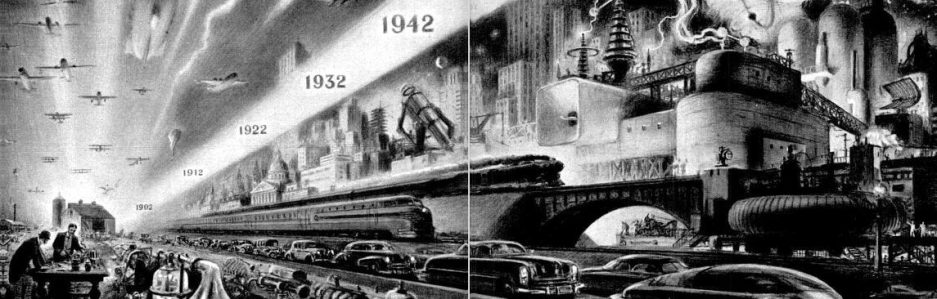
What the reaction reveals, however, is that we tend to think in binary oppositions — this or that, either/or — and that the binary opposite of contemporary technology, in many people’s minds, is some past technological state, for some reason often associated with the 19th century religious sectarianism or Medieval Europe.  So it seems that on the assumption of this binary opposition, any critique of present technology necessarily groups you with either the Amish or the “bring out your dead” crowd.  In fact, there is a good deal of wisdom residing in the past and in intentional communities, but this is beside the more narrow point I’d like to make here.
Binary oppositions are often inherently unstable or else false dilemmas.  But even if we were to set up a binary opposition with present day technology being one member of the pair, who says that some past technological state must be the other member?  We could just as easily imagine the other member being some ideal future state.  I don’t mean this is in some strong utopian sense.  The idealized future is  more dangerous than the idealized past.  However, most of us have certain ideas about what a marginally better world might look like, even if only on the very limited scale of our own personal lives.   So why not make this desire for a better way, which at its best is informed by the past, the other of the present ecology of technology?  In this light, we might consider reasonable critiques of our technologies not as interventions in favor of an unrecoverable past, but rather as steps toward a better, attainable future.

It may be worth remembering that one very famous critic of technology, Marshall McLuhan, believed  that, “There is absolutely no inevitability as long as there is a willingness to contemplate what is happening” (The Medium is the Massage).  Sometimes, however, it is precisely the contemplation part that we struggle with.  Perhaps because in technology, as in politics, binary oppositions tend to undermine, rather than encourage, thought.

Mark Zuckerberg, Moral Philosopher of Identity

In a recent blog post, Steve Cheney bemoans the ongoing progress that Facebook is making toward becoming the ambient background of the Internet.  Specifically, he is concerned that Facebook is killing your authenticity:

… now Facebook’s sheer scale is pushing it in a new direction, one that encroaches on your authenticity.

Facebook is no longer a social network. They stopped being one long before the movie. Facebook is really a huge broadcast platform. Everything that happens between its walls is one degree away from being public, one massive auditorium filled with everyone you’ve ever met, most of whom you haven’t seen or spoken to in years.

Cheney’s post was triggered by the recent adoption of Facebook commenting by a number of large websites, a move that builds on the earlier integration of the “Like” button into almost every commercial, news, and entertainment site of note as part of Facebook’s “Open Graph” platform.  The trajectory here seems fairly clear.  Facebook is forging a global internet identity for you, one that it owns, of course, and with which it stands to make a fair bit of money.

Helpfully, Cheney did not frame his complaint within a denial of the basically social nature of human beings along the lines suggested by Andrew Keen not too long ago.  On the contrary, Cheney acknowledges our social impulses and is concerned that one singular online identity will not do justice to the complexity of human personality and truly social interaction.  One indiscriminate identity will result in one inauthentic and shallow identity that will inhibit rather than promote meaningful sociability.

“A George divided against itself cannot stand!”

The George in question is, of course, the character of George Costanza on Seinfeld.  In one of the more memorable exchanges from the remarkably memorable series, George explains what would happen if Relationship George were to come into contact with Independent George – Independent George would be no more.  We can relate to George in this situation because most of us maintain a handful of different personas that we cycle through as we navigate our way through life.  There are elements of our personality we reveal in some settings that we do not disclose in others; we present some aspects of our selves to certain people and not to others.  When for some reason these roles come into contact with one another it is possible that a little tension and confusion may ensue.  No news here.

In the early days of the Internet, when a kind of felicitous anarchy seemed to reign, it was fashionable to view the anonymity of the web as a playhouse of identity.  Individuals were able to try on and experiment with all sorts of identities — for better or for ill —  with relative safety and little worry of being found out.  It would have been unthinkable that one single and fully transparent identity would mark us across our Internet experience.

But that is exactly the trajectory we have been on for the last several years and this increases the odds of our many worlds colliding occasionally leading us to experience the kind of existential crisis that George’s histrionics embodied.  When our worlds collide, we too begin to sense that we might be losing our independent self, or the ability to control what people see and hear of us, control of what we might call our public identities.  We have a more difficult time calibrating our public personas to fit specific audiences and tasks.

Take for example the awkwardness and angst that arose when parents began joining Facebook and attempted to “friend” their children.  A Washington Post story on the topic from September 2008 cited protest groups formed in response with less than subtle names such as “What Happens in College Stays in College: Keep Parents Off Facebook!”  The author noted that it might seem odd that a “generation accustomed to sharing everything online” and with little or no apparent awareness of the distinction between private and public becomes apoplectic when merely two more people gain access to their already remarkably public personas.  But this misses the point.  What was at stake, of course, was control over who knew what.  The students experienced exactly what George did – their worlds collided and their anxiety reflected the increasing difficulty of controlling their public identity.

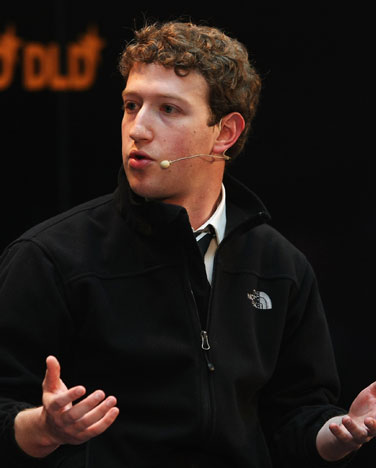
The ubiquity of one dominant social media platform makes it harder to exercise effective control over the presentation of our identities.  Mark Zuckerberg, moral philosopher that he is, rather conveniently believes,

You have one identity… The days of you having a different image for your work friends or co-workers and for the other people you know are probably coming to an end pretty quickly… Having two identities for yourself is an example of a lack of integrity.

Facebook’s near monopoly on social networking has reigned in the proliferation of profiles and, if fact, studies suggest that a Facebook profile tracks fairly closely to the truth about a person.  But there is still the question of who sees that more or less truthful public approximation of our personality and how much they see.  Furthermore, should Facebook, or any social media site be in the business of compelling people to live with integrity, particularly while profiting from the enforcement of this integrity?  More importantly, is it really integrity that is being forced upon us?  Or, to put it another way, does the maintenance of various personas necessarily entail a morally problematic lack of integrity? Is duplicity the only reason why we would withhold some aspect of our personality in certain circumstances?

Authentic and meaningful relationships typically depend upon the natural evolution of interpersonal trust and confidence.  Demanding immediate and equal transparency across the board works against the natural progression of social interaction.  Pace Mr. Zuckerberg, there are good reasons why we don’t reveal ourselves in equal measure to everyone and in all circumstances that have nothing to do with a lack of integrity.

Information Overload and the Possibilities of Digital Asceticism

Sharon Begley’s Newsweek piece, “I Can’t Think,” tackles the problem of information overload with the help of some recent neurological studies.  Perhaps not surprisingly, “With too much information, ” according to one researcher, “people’s decisions make less and less sense.”  Most of us are all too familiar with the mounting sense of indecision and even anxiety the more information we collect regarding an important decision, so this won’t come as too much of a surprise.  Here is one interesting note, however, analogous to the observations noted a couple of days ago about memory and creativity:

“If you let things come at you all the time, you can’t use additional information to make a creative leap or a wise judgment,” says Cantor. “You need to pull back from the constant influx and take a break.” That allows the brain to subconsciously integrate new information with existing knowledge and thereby make novel connections and see hidden patterns. In contrast, a constant focus on the new makes it harder for information to percolate just below conscious awareness, where it can combine in ways that spark smart decisions.

On the same topic, Nicholas Carr has offered a helpful distinction in a recent blog post.  The problem with information used to be not having enough of it and designing good filters to find the relevant stuff.  This is no longer the issue.

Situational overload is the needle-in-the-haystack problem: You need a particular piece of information – in order to answer a question of one sort or another – and that piece of information is buried in a bunch of other pieces of information. The challenge is to pinpoint the required information, to extract the needle from the haystack, and to do it as quickly as possible. Filters have always been pretty effective at solving the problem of situational overload …

Situational overload is not the problem. When we complain about information overload, what we’re usually complaining about is ambient overload. This is an altogether different beast. Ambient overload doesn’t involve needles in haystacks. It involves haystack-sized piles of needles. We experience ambient overload when we’re surrounded by so much information that is of immediate interest to us that we feel overwhelmed by the never ending pressure of trying to keep up with it all.

As is often noted, given the choice between the problems attending information scarcity and those attending information over-abundance, better to opt for the latter.  It may ultimately be difficult to argue with this point.  But problems are problems and so we feel their force and long for solutions.  Given that this is Ash Wednesday, one is tempted to suggest that perhaps what is needed are new personal practices of digital asceticism informed by our (evolving) understanding of the conditions under which the human mind and body best function and flourish.  These are some of the possible choices that may inform such a set of practices, at least as they come to my mind:

  • Intentionally aim for the temperate use of digital media
  • Allow for periods of silence
  • Seek digitally unmediated interactions with others
  • Accept that we cannot keep up with all of it
  • Acknowledge the goodness of certain limitations associated with embodiment
  • Practice separation from devices that make you anxious by their absence

More suggestions welcome.

‘Haunted Places Are the Only Ones People Can Live In’

Places have a way of absorbing and bearing memories that they then relinquish, bidden or unbidden. In three artful paragraphs Michel de Certeau enchants us with a series of poignant reflections on place and memory built upon a string of evocative metaphors. The whole discussion appears near the conclusion of a chapter titled “Walking the City” in The Practice of Everyday Life.

The context of walking and moving about spaces leads de Certeau to describe memory as “a sort of anti-museum:  it is not localizable.”  Where museums gather pieces and artifacts in one location, our memories have dispersed themselves across the landscape, they colonize.  Here a memory by that tree, there a  memory in that house.  De Certeau is principally developing this notion of a veiled remembered reality that lies beneath the visible experience of space.

And not only spaces, for as he puts it, “objects and words also have hollow places in which a past sleeps,” suggesting then this metaphor:  “A memory is only a Prince Charming who stays just long enough to awaken the Sleeping Beauties of our wordless stories.”  But it is principally with places that de Certeau is concerned, places made up of “moving layers.”  We point here and there and say things like, “Here, there used to be a bakery” or “That’s where old lady Dupuis used to live.”  We point to a present place only to evoke an absent reality:  “the places people live in are like the presences of diverse absences.”  Only part of what we point to is there physically; but we’re pointing as well to the invisible, to what can’t be seen by anyone else, which begins to hint at a certain loneliness that attends to memory.  Reality is already augmented.  It is freighted with our memories, it comes alive with distant echoes and fleeting images.

The loneliness of memory is also captured in a comment incorporated by de Certeau:  “‘Memories tie us to that place …. It is personal, not interesting to anyone else …'”  It is like sharing a dream with another person: its vividness and pain or joy can never be recaptured and represented so as to affect another in the same way you were affected.  It is not interesting to anyone else, and so it is with our memories.  Others will listen, they will look were you point, but they cannot see what you see.

And perhaps it is this invisibility of memory stored away in places that inevitably suggests to de Certeau the haunting metaphor:  “There is no place that is not haunted by many different spirits hidden there in silence, spirits one can ‘invoke’ or not.”  But, he goes on to say, “Haunted places are the only ones people can live in.”

At this juncture de Certeau notes that this unseen, absent reality laid over our perception of present places “inverts the schema of the Panopticon.  This is a curious aside given that de Certeau is in conversation with Foucault, for whom the Panopticon becomes a metaphor for disciplinary society in Western cultures.  Rather than being seen by an unseen presence, we see an unseen absence.  Is this also then a form of resistance, a way to disperse the power of disciplinary society?  Do we invoke our memories inhabiting our spaces in order to inoculate ourselves against the pressures of conformity?  Our memories, especially perhaps childhood memories, are so particular that they reinforce the uniqueness of our experience.

Finally, de Certeau points to the embodied status of these memories:  “Places are fragmentary and inward-turning histories, pasts that others are not allowed to read … symbolizations encysted in the pain or pleasure of the body. ‘I feel good here’:  the well-being under-expressed in the language it appears in like a fleeting glimmer is a spatial practice.”  We not only see our memories, we feel them.  Of course, the proper vocalization of this feeling is not always, “I feel good here.”

‘We mustn’t take people for fools’: de Certeau on Reading as Resistance

In The Practice of Everyday Life, French theorist and sometime Jesuit, Michel de Certeau presents an account of individual agency which seeks to nuance Foucault’s exposition of the disciplinary society.  Where certain historical and sociological narratives are inclined to see only passive consumers at the mercy of structural forces, de Certeau wants us to see active users who “make innumerable and infinitesimal transformations of and within the dominant cultural  economy in order to adapt it to their own interests and their own rules” (xiv).  Without denying the existence and significance of “disciplinary technology” and the “microphysics of power,” he also wants to

bring to light the clandestine forms taken by the dispersed, tactical, and make-shift creativity of groups or individuals already caught in the nets of ‘discipline.’  Pushed to their ideal limits, these procedures and ruses of consumers compose the network of an antidiscipline …” (xiv-xv).

Among the anti-disciplinary practices analyzed by de Certeau, we may be surprised to find reading.  And reading is of particular significance as a practice because,

From TV to newspapers, from advertising to all sorts of mercantile epiphanies, our society is characterized by a cancerous growth of vision, measuring everything by its ability to show or be shown and transmuting communication into a visual journey.  It is a sort of epic of the eye and of the impulse to read (xxi).

Bear in mind that de Certeau is writing in the early 1980’s, well before the advent of digital technologies we now take for granted which have only accelerated and accentuated (certain forms of) reading and the visual.  Given his eclectic account of what constitutes reading, however, de Certeau’s analysis is well-positioned to retain its relevance.

Reading, in the very broad sense employed by de Certeau, may appear to be in its very nature a quintessentially  passive activity, a kind of thoughtless consumption.  This could not be further from the truth:

In reality, the activity of reading has on the contrary all the characteristics of a silent production:  the drift across the page, the metamorphosis of the text effected by the wandering eyes of the reader, the improvisation and expectation of meanings inferred from a few words, leaps over written spaces in an ephemeral dance.  [The reader] insinuates into another person’s text the ruses of pleasure and appropriation; he poaches on it, is transported into it, pluralizes himself in it like the internal rumblings of one’s body.  (xxi)

The movement of the reader’s world into the author’s place “makes the text habitable, like a rented apartment.  It transforms another person’s property into a space borrowed for a moment by a transient” (xxi).  Later in the book, de Certeau returns to this theme of reading (consumption) as transience, especially in contrast to writing (production):

Far from being writers – founders of their own place, heirs of the peasants of earlier ages now working on the soil of language, diggers of wells and builders of houses – readers are travelers; they move across lands belonging to someone else, like nomads poaching their way across fields they did not write, despoiling the wealth of Egypt to enjoy it themselves …. Reading takes no measures against the erosion of time (one forgets oneself and also forgets), it does not keep what it acquires, or it does so poorly, and each of the places through which it passes is a repetition of the lost paradise.

Indeed, reading has no place:  Barthes reads Proust in Stendhal’s text …. [The reader’s] place is not here or there, one or the other, but neither the one nor the other, simultaneously inside and outside, dissolving both by mixing them together, associating texts like funerary statues that he awakens and hosts, but never owns.  In that way, he also escapes from the law of each text in particular, and from that of the social milieu. (174)

The placelessness of reading and the tactics it evokes from the reader, if I understand de Certeau, free the reader from the law-like dominance of any one text and, by extension, society itself, which can be read as a book.  In the Middle Ages, de Certeau notes early on, the text was a book, today it is a “whole society made into a book” (xxii).  Later on he adds, “This text was formerly found at school.  Today, the text is society itself.  It takes urbanistic, industrial, commercial, or televised forms” (167).

The tactics of reading become the strategies of non-conformity.  The consumer is not merely a passive recipient, she is an active user that evades the pressures of conformity, even if subtly and evasively.  This analysis elides nicely with the conditions of the digital age, but should now be updated to account for the vast democratization of the means of writing/production that digital technologies and the Internet have enabled.  What happens to the strategies of resistance developed and deployed under the conditions of the mass market when we enter into the diversified field of digital media?  Do the implicit and tacit tactics become explicitly instantiated under the new conditions?  Does the underground and invisible now turn into the mainstream and visible?  Did the silent tactics of reading guide the evolution of digital practices?

And one last word, for now, from de Certeau.  In debates about the consequences of the Internet, it may be too often assumed that users are merely passive pawns at the disposal of massive and often invisible forces, whether of the medium itself or the commercial powers that profit from the medium. As he counseled his contemporaries, de Certeau may have counseled us:

… it is always good to remind ourselves that we mustn’t take people for fools (176).