Conquering the Night: Technology, Fear, and Anxiety

Tim Blanning begins his review of Craig Koslofsky’s Evening’s Empire: A history of the night in early modern Europe as follows:

In 1710, Richard Steele wrote in Tatler that recently he had been to visit an old friend just come up to town from the country. But the latter had already gone to bed when Steele called at 8 pm. He returned at 11 o’clock the following morning, only to be told that his friend had just sat down to dinner. “In short”, Steele commented, “I found that my old-fashioned friend religiously adhered to the example of his forefathers, and observed the same hours that had been kept in his family ever since the Conquest”. During the previous generation or so, elites across Europe had moved their clocks forward by several hours. No longer a time reserved for sleep, the night time was now the right time for all manner of recreational and representational purposes.

Given my recent borrowings from David Nye’s study of electrification, it will come as no surprise that the title of Blanning’s review, “The reinvention of the night,” caught my eye. I was expecting a book dealing with the process of electrification, but Koslofsky’s story, as the subtitle of his book suggests, unfolds two to three hundred years before electrification.

It also features technology less prominently than I anticipated, at least Blanning doesn’t emphasize it in his review. In fact, he writes, “This had little to do with technological progress, for until the nineteenth century only candles and oil lamps were available.” This suggests a rather narrow definition of technology since candles and oil lamps are just that. It may be that Blanning’s emphasis is on the “progress” side of “technological progress,” but immediately after this sentence he writes, “Most advanced was the oil lamp developed in the 1660s by Jan van der Heyden, which used a current of air drawn into the protective glass-paned lantern to prevent the accretion of soot, and made Amsterdam the best-lit city in Europe.” This would amount to technological progress, no?

in any case, what I found most interesting, and what connected directly with Nye, was the following observation by Blanning: “At the heart of his argument is the contrariety between day and night, light and dark. On the one hand, the sixteenth century witnessed an intensification of the association of the night with evil …” That, and the theme of a shifting civic/public sphere (a la Habermas) that moved not only from the town square to the aristocratic halls and coffee houses, but also from the day time to the night time.

Take both together and we have another example of the reciprocal relationship between technology and social structures, assuming you’re buying my hunch that this is a story in which technology, even if it is “primitive” technology, is implicated.

A society’s symbolic tool kit can shift. We might take for granted that night always evoked fear and dread and evil, and although there is something to that of course, the story is more complex. Perhaps night’s identification with evil intensified in part because of the gradual conquest of the night by artificial illumination. It would be a paradoxical case of unintended, unforeseen consequences. The more we domesticate darkness, the more darkness takes its revenge on us. Perhaps if we were more at home in the darkness, we would be less fearful of it.

Consider the following passage cited by Nye from Henry Beston writing in the early twentieth century:

“We of the age of the machines, having delivered ourselves of nocturnal enemies, now have a dislike of night itself. With lights and ever more lights, we drive the holiness and beauty of the night back to the forests and the sea; the little villages, the crossroads even, will have none of it. Are modern folk, perhaps, afraid of night? Do they fear that vast serenity, the mystery of infinite space, the austerity of stars? Having made themselves at home in a civilization obsessed with power, which explains its whole world in terms of energy, do they fear at night for their dull acquiescence and the pattern of their beliefs? Be the answer what it will, today’s civilization is full of people who have not the slightest notion of the character or poetry of night, who have never even seen the night.”

This is an interesting passage not only because it suggests how technologies enter into symbolic ecosystems and reshape those ecosystems just as their adoption is conditioned by that same ecosystem. It is also interesting because what Beston feared losing — the serenity, mystery, austerity — is itself a very modern sensibility. This is the sensibility of a modern individual formed by a post-Copernican cosmology. A medieval individual could not have written that passage, and not only because illumination was for them a still distant and unimagined phenomenon. They were still at home in a much smaller and coherent universe. They did not look up and see “space,”they looked up and saw the vastly populated heavens. But that is another story.

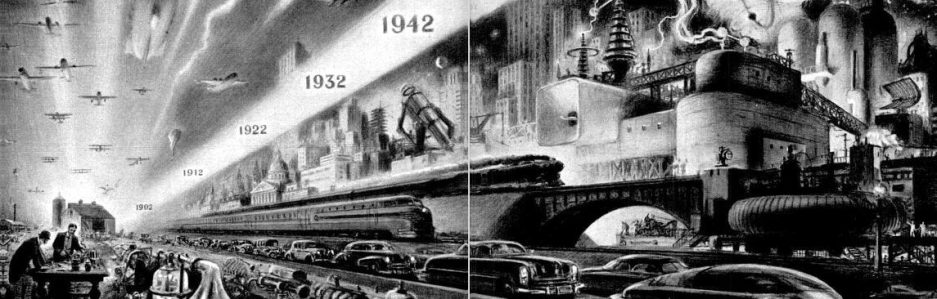
Night has been on the retreat for quite some time now, conquered by the science and technology of illumination. Night’s retreat has had social, political, and psycho-symbolic consequences. The mystery of the night is chased away only to allow in the terror of the night. Technology shapes and is shaped by its semiotic environment.

One of the wonders of writing is that you’re never quite sure where you will end up when you start. So while my initial intent was simply to note another illustration of Nye’s notion of the social construction of technology, writing’s momentum leads me to the notion that domestication may, ironically, lead to the displacement of fear and anxiety to another register. It is as if, like Dr. Moreau’s creatures, the realms we tame through our techno-scientific prowess remain sources of reconfigured and intensified fear and anxiety. Dr. Moreau instills fear in his beasts through violence because he fears the violence they may do to him. Fear begets fear — that is perhaps the core of H. G. Wells’ tale — and that principle is at work in our uneasy relationship with technology.

If we pursue technology in order to conquer what we fear, then we also create an attending anxiety over the (inevitable?) failure of our systems of control and mastery. It would seem that what we tame, retains its wildness veiled, yet palpable and intensified.

Electrification, Refrigerators, and the Social Construction of Technology

Yesterday, I alluded to David Nye’s Electrifying America, a social history of the electrification of America from 1880-1940. At the heart of Nye’s study is the contention that technology is a social construction. By this he means that technology always enters into a pre-existing social world and a technology’s adoption, use, and meaning is derived from that social world. So, for example, Nye writes:

“A technology is not merely a system of machines with certain functions; it is part of a social world. Electrification is not an implacable force moving through history, but a social process that varies from one time period to another and from one culture to another. In the United States electrification was not a ‘thing’ that came from outside society and had an ‘impact’; rather, it was an internal development shaped by its social context. Put another way, each technology is an extension of human lives: someone makes it, someone owns it, some oppose it, many use it, and all interpret it.” (ix, emphasis mine)

The history of technology is full of similar stores about social factors conditioning the adoption of new technologies. In a post titled “How the refrigerator got its hum,” science writer Alice Bell briefly recounts the story of early refrigeration and the adoption of electric over gas refrigerators. It’s a quick and interesting read if your are not familiar with the story. She notes near the end that, “In many respects, the history of technology is a history of failed machines; of routes we didn’t take, not the ones we did.” And she cites David Edgerton’s Shock of the Old to the same effect:

The history of invention is not the history of a necessary future to which we must adapt or die, but rather of failed futures, and of futures firmly fixed in the past. We do not have a history of invention, but instead histories of the invention of only some of the technologies which were later successful (Edgerton, 2006: 184. Emphasis as original).

She then ties it all up with the following conclusion:

And there’s the moral of the story: the possibilities around technology are multiple. They are not limitless, but they aren’t singular either, and they certainly are not linear. There are choices when it comes to the technologies we choose to take on, and choices about how we make use of them, when and if.

This is very well and succinctly put. I would only add that these choices later constrain and condition future choices yielding what Thomas Hughes has called “technological momentum.”

Nathaniel Hawthorne Anticipates McLuhan and de Chardin

Those familiar with Marshall McLuhan will remember his view, and it was not his alone, that our technologies are fundamentally extensions of ourselves. And in McLuhan’s view, electric technologies were extensions of our nervous system. So, for example, In Understanding Media, McLuhan writes:

“With the arrival of electric technology, man extended, or set outside himself, a live model of the central nervous system itself.” (65)

“When information moves at the speed of signals in the central nervous system, man is confronted with the obsolescence of all earlier forms of acceleration, such as road and rail. What emerges is a total field of inclusive awareness.” (143)

“It is a principle aspect of the electric age that it establishes a global network that has much of the character of our central nervous system. Our central nervous system is not merely an electric network, but it constitutes a single unified field of experience.” (460-461)

Those familiar with McLuhan will also know not only that McLuhan was a Roman Catholic (recent essay on that score here), but that he was influenced by the thought of a relatively fringe Catholic paleontologist and theologian/philosopher, Teilhard de Chardin, who, in The Future of Man, spoke of technology creating “a nervous system for humanity … a single, organized, unbroken membrane over the earth … a stupendous thinking machine.”

As it turns out, McLuhan and de Chardin were trading in a metaphor/analogy that had even older roots. At the outset of his fascinating (if your into this sort of stuff) study Electrifying America, David E. Nye cites the following passage from Nathaniel Hawthorne’s The House of Seven Gables, in which the character Clifford exclaims,

“Then there is electricity, the demon, the angel, the mighty physical power, the all-pervading intelligence!” … “Is it a fact — or have i dreamt it — that, by means of electricity, the world of matter has become a great nerve, vibrating thousands of miles in a breathless point of time? Rather, the round globe is a vast head, a brain, instinct with intelligence! Or, shall we say, it is itself a thought, nothing but a thought, and no longer the substance which we deemed it!”

Hawthorne’s novel, in case you’re wondering, dates from 1851.

Weekend Reading, 9/23/11

Happy first day of fall, particularly for those of you who live in parts of the country where that is not merely a calendrical fact, but an existential one as well.

“Facebook Boldly Annexes the Web” by Ben Elowitz at All Things D: There are occasionally rumbling about Facebooks fall from grace, for example around the release of Google+ and whenever Facebook changes its layout, as it did a few days ago, or stumbles on privacy. Elowitz, however, believes Facebook is just getting started on the path to redefining the Web. (Beware, there is a good deal of hype to cut through.)

“Rethinking Chesterton” by Jay Parini in the The Chronicle of Higher Education: Nice piece on Chesterton, his wonder at life, good cheer, adroit mind, and enduring significance. As you may have noticed if you’ve been dropping in for awhile, you’ll have noticed that I think rather highly of Chesterton, and I keep good company in doing so.

“Tempest in an Inkpot” by Graham T. Beck in The Morning News: Another take on the (ir)relevance of cursive script. Good on the recent history of handwriting and its entanglement with technology all along the way. Seems to suggest that this entanglement means we ought not care too much about the eclipse of cursive, I tend to think the contrary is true. May write more about this at some point.

“The Unsung Sense: How Smell Rules Your Life” by Catherine de Lange at New Scientist: Interesting piece on our sense of smell, including its relation to memory. “Our sense of smell may even help us to pick up on the emotional state of those around us. This idea has been highly controversial …”

This isn’t exactly recent, but check out this older post on the 1939 World’s Fair for two video clips of General Motor’s Futurama exhibit complete with narration. The exhibit depicted the “wonder-world of 1960” as a grand, utopian vision of the future. Fascinating. “Man continually strives to replace the old with the new.”

Update: The World’s Fair videos linked above appear no longer to be available. Take a look at this Wired story from last year for the videos along with a number of color photographs from the event.

Landlines, Cell Phones, and Their Social Consequences

Photo credit: Dean Terry

If you’re of a certain age, you’ll remember the pre-cellular days of household phones. One line for everyone, and only one person on the phone at a time. Under the best of circumstances this situation would often lead to more than a few inconveniences. In less than ideal cases, inconvenience could yield to much worse. I’m not entirely sure what got me thinking about the place of the phone in my high school years, but, once I started collecting memories, I began to realize that a number of experiences and situations that were then common have disappeared following the emergence of cell phones. And, it seems to me, that not all of these transformations are altogether trivial.

For the record, my high school years were in the 1990s; cell phones were not quite rare and they had already evolved well past the “brick” era. Yet, they were not exactly common either, and they certainly had not displaced the landline. Beepers were then the trendy communication accessory of choice.

As I thought back to the pre-cellular era, it was the rather public nature of the landline conversation that most caught my attention. The household phone was not a subtle creature. Placing a call to a friend meant, in a sense, placing a call to their whole family. The ring of a phone was indiscriminate, so it was that your call was a matter of public record. If your friend picked up, they may later be asked who it was that called because everyone knew someone had called. If they did not pick up, then you might end up talking to a family member, hopefully one who was kind and polite. So not, for example, a bratty sibling or a cranky parent. Or both, since there was always the possibility that more than one person would pick up and the awkward process of determining who the call was for and getting them and them alone on the line would ensue.

That possibility alone, of perforce having to interact with someone other than the person you intended to speak to, functioned as a form of socialization. It meant that you got to know your friend’s family, including adults, whether you wanted to or not. Consider that it is not altogether unusual for us now to resort to texting so as not to talk to even the person with which we intend to communicate. Back then, we not only aimed to talk to someone, but we ran the risk of talking to other people as well. This strikes me as somewhat consequential.

Then, of course, there were all of those not quite licit conversations and the devious ingenuity they occasioned. For example, aiming to talk past a curfew or after other members of the family had gone to bed, one would arrange a set time for the call and then sit waiting with hand on phone, maybe even finger on hook, in order to pick up the call at the very first vibration of sound. Or the more serious variety, which often involved the maintenance of unacknowledged and disapproved relationships. Again, if you are of a certain age, I suspect you will be able to supply a number of anecdotes on that score.

This dynamic was recently dramatized in the series Mad Men, set in the early 1960s as both Don and Betty Draper maintain illicit relationships and their phone calls, placed and received, constantly threaten to unravel their secrets.

Also, the landline was public not only in that it made phone calls a matter of public notice, but it was also a shared resource. If you were on the phone, someone else could not be; some equitable system of sharing this resource, that was at times in heavy demand, would need to be devised. The difficulty of arriving at such an equitable distribution was, naturally, directly proportional to the number of teenagers in the house.

All of this together led me to recall the distinctions Hannah Arendt drew in her hefty book, The Human Condition, among the private, public, and social realms. I want to borrow these distinctions to think about the differences between landlines and cell phones, but I won’t be using the terms in quite the same way that she does. On one point, though, I do want to track more closely to her usage, and that is her conception of what constitutes the public realm: disclosure. The public realm was one in which individuals acted in such a manner that they disclosed themselves to others and were, in turn, acknowledge by others. The public realm was a function of scale. Its scale was such that the individual acted among many, but not so many that identity was lost and action rendered unintelligible.

The social realm featured a multiplicity of individuals as well — it was not private — but it took place on a mass scale and even though (or, because) it included multitudes, it was, in fact, a realm of anonymity — its image was the faceless crowd. This differentiation between the public and the social is especially useful now that the digital social realm has emerged over the last decade. Even though we can’t simply elide what we call social media with Ardent’s social realm, the awareness of a distinction among ways of not being by oneself is all the more important.

In Arendt’s analysis, what counted as the private realm shifted its terms according to whether it was paired with the public or social. In relation to the public realm, the private was the relative seclusion of household, a publicly respected zone. But as the household itself became a province of the social, privacy was reconfigured as anonymity.

Consider the landline an instance of the public dynamic and the cell phone a manifestation of the social dynamic, loosely following Arendt’s model. For all the reasons listed above, the landline brought the user into public view. It entailed a necessary appearing in the midst of others, the taking of a certain responsibility for one’s actions, the negotiation of rights to a shared resource, and it yielded a privacy that must be granted by others rather than seized by seclusion.

On that last point consider that while one could lock themselves in their room to have some privacy, the holy grail of teenage life back then, this privacy could rather easily be violated through numerous forms of eavesdropping. To be actualized, this privacy must be conceived of as a transaction of public trust.

By contrast the cell phone allows for a form of privacy that is closer to mere anonymity rather than to a publicly acknowledge and respected right. The cell phone also encourages concealment, rather than disclosure. If my phone is silenced, there is hardly any necessary reason why anyone would know that I have received a call, and if I require privacy I simply take myself and my phone where no one can hear me. I absent myself, I make myself disappear and consequently make no claims upon the civility or trust of others in order to have my privacy. What’s more, the cell phone is typically not shared materially, even though something abstract, like minutes, may be shared in a family plan. No limits are therefore placed on use of the resource, at least for those who can afford high-end plans.

If we take the habits of phone use to be a practice that reinforces certain ways of being, then the differences between the landline and the cell phone are not insignificant. Landlines yielded a public self, constituted privacy as a right premised upon public virtues, and instilled a sense of limits that come from the use of a shared and bounded resource. Cell phones, by contrast, yield an anonymous self, constitute privacy as a function of anonymity and dis-appearing, and instill habits of unbounded and unlimited consumption.


You can subscribe to my weekly newsletter, The Convivial Societyhere.
You can leave a tip here.