The Frictionless Life and Its Discontents: You Heard It Here First

Nick Carr links to a post by Michael Loukides, “The End of the Social,” which takes aim at the automated sharing of music via the Spotify/Facebook alliance. Loukides observes:

“It is meaningful if I tell you that I really like the avant-garde music by Olivier Messiaen. It’s also meaningful to confess that I sometimes relax by listening to Pink Floyd. But if this kind of communication is replaced by a constant pipeline of what’s queued up in Spotify, it all becomes meaningless. There’s no “sharing” at all. Frictionless sharing isn’t better sharing; it’s the absence of sharing. There’s something about the friction, the need to work, the one-on-one contact, that makes the sharing real, not just some cyber phenomenon. If you want to tell me what you listen to, I care. But if it’s just a feed in some social application that’s constantly updated without your volition, why do I care?”

Loukides in turn links to a post by Andrés Monroy-Hernández, “In Defense of Friction,” in which the author takes aim at systems of automated trust in online environments. He also challenges the ideal of frictionless social interactions:

“In many scenarios, automation is quite useful, but with social interactions, removing friction can have a harmful effect on the social bonds established through friction itself. In other cases, as Shauna points out, ‘social networking sites are good for relationships so tenuous they couldn’t really bear any friction at all.’

I am not sure if sharing has indeed been ruined by Facebook, but perhaps this opens new opportunities for new online services that allow people to have ‘friction-full’ interactions.”

Following the potential rabbit hole one link further, Monroy-Hernández links to a post by Molly Wood on the pitfalls of frictionless sharing:

Frictionless sharing via Open Graph recasts Facebook’s basic purpose, making it more about recommending and archiving than about sharing and communicating. That’s a potentially dangerous strategy–not just because oversharing diminishes our interest in sharing but also because it’s tweaking the formula that made the site a winner in the first place.

All of this to remind you that you heard it here first: A Frictionless Life is Also a Life Without Traction.

Traction implies resistance and sometimes trouble, but it also presents us with the opportunity to navigate meaningfully.  A frictionless life may promise ease and a certain security, but it also leaves us adrift, chasing one superficial pleasure after another; never satisfied, because we never experience the struggle against resistance that is essential to a sense of accomplishment.  The trajectory of our desire toward a frictionless life, then, may paradoxically leave us unable to find meaningful satisfaction or a sense of fulfillment.

Read the rest if you missed it the first time back in May.

Glad the notion is catching on!

The Machinery of Poetry?

John Stuart Mill in the Westminster Review from 1831:

“It would be a pity that poetry should be an exception to the Great Law of progress that attains in human affairs: and it is not. The machinery of a poem is not less susceptible of improvement than the machinery of a cotton mill; nor is there any better reason why the one should retrograde from the days of Milton than the other from those of Arkwright.”

My only question is this: how does a thinker as subtle as Mill (perhaps I’m giving him too much credit) make such an evidently egregious category mistake? Is it the power of the myth of the machine or is it the power of metaphor? Both I suspect.

“Mechanical in Head and Heart”: Carlyle and Darwin on the Mind as Machine

In last week’s post on Leo Marx and the sources of technological pessimism, I noted that Marx alludes to an 1829 essay by Thomas Carlyle, “Sign of the Times,” in which Carlyle describes his era as an “Age of Machinery.” Here is the fuller context of that phrasing:

“Were we required to characterize this age of ours by any single epithet, we should be tempted to call it, not an Historical, Devotional, Philosophical, or Moral Age, but above all others, the Mechanical Age. it is the Age of Machinery, in every outward and inward sense of that word: the age which, with its whole undivided might, forwards, teaches and practices the great art of adapting means to ends.”

More from Carlyle:

“Not the external and physical alone is now managed by machinery, but the internal and spiritual also …. The same habit regulates not our modes of action alone, but our modes of thought and feeling. Men are grown mechanical in head and heart, as well as in hand. They have lost faith in individual endeavors, and in natural force, of any kind. Not for internal perfection but for external combinations and arrangements for institutions, constitutions, for Mechanism of one sort or another, do they hope and struggle.”

In Christian Worship and Technological Change, Susan J. White, pairs Carlyle’s sentiment with the following passage from Darwin’s “Recollections of the Development of My Mind and Character”:

“I have said that in one respect my mind has changed in the last twenty or thirty years. Up to the age of thirty, poetry of many kinds … gave me great pleasure, and even as a schoolboy I took intense delight in Shakespeare. But now for many years I cannot read a line of poetry; I have tried lately to read Shakespeare, and found it so intolerably dull that it nauseated me. I have also almost lost my taste for pictures or music …. My mind seems to have become a kind of machine for grinding general laws out of a large collection of facts.”

First of all, this latter self-diagnosis is terribly sad. One hopes that Darwin’s experience is not suggestive of a general tendency, even as one suspects that it may very well be.

Secondly, Carlyle and Darwin, in their own way, intuited what later scholars including Mumford and McLuhan would formalize into theory: our habits of mind and patterns of thought have a way of adapting themselves to our technological environment.

Ours, however, is no longer an Age of Machinery in the same way. How might we update Carlyle’s and Darwin’s observations to better fit our own time? How might we label our age? How has our technological environment worked its way into our heads and hearts?

“Does Technology Drive History?”: A Brief Review

You may have gathered from some of my posts over the last couple of weeks, including the last one,  that I’ve been reading Does Technology Drive History?: The Dilemma of Technological Determinism edited by Leo Marx and Merritt Roe Smith. Previous posts have drawn on one or two chapters in particular. Here is a review of the whole for those who may be interested. Incidentally, the whole is quite complex and dense, so this does not do it justice. After the review, I’ll add just a few more thoughts that have occurred to me since writing the review. I’ve also edited out the paragraph on Marx’s essay since I discussed it at length in the previous post.

Having worked through the essays collected in this volume, one may be tempted to conclude that the title question finally dissolves into a debate about semantics and taxonomies. The dilemma is real enough, and palpably so. That technological determinism, as more than one author noted, is such a hard notion to dispel, that it is repeatedly resuscitated, that it can exert such a powerful influence upon the popular imagination — all of this suggests that “technological determinism” attempts, however unsatisfactorily, to name a phenomenon that is still in search of adequate description and explanation. The essays collected by Smith and Marx (a historically suggestive pair of surnames) in Does Technology Drive History? are an effort to name this elusive phenomenon.

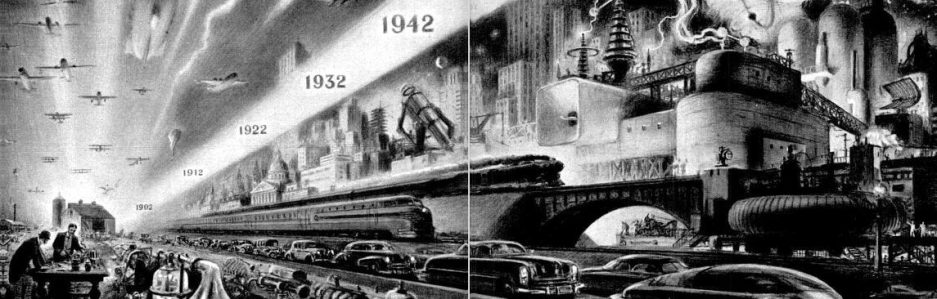
The first two essays, by Merritt Roe Smith and Michael L. Smith respectively, provide a cultural frame for the succeeding discussion. They each draw on visual resources, particularly the lithography of Currier and Ives, to illustrate the deep and abiding faith in technologically abetted progress that animated American history. The iconography of railroads, steamships, and telegraph lines infused popular scenes depicting the advance of technology and civilization across the American continent, simultaneously dispersing darkness and displacing dissidents. These essays also point to the first of many distinctions that the reader must bear in mind as they attempt to hold the rich complexity of the debate in mind. The distinction in this case is between the fact and the idea of technological determinism. The status of the former is, of course, the question under debate. The latter, however, is a matter of belief independent of the ontological status of the object of belief, and it is apparent that belief in technological determinism functioned as an article of faith in nineteenth century America expressed most commonly under the banner of Progress.

This important distinction between the (debatable) reality of technological determinism and technological determinism as an idea that is widely accepted recurs in the later essays by Rosalind Williams and Leo Marx. Williams also links the notion of technological determinism to a faith in progress, but she finds her link outside of the American context in the work of two French Enlightenment writers, Turgot and Condorcet. Like their nineteenth century American heirs, Turgot and Condorcet believed civilization would advance in step with technological and scientific progress. Whether or not this was objectively true, it was subjectively believed, and more importantly, acted upon. “Ultimately,” Williams concludes, “not machines but people create technological determinism.” And following Mumford and Havel, Williams would have us ask whose interests are served by the proliferation of the idea of technological determinism.

…..

The semantic angle is pressed most forcefully by Bruce Bimber who identifies three accounts of technological determinism: normative, nomological, and unintended consequence. In good analytic philosophical style he then precisely defines “technological” and “determinism” in such a way that all but nomological determinism fail to meet the definitional standard. The nomological account, of which Heilbroner’s classic essay reprinted in this volume is representative, posits a law-like relationship between technological causes and social effects. Using the debate over technological determinism in the thought of Karl Marx as a case study, Bimber concludes that a theory of history that would meet the criteria of nomological determinism would be implausible. Thus, he urges that we clear the debate over the social consequences of technology of the obfuscating language of determinism.

In the remaining essays dealing with the question of “technological determinism’s” status as historical reality, we find more parsing, defining, and categorizing. The usual pattern is to define two extremes and then offer a third mediating position. The essays by Thomas Hughes and Thomas Misa each present a variation of this approach. Hughes seeks to stake out a position between technological determinism on the one hand and social constructivism on the other. He finds both accounts ultimately inadequate even though each manages to grasp a part of the whole situation. As a mediating position, Hughes offers the concept of “technological momentum.” By it Hughes seeks to identify the inertia that complex technological systems develop over time. Hughes’ approach is essentially temporal. He finds that the social constructivist approach best explains the behavior of young systems and the technological determinist approach best explains the behavior of mature systems. “Technological momentum” offers a more flexible model that is responsive to the evolution of systems over time.

If Hughes’ approach is essentially temporal, Misa’s account is in some sense spatial. He positions his approach between “micro-level” and “macro-level” approaches to technological systems. The claims made by macro-level analysis, technological determinism’s natural habitat, cannot be sustained at the micro-level. But large trends and the social consequences of technological change remain invisible at the micro-level. Misa recommends “meso-level” analysis focused on institutions of mediating scale situated “between the firm and the market or between the individual and the state.” At this level Misa believes scholars are most likely to integrate the social shaping of technology with the technological shaping of society.

Philip Scranton is likewise sensitive to matters of scale when he proposes that “totalizing determinisms” be replaced by “local determinations.” In his view, the resolution to the dilemma lies in particularizing the object of analysis. Scranton’s essay is a reflection on matters of historiography. He finds that master-narratives of progress and technological determinism have clouded the vision of historians of technology to the contingent and particular. His sensibilities are essentially postmodern and they include the rejection of grand narratives, the embrace of a “plurality of rationalities,” and a focus on matters of power differentials. He urges an approach which shares a certain affinity with Clifford Geertz’ “thick descriptions,” some of which might uncover local instances of technological determinism, but many more which will not.

Perhaps the most pertinent consideration that arises from the essays described above, as well as those that were not mentioned, is that the question of technological determinism is enormously complex. Because of this it might seem pedantic to note areas that were left unexamined, but it is curious that very little mention was made of what Walter Ong has labeled “technologies of the word.” These technologies — writing, printing, and later electronic means of communication — influence human beings at the most fundamental level, that of thought and expression. Whether they are finally endorsed or not, it seems negligible to omit mention of the work of Ong, his teacher Marshall McLuhan, or the German theorist Friedrich Kittler who, among others, have each in their own way drawn attention to the formative influence of communication technologies on individual consciousness and society.

Interaction with the work of practice theorists such as Pierre Bourdieu and Michel de Certeau might have also added yet another rich layer of analysis by seeking to locate the nexus of technology and society in the embodied rituals of everyday life which structure the lived experience of individuals. A mere hint in this direction is offered, incidentally it would seem, by J. M. Staudenmaier in his closing essay when he alludes to the “catechetical extremes of the Disney imagineers” in constructing the EPCOT experience. In fact, technologically inflected catechetical instruction of habits and beliefs is on offer throughout society, not only at EPCOT. Examining these technological dimensions of lived experience would seem to be yet another potential source for theorizing the question of technological determinism.

Altogether, however, the essays collected by Marx and Smith offer an invaluable entry into the debate over technological determinism and, through this debate, into the larger question of technology’s role in society. A question that is increasingly becoming more, not less pressing.

A couple of additional comments:

a. Media theorists (or media ecologists), philosophers of technology, and historians of technology could benefit from more interaction. Specialization is the rule of the academy, of course, and the professional associations, but the question of technology involves such an interdisciplinary set of considerations that it necessitates a variegated, inter-disciplinary approach. As I mentioned in the review, it is unfortunate that hardly any reference at all was made to the consequences of communication technologies for thought and expression. But, the flip side is that the theorizing of media theorists and the philosophizing of philosophers of technology is sometimes untethered from concrete, historical analysis and all the worse for it.

b. Against the technological determinists, many of the writers in this volume stressed the social construction of technology (see my posts on David Nye). The actual history of the adoption of technologies reveals very complex circumstances in which factors other than the nature of the technology drive the technology’s deployment and evolution. The social factors are the result of human agents acting on, against, with, for the technology in question. Okay, fair enough. But it is tacitly assumed that the human agents are always fully aware and rationally self-possessed. What if many of the choices are not the result of deliberate rationalization, but stem instead from pre-rational, unconscious, or habituated dispositions. And what if some of these are the result of previous long-term engagement with certain technologies? This brings us back to the media theorists who are sensitive to the manner in which our media condition or thinking and acting. I tried my hand at approaching the question here: “Technology, Habit, and Being in the World.”

Leo Marx on the Sources of our Technological Pessimism

Are we living in an age of technological optimism or technological pessimism?

In “The Idea of ‘Technology’ and Postmodern Pessimism,” Leo Marx, a leading historian of technology and American culture, argues that while technological optimism had been the default mode of American culture throughout most of its history, technological pessimism asserted itself to an unprecedented degree in the second half of the twentieth century. His essay traces the roots of what he terms “postmodern pessimism” in the earlier, dominant technological optimism and the evolution of our terminology for what comes to be known as “technology.” This latter semantic history, not unlike that which undergirds his more recent “Technology: The Emergence of a Hazardous Concept,” throws light on significant shifts in the nature of technology in the nineteenth and early twentieth centuries. These shifts fuel a new way of conceptualizing technology which in turn becomes a precondition for the emergence of technological pessimism.

Marx begins by reminding us of the “progressive world picture” which emerges out of the Enlightenment. For the cultures of modernity, “conceptions of history,” he explains, “serve a function like that served by myths of origin in traditional cultures: They provide the organizing frame, or binding meta-narrative, for the entire belief system.” And the “conception of history” animating Enlightenment society expected “steady, continuous, cumulative improvement in all conditions of life” driven by the advance of science and what was then called, among other phrasings, “the practical arts.” The West’s “dominant belief system,” in Marx’s words, “turned on the idea of technical innovation as a primary agent of progress.”

But then come the shifts Marx perceives in the concept of technology. The first development is artifactual, it relates to the actual technological artifacts. The introduction of mechanical, chemical, and electric power led to the development of “large-scale, complex, hierarchical, centralized systems,” examples of which include the railroads and electrical power systems. In other words, these new technologies are no longer discreet artifacts, more or less independent in their function; they are vast, technological systems.

The second important development is ideological. The earlier Enlightenment notion of progress viewed technology as a necessary, but not sufficient cause of progress which was understood as a movement toward “a more just, republican society.” This political vision was gradually replaced by a technocratic notion of progress which amounted merely to the continued improvement of technology.

Alongside these artifactual and ideological transformations, the terminology applied to the phenomena in question was also evolving. Older words or phrases for what we today would simply label technology included the “mechanical arts” or the “practical arts” — it was an older nomenclature better fitted to traditional, craft based technologies. But this terminology seemed inadequate to describe the reality of emerging complex technological systems. Marx points to Thomas Carlyle’s 1829 essay, “Signs of the Times,” as an instance of the search for a new vocabulary with which to name the shifting technological landscape. Carlyle suggested that his was an “Age of Machinery,” but by “machinery” he meant more than the material machines themselves. Included in the term was the “mechanical philosophy” associated with Descartes and Locke, the systematic division of labor, and the emergence of bureaucratic organization.

By the late nineteenth century the “abstract, sociologically and politically neutral … word ‘technology,’ with its tacit claim to being a distinctive, independent mode of thought and practice like ‘science,’ began to fill the semantic void. In Marx’s view, it would not be until the 1930’s that the term would achieve “truly wide currency.” By mid-century it was used more or less as we use it today, to denote a remarkably wide array of tools and techniques, singularly and in complex combination.

The term’s elasticity, according to Marx, fit the new reality “in which the boundary between the intricately interlinked artifactual and other components — conceptual, institutional, human — is blurred and often invisible.” Marx goes on to add, “by virtue of its abstractness and inclusiveness, and its capacity to evoke the inextricable interpenetration of (for example) the powers of the computer witht eh bureaucratic practices of large modern institutions, ‘technology’ (with no specifying adjective) invites endless reification.”

The consequence is a “common tendency” to “invest ‘technology’ with a host of metaphysical properties and potencies, thereby making it seem to be a determinate entity, a disembodied autonomous causal agent of social change.”

Recalling the second, ideological development, the semantic evolution just describe took place alongside of related evolution in the concept of “progress.” The development of technology had been previously understood to be a means to the end of constructing a “just, republican society.” By the late nineteenth century the advance of technology was synonymous with “progress”; it was the no longer a means, it was the end.

Marx again: “At this time … the simple republican formula for generating progress by directing improved technical means to societal ends was imperceptibly transformed into a quite different technocratic commitment to improving ‘technology’ as the basis and the measure of — as all but constituting — the progress of society.” For a discussion of the visual and artistic representation of this development in the nineteenth century see an earlier post, “The Art of Technology and Empire.” Marx cites the Italian Futurists, Mondrian, the Precisionists and Constructivists, Le Corbusier, and the International Style as later twentieth century symptoms of the shift in values.

Finally, returning to the topic of the essay, “postmodern pessimism,” Marx concludes that amidst the smoldering ruins of World War II the techno-utopianism dissolved. The disenchantment with technology, exhibited since the early nineteenth century by an “adversary culture” with roots in the Romantic critique of the Enlightenment, now gained traction with the wider culture. It was all the more plausible because of the way “technology” had been invested with autonomous, casual agency and the manner in which progress and technology had been elided. Ironically, the postmodern critique of modernist technological systems often came hand in hand with a valorization of new electronic and digital means of communication; this, in Marx’s view, merely replaces one technocracy with another.

The point Marx seeks to drive home at the end of his analysis is this: We have, by our terminology and our ideology obscured the social and political dimensions of the technological systems we’ve created and in so doing consequently obscured the role of human agency. He sardonically concludes his essay by observing that “it might be well to acknowledge how consoling it is to attribute our pessimism to the workings of so elusive an agent of change.”

Some thoughts to wrap up. First, the history Marx traces, both semantic and ideological, is important in its own right. Also, Marx makes an important point regarding the power of our categories to shape our thinking. If we feel a loss of agency in the face of modern technological systems, is it in part because of the adoption of the abstract language of “technology”? Perhaps. But, as Marx shows, the term filled a real semantic void, and these systems are real enough as is there inertia or momentum.

This essay also reminded me of my recent exchange with PJ Rey regarding his essay on trust in complex technologies. These complex systems may make us more aware of our embeddedness in social reality, but because of the sense of a loss of agency that they can engender I suspect it is a rather angst ridden sociality that we partake of. My sense is still that it is not quite “trust” we have in these systems, much less in the experts who designed them, so much as it is a cheery apathy or indifference born out of an inability to imagine an alternative to acquiescence. Those who resist may appear to be misanthropic cranks, but their resistance may have more to do with a distrust in the system (warranted or not), than some sort of misplace individualism.

Finally, Marx is right to press us to take responsibility for our decisions and their consequences. “Technology made me do it” will not get us any farther than Flip Wilson’s “the devil made me do it.”

___________________________________________________________

Update: Take a look at Doug Hill’s thoughtful comment on Marx’s view in the comments section of the  following post.