Nobody asked me, but here they are anyway. A short list of suggestions and clarifications for pundits, journalists, bloggers, and assorted scribblers who write about technology, in no particular order …
1. Don’t be a Borg. The development, deployment, and adoption of any given technology does not unfold independently of human action.
2. Do not cite apparent historical parallels to contemporary concerns about technology as if they invalidated those concerns. That people before us experienced similar problems does not mean that they magically cease being problems today.
3. Do not deify technology or assign salvific powers to Technology.
Pieter Brueghel, Construction of the Tower of Babel (1563)
4. When someone criticizes a specific technology without renouncing all other forms of technology, they are not being hypocritical–they are thinking.
“I believe that you must appreciate technology just like art. You wouldn’t tell an art
connoisseur that he can’t prefer abstractionism to expressionism. To love is to choose. And today, we’re losing this. Love has become an obligation.” (Paul Virilio)
5. Relatedly, the observation that human beings have always used technology is not a cogent response to the criticism of particular technologies. The use of a pencil does not entail my endorsement of genetic engineering.
6. Don’t grant technology independent or sufficient causal force. Consequences follow from the use of technology, but causality is usually complex and distributed.
7. If you begin by claiming, hyperbolically, that a given technology is revolutionary, thereafter responding to critics by assuring them that nothing has changed is disingenuous at best. If something is completely different, it can’t also be exactly the same.
10. That people eventually acclimate to changes precipitated by the advent of a new technology does not prove that the changes were inconsequential or benign.
These are, of course, otherwise known as Sacasas’ pet peeves. You may take them accordingly.
Sign up for The Convivial Society, my newsletter about technology and society, here.
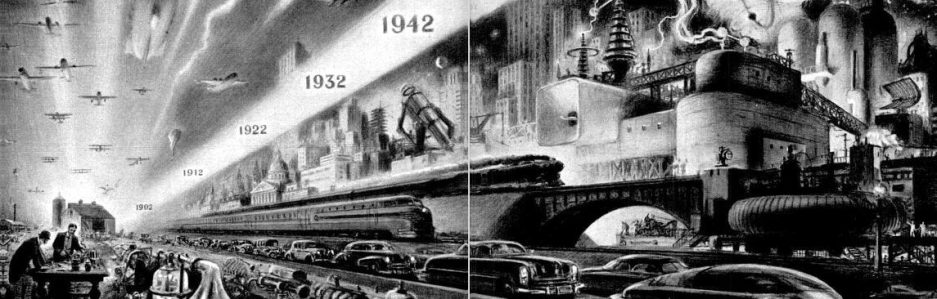
Alvin Toffler’s 1970 book, Future Shock, popularized the title phrase and the concept which it named, that technology was responsible for the disorienting and dizzying quality of the pace of life in late twentieth century industrialized society. Toffler, however, was not the first to observe that technology appeared to accelerate the pace of modern life; he only put a name to an experience people had been reporting since at least the late nineteenth century.
“The German sociologist Hartmut Rosa catalogues the increases in speed in his recent book, Social Acceleration: A New Theory of Modernity. In absolute terms, the speed of human movement from the pre-modern period to now has increased by a factor of 100. The speed of communications (a revolution, Rosa points out, that came on the heels of transport) rose by a factor of 10 million in the 20th century. Data transmission has soared by a factor of around 10 billion.
As life has sped up, we humans have not, at least in our core functioning: Your reaction to stimuli is no faster than your great-grandfather’s. What is changing is the amount of things the world can bring to us, in our perpetual now. But is our ever-quickening life an uncontrolled juggernaut, driven by a self-reinforcing cycle of commerce and innovation, and forcing us to cope with a new social and psychological condition? Or is it, instead, a reflection of our intrinsic desire for speed, a transformation of the external world into the rapid-fire stream of events that is closest to the way our consciousness perceives reality to begin with?”
Vanderbilt explores both of these possibilities without arriving at a definitive conclusion. He closes his essay on this ambiguous note: “That we enjoy accelerated time, and pay a price for it, is clear. The ledger of benefits and costs may be impossible to balance, or even to compute.”
He goes on to say that the most important characteristic of accelerated time may be neither pleasure nor pain, but utility. It’s not entirely clear, though, how useful acceleration really is. Earlier, Vanderbilt had noted the following:
“Rosa says the ‘technical’ acceleration of being able to send and receive more emails, at any time, to anyone in the world, is matched by a ‘social’ acceleration in which people are expected to be able to send and receive emails at any time, in any place. The desire to keep up with this acceleration in the pace of life thus begets a call for faster technologies to stem the tide. And faced with a scarcity of time (either real or perceived), we react with a ‘compression of episodes of action’—doing more things, faster, or multitasking. This increasingly dense collection of smaller, decontextualized events bump up against each other, but lack overall connection or meaning.”
_______________________________
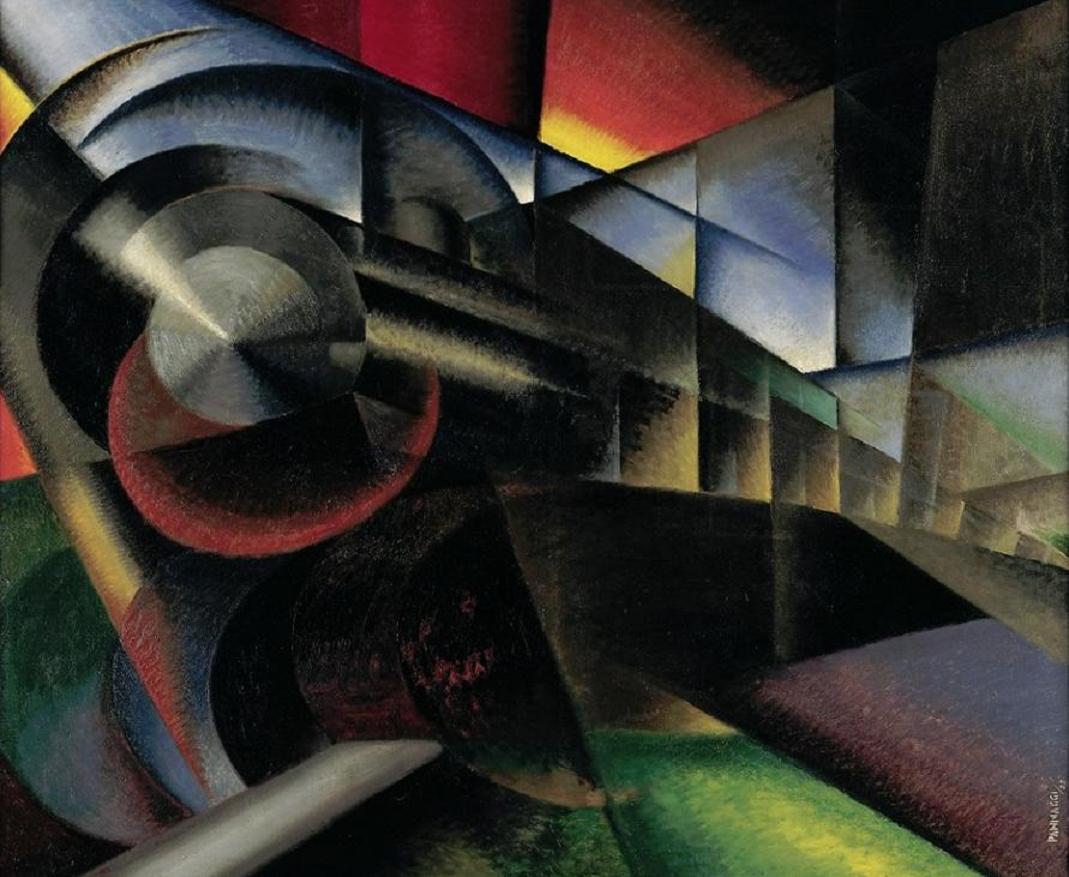
At the turn of the twentieth century, not everyone was complaining about the accelerating pace of life. In 1909, F.T. Marinetti published “The Futurist Manifesto,” a bracing call to embrace the accelerated pace of modernity. The Italian Futurists glorified speed and technologies of acceleration. They also glorified war, violence, danger, and chauvinism, of both the male and nationalistic variety. At the Smart Set, Morgan Meis recently reviewed the Guggenheim’s exhibition, “Italian Futurism, 1909–1944: Reconstructing the Universe.” Early in his review, Meis cited the fourth of Marinetti’s Futurist principles:
“We declare that the splendor of the world has been enriched by a new beauty: the beauty of speed. A racing automobile with its bonnet adorned with great tubes like serpents with explosive breath … a roaring motor car which seems to run on machine-gun fire, is more beautiful than the Victory of Samothrace.”
“Speeding Train (Treno in corsa),” Ivo Pannaggi (1922)
The Manifesto also included the following cheery principles of action:
8. We want to glorify war — the only cure for the world — militarism, patriotism, the destructive gesture of the anarchists, the beautiful ideas which kill, and contempt for woman.
9. We want to demolish museums and libraries, fight morality, feminism and all opportunist and utilitarian cowardice.
Seis rightly insists that Futurism and Fascism were inextricably bound together despite the efforts of some critics to disentangle the two: “There is no point in denying it. Most of the Italian Futurists, Marinetti most of all, were enthusiastic fascists.” From there, Seis goes on to argue that the Futurist/Fascist embrace of speed, violence, and technology was a form of coping with the horrors of the First World War:
“Sensible persons confronted by the calamity and destruction of WWI felt chastened and depressed in the aftermath of the war. There were civilization-wide feelings of shame and regret. “Let us never,” it was said by most, “do that again. Let the Great War be the war that ends all wars.” The Futurists did not accept this line of thinking. They were among an odd and select group that said, “Let us have more of this. Let us have bigger and more spectacular wars.” […] “How does it make us feel,” they wondered, “to say yes to the bombs and the machines and the explosions?”
In saying “yes,” in asking for more, they discovered a secret source of power. It was a way forward. By choosing to embrace the most terrible aspects of the war and the industrial civilization that had made it possible, the Futurists gave themselves a kind of immunity from the paralysis that European civilization experienced after the war.”
In other words, there was power in embracing the forces that were disordering society and disorienting individuals. There is nothing terribly profound in the realization that embracing new technologies often puts one at an advantage over those who are slower to do so or refuse to altogether. It is only the explicit embrace of violence in the wake of World War I that lends the Futurists the patina of radical action.
In our own day, we hear something like the Futurist bravado in the rhetoric of the posthumanist movement. The future belongs to the brave and the strong, to those who are untroubled by the nebulous ethical qualms of the weak and sentimental. As Gary Marcus recently wrote about the future of bio-technological enhancements, “The augmented among us—those who are willing to avail themselves of the benefits of brain prosthetics and to live with the attendant risks—will outperform others in the everyday contest for jobs and mates, in science, on the athletic field and in armed conflict. These differences will challenge society in new ways—and open up possibilities that we can scarcely imagine.”
If we must speak of inevitability with regards to technology, then we must speak of the inevitability of the human quest for power.
_______________________________
The French philosopher and critic, Paul Virilio, was ten years old when the Nazi war machine overran his home. He went on to devote his academic life to the problems of speed, technology, and modernity. Anyone who voices concerns with the character of technological modernity will eventually be asked if they are against Progress, and, indeed, such was the case for Virilio in a 2010 interview. He responded this way:
“No. I’ve never thought we should go back to the past. But why did the positive aspect of progress get replaced by its propaganda? Propaganda was a tool used by Nazis but also by the Futurists. Look at the Italian Futurists. They were allies with the Fascists. Even Marinetti. I fight against the propaganda of progress, and this propaganda bears the name of never-ending acceleration.”
A little later in the interview, Virilio was asked if he was annoyed by those who insisted that technological progress was an unalloyed good. He responded,
“Yes, it’s very irritating. These people are victims of propaganda. Progress has replaced God. Nietzsche talked about the death of God—I think God was replaced by progress. I believe that you must appreciate technology just like art. You wouldn’t tell an art connoisseur that he can’t prefer abstractionism to expressionism. To love is to choose. And today, we’re losing this. Love has become an obligation. Progress has all the defects of totalitarianism.”
Virilio has long argued that the “accident” is an intrinsic element of technology. Virilio’s use of the word “accident” is meant to encompass more than the unplanned happenstance, he alludes as well to the old philosophical distinction between substance and accidents, but it does take the conventional accident as a point of departure. Virilio does not, however, see the accident as an unfortunate deviation from the norm, but as a necessary component. In a variety of places, he has expressed some variation of the following:
“When you invent the ship, you also invent the shipwreck; when you invent the plane you also invent the plane crash; and when you invent electricity, you invent electrocution… Every technology carries its own negativity, which is invented at the same time as technical progress.”
Elsewhere, Virilio borrowed a theological concept to further elaborate his theory of the accident:
“Now, this idea of original sin, which materialist philosophy rejects so forcefully, comes back to us through technology: the accident is the original sin of the technical object. Every technical object contains its own negativity. It is impossible to invent a pure, innocent object, just as there is no innocent human being. It is only through acknowledged guilt that progress is possible. Just as it is through the recognized risk of the accident that it is possible to improve the technical object.”
In yet another context, Virilio explained, “Accidents have always fascinated me. It is the intellectual scapegoat of the technological; accident is diagnostic of technology.” This is a provocative idea. It suggests not only that the accident is inseparable from new technology, but also that technological progress needs the accident. Without the accident there may be no progress at all. But we do not acknowledge this because then the happy illusion of clean and inevitable technological progress would take on the bloody aspect of a sacrificial cult.
In the face of the quasi-religious status of the cult of technology, Virilio insists, “It is necessary to be an atheist of technology!”
_______________________________
In Future Shock, Alvin Toffler commended the reading of science-fiction. Against those who held science-fiction in low literary regard, Toffler believed “science fiction has immense value as a mind-stretching force for the creation of the habit of anticipation.” “Our children,” he urged,
“should be studying Arthur C. Clarke, William Tenn, Robert Heinlein, Ray Bradbury and Robert Sheckley, not because these writers can tell them about rocket ships and time machines but, more important, because they can lead young minds through an imaginative exploration of the jungle of political, social, psychological, and ethical issues that will confront these children as adults.”
Bradbury, for one, marked an obsession with speed as one of the characteristic disorders of the dystopian world of Fahrenheit 451. In that world, traveling at immense and reckless speed was the norm; slowness was criminal. In the story, speed is just one more of the thought-stifling conditions of life for most characters. The great danger is not only the risk of physical accidents, but also the risk of thoughtlessness, indifference, and irresponsibility. Mandated speed and the burning of books both worked toward the same end.
Interestingly, these imaginative aspects of Bradbury’s story were already present in the Futurists’ vision. Not only did they glorify speed, violence, and technology, they also called for an incendiary assault on the educational establishment: “It is in Italy that we are issuing this manifesto of ruinous and incendiary violence, by which we today are founding Futurism, because we want to deliver Italy from its gangrene of professors, archaeologists, tourist guides and antiquaries.”
In Fahrenheit 451, a character named Faber is among the few to remember a time before the present regime of thoughtlessness. When the protagonist, Guy Montag, meets with him, Faber lays out three necessary conditions for the repair of society: quality of information, the time to digest it, and “the right to carry out actions based on what we learn from the interaction of the first two.”
If we credit Bradbury with knowing something about what wisdom and freedom require, then we might conclude that three disastrous substitutions tempt us. We are tempted to mistake quantity of information for quality, speed for time, and consumer choice for the freedom of meaningful action. It seems, too, that a morbid, totemic fascination with the technical accident distracts us from the more general social accident that unfolds around us.
It would be disingenuous to suggest “solutions” to this state of affairs. Bradbury himself steered clear of a happy ending. In the world of Fahrenheit 451, the general, cataclysmic accident is not circumvented. We may hope and work for better. At least, we should not despair.
_______________________________
Another writer of imaginative fiction, J.R.R. Tolkien has his character Gandalf declare, “Despair is only for those who see the end beyond all doubt. We do not.”
Tolkien too lived through the mechanized horrors of the First World War. He would likely sympathize with Virilio’s claim, “War was my university.” But unlike the Futurists and their Fascist heirs, he did not believe that an embrace of power and violence was the only way forward. Interestingly, the counsel against despair cited above is taken from a point in The Fellowship of the Ring when a course of action with regards to the ring of power is being debated. Some of those present urged that the ring of power be used for good. The wiser among them, however, recognized that this was foolishness. The ring was designed for dominance, and the power it yielded it would always bend toward its design and corrupt those who wielded it.
It is worth mentioning that Tolkien once explained to a friend that “all this stuff is mainly concerned with Fall, Mortality, and the Machine.” He elaborated on the idea of the “Machine” in this way: “By the last I intend all use of external plans or devices (apparatus) instead of development of the inherent inner powers or talents — or even the use of these talents with the corrupted motive of dominating: bulldozing the real world, or coercing other wills.”
So rather than submit to the logic of power and dominance, Gandalf urges a counterintuitive course of action:
“Let folly be our cloak, a veil before the eyes of the Enemy! For he is very wise, and weighs all things to a nicety in the scales of his malice. But the only measure that he knows is desire, desire for power; and so he judges all hearts. Into his heart the thought will not enter that any will refuse it, that having the Ring we may seek to destroy it. If we seek this, we shall put him out of reckoning.”
The point, I suggest, is not that we should seek to destroy our technology. It is rather that we should refuse the logic that has animated so much of its history and development: the logic of power, dominance, and thoughtless irresponsibility. That would be a start.
If you’ve appreciated what you’ve read, consider supporting or tipping the writer.
Because our thinking about “technology” should be informed by, if not grounded in, the history of particular technologies, I’ve been a fan of work that zooms in to explore the often engaging and surprising history of a technological artifact that we’ve long taken for granted and hardly think of as “technology” any longer. Toilet paper, for instance.
One of the three pieces I’m passing along happens to mention that during WWII, generals decided how many sheets of toilet paper soldiers were allotted per day: “the British got three sheets a day, American GIs twenty-two.” That fact comes from, “Hold or Fold,” a review of a new book on the history of paper:On Paper: The Everything of Its Two-Thousand-Year History. The review concludes, counter-intuitively, “For the moment, at least, paper remains the standard to which digital media can only aspire,” and it includes more than few surprising and instructive observations along the way.
The second piece traces the history of a more recent invention, the microwave. “The Slow Death of the Microwave” takes as its point of departure declining microwave sales over the last several years. It goes on to sketch the history of the microwave and to illustrate a number of recurring principles in the history of technology. For example, while new technologies can contribute to a shift in cultural practices, such as the preparation and consumption of food, cultural shifts can and do reshape the way we use and value technologies.
The third piece is not about any one technology, but about a technologically mediated practice: self-portraiture. We may immediately think of the ubiquitous and much-maligned “selfie,” but, of course, self-portraits have been around for a long, long time. How much more interesting to think about “selfies” as one iteration of a long-standing practice? You can begin to do so by reading The Guardian’s review of The Self-Portrait: A Cultural History.
It’s been a little quiet on here for the past couple of weeks. You can expect some more frequent posts in the next few days. You may take that as either a promise or a warning.
Here are reminders, if we needed them, that the role of technology in our world transcends artifacts, tools, and devices. It also entails, as Jacques Ellul well understood, a particular way of looking at the world and its problems (and, as Morozov has suggested, it constitutes certain conditions and phenomenon as problems).
“Amazon equals Walmart in the use of monitoring technologies to track the minute-by-minute movements and performance of employees and in settings that go beyond the assembly line to include their movement between loading and unloading docks, between packing and unpacking stations, and to and from the miles of shelving at what Amazon calls its “fulfillment centers”—gigantic warehouses where goods ordered by Amazon’s online customers are sent by manufacturers and wholesalers, there to be shelved, packaged, and sent out again to the Amazon customer.
Amazon’s shop-floor processes are an extreme variant of Taylorism that Frederick Winslow Taylor himself, a near century after his death, would have no trouble recognizing. With this twenty-first-century Taylorism, management experts, scientific managers, take the basic workplace tasks at Amazon, such as the movement, shelving, and packaging of goods, and break down these tasks into their subtasks, usually measured in seconds; then rely on time and motion studies to find the fastest way to perform each subtask; and then reassemble the subtasks and make this “one best way” the process that employees must follow.”
“There’s a fine line between micromanaging and house arrest, and British grocery store chain Tesco […] seems determined to cross it. According to the Irish Independent, employees at the company’s Dublin distribution center are forced to wear armbands that measure their productivity so closely that the company even knows when they take a bathroom break.
The armbands, officially known as Motorola arm-mounted terminals, look like something between a Game Boy and Garmin GPS device. The terminals keep track of how quickly and competently employees unload and scan goods in the warehouse and gives them a grade. It also sets benchmarks for loading and unloading speed, which workers are expected to meet. The monitors can be turned off during workers’ lunch breaks, but anything else—bathroom trips, visits to a water fountain—reportedly lowers their productivity score.”
These folks would’ve been in trouble. They might also have had the good sense to revolt, being peasants and all.
A little over two weeks ago, The New Republic ran a piece by Evgeny Morozov titled “The Mindfulness Racket.” Comments that accompanied links to the article on social media suggested that Morozov had torn into the advocates of mindfulness and critics of digital distraction with the sort of eviscerating rhetoric that we’ve come to expect from him. The title reinforced the expectation.
When I finally got around to reading the article, however, I found that this was not exactly the whole story. Morozov does take issue with the “digital detox crowd,” but not because of their desire to disconnect or their uneasiness with the new “attention economy.” Rather, he takes aim at their motives and their strategies. For instance, Morozov points out that many advocates of mindfulness urge us “to unplug—for an hour, a day, a week—so that we can resume our usual activities with even more vigor upon returning to the land of distraction.” Unplugging and the pursuit of mindfulness, if it is only practiced in order to re-immerse oneself in the same regime of distraction and technocratic productivity, if it does nothing to change the conditions that gave rise to the need to disconnect in the first place–such practices simply do not go far enough.
Approached in this way, disconnection functions analogously, although inversely so, to the place of carnival in medieval society. Carnivals playfully overturned the expectations and assumptions ordering society. They inverted political, religious, and social expectations. They were temporary eruptions of disorder that ultimately functioned to preserve the order of society. They did so by operating as safety valves releasing the tensions, frustrations, and desires that were ordinarily repressed by the existing moral order. Extraordinary moments of controlled disorder, in other words, served to preserve the ordinarily existing order. On Morozov’s reading, disconnection as practiced by many of its advocates functions similarly. Disconnection is a moment of order that functions to sustain the ordinarily disordered status quo.
Morozov also alludes to Nathan Jurgenson’s critical essay, “The Disconnectionists,” and Alexis Madrigal’s similarly suspicious piece, “‘Camp Grounded,’ ‘Digital Detox,’ and the Age of Techno-Anxiety.” But Morozov’s brief discussion of these pieces is a hinge in his argument. After citing Jurgenson and Madrigal, both of whom raise important considerations, Morozov adds,
“Note that it’s the act of disconnection—the unplugging—that becomes the target of criticism, as if there are no good reasons to be suspicious of the always-on mode championed by Silicon Valley, what is called ‘real-time.’”
A little further on he warns, “critics like Madrigal risk absolving the very exploitative strategies of Twitter and Facebook.” From there Morozov suggests that the problematic aspects of social media should not be viewed as a natural price to pay for the enjoyment and benefits we derive from it. Rather, he thinks we should scrutinize social media as we would slot machines: “With social media—much like with gambling machines or fast food—our addiction is manufactured, not natural.”
Finally, Morozov is right to stress the fact that “why we disconnect matters.” “We can continue in today’s mode of treating disconnection as a way to recharge and regain productivity,” Morozov suggests, “or we can view it as a way to sabotage the addiction tactics of the acceleration-distraction complex that is Silicon Valley.” Of course, it is the latter option that Morozov urges us to adopt.
I trust that this has been a faithful summary of Morozov’s argument, but I encourage you to read the whole piece. Critics like Jurgenson, whose essay from last year I’ve long meant to write about, and Madrigal raise important concerns, but it has always seemed to me that the net, perhaps unintended, effect of their criticism was to suggest that there is no real problem with the way that our digital lives are ordered. In my view, Jurgenson and Madrigal are most useful when they are pointing out the self-serving and self-righteous tendencies in some of the digital cultures critics. Morozov does the same, but in doing so he does not suggest that the problem itself is illusory. In fact, the most serious failure of the disconnectionists in his view is their failure to fully understand the scope of the problem. Consequently, they have not been serious enough in their efforts to redress it.

 . The review concludes, counter-intuitively, “For the moment, at least, paper remains the standard to which digital media can only aspire,” and it includes more than few surprising and instructive observations along the way.
 .
.
 L.M. Sacasas