
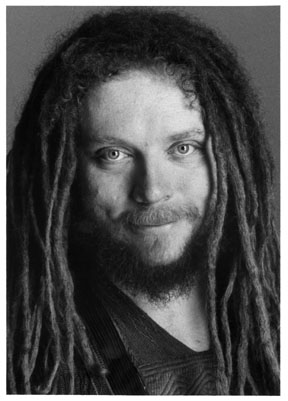
 If you try to keep up with the ongoing debate regarding the Internet and the way it is shaping our world and our minds, you will inevitably come across the work of Jaron Lanier. When you do, stop and take note. Lanier qualifies as an Internet pessimist in Adam Thierer’s breakdown of The Great Debate over Technology’s Impact on Society, but he is an insightful pessimist with a long history in the tech industry. Unlike other, often insightful, critics such as the late Neil Postman and Nicholas Carr, Lanier speaks with an insider’s perspective. We noted his most recent book, You Are Not a Gadget: A Manifesto,
Earlier this week, I ran across a short piece Lanier contributed to The Chronicle of Higher Education in response to the question, “What will be the defining idea of the coming decade, and why?” Lanier’s response, cheerfully titled “The End of Human Specialness,” was one of a number of responses solicited by The Chronicle from leading scholars and illustrators. In his piece, Lanier recalls addressing the “common practice of students blogging, networking, or tweeting while listening to a speaker” and telling his audience at the time,
The most important reason to stop multitasking so much isn’t to make me feel respected, but to make you exist. If you listen first, and write later, then whatever you write will have had time to filter through your brain, and you’ll be in what you say. This is what makes you exist. If you are only a reflector of information, are you really there?
We have all experienced it; we know exactly what Lanier is talking about. We’ve seen it happen, we’ve had it happen to us, and — let’s be honest — we have probably also been the offending party. Typically this topic elicits a rant against the incivility and lack of respect such actions communicate to those who are on the receiving end, and that is not unjustified. What struck me about Lanier’s framing of the issue, however, was the emphasis on the person engaged in the habitual multitasking and not on the affront to the one whose presence is being ignored.
We are virtually dispersed people. Our bodies are in one place, but our attention is in a dozen other places and, thus, nowhere at all. This is not entirely new; there are antecedents. Long before smart phones enabled a steady flow of distraction and allowed us to carry on multiple interactions simultaneously, we wandered away into the daydreams our imagination conjured up for us. My sense, however, is that such retreats into our consciousness are a different sort of thing than our media enabled evacuations of the place and moment we inhabit. For one thing, they were not nearly so frequent and intrusive. We might also argue that when we daydream our attention is in fact quite focused in one place, the place of our dream. We are somewhere rather than nowhere.
Whatever we think of the antecedents, however, it is clear that many of us are finding it increasingly difficult to be fully present in our own experience. Perhaps part of the what is going on is captured by the old adage about the man with a hammer to whom everything looks like a nail. My most vivid experience with this dynamic came years ago with my first digital camera. To the person with a digital camera (and enough memory), I discovered, everything looks like a picture and you can’t help but take it. I have wonderful pictures of Italy, but very few memories. And so we may extrapolate: to the person with a Twitter account, everything is a tweet waiting to be condensed into 140 characters. To the person with a video recorder on their phone, everything is a moment to be documented. To the person with an iPhone … well, pick the App.
 In an article written by professor Barry Mauer, I recently learned about Andy Warhol’s obsessive documentation of his own experience through photographs, audiotape, videotape, and film. In his biography of Warhol, Victor Bockris writes,
Indeed, Andy’s desire to record everything around him had become a mania. As John Perrault, the art critic, wrote in a profile of Warhol in Vogue: “His portable tape recorder, housed in a black briefcase, is his latest self-protection device. The microphone is pointed at anyone who approaches, turning the situation into a theater work. He records hours of tape every day but just files the reels away and never listens to them.”
 Warhol’s behavior would, I suspect, seem less problematic today. Here too he was perhaps simply ahead of his time. Given much more efficient tools, we are also obsessively documenting our lives. But what most people do tends to be viewed as normal. It is interesting, though, that Perrault referred to Warhol’s tape recorder as a “self-protective device.” It called to mind R. R. Reno’s analysis of the pose of ironic detachment so characteristic of our society:
We enjoy an irony that does not seek resolution because it supports our desire to be invulnerable observers rather than participants at risk. We are spectators of our lives, free from the strain of drama and the uncertainty of a story in which our souls are at stake.
“Spectators of our lives.” The phrase is arresting, and the prospect is unsettling. But it is hardly necessary or inevitable. If the cost of re-engaging our own lives, of becoming participants at risk in the unfolding drama of our own story is a few less photos that we may end up deleting anyway, one less Facebook update from our phone, or one text left unread for a short while, then that is a price well worth paying. We will be better for it, and those others, in whose presence we daily live, will be as well.
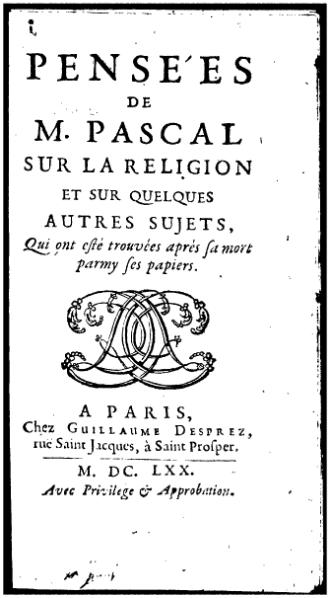
 , or thoughts. Pascal is today remembered, if at all, either for his law of fluid pressure or an argument for God’s existence known as Pascal’s Wager. Neither quite does justice to the depth of his insight into what we used to call the human condition.
 ,
,



 L.M. Sacasas