The Borg Complex

[Update: See the Borg Complex primer here.]

“Is technology good for religion?”

Well, it was only a matter of time. Actually, I’m surprised I’ve only lately come across the question. The formulation echoes previous queries such as “Is Google Making Us Stupid?” and “Is Facebook Making Us Lonely?” In this case, the title does not belong to a fully developed essay in The Atlantic, but rather to a brief blogpost. It was published at The Immanent Frame, a scholarly site devoted to the sociology of religion, and it pointed readers to a recent (and not quite scholarly) piece in the Washington Post by Lisa Miller.

The title of Miller’s article dispensed with the pretense of an interrogative, opting instead for a confident declarative: “The religious authorities and pundits are wrong: Technology is good for religion.” So there you have it. Case closed. End of discussion. Although, of course, nothing could be further from the truth.

I read a lot about technology and its consequences for individuals, institutions, and society. To the writing of such articles, essays, and books there is now seemingly no end. The quality of such work varies considerably; some of it is thoughtful, some of it hysterical (and not in the humorous sort of way). Perspectives on the relative merits of technology vary greatly as well. There are unabashed critics and boosters, and more temperate souls as well. All of this is as one would expect, and I typically don’t mind reading pieces from points all along the spectrum.

But occasionally I will come across a piece that irks me. Usually it is not the content that manages to unbalance my humors, it is the tone. This tone arises from what I’ve just now decided to call a “Borg Complex.” The implicit tone of those with a Borg Complex can be summed up by the line, “Resistance is futile.” That line has entered our pop-cultural lexicon through the Star Trek franchise. I won’t pretend to be an expert on Borg lore; I’ll only note that the Borg always announced some variation of the following to their victims: “We will add your biological and technological distinctiveness to our own. Resistance is futile.”

The spirit of the Borg lives in writers and pundits who take it upon themselves to prod on all of those they deem to be deliberately slow on the technological uptake. These self-appointed evangelists of technological assimilation would have us all abandon any critique of technology and simply adapt to the demands of technological society.  Except, of course, that when this message is articulated by humans with a Borg Complex it loses the tone of cool, malevolent indifference and instead takes on a tone of grating condescension. The tone is also characterized by the annoying self-assurance of those who have seen the light and feel a mixture of pity and disgust toward the poor souls who remain in the darkness.

Miller’s essay is a case in point. Although it displays a milder manifestation, it still helpfully demonstrates some of the standard symptoms of the Borg Complex.

1. Makes grandiose, but unsupported claims: “Technology can greatly enhance religious practice. Groups that restrict and fear it participate in their own demise.”

2. Uses the term Luddite a-historically and as a casual slur: “Luddites insist that nothing can replace the human touch of a faith community …”

3. Pays lip service to, but ultimately dismisses genuine concerns: “And this, of course, is true. But …”

4. Equates resistance or caution to reactionary nostalgia: “To insist that new ways of relating are not good or Godly ones is backward looking.”

5. Starkly and matter-of-factly frames the case for assimilation: “When new generations bring their values to religion, religion will have to adapt.”

6. Announces the bleak future for those who refuse to assimilate: “If religious groups don’t embrace and encourage the practice of faith online, the faithful might go shopping instead.”

In the coming days I might work on a fuller diagnostic guide for the Borg Complex with some suggestions for treatment.

Until then, carry on with the work of intelligent, loving resistance were discernment and wisdom deem it necessary.

_______________________________________

Read updates to the Borg Complex case files here.

Revisiting “The Religion of Technology”

Several months ago I wrote a short post on David Noble’s The Religion of Technology. Having recently revisited the book I thought it would be worthwhile to post about Noble’s work once again, this time with a little more detail.

Noble’s thesis offers an intriguing perspective on the relationship between religion and technology. By tracing their historical entwinement, Noble claimed to expose more than “a merely metaphorical” relationship between the two. Noble intended the designation, religion of technology, “literally and historically, to indicate that modern technology and religion have evolved together and that, as a result, the technological enterprise has been and remains suffused with religious belief.”

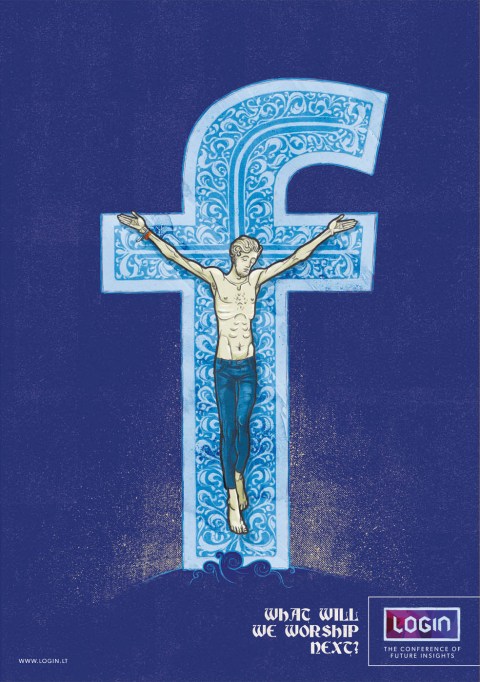
Noble is making an important distinction here. It is not uncommon to hear people talk metaphorically about technology in religiously inflected language or to draw analogies between religious practices and technology. As an example consider the poster below for “Login: The Conference of Future Insight” by the New! ad agency (h/t @troy_s). This poster analogically relates religion to technology by taking as its theme, “What will we worship next?” The question implies that we “worship” technology analogously to the worship of the religious believer, or that technology functions analogously to a deity in the life of the believer. This is a perfectly valid and suggestive angle of inquiry. However, it is not exactly what Noble has in mind. He unearths a concrete historical interrelationship between the Western technological project and the Christian tradition. A relationship, incidentally, which Noble hoped could be severed for the benefit of all involved.

By the New! ad agency

According to Noble, the religion of technology constitutes “an enduring ideological tradition that has defined the dynamic Western technological enterprise since its inception.” Consequently, it’s influence is evident not only upon “professed believers and those who employ explicitly religious language,” but also on many for “whom the religious compulsion is largely unconscious, obscured by a secularized vocabulary.” This influence manifests itself in the utopian hopes attached to the technological enterprise and can be traced back to the late Middle Ages. These utopian hopes include the expectation that technology would bring about the perfection of the individual and of society and serve as a vehicle of transcendence.

Statue of Roger Bacon in the Oxford University Museum of Natural History

The religion of technology emerges out of a worldview that posits an original state of perfection that, once lost, must be retrieved. Noble’s narrative traces the manner in which technology came to occupy a central place in this effort to regain the lost paradise. The medieval Christian worldview posited the requisite fallen condition: humanity had, by Adam’s sin, fallen from a state of spiritual and material perfection, and technology’s entanglement with the project of restoring the fallen order begins in an unlikely setting. Within the Benedictine monastic tradition, according to Noble’s interpretation*, work and its tools came to be seen as a means of grace enabling the recovery of mankind’s original perfection. At the dawning of the second millennium, this redemptive view of work and its tools was then joined to an eschatological fervor that anticipated the soon return of Christ and the renewal of the created order. In Noble’s narrative, this fusion was best exemplified by Roger Bacon:

“Having inherited the new medieval view of technology as a means of recovering mankind’s original perfection, Bacon now placed it in the context of millenarian prophecy, prediction, and promise. If Bacon, following Erigena and Hugh of St. Victor, perceived the advance of the arts as a means of restoring humanity’s lost divinity, he now saw it at the same time, following Joachim of Fiore, as a means of anticipating and preparing for the kingdom to come, and as a sure sign in and of itself that that kingdom was at hand.”

Noble goes on to describe the manner in which Christianity’s evangelical and missionary impulse “encouraged exploration, and thereby advanced the arts upon which such exploration depended, including geography, astronomy, and navigation, as well as shipbuilding, metallurgy, and, of course, weaponry.” Francis Bacon – who, Noble notes, “is typically revered as the greatest prophet of modern science” – is the next key figure in the evolution of the religion of technology. Noble, agrees with Lewis Mumford’s insistence that what Bacon advanced was “science as technology.” Bacon had little patience for science that did not issue in application and he suffused his advocacy of science as technology with a very specific theological aim: “the relief of man’s estate” understood as the amelioration of the material consequences of humanity’s fall. While the advent of Protestantism addressed the spiritual consequences of the fall, the scientific revolution underway in Europe was destined to address its material consequences. Both together would result in the re-establishment of the unfallen created order.

At the end of the nineteenth century, the religion of technology was alive and well in America, and it was best exemplified, according to Noble, by the techno-utopianism of Edward Bellamy whose writings “resound with the familiar refrains of redemption, of the divinely destined recovery of mankind’s lost perfection.” The historian Howard P. Segal, cited by Noble, summarizes Bellamy’s depiction of life in the year 2000 as follows:

The United States of the year 2000 is very much a technological utopia: an allegedly ideal society not simply dependent upon tools and machines, or even worshipful of them, but outright modeled after them. … The purposeful, positive use of technology – from improved factories and offices to new highways and electric lighting systems to innovative pneumatic tubes, electronic broadcasts, and credit cards – is, in fact, critical to the predicted transformation of the United States from living hell into a heaven on earth.

Following his survey of the historical origins of the religion of technology, Noble demonstrates its continuing vitality throughout the twentieth century in chapters exploring atomic weaponry, the space program, artificial intelligence, and genetic engineering. In each of these fields, Noble illustrates the enduring allure of the religiously inspired techno-utopian quest for perfection and transcendence.  In the end, Noble concludes that the religion of technology ultimately hinges on a hope of salvation that technology cannot finally provide.

_________________________________________________

*Noble’s interpretation of the Benedictine tradition should be qualified by George Ovitt’s work on the same.

American Technological Sublime: Our Civil Religion

David Nye, the author of Electrifying America which I cited a handful of times in the past month or so, is also the author American Technological Sublime (1995), a classic work in the history of technology. Except that it is not a work of history in the strict disciplinary sense. Nye draws promiscuously from other fields — citing for example Burke, Kant, Durkheim, Barthes and Baudrillard among others — to present a wide ranging and insightful study into the American character.

The concept of the technological sublime was not original to Nye. It had first been developed by Perry Miller, a prominent mid-twenieth century scholar of early American history, in his study The Life of the Mind in America. There Miller noted in passing the almost religious veneration that sometimes attended the experience of new technologies in the early republic.

Miller found that in the early nineteenth century “technological majesty” had found a place alonside the “starry heavens above and the moral law within to form a peculiarly American trinity of the Sublime.” Taking the steamboat as an illustration, Miller suggests that technology’s cultural ascendancy was abetted by a decidedly non-utilitarian aspect of awe and wonder bordering on religious reverence. “From the beginning, down to the great scenes of Mark Twain,” Miller explains, “the steamboat was chiefly a subject of ecstasy for its sheer majesty and might, especially for its stately progress at night, blazing with light through the swamps and forests of Nature.”

Leo Marx, who I’ve also mentioned here of late, also employed the technological sublime, but again in passing. It fell to David Nye, a student of Marx’s, to develop a book length treatment of the concept. Nye looks to Edmund Burke and Immanuel Kant in order fill out the concept of the sublime, but it is apparent from the start that Nye is less interested in the philosopher’s solitary experience of the sublime in the presence of natural wonders than he is in the popular and often collective experience of the sublime in the presence of technological marvels.

Nye, with a historian’s eye for interesting and compelling sources, weaves together a series of case studies that demonstrate the wonder, awe, and not a little trepidation that attended the appearance of the railroads, the Brooklyn bridge, the Hoover Dam, the factory, skyscrapers, the electrified cityscape, the atomic bomb, and the moon landing. Through these case studies Nye demonstrates how Americans have responded to certain technologies, either because of their scale or their dynamism, in a manner that can best be described by the category of the sublime. And perhaps more importantly, he argues that this experience of the technological sublime laced throughout American history has acted as a thread stitching together the otherwise diverse and divided elements of American society.

If the philosophers provided Nye with the terminology to name the phenomenon, he takes his interpretative framework from the sociologists of religion. Nye’s project is finally indebted more to Emile Durkheim than to either Burke or Kant. Nye notes early on that “because of its highly emotional nature, the popular sublime was intimately connected to religious feeling.” Later he observes that the American sublime was “fused with religion, nationalism, and technology” and ceased to be a “philosophical idea” instead it “became submerged in practice.”

This emphasis on practice is especially important to Nye’s overall thesis and it is on the practices surrounding the technological sublime that he concentrates his attention. For example, with each new sublime technology he discusses, Nye explores the public ceremonies that attended its public reception. The 1939 World’s Fair, to take another example, appears almost liturgical in Nye’s exposition with its carefully choreographed exhibitions featuring religiously intoned narration and a singular vision for a utopian future.

This attention to practices and ceremonies was signaled at the outset when Nye cited David Kertzer’s “Neo-Durkheimian view” that “ritual can produce bonds of solidarity without requiring uniformity of belief.” This functionalist view of religious ritual informs Nye’s analysis of the technological sublime throughout. In Nye’s story, the particular technologies are almost irrelevant. They are significant only to the degree that they gather around themselves a set of practices. And these practices are important to the degree that they serve to unify the body politic in the absence of shared blood lines or religion.

All told, Nye has written a book about a secular civil religion focused on sublime technologies and he has presented a convincing case. Absent the traditional elements that bind a society together, the technological sublime provided Americans a set of shared experiences and categories around which a national character could coalesce.

Nye has woven a rich, impressive narrative that draws technology and religion together to help explain the American national character. There’s a great deal I’ve left out that Nye develops. For example: the evolving relationship of reason to nature and technology as mediated through the sublime or the diminishing active role of citizens, and especially laborers, in the public experience of the technological sublime. But these, in my view, are minor threads.

The take-away insight is that Americans blended, almost seamlessly, their religious affections with their veneration for technology until finally the experience of technology took on the unifying role of religion in traditional societies. Historically American’s have been divided by region, ethnicity, race, religion, and class. American share no blood lines and they have no ancient history in their land. What they have possessed, however, is a remarkable faith in technological progress that his been periodically rekindled by one sublime technology after another all the way to the space shuttle program and its final mission.

The question I’m left with is this: What happens when the technological sublime runs dry? As Nye points out, it is, unlike the natural sublime, a non-renewable sublime. In other words, the sublime response wears off and must find another object to draw it out. If Nye is right — and I do think it is possible to overreach so I want to be careful — there is not much else that serves as well as the technological sublime to bind American society together. Perhaps then, part of our recent sense of unraveling, our heightened sense of disunity, the so called culture wars — perhaps these are accentuated by the withdrawal of the technological sublime. Perhaps, but that would take another book to explore.

“Suspended Power”

Weekend Reading, 9/16/2011

A little bit of politics, religion, parenting, plagiarism … you know, all the stuff you’re not supposed to talk about at the dinner table.  Plus one surprise for you at the end. Hope you have a lovely weekend.

“Pew’s Must See Picture of US Politics” by Rod Dreher at The American Conservative: Dreher provides an overview of the recently released Pew Center Political Typology Report, its first since 2005. Some interesting, counter-intuitive findings. Follow his link to the Pew page and you can take the survey to find out where you are in the Pew Typology.

“Varieties of irreligious experience” by Jonathan Rée in New Humanist: “The dividing lines between religiosity and secularism, or between belief and disenchantment, are not getting any clearer as time goes by, and if there has been a lot of traffic travelling from the camp of religion to the camp of disbelief in the past couple of centuries, it has followed many different paths, and is bound for many different destinations.” Well written piece in a Jamesian key on the subtleties of dis-belief in traditional religion.

“The Evolution of Data Products” by Mike Loukides at O’Reilly Radar: Helpful piece on the evolution and future trajectory of data and data products. “Data products are striving for the same goal: consumers don’t want to, or need to, be aware that they are using data. When we achieve that, when data products have the richness of data without calling attention to themselves as data, we’ll be ready for the next revolution.”

“What if the Secret to Success is Failure” by Paul Tough at the NY Times Magazine: Longish piece on efforts to instill character education in schools. “This push on tests is missing out on some serious parts of what it means to be a successful human.” “Our kids don’t put up with a lot of suffering. They don’t have a threshold for it. They’re protected against it quite a bit. And when they do get uncomfortable, we hear from their parents.”

“Uncreative Writing” by Kenneth Goldsmith at the The Chronicle of Higher Ed: Be warned, this piece may make you angry. Author argues the virtues of plagiarism claiming that writing must adjust to the conditions brought about by the computer, although there is a trajectory leading to this moment that pre-dates the computer. Some interesting points — it’s not a “crazy” piece — but my response is mixed.

And, last but not least, an impressive and surprising rendition of the national anthem from someone you wouldn’t have guessed could pull it off: watch it here.

“It was impossible to hate”: Presence, Absence, and Graham Greene’s Whiskey Priest

“When you visualize a man or woman carefully, you could always begin to feel pity.”  Or so the nameless priest in Graham Greene’s 1940 novel, The Power and the Glorythought to himself as he sat in a dark, dank, crowded jail cell accosted by a self-righteous woman intent on exposing his unworthiness.

The unnamed priest, however, needed no convincing.  Earlier in the novel we read that,

He was a bad priest, he knew it:  they had a word for his kind — a whiskey priest — but every failure dropped out of his sight and out of mind:  somewhere they accumulated in secret — the rubble of his failures.  One day they would choke up, he supposed, altogether the source of grace.  Until then he carried on, with spells of fear, weariness, with a shamefaced lightness of heart.

The Power and the Glory is set in the Mexican state of Tabasco during the 1930’s when the Red Shirts, a rabidly anti-clerical paramilitary organization, came to power and brutally suppressed the Catholic Church.  Greene’s protagonist, along with Padre Jose, a priest who agreed to marry and forsake his calling in exchange for his life, are the last vestiges of the Church in the state.

Throughout the story the whiskey priest eludes a fanatical police lieutenant who is hell bent on eradicating each and every reminder of the state’s religious past.  “He wanted to destroy everything,” the narrator’s voice explains, “to be alone without any memories at all.”  While evading capture, the nameless priest reluctantly and with an ever-present sense of his worthlessness ministers the sacraments in secret.  He hears confession in the darkness before dawn, he holds a Mass with illicit wine — the Red Shirts also banned alcohol — in dingy jungle huts, and finally he forsakes the promise of safety across the state border to attend to an American convict dying of a gun shot wound that he might be absolved.

Through it all, as author Scott Turrow recently put it, “he emerges as a figure of intense humility and faith, willing to sacrifice himself to attend in secret to the devoted and utterly unaware of his own goodness.”  Not unlike Christ, who in John’s Gospel returns to Jerusalem fully aware that it will cost him his life in order to attend to the dying Lazarus, the priest returns to attend to the dying American knowing that he is to be betrayed to the police and most likely executed.  And indeed, that is the path marked out for him.

In the concluding pages of the novel, after the priest has been unceremoniously executed, an event we witness through the eyes of an English dentist with whom the story had begun, we revisit a number of the families and individuals who along the way had harbored or otherwise interacted with the nameless priest.  In each case, we discover that the priest’s presence among them had been consequential — perhaps ambiguously so, but felt and remembered nonetheless.  This was particularly evident in the case of a young boy whose family had early on sheltered the whiskey priest.  At various points in the novel we listen in as the mother reads to the boy and his sisters an account of the death of a famous Mexican martyr.  The boy had been distracted, unimpressed.  But in the end, when he learns that the shabby priest with the “funny smell” who had been in their very house was also put to death, had now also become a martyr, he has a change of heart.

It brought it home to one — to have had a hero in the house, though it had only been for twenty-four hours.  And he was the last.  There were no more priests and no more heroes.

The priest’s presence, in retrospect, had made the difference.  This appears, from one perspective, to be the central premise of the novel.  By contrast, the oppressive quality of the setting is early on described as a “huge abandonment,” and the antagonist, the hell-bent lieutenant, was marked by the experience of a “vacancy,” and absence.  The priest, tortured by his own failures — often drunk and father of an illegitimate child — cannot quite see the significance of his presence.  He is in his own eyes merely a “fool” who “loves all the wrong things.”  But it is his presence we learn that has made all the difference, that has given hope and sustained faith.

In that prison with which we began, in the darkness, the priest gives profound expression to the significance of presence.

When you visualized a man or woman carefully, you could always begin to feel pity … that was a quality God’s image carried with it … when you saw the lines at the corners of the eyes, the shape of the mouth, how the hair grew, it was impossible to hate.

Greene considered The Power and the Glory to be his best novel.  Critics including John Updike, who wrote the Introduction to the 50th Anniversary Edition, agreed.  It is frequently listed among the best novels of the 20th century.  I read The Power and the Glory while also reflecting on the theme of presence along the lines suggested by Jaron Lanier.  Lanier drew attention to what we might call our presence to ourselves, that is our full engagement in our own experience that was threatened whenever our desire to record and publish our lives through social media led us to fragment our focus and our attention, to become spectators of our own lives.

Reflecting on Greene’s novel provided yet another angle from which to think of presence.  It suggested that our presence to one another may be the most significant gift we can offer.  Alienation and loneliness are still with us.  We speak incessantly of our living in a “connected” age, and indeed it has never been easier to make and maintain connection.  But connection is not presence.   It is true that very often, especially where great distance separates us, a connection is all we can offer — it is better than nothing.  But how often do we fail to give our whole presence to one another when we are separated by feet and inches?  How often do we fail not only to give our own, but to perceive the other’s presence so that we may notice “the lines at the corners of the eyes, the shape of the mouth, how the hair grew”?

Like the unnamed whiskey priest, we may never know what difference our presence will make in the life of another.  What we do know is that our absence, whether literal or effected by our fractured inattentiveness, may in the end contribute to a “huge abandonment.”