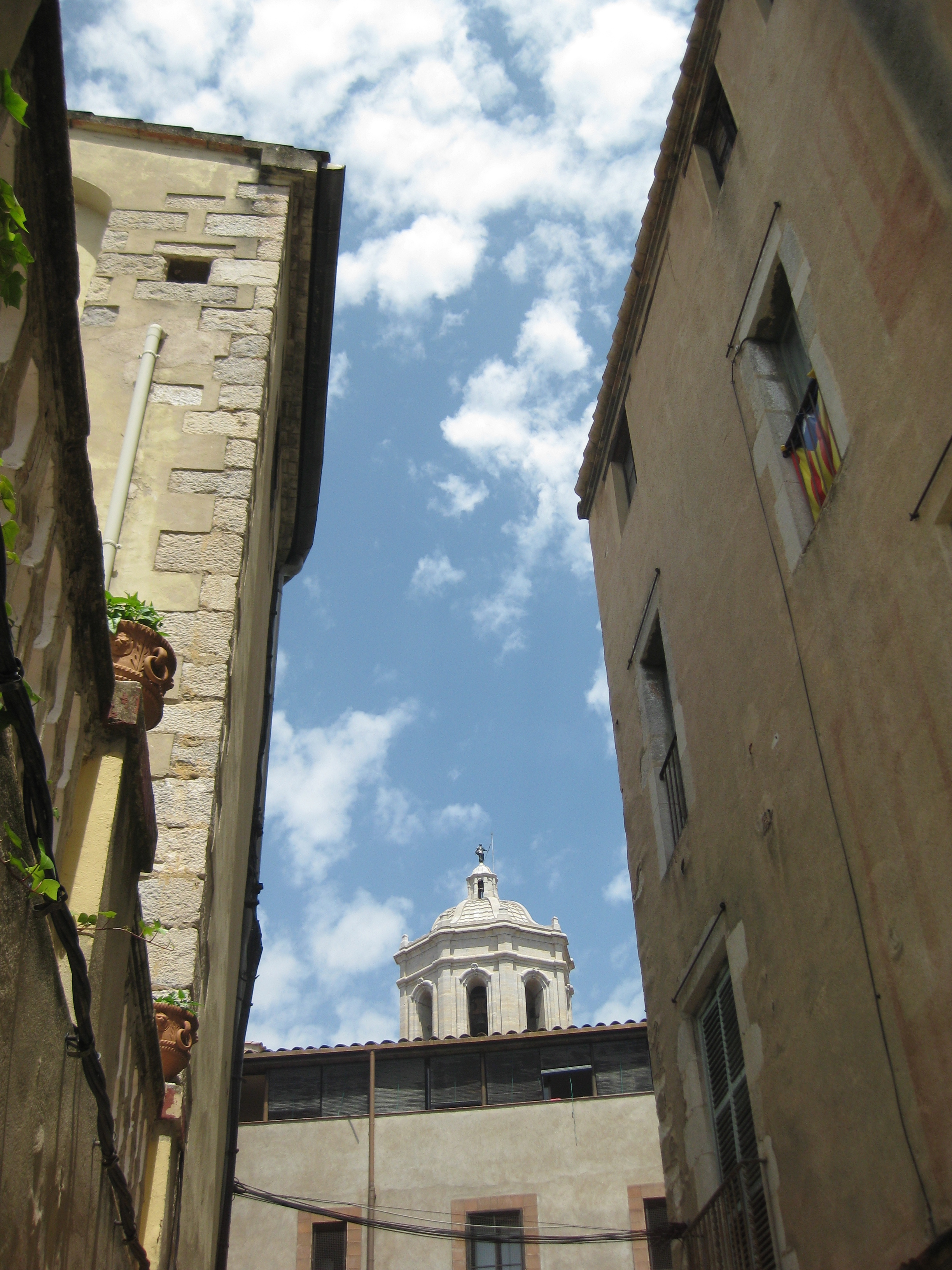
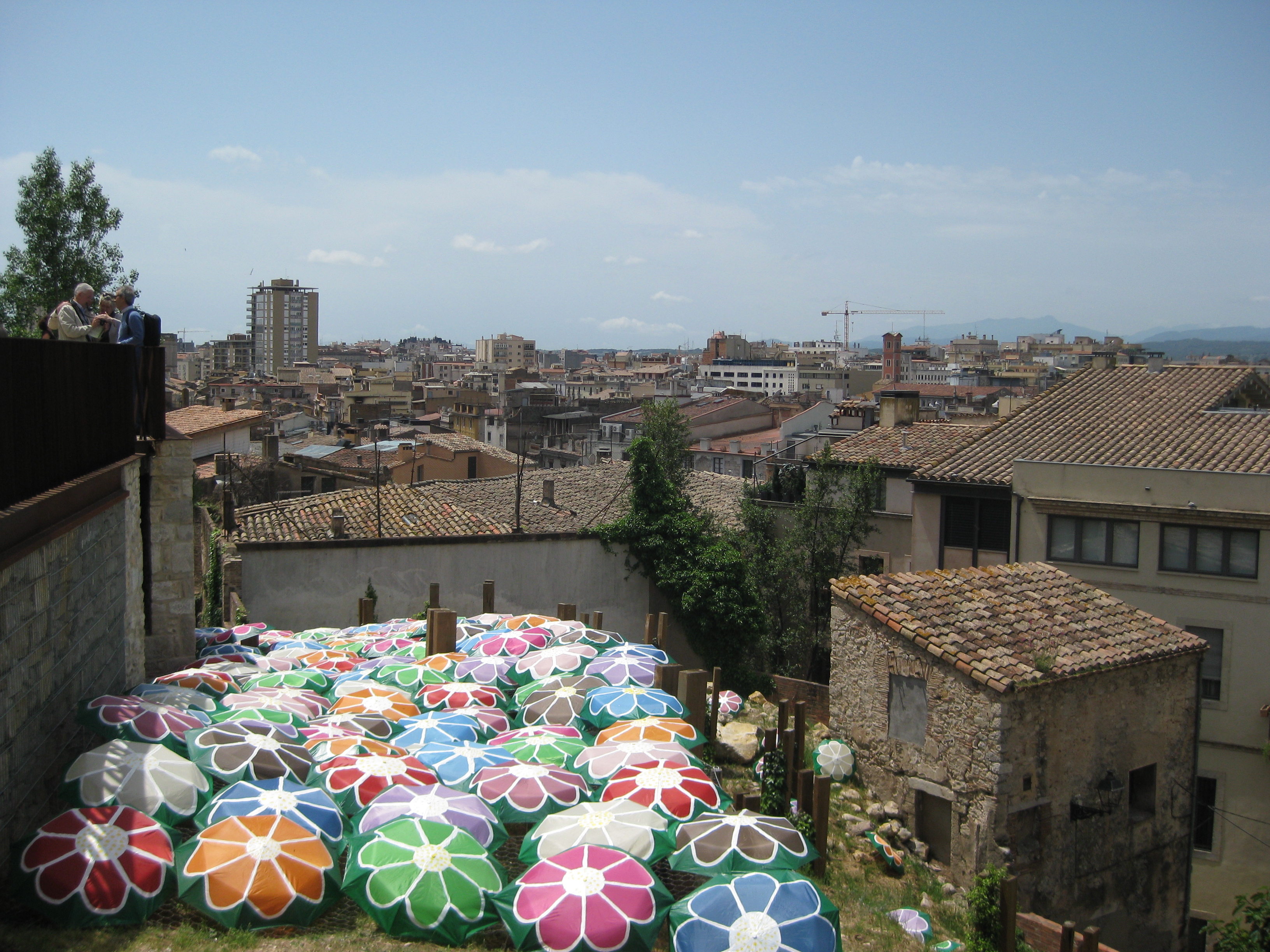
I’m not a photographer and this is not a travel blog. That said, I trust you will indulge me as I put up a post or two over the next few days with photographs from the past couple of weeks. For part of that time I was in Barcelona, a vibrant city with a rich historical and cultural heritage. A little later on this week I’ll likely post about the world’s fairs held there in 1888 and 1929. But for now I’ll share some photographs taken just a short train trip to the north in the city of Girona. Serendipitously, I came to the city during the annual Temps de Flors, a flower festival held each May.
Even without the flowers, Girona is a delightful city; the flowers simply add gorgeous dashes of color to the remarkably photogenic scenery. Of course, photographs don’t quite measure up to the experience, particularly when they are taken by an amateur with a rather pedestrian camera, but here a few of the better or more interesting ones.
N.B. The bridge in the first photo was designed by Gustave Eiffel whose more famous work resides in Paris and no political statement is necessarily intended by the last photo.
Natural wonders, lightning storms, tornadoes, sunsets — we sometimes describe the experience of these sorts of natural phenomenon as experiences of the sublime. They leave us in awe and render us speechless if only for a moment. There is a long tradition of reflection about the nature of the sublime experience going back at least to the eighteenth century. Kant and Burke in particular are often taken as starting points for the discussion. The sublime in Burke’s view was tinged with a certain terror, and for Kant the ability of human reason to take in and domesticate the sublime was a testament to its power.
More recently historian David Nye has argued that it is not only nature that inspires sublime experiences, our modern technologies also have the ability to elicit similar reactions of wonder, awe, and not a little trepidation. In American Technological Sublime, Nye argued that these experiences of the technological sublime have been especially characteristic of American society and have amounted to a kind of civil religion. They have at least been an integral part of the American civil religion. These experiences were more than moments of profound personal experience. They were moments that forged the collective national character. They were rituals of solidarity.
The first railroads, the first massive industrial factories, the electrified cityscapes, the Hoover Dam, the atomic bomb — all of these and more have inspired sublime experiences in those who first witnessed their appearance. One is reminded as well of Henry Adams’ famous account of the massive Corliss engine that powered the Philadelphia Centennial Exposition in 1876 and led Adams to compare the place of the dynamo in modern society to the place of the Virgin Mary in medieval society.
In more recent history the space program has supplied most instances of the technological sublime. Nye describes rocket launches at Cape Caneveral as quasi-religious events: “the event is less a matter of spectatorship than a pilgrimage to a shrine where a technological miracle is confidently expected.” In his account of the launch of Apollo 11, Nye describes Norman Mailer’s experience of the event. Mailer came as a skeptic, bent on resisting the allure of the event. He was determined not to be caught up in the fervor and devotion of the crowd of pilgrims. And yet … When the rocket launched and the earth began to rumble and the sound caught up with the sight, Mailer found himself saying over and over again, “Oh, my God! oh my God! oh, my God! oh my God!” That is the power of the technological sublime.
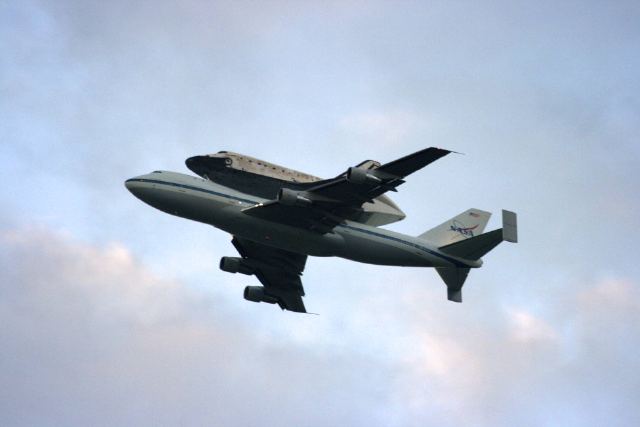
I write all of this today because yesterday Americans in Florida and the Washington D. C. area got an experience of the technological sublime. The space shuttle Discovery whose launches had been occasion for numerous pilgrimages to the Cape, especially as the shuttle program wound down, took her final voyage mounted on a specially fitted 747. If you were able to catch a glimpse of the spectacle, perhaps you know experientially what Nye theorized. If you were not able to see the sight in person, you have only to read the new stories, personal accounts, and, yes, tweets to conclude that the technological sublime is alive and well, if perhaps increasingly rare.
The technological marvel, the national pride, the sense of solidarity, the awe, the pride, the wave of emotion, the patriotic fervor abetted by the military jet accompanying the shuttle on its final voyage — you can read all of it on the faces of the spectators and in the nature of the pictures that made their way around the news outlets and blogs.
In the midst of it all, however, there was a sense of nostalgia as well. Of course, part of that nostalgia arises from the fact that this was a final voyage, and as such it recalled to mind all of the previous voyages, including those that ended in tragedy. But perhaps the nostalgia also arose from a tacit realization (if such a thing is possible) of the absence of such experiences from our more common and ordinary encounters with technology. In his final chapter, Nye describes the transition to what he calls the “consumer’s sublime” typified by Las Vegas and Disneyland. “The epiphany,” Nye writes, “has been reduced to a rush of simulations, in an escape from the very work, rationality, and domination that once were embodied in the American technological sublime.”
Put that way, one wonders whether it is not on the whole better that the American technological sublime is waning. And yet when one experiences its “melancholy, long withdrawing roar,” perhaps it is only natural to feel a tinge of sadness.
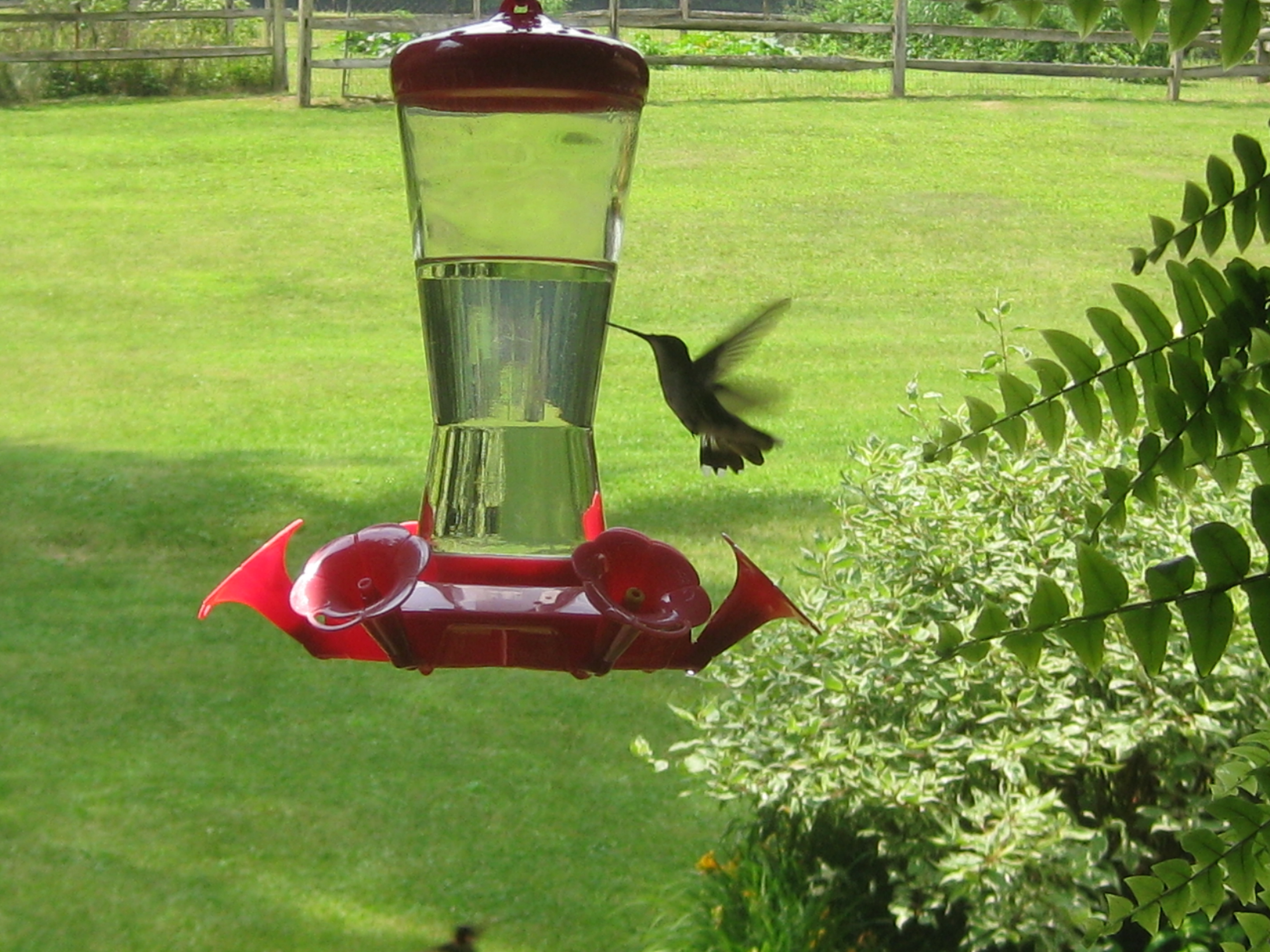
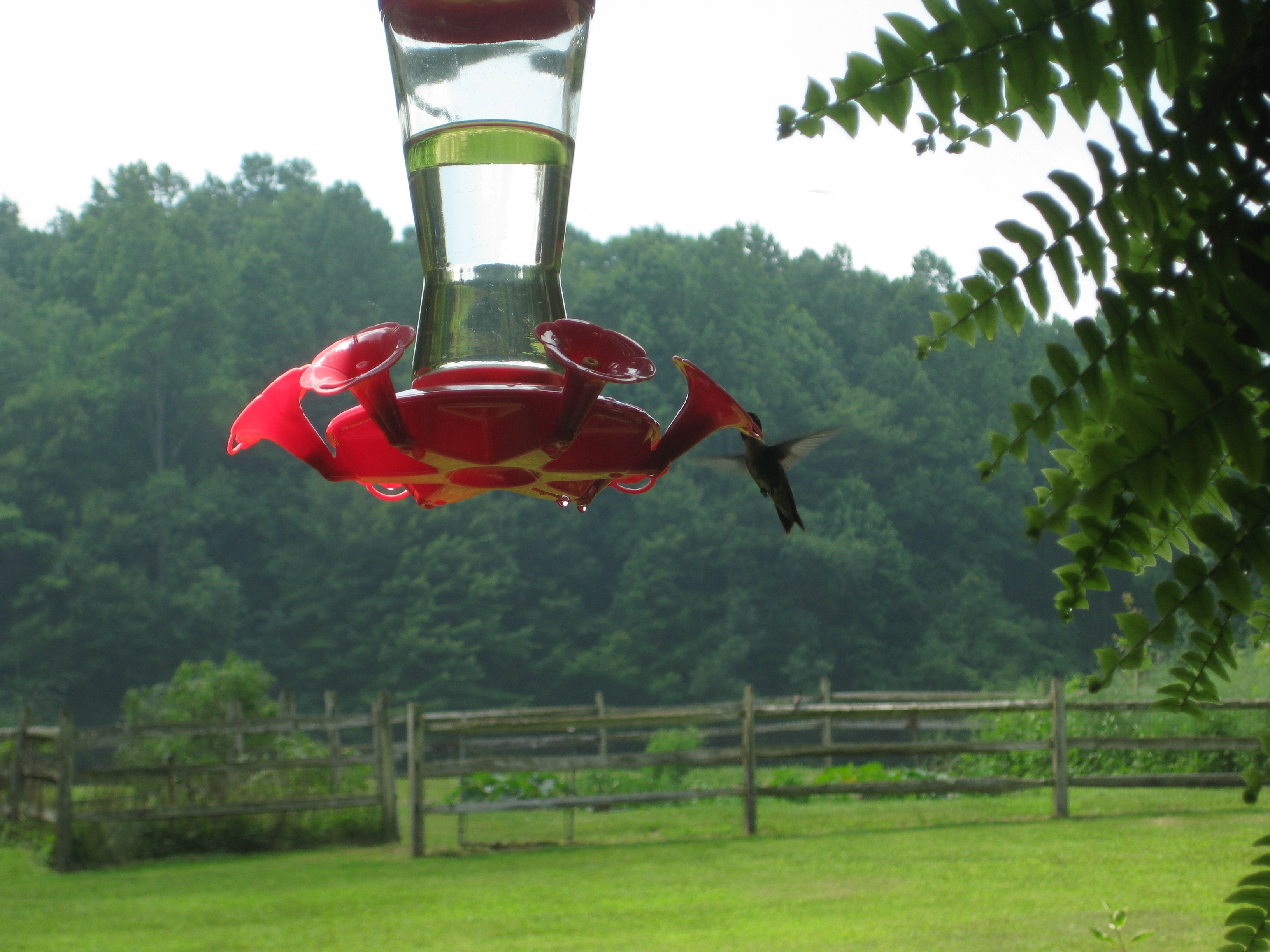
I’m fairly certain that until I visited western Pennsylvania this summer, I could count on one hand, maybe two, how many hummingbirds I’d seen in my life. Given the location and time of year, and thanks to a pair of hummingbird feeders, I easily surpassed that number of sitings in about, oh, two minutes time.
The hummingbirds endlessly fascinated and delighted me. They buzzed effortlessly back and forth from feeder to feeder just slow enough for the eye to follow with some effort, and then would stop so suddenly the eye would continue down an anticipated trajectory for a hundredth of a second before realizing it was now following only a projection. I say it would stop, but really it was not a stop since tiny wings were still in blurred motion. It was a hover, a hover and then a dash. Dashing creatures, unafraid to whirl by so closely instinct made you duck. Sometimes it would stop, perched on the feeder. When it did, you realized just how small a bird this was, and elegant.
When the hummingbird hovered to draw from the feeder, unbroken focus seemed married to feverish activity. Maybe there is a useful digital age metaphor wrapped up in that moment.
I took the shots below (incidentally, interesting metaphor we chose for the act of taking pictures) with a pretty average camera from a fairly close distance.









 L.M. Sacasas