
The title is taken from the first of T. S. Eliot’s” Four Quartets,” Burnt Norton. Here is a bit more context:
Neither plenitude nor vacancy. Only a flicker
Over the strained time-ridden faces
Distracted from distraction by distraction
Filled with fancies and empty of meaning
Tumid apathy with no concentration
Men and bits of paper, whirled by the cold wind
That blows before and after time,
Wind in and out of unwholesome lungs
Time before time and after.
 Although these lines were first published near the middle of the last century, they unmistakably resonate with the present. The problem of distraction facilitated and encouraged by Internet culture is among the chief targets of Nicholas Carr’s The Shallows, the public reception of which has been noted in some previous posts. The reviews keep coming in. Todd Gitlin’s review, “The Uses of Half-True Alarms,” appeared in The New Republic on June 7th. Gitlin is clearly hesitant to embrace Carr’s claims in their fullness, but one is left with the sense that he is largely sympathetic to Carr’s argument.
I was especially pleased to see Gitlin express the obvious rejoinder to a frequent criticism directed toward Carr and others who raise questions about our too often uncritical embrace of all things technological. This criticism is on display, for example, in the opening paragraphs of Steven Pinker’s recent op-ed in the NY Times. Pinker never mentions Carr or his recent book, but they are clearly in view. In its most basic form, the criticism runs something like this: “moral panic” (to use Pinker’s phrase) is present whenever a new technology comes on the scene, society has obviously survived those past technological developments thus the panic was misguided, and hence we should not pay too much attention to those who are raising questions about new technologies today.
There are a number of problems with this line of reasoning, but after offering his own version of the argument, Gitlin to his credit aptly stated perhaps the most obvious one:
Carr would no doubt respond that a repeated alarm is not necessarily a false alarm, and he would be right.
In his review, Gitlin cites Eliot’s lines which Carr employs in The Shallows. Interestingly, last night I had been reading Paul Johnson’s chapter on Eliot in his 2006 book Creators: From Chaucer and Durer to Picasso and Disney. With all the recent attention drawn to our lack of attention in mind, I was struck by the following passage:
Eliot always worked hard at whatever he was doing, being conscientious, and consumed with guilt if he was “lazy” (a rare state), and having moreover the priceless gift of concentrating. He could set to work immediately, first thing in the morning, without any time-consuming preliminary fiddling or rituals. If interrupted, he could refocus immediately and resume work. The intensity with which he worked was almost frightening.
Eliot, as Johnson describes him, appears to be the stark antithesis of the Internet Man. The concern of some is that men and women of Eliot’s prodigious talent and skills will be increasingly rare in a culture dominated by the habits and priorities of the Internet. Time will tell of course. Needless to say, men and women of that caliber are rare in any age. Will they become extinct? In my more hopeful moments, I think not. Unfortunately, this minimal optimism — surely a few men and women of genius will still emerge — is another frequent line of response to Carr’s thesis. It is not as if before the Internet most of us were reading Proust and honing our cello skills. More likely, so the argument goes, we were wasting our time with that last invention to a spark “moral panic,” the television. (This is, I suspect, true enough. However, one wonders how different things would be if a prior generation had heeded warnings about that screen and its dangers.)
But here again I find the argument misguided. Of course, all of us have never been all that we could be. The use of this argument against Carr and the like is rather depressing. The assumption seems to be, “No worries, we’ve always been mediocre and always will be.” This may be true, but it is a symptom of some kind of cultural anemia that we now embrace this line of thinking in defense of our gadgets and our toys. The question is not whether we have in the past made any better use of our time, the question is whether our tools and our social climate in general are more or less conducive to the pursuit of some kind of excellence, however halting the pursuit. Johnson noted a certain guilt that Eliot experienced when he perceived himself to have failed to use his time well. It is perhaps the general absence of such guilt in the Wireless Age that is most telling of our present ills.
You can subscribe to my newsletter, The Convivial Society, here.
 likewise continues to get a great deal of attention. Jonah Lehrer’s review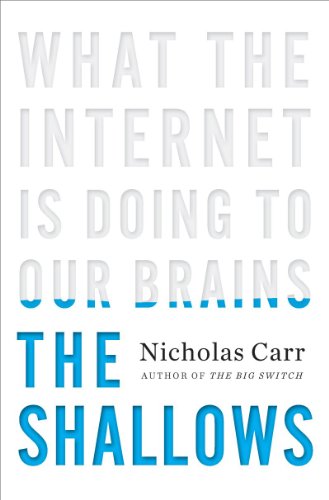
 L.M. Sacasas