
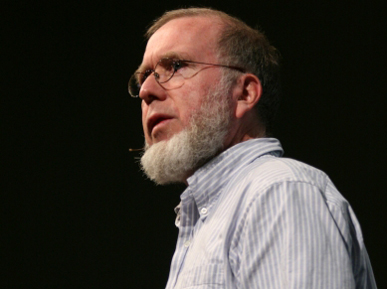
Kevin Kelly, God, and Technology

As I have read and thought about technology and its cultural consequences, I have especially appreciated the work of Marshall McLuhan, Walter Ong, Jacques Ellul, Ivan Illich, and Albert Borgmann.  My appreciation stems not only from the quality and originality of their work, but also from a curiosity about the manner in which their religion informed their thinking; all were deeply committed to some expression of the Christian faith.  We would do well to add the name of Kevin Kelly to the list of theorists and students of technology who bring a theological perspective to their work.

Of course, the Christian tradition is an ocean with many currents, and so it is not surprising that despite their common core commitments, the work of the scholars mentioned each takes on a distinct hue.  Of those mentioned, Kelly is in my estimation the most optimistic about the future of technology and that comes across quite clearly in his recent interview with Christianity Today.

There Kelly connects technology with God’s own creative capacity and the freedom with which He endows humanity:

We are here to surprise God. God could make everything, but instead he says, “I bestow upon you the gift of free will so that you can participate in making this world. I could make everything, but I am going to give you some spark of my genius. Surprise me with something truly good and beautiful.”

He also provides the following explanation of the term technium which he coined:

I use technium to emphasize that human creation is more than the sum of all its parts. An ecosystem behaves differently from its individual plant and animal components. We have thoughts in our minds that are more than the sum of all neuron activity. Society itself has certain properties that are more than the sum of the individuals; there is an agency that’s bigger than us. In the same way, the technium will have a behavior that you’re not going to find in your iPhone or your light bulb alone. The technium has far more agency than is suggested by the word culture.

I find this emergent model to be an interesting way to get at the influence of technology.  I try to navigate a path between approaches to technology that take the tools to be determinative of human action on the one hand, and others which take the tools to be merely neutral objects of human action on the other.  I’m not sure if I’m prepared to unreservedly endorse Kelly’s formulation, but I am generally sympathetic.

I’m less inclined to sign onto the remarkably positive outlook Kelly articulates for the technium, although I must admit that it is both refreshing and invigorating. Kelly is sure that “… the world is a better place now than it was 1,000 years ago. Whatever quantifiable metric you want to give to me about what’s good in life, I would say there’s more of it now than there was 1,000 years ago.” And, indeed, by many if not most measures, it most certainly is.  Yet, I would hesitate to claim that in every way that life has improved it has done so because of the technium, and I would be inclined to argue that in certain important respects elements of the technium have worked against human happiness and fulfillment.

Kelly acknowledges, but underemphasizes the fallibility and folly of humanity. He believes that God’s grace, seemingly operating through the technium, more than cancels out the folly.  I share the hope in principle, but would not so closely connect the operations of God’s grace to the sphere of technological advance.

Perhaps the point of tension that I experience with Kelly’s position stems from his definition of goodness:  “… overall the technium has a positive force, a positive charge of good. And that good is primarily measured in terms of the possibilities and choices it presents us with.”  Kelly illustrates his point by asking us to imagine Mozart being born into a world in which the piano has not been invented – what a tragedy.  This resonates, but then we might ask, what of all of those would be Mozarts that did in fact live, as surely they did.  Is their happiness and fulfillment so tied to an as of yet future invention that their life is otherwise rendered unfulfilled?  Would this not suggest that, in fact, the grass is always greener in the future perpetually and so happiness and fulfillment is never finally attainable?  Fulfillment would taunt us from just around the corner that is the future.

Perhaps the problem arises from too quickly eliding the infinite creative possibilities of the Creator with the limited, derivative creativity of the creature.  To be human is to flourish within the limitations of material and embodied existence. Expanding choice is not necessarily a bad thing, of course, but hitching the possibility of human fulfillment to the relentless expansion of choice seems to overlook the manner in which the voluntary curtailment of choice might also serve as the path to a well-lived life.

Curiously, Kelly practices a way of life that would seem on the surface to be at odds with the gospel of choice maximalization.  He has written engagingly about the Amish and recommended aspects of their approach to technology.  In his personal life, Kelly has implemented a good bit of Amish minimalism.  When asked about whether this constituted an inconsistency between his words and his actions, Kelly responded:

Technology can maximize our special combination of gifts, but there are so many technological choices that I could spend all my time just trying out technologies. So I minimize my technological choices in order to maximize my output. The Amish (and the hippies) are really good at minimizing technologies. That’s what I am trying to do as well. I seek to find those technologies that assist me in my mission to express love and reflect God in the world, and then disregard the rest.

But at the same time, I want to maximize the pool of technologies that people can choose from, so that they can find those tools that maximize their options and minimize the rest.

I can see his angle and would stop short of suggesting that this was indeed an inconsistency on Kelly’s part, but I will say that for my part I find more wisdom in Kelly’s practice than in his unbounded hope for the technium.

______________________________________________________

See also Nicholas Carr’s comments on Kelly’s interview (as well as Kelly’s response in the comment thread) and Kevin Kelly’s TED Talk.

Marx, Freud, and … McLuhan

Just wanted to pass along Jeet Heer’s piece, “Divine Inspiration” in The Walrus, on Marshall McLuhan, his legacy, and his Catholicism.  Excerpts below.  Click through for the whole piece which is not long at all.

  • It’s a measure of McLuhan’s ability to recalibrate the intellectual universe that in this debate, [Norman] Mailer — a Charlie Sheen–style roughneck with a history of substance abuse, domestic violence, and public mental breakdowns — comes across as the voice of sobriety and sweet reason. Mailer once observed that McLuhan “had the fastest brain of anyone I have ever met, and I never knew whether what he was saying was profound or garbage.”
  • Indeed, his faith made him a more ambitious and far-reaching thinker. Belonging to a Church that gloried in cathedrals and stained glass windows made him responsive to the visual environment, and liberated him from the textual prison inhabited by most intellectuals of his era. The global reach and ancient lineage of the Church encouraged him to frame his theories as broadly as possible, to encompass the whole of human history and the fate of the planet. The Church had suffered a grievous blow in the Gutenberg era, with the rise of printed Bibles leading to the Protestant Reformation. This perhaps explains McLuhan’s interest in technology as a shaper of history. More deeply, the security he felt in the promise of redemption allowed him to look unflinchingly at trends others were too timid to notice.
  • Like Marx and Freud, he was an intellectual agitator, a conceptual mind expander, the yeast in the dough. After Marx, we can no longer ignore the reality of class difference; after Freud, we can’t pretend that our mental life isn’t saturated with sexual impulses; after McLuhan, we can’t imagine that technology is just a neutral tool. Moreover, like Darwin and Marx, McLuhan is no longer just one man but rather a living and evolving body of thought.

A few months ago I posted a link to a YouTube clip of the Mailer/McLuhan debate here, and here is a piece on Chesterton’s influence on McLuhan.

Incidentally, while pairing McLuhan with the likes of Marx, Darwin, and Freud is in some respects incongruous, what they do have in common is an awareness, sometimes overplayed, of the external forces shaping and influencing human thought  and personality.  What may set McLuhan apart on this score is his unwillingness to slide into determinism:

“There is absolutely no inevitability as long as there is a willingness to contemplate what is happening.”  — Marshall McLuhan, The Medium is the Massage

Studied Responses: Reactions to bin Laden’s Death

Image: CNN Belief Blog

In the moments, hours, and days following the announcement of Osama bin Laden’s death I was repeatedly struck by the amount of attention paid to the manner in which Americans were responding to his death.  Almost immediately I began to pick up notes of concerned introspection about the response (e.g., the jubilant crowds gathered at the White House and Ground Zero), and what ought to be the appropriate response.

This introspection appears to have been most pronounced within religious circles.  At Christianity Today, Sarah Pulliam Bailey gathered together Tweets from a number of evangelical Christian leaders and bloggers addressing the question, “How should Christians respond to Osama bin Laden’s death?”  A sizable comment thread formed below the post.  At the religion and media web site, Get Religion, in a post titled “Churches respond to Osama’s death,” we get another round of links to church leaders writing about the appropriate response to the killing of bin Laden.

The topic, however, was also prominent in the more mainstream media.  NPR, for example, ran a short piece titled “Is It Wrong to Celebrate Bin Laden’s Death” and another piece focused on bin Laden’s death titled “Is Celebrating Death Appropriate?”  In the former story we get the following odd piece of reflection:

Laura Cunningham, a 22-year-old Manhattan reveler — gripping a Budweiser in her hand and sitting atop the shoulders of a friend — was part of the crowd at ground zero in the wee hours Monday. As people around her chanted “U-S-A,” Cunningham was struck by the emotional response. She told New York Observer: “It’s weird to celebrate someone’s death. It’s not exactly what we’re here to celebrate, but it’s wonderful that people are happy.”

I say “odd,” because it is not clear that this young lady knew what or why she was celebrating.  “But it’s wonderful that people are happy”?  What?

The NY Times also ran a story titled, “Celebrating a Death: Ugly, Maybe, but Only Human.”  And, finally, in case you are interested, Noam Chomsky would also like you to know about his reaction to Osama’s death, although I imagine you can guess.  Additionally, at CNN’s Belief Blog, you can read “Survey:  Most Americans say its wrong to celebrate bin Laden’s death,” and Stephen Prothero’s reflections on the aforementioned survey.  You get the idea.

So all of this strikes me as rather interesting.  For one thing, I can’t really imagine this sort of self-awareness permeating the responses of previous generations to historical events of this sort.  Of course, this may be because this event is sui generis, although I doubt that is quite right.  It seems rather another instance of the self-reflexiveness and self-reference that has become a characteristic of our society.  I might push this further by noting that this post just adds another layer, another mirror, as I reflect on the reflections.  My usual explanation for this hypertrophied self-awareness is the collapse of taken-for-granted social structures and customs and the correlated rise of the liberated, spontaneous self.  The spontaneous self as it turns out is not that spontaneous; rather it is performed.  Performance is studied and aware of itself; conscious of its every response.  Naturally then, we are asking at the cultural level whether our “spontaneous” celebrations were appropriate.  Did we play this part right?

This posture seems to me to lack a certain degree of integrity, in the sense that our way of being in the world is not integrated; very little comes naturally, our actions all feel rather artificial.  Perhaps especially at those times when we most wish we could just be fully in the moment, we rather feel a certain anxiety about feeling the right way — are we feeling the way we are supposed to be feeling, etc.  However, the integrated self is also somewhat opaque to itself; it is capable of acting literally without thought, and thus perhaps thoughtlessly.

I’ll resist the temptation to provide a concluding paragraph that wraps things up neatly with a fresh insight.  More of an aspiration than a temptation, I suppose, if the insight just isn’t there.

iSpirituality: Religous Apps and Spiritual Practices

Religious apps for the iPhone and iPad have been in the news lately.  In “Religion on Your iPhone?”, Lisa Fernandez discusses a variety of apps created for Christians, Muslims, Jews, Hindus, and Buddhists.  The Apple app store is, if nothing else, an apparently ecumenical space.  Among the various religious apps, however, “Confession: A Roman Catholic App” has probably received the most attention and a good deal of it seemingly misguided.  The folks at Get Religion have broken down some of the misleading news stories related to the app and the Catholic League collected a few of the offending headlines including:

• “Can’t Make it to Confession? There’s an App for That”
• “Catholic Church Approves Confession by iPhone”
• “Bless Me iPhone for I Have Sinned”
• “Catholic Church Endorses App for Sinning iPhone Users”
• “Forgiveness via iPhone: Church Approves Confession App”
• “New, Church-Approved iPhone Offers Confession On the Go”
• “Confess Your Sins to a Phone in Catholic Church Endorsed App”
• “Catholics Can Now Confess Using iPhone App”

Bottom line: the app is intended to help prepare for confession and is not intended to substitute for face-to-face confession.  There is no virtual priest, and there is no virtual absolution.  As Terry Mattingly put it at Get Religion,

This app is actually a combination between a personal diary and the “examination of conscience” booklets and tracts that Catholic and Orthodox Christians have carried in their pockets, wallets and purses for generations.

You may also want to take a look at Maureen Dowd’s rather snarky take on the Confession app in her NY Times column, “Forgive Me, Father, For I Have Linked.”

Click image to see WSJ video report

The Wall Street Journal has also recently posted a video report on religious apps:  “From apps that let you tweet Bible verses to those that help you face Mecca or pray the right Hebrew blessings with the right foods, some of the pious are embracing mobile technology.”  The story follows the usual pattern:  new thing > positive reaction to new thing > negative reaction to new thing > conclusion offering moderating position.  Concerns, voiced mainly by a Christian pastor, include the danger of disengaging from the face-to-face community and misdirecting the focus of religious experience onto the device and away from God.

Professor Rachel Wagner, author of the forthcoming “Godwired: Religion, Ritual and Virtual Reality,” also appears in the report and frames the issue as a struggle between relevance to contemporary culture and faithfulness to ancient traditions.  She suggests that what is at issue is the degree of interactivity with the ritual or practice that the apps allow.  As she puts it, “Those religious groups that want to stay true to their traditions are going to allow less wiggle room.”  It’s not entirely clear from the segment what exactly Wagner means by interactivity, but I suspect she has in view the flexibility of the rituals.  In other words, interactivity implies that ancient rituals may be reshaped by their re-presentation in new media.

Putting the issue this way recalls Paul Connerton’s thesis in How Societies Remember.  In Connerton’s analysis,

Both commemorative ceremonies and bodily practices therefore contain a measure of insurance against the process of cumulative questioning entailed in all discursive practices.  This is the source of their importance and persistence as mnemonic systems.  Every group, then, will entrust to bodily automatisms the values and categories which they are most anxious to conserve.  They will know how well the past can be kept in mind by a habitual memory sedimented in the body.

In other words, embodied practices or rituals represent the most durable mode of remembering.  This is in part because they are less likely to be questioned and altered than knowledge encoded in spoken or written texts.  The core of a tradition’s identity then is wrapped up in its rituals and embodied practices; changes to the rituals and practices effect changes to collective memory and identity.

Consider, for example, that while the Reformation clearly involved the reformulation of key doctrines, it also restructured the embodied rituals of Catholic practice and re-ordered the material conditions of worship.  Bodily habits such as crossing oneself and material conditions such as the architecture of churches changed as much as doctrinal standards.  I suspect one could argue convincingly that for laymen and women, the changes in embodied practice and material conditions of worship were more significant than abstract doctrinal reformulations.

Anecdotally, I vividly recall some years ago being in a certain Protestant context and witnessing a young boy being pulled up rather brusquely from a kneeling posture during prayer with the very straightforward admonition, “We don’t do that here!”  It apparently smacked of Catholicism.  A particular vision of the faith was thereby inculcated by regulating the body.

With this in mind, then, the most interesting thing about religious apps may not be their content, but the way that they insert themselves into the embodied experience of worship and religious practice.  This may occur through the use of a cell phone to access the apps during worship.  (Remember how easy it is to spot someone who is being attentive to their cell phones by simply observing their posture.)  It may also occur through the way an app repackages a ritual or practice for digital mediation, perhaps abstracting bodily elements while preserving more mental components.  In either case, religious apps are likely leave their mark by subtly reshaping the way the body engages in worship and spiritual practice.

Vast Palaces of Memory and the Wonder of Being Human

I come to fields and vast palaces of memory, where are the treasures of innumerable images of all kinds of objects brought in by sense-perception.  Hidden there is whatever we think about …. When I am in this storehouse, I ask that it produce what I want to recall, and immediately certain things come out; some things require a longer search, and have to be drawn out as it were from more recondite receptacles.  Some memories pour out to crowd the  mind and, when one is searching and asking for something quite different, leap forward into the center as if saying ‘Surely we are what you want?’ With the hand of my heart I chase them away from the face of my memory until what I want is freed of mist and emerges from its hiding places.  Other memories come before me on demand with ease and without any confusion in their order.

This passage is from Augustine’s chapter on Memory in his Confessions, and to some degree it resonates with our own experience of memory.  I suspect, however, that at the same time it may seem as if Augustine’s memory is more expansive than our own and that he has achieved a greater organization and mastery over his memory than what we would claim over ours.  And this is probably about right.

In The Art of Memory,Francis Yates wonders,

It is as a Christian that Augustine seeks God in the memory, and as a Christian Platonist, believing that knowledge of the divine is innate in memory.  But is not this vast and echoing memory in which the search is conducted that of a trained orator?

The “vast palace of memory” that Augustine describes suggests to Yates a memory that has been trained in the artificial memory tradition associated with classical rhetoric.  It is a fascinating tradition that Yates elegantly chronicles in her classic work and which Joshua Foer has revisited in his recently published, Moonwalking with Einstein: The Art and Science of Remembering Everything. You can get an article length taste of Foer’s book in his piece for NY Times Magazine, “Secrets of  a Mind Gamer.”

This may become a well-worn topic around here in coming days, weeks, months, so I’ll apologize in advance for that.  At this point, though, I’ll only throw out the observation that in his rather dense, Memory, History, Forgetting, Paul Ricoeur considers various abuses of memory including artificial memory.

Coming back to Augustine, he goes on to write of memory,

It is a vast and infinite profundity.  Who has plumbed its bottom?  This power is that of my mind and is a natural endowment, but I myself cannot grasp the totality of what I am.  Is the mind, then, too restricted to compass itself, so that we have to ask what is that element of itself which it fails to grasp?  Surely that cannot be external to itself; it must be within the mind.  How then can it fail to grasp it?  This question moves me to great astonishment.  Amazement grips me.

This is a remarkable observation of the inability of memory, and the mind more generally, to encompass itself.  His wonder at the complexity and opaqueness of the “inward man” is one of Augustine’s most significant and enduring contributions to the Western tradition. The recognition that there is an element of itself that the mind fails to grasp, that “the mind knows things it does not know it knows,” predates the Freudian unconscious by a good 1500 years.

Finally, this astonishment and amazement also lead Augustine to question why we are not all equally amazed by the mystery and wonder that is a human being:

People are moved to wonder by mountain peaks, by vast waves of the sea, by broad waterfall on rivers, by the all-embracing extent of the ocean, by the revolutions of the stars.  But in themselves they are uninterested.

A good reminder that the most amazing thing about the universe that contains such wonders may be the creature who is able to contemplate them, be moved by them, and hold them in memory.