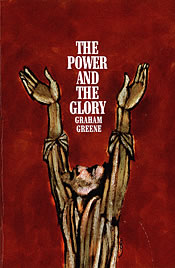
“It was impossible to hate”: Presence, Absence, and Graham Greene’s Whiskey Priest

“When you visualize a man or woman carefully, you could always begin to feel pity.”  Or so the nameless priest in Graham Greene’s 1940 novel, The Power and the Glorythought to himself as he sat in a dark, dank, crowded jail cell accosted by a self-righteous woman intent on exposing his unworthiness.

The unnamed priest, however, needed no convincing.  Earlier in the novel we read that,

He was a bad priest, he knew it:  they had a word for his kind — a whiskey priest — but every failure dropped out of his sight and out of mind:  somewhere they accumulated in secret — the rubble of his failures.  One day they would choke up, he supposed, altogether the source of grace.  Until then he carried on, with spells of fear, weariness, with a shamefaced lightness of heart.

The Power and the Glory is set in the Mexican state of Tabasco during the 1930’s when the Red Shirts, a rabidly anti-clerical paramilitary organization, came to power and brutally suppressed the Catholic Church.  Greene’s protagonist, along with Padre Jose, a priest who agreed to marry and forsake his calling in exchange for his life, are the last vestiges of the Church in the state.

Throughout the story the whiskey priest eludes a fanatical police lieutenant who is hell bent on eradicating each and every reminder of the state’s religious past.  “He wanted to destroy everything,” the narrator’s voice explains, “to be alone without any memories at all.”  While evading capture, the nameless priest reluctantly and with an ever-present sense of his worthlessness ministers the sacraments in secret.  He hears confession in the darkness before dawn, he holds a Mass with illicit wine — the Red Shirts also banned alcohol — in dingy jungle huts, and finally he forsakes the promise of safety across the state border to attend to an American convict dying of a gun shot wound that he might be absolved.

Through it all, as author Scott Turrow recently put it, “he emerges as a figure of intense humility and faith, willing to sacrifice himself to attend in secret to the devoted and utterly unaware of his own goodness.”  Not unlike Christ, who in John’s Gospel returns to Jerusalem fully aware that it will cost him his life in order to attend to the dying Lazarus, the priest returns to attend to the dying American knowing that he is to be betrayed to the police and most likely executed.  And indeed, that is the path marked out for him.

In the concluding pages of the novel, after the priest has been unceremoniously executed, an event we witness through the eyes of an English dentist with whom the story had begun, we revisit a number of the families and individuals who along the way had harbored or otherwise interacted with the nameless priest.  In each case, we discover that the priest’s presence among them had been consequential — perhaps ambiguously so, but felt and remembered nonetheless.  This was particularly evident in the case of a young boy whose family had early on sheltered the whiskey priest.  At various points in the novel we listen in as the mother reads to the boy and his sisters an account of the death of a famous Mexican martyr.  The boy had been distracted, unimpressed.  But in the end, when he learns that the shabby priest with the “funny smell” who had been in their very house was also put to death, had now also become a martyr, he has a change of heart.

It brought it home to one — to have had a hero in the house, though it had only been for twenty-four hours.  And he was the last.  There were no more priests and no more heroes.

The priest’s presence, in retrospect, had made the difference.  This appears, from one perspective, to be the central premise of the novel.  By contrast, the oppressive quality of the setting is early on described as a “huge abandonment,” and the antagonist, the hell-bent lieutenant, was marked by the experience of a “vacancy,” and absence.  The priest, tortured by his own failures — often drunk and father of an illegitimate child — cannot quite see the significance of his presence.  He is in his own eyes merely a “fool” who “loves all the wrong things.”  But it is his presence we learn that has made all the difference, that has given hope and sustained faith.

In that prison with which we began, in the darkness, the priest gives profound expression to the significance of presence.

When you visualized a man or woman carefully, you could always begin to feel pity … that was a quality God’s image carried with it … when you saw the lines at the corners of the eyes, the shape of the mouth, how the hair grew, it was impossible to hate.

Greene considered The Power and the Glory to be his best novel.  Critics including John Updike, who wrote the Introduction to the 50th Anniversary Edition, agreed.  It is frequently listed among the best novels of the 20th century.  I read The Power and the Glory while also reflecting on the theme of presence along the lines suggested by Jaron Lanier.  Lanier drew attention to what we might call our presence to ourselves, that is our full engagement in our own experience that was threatened whenever our desire to record and publish our lives through social media led us to fragment our focus and our attention, to become spectators of our own lives.

Reflecting on Greene’s novel provided yet another angle from which to think of presence.  It suggested that our presence to one another may be the most significant gift we can offer.  Alienation and loneliness are still with us.  We speak incessantly of our living in a “connected” age, and indeed it has never been easier to make and maintain connection.  But connection is not presence.   It is true that very often, especially where great distance separates us, a connection is all we can offer — it is better than nothing.  But how often do we fail to give our whole presence to one another when we are separated by feet and inches?  How often do we fail not only to give our own, but to perceive the other’s presence so that we may notice “the lines at the corners of the eyes, the shape of the mouth, how the hair grew”?

Like the unnamed whiskey priest, we may never know what difference our presence will make in the life of another.  What we do know is that our absence, whether literal or effected by our fractured inattentiveness, may in the end contribute to a “huge abandonment.”


Meeting the Rule of Technology with Counterpractices

From Albert Borgmann’s Power Failure:

“… for a long time time to come technology will constitute the common rule of life.  The Christian reaction to that rule should not be rejection but restraint … But since technology as a way of life is so pervasive, so well entrenched, and so concealed in its quotidianity, Christians must meet the rule of technology with a deliberate and regular counterpractice.

Therefore, a radical theology of technology must finally become a practical theology, one that first makes room and then makes way for a Christian practice.  Here we must consider again the ancient senses of theology, the senses that extend from reflection to prayer.  We must also recover the ascetic tradition of practice and discipline and ask how the ascesis of being still and solitary in meditation is related to the practice of being communally engaged in the breaking of the bread.  The passage through technology discloses a new or an ancient splendor in ascesis.  There is no duress or denial in ascetic Christianity.  On the contrary, liberating us from the indolence and shallowness of technology, it opens to us the festive engagement with life.”

The crucial insight here, for Christians and non-Christians alike, is the necessity of formulating deliberate and intentional counterpractices.  It is not enough to merely desire or will to live well with technology.  The “rule of technology” engraves itself on us by shaping the routines and habits of daily life so that it is both pervasive and unnoticed. Drawing on Pierre Bourdieu, Jamie Smith makes a similar point in a recent blog post:

But as Pierre Bourdieu would emphasize, such “micropractices” have macro effects: what might appear to be inconsequential micro habits are, in fact, disciplinary formations that begin to reconfigure our relation to the wider world–indeed, they begin to make that world. As Bourdieu puts it in The Logic of Practice, “The cunning of pedagogic reason lies precisely in the fact that it manages to extort what is essential while seeming to demand the insignificant” (p. 69).

The force of such habituated, world-making practices and micro-practices must be met with counterpractices.

Material Faith: Gestures Toward a Theology of Technology

In his 2003 book, Power Failure: Christianity in the Culture of Technology, philosopher Albert Borgmann invites us to consider what a theology of technology might look like.  He suggests that “there is hope for a coming to terms with technology not in the vortex of the initial confrontation, but only after one has passed through it.”  Then he goes on to add,

A radical theology of technology would be one that, through the experience of technology, could call into question what now counts as unproblematic …. In short I believe that the experience of technology can awaken in us a new potentia oboedientialis, a new capacity to hear the word of God.

As I read him, Borgmann is suggesting that a theology of technology is enabled by the experience of technology to perceive aspects of human experience that would otherwise remain obscured.  Passing through the vortex allows us to see more clearly what we may have apprehended only vaguely, if at all.

So for example, it seems that the vortex of rapid technological change encourages us to become aware of technology’s cultural consequences in a way that those who experienced technological change at a glacial pace would have been unlikely to perceive.  When technology does not change markedly in a generation or more, it tends to blend into the presumed natural order of things.  The acceleration of technological change encourages awareness of the attendant disruptions of established patterns of life.  Such awareness is sometimes accompanied by anxiety, euphoria, or nostalgia.  At best, though, it is a first step toward a discerning, critical disposition aimed at faithfulness and wisdom.

Two elements of experience thrown into relief by passing through the technological vortex come to mind.  Theorists of technology, and of digital media in particular, have over the last decade drawn attention to the materiality of texts and to the embodied nature of knowledge.  It is a concern fostered by the apparent immateriality of digital media and the not-so-fringe visions of disembodied immortality that animate many in the Silicon Valley set.

The rhetoric of disembodied posthumanism, for example, led Katherine Hayles, a scholar of literature and computer science, to articulate a countervision which secures the significance of the body.  In doing so, Hayles drew on the work of Pierre Bourdieu and Paul Connerton.  Both Bourdieu and Connerton produced rich studies of embodied practices within traditional societies — practices geared toward the task of cultural remembrance.  Connerton cited, among other examples, the significance of the enacted Christian liturgy as an instance of embodied practice aimed at securing enduring social memory. The ascendency of digitized memory, then, is the figure against which the ground of embodied knowing and remembering becomes visible.

Along similar lines, Jerome McGann working within the field of literary studies and having pioneered the digital archive (Rossetti Archive) drew attention to the significance of materiality in the case of texts.  When texts become digital, it is suddenly important to ask what difference the material attributes of the book makes.  Reinforcing Borgmann’s point, the materiality of the book would have remained largely taken for granted had not the advent of digital texts and e-readers drawn our attention to it.

Similarly, a theology of technology will address itself to the new fields of human experience being disclosed by the rapid advance of technology.  This by no means amounts to a wholesale endorsement of all technological change and its consequences.  Marshall Mcluhan, for example, viewed the task of understanding technology as an act of resistance to that same technology:

I am resolutely opposed to all innovation, all change, but I am determined to understand what’s happening because I don’t choose just to sit and let the juggernaut roll over me.  Many people seem to think that if you talk about something recent, you’re in favor of it.  The exact opposite is true in my case.  Anything I talk about is almost certainly to be something I’m resolutely against, and it seems to me the best way of opposing it is to understand it, and then you know where to turn off the button.  (Understanding Me:  Lectures and Interviews, 101-102)

Of course, we need not take quite so oppositional a view either.  Rather, the point is to reckon with what technology discloses about itself, the world we inhabit, and the human condition – and to take theological account of such disclosure.

It is worth noting that the renewed focus on embodiment, materiality, and what amounts to liturgical forms of knowing and remembering accord well with prominent themes within the Christian tradition.  It is, however, a focus that the Christian tradition has historically struggled to maintain.  Strands of American evangelicalism in particular, but not exclusively, have tended to reduce faith and practice to assent to the intellectual content of propositional statements thus occluding the significance of the material and embodied conditions of Christian discipleship and worship.

Perhaps taking a cue from theorists of technology it is possible to look again at the significance of the body and the rich material culture of Christian faith and practice.  Moreover, resources within the Christian tradition may fruitfully be brought to bear upon contemporary discussions of embodiment and materiality yielding genuine engagement and dialog.  The Christian faith after all is a faith of bread and wine, water and wood, body and blood.  It is just the right time, then, to rediscover the body and materiality of faith.

Nostalgia as Active Memory and Index of Our Desires

Below is an excerpt of an email exchange between myself and Mark Garcia, my very thoughtful friend who generously reads what I write on here. The exchange was occasioned by my earlier thoughts on nostalgia in Woody Allen’s Midnight in Paris. It was, I thought, worth posting here for a (slightly) wider audience. My thanks to Mark for pushing these reflections further along.

Collaboration in action, although you’ll see the real insights are not mine:

MG:  … is romanticized nostalgia for the ahistorical past itself a signal of transcendence, pace Berger, but not only of a heavenly and ‘other’ present or purely vertical, up-there, or beyond reality, but a reach for a certain kind of heavenly future?

MS: Yes, and few have captured that better than C. S. Lewis in The Weight of Glory in which he remarks that we take our revenge on what amounts to a longing for transcendence by, among other things, labeling it nostalgia and being done with it.

MG: Nostalgia as revenge is fascinating. Is it possibly, then, a form of memory in action, the action being the pursuit of some perceived form of justice? Is nostalgia at heart a longing for a certain form of “putting things right” and thus, in that way, a longing for an order of perfect justice and goodness?

MS: Yes, absolutely, memory in action. Memory, insofar as it is a search and not spontaneous, is in an index of desire. Nostalgia in this sense names the desire not only for justice, but also peace, joy, belonging, settledness, wholeness — shalom, shall we say?

MG: So whatever adjustments, reconfigurations, and manipulations of history nostalgia introduces are themselves the index to the desire nostalgia acts upon, e.g., nostalgic reconfigurations of one’s painful past reflects a desire for justice, reconfigurations of a lonely past along more satisfying lines reflects the desire for belonging, etc. This could take positive or negative forms, too: a positive or upward reconfiguration of a painful history might make things seem better than they were in order to aid present coping with it, whereas a negative or downward reconfiguration of that same past might make things seem worse than they were in order to aid present justifications of felt bitterness, injustice, or whatever. How varied are our grasping at shalom! As varied as we are, inside and out.

MS: Just so.

I also find it worthwhile to quote at some length from the essay by Lewis I referenced in the exchange. It is one of the most enchanting passages in the whole of Lewis’ oeuvre:

In speaking of this desire for our own far- off country, which we find in ourselves even now, I feel a certain shyness. I am almost committing an indecency. I am trying to rip open the inconsolable secret in each one of you—the secret which hurts so much that you take your revenge on it by calling it names like Nostalgia and Romanticism and Adolescence; the secret also which pierces with such sweetness that when, in very intimate conversation, the mention of it becomes imminent, we grow awkward and affect to laugh at ourselves; the secret we cannot hide and cannot tell, though we desire to do both. We cannot tell it because it is a desire for something that has never actually appeared in our experience. We cannot hide it because our experience is constantly suggesting it, and we betray ourselves like lovers at the mention of a name. Our commonest expedient is to call it beauty and behave as if that had settled the matter. Wordsworth’s expedient was to identify it with certain moments in his own past. But all this is a cheat. If Wordsworth had gone back to those moments in the past, he would not have found the thing itself, but only the reminder of it; what he remembered would turn out to be itself a remembering. The books or the music in which we thought the beauty was located will betray us if we trust to them; it was not in them, it only came through them, and what came through them was longing. These things—the beauty, the memory of our own past—are good images of what we really desire; but if they are mistaken for the thing itself they turn into dumb idols, breaking the hearts of their worshippers. For they are not the thing itself; they are only the scent of a flower we have not found, the echo of a tune we have not heard, news from a country we have never yet visited.

He later adds:

Apparently, then, our lifelong nostalgia, our longing to be reunited with something in the universe from which we now feel cut off, to be on the inside of some door which we have always seen from the outside, is no mere neurotic fancy, but the truest index of our real situation.

John Mayer and John Piper: Twitter Case Studies

I’ve never read the tweets of John Mayer, but I suspect they are an improvement on the tweets of Kanye West. In any case, Mayer apparently tweeted a lot, in fact, he recently owned up to a case of Twitter addiction. At a Berklee Performance Center Clinic for aspiring musicians, he had this to say:

“The tweets are getting shorter, but the songs are still 4 minutes long. You’re coming up with 140-character zingers, and the song is still 4 minutes long…I realized about a year ago that I couldn’t have a complete thought anymore. And I was a tweetaholic. I had four million twitter followers, and I was always writing on it. And I stopped using twitter as an outlet and I started using twitter as the instrument to riff on, and it started to make my mind smaller and smaller and smaller. And I couldn’t write a song.”

Mayer’s comments came to the attention of John Piper, a prominent Christian pastor with his own not insignificant Twitter following.  In a blog post, Piper offered his own experience as an alternative to Mayer’s:

My experience of publishing three Tweets a day (usually written and scheduled a week or two ahead of time) is different. Mayer said, “I couldn’t have a complete thought anymore.” To me this is almost the opposite of what happens. But that may depend on what we aim to do with Twitter.

Piper goes on to add, in what amounts to his philosophy of tweeting, that he aims to be capacious, concise, and compelling when he composes his tweets (preachers seem to have a hard time resisting alliteration). Along the way he likens tweets to proverbs and explains that, “Tweets for me are a kind of poetry.” This is all very nicely put, and I suspect it makes for pretty decent tweets.

Two users, admittedly two very different users, and two quite different experiences. Of course, there is nothing particularly surprising about this.  We shouldn’t necessarily expect any two users to have the same experience with any technology. Yet, I couldn’t help but wonder what might account for the difference, or if one were more typical.

We get a hint at what the difference might be when Piper writes, “My experience of publishing three Tweets a day (usually written and scheduled a week or two ahead of time) is different.”

That parenthetical statement suggests to me that Piper is not really tweeting. Obviously, he is composing words that are eventually shared via Twitter, but he is doing so in a manner that almost renders the platform irrelevant from the standpoint of personal experience. I would even bet that Piper is not the one interacting with the Twitter interface, in other words I wonder if he passes his composed tweets on to a third party who then types them in and publishes them. (There wouldn’t be a thing wrong with this, of course.) A quick look at Piper’s Twitter feed confirms the suspicion that his use of the interface is minimal since we find only the carefully composed statements and occasional links, but no interaction with other Twitter users. He has 185,000+ followers, and follows only 66. There are no @s0andso, no signs of conversation.

So let me suggest that Piper might as well be composing fortune cookie messages. Piper’s experience and habits are solidly in the world of old media. Piper’s thinking is not being influenced by Twitter because he is not using Twitter. In other words, Piper’s experience tells us nothing about the consequences of Twitter for someone who is actually robustly engaged with the interface, like John Mayer for example.

Piper’s closing paragraph further suggests that he is not exactly experiencing Twitter:

I don’t ask that others Tweet the way I try to. I only write this blog post to explain why I don’t experience Twitter the way John Mayer did, and why you don’t have to either. If your goal is to spread capaciousconcisecompelling truth about God and his ways, the Tweet is a fruitfully demanding form.

To describe a Tweet as a “fruitfully demanding form” is to view Twitter through the lens of the literary. Piper is measuring Twitter strictly in light of its verbal qualities, in the same way he might view a sonnet or a haiku. This a valid level of engagement and analysis, but has little to do with the way Twitter is experienced by most of its users. Moreover, it misses the significant points of contrast between print and digital media environments.

I hope it is clear that I’m certainly not criticizing Piper. My point is to understand the influence of technology, and I suspect that it is found in part in the habits formed by use of technology, or the practice of an interface. Piper has not experienced the effects of Twitter because he has not entered into the practice of Twitter defined as a robust and sustained engagement with the interface. I suspect that his Twitter account isn’t open on his desktop or smartphone. He probably is not emerged in the flow of TwitterTime. This is probably a good thing. By not really using the medium, he is not being used by it either. In any case, I would suggest that a tool’s influence will not really be felt until its use becomes a practice integrated into our form of life.

________________________________________________________

H/T: Mr. Greenwald for pointing me to Piper post.