E-books Go to School

Article first published as E-books Go to School – What is the Plan for Implementation? on Blogcritics.

On Monday, text book publisher McGraw-Hill rolled out its first digital, cloud-based textbook.   While McGraw-Hill had previously sold digital supplements to print curriculum, this will be the first all-digital effort available to the K-12 market.  It comes as something of a surprise that it has taken so long, but the hardware limitations frequently faced by schools had until recently presented enough of an obstacle to discourage publishers.  According to Sarah Kessler at Mashable, the e-books will be part of a complete online curriculum for K-12 math and 7-12 science which will also allow students to “participate in Facebook-like conversations that stay with the text.”  Polly Stansell, of McGraw-Hill, explains, “We’re trying to meet students and teachers where they’re at digitally.”

A recent study, however, suggests that this may not necessarily be the wisest strategy, at least as far as educational effectiveness is concerned.  The University of California Libraries recently released the findings of a 2010 survey of e-book users which included graduate and undergraduate students as well as post-doctoral researchers and faculty members.  Surprisingly, the youngest participants registered the strongest preference for print.  Undergraduates reported the highest percentage of participants, 58%, preferring print textbooks over e-books.  Altogether, 44% of the participants said they preferred print, while only 35% said they preferred e-books.

Participants were also asked to explain their preference, and their responses were summarized by Nicholas Carr as follows, “The answers suggest that while students prefer e-books when they need to search through a book quickly to find a particular fact or passage, they prefer printed books for deep, attentive reading.”  One response in particular, also cited by Carr, was especially illuminating:

I answered that I prefer print books, generally. However, the better answer would be that print books are better in some situations, while e-books are better in others. Each have their role – e-books are great for assessing the book, relatively quick searches, like encyclopedias or fact checking, checking bibliography for citations, and reading selected chapters or the introduction. If I want to read the entire book, I prefer print. If I want to interact extensively with the text, I would buy the book to mark up with my annotations; if I want to read for background (not as intensively) I will check out a print book from the library if possible. All options have their place …”

Practical, sensible flexibility of this sort implies the freedom to fit a technology to the educational situation.  Unfortunately, it is more often the case that the educational situation must conform to the technology.  Education is often driven by a certain faddishness, and this seems to be especially true when it comes to technology.  There is long and undistinguished list of tools and devices that were all intended to revolutionize the field and deployed into classrooms precipitously and with little evidence of their value.

This drive to implement new technologies is often accompanied by the rhetoric of choice and freedom for students and teachers, but choice is often precisely what gets left behind.  An all online, cloud based curriculum certainly expands the materials available to students and teachers, but it would almost certainly eliminate the kind of flexibility enjoyed by the student cited in the University of California study.  When schools buy in to new technologies the financial investment yields a corresponding pressure to implement what has been purchased.  This pressure is typically a function of avoiding the appearance of wasted money rather than evidence that education would be made more effective.

The educational value of e-books will likely be uneven as is often the case with any technology, even print; only time will tell. Ideally, the implementation of e-books will be guided by a willingness to perceive the circumstances under which they offer a genuine advance over print and where print still retains the advantage. In part, this is a matter of bending the tool to the needs of the student, rather than bending the student to fit the demands of the tool. Buying into (literally and figuratively) the ideology of educational technology fed by industry marketing undermines the discernment necessary to make just those kinds of judgments.
Writing Cannot Be Taught, But It Can Be Learned

Serendipitously, I encountered two book reviews yesterday containing very sound advice on the art of writing.  I expected as much out of the first review in which Joseph Epstein, whose prose I’ve long admired, politely begs to differ with Stanley Fish on how one ought to go about the process of writing well.  The second piece, a review of two books on higher education by Louis Menand, himself a more than competent stylist, offered its comments on writing incidentally to its main point.  I took both to be very near the truth of the matter.

Epstein opens his review of Stanley Fish’s How to Write a Sentence with the following  observations:

After thirty years of teaching a university course in something called advanced prose style, my accumulated wisdom on the subject, inspissated into a single thought, is that writing cannot be taught, though it can be learned—and that, friends, is the sound of one hand clapping. A. J. Liebling offers a complementary view, more concise and stripped of paradox, which runs: “The only way to write is well, and how you do it is your own damn business.”

Learning to write sound, interesting, sometimes elegant prose is the work of a lifetime. The only way I know to do it is to read a vast deal of the best writing available, prose and poetry, with keen attention, and find a way to make use of this reading in one’s own writing. The first step is to become a slow reader. No good writer is a fast reader, at least not of work with the standing of literature. Writers perforce read differently from everyone else. Most people ask three questions of what they read: (1) What is being said? (2) Does it interest me? (3) Is it well constructed? Writers also ask these questions, but two others along with them: (4) How did the author achieve the effects he has? And (5) What can I steal, properly camouflaged of course, from the best of what I am reading for my own writing? This can slow things down a good bit.

A bit further into the review he adds:

First day of class I used to tell students that I could not teach them to be observant, to love language, to acquire a sense of drama, to be critical of their own work, or almost anything else of significance that comprises the dear little demanding art of putting proper words in their proper places. I didn’t bring it up, lest I discourage them completely, but I certainly could not help them to gain either character or an interesting point of view. All I could do, really, was point out their mistakes, and, as someone who had read much more than they, show them several possibilities about deploying words into sentences, and sentences into paragraphs, of which they might have been not have been aware. Hence the Zenish koan with which I began: writing cannot be taught, but it can be learned.

In “Live and Learn:  Why We Have College”, Louis Menand reviews two recent books on the state of higher education and along the way offers his own well-considered thoughts  on the subject.  One of the two books, In the Basement of the Ivory Tower: Confessions of an Accidental Academic (which began its life as an article in The Atlantic)  contained, in Menand’s estimation, sound thoughts on writing:

When he is not taking on trends in modern thought, Professor X is shrewd about the reasons it’s hard to teach underprepared students how to write. “I have come to think,” he says, “that the two most crucial ingredients in the mysterious mix that makes a good writer may be (1) having read enough throughout a lifetime to have internalized the rhythms of the written word, and (2) refining the ability to mimic those rhythms.” This makes sense. If you read a lot of sentences, then you start to think in sentences, and if you think in sentences, then you can write sentences, because you know what a sentence sounds like. Someone who has reached the age of eighteen or twenty and has never been a reader is not going to become a writer in fifteen weeks.

For Menand and Epstein, the secret, if there is one, of good writing appears to be attentive reading, and a lot of it.

Teaching What It Feels Like To Be Alive

… it’s the stuff that’s about what it feels like to live.  Instead of being a relief from what it feels like to live.

That is how David Foster Wallace, in Although of Course You End Up Becoming Yourself, contrasted traditional literature with its coherent narrative and a satisfying sense of closure, to experimental or avant-garde literature which typically exhibits neither.  I’ve been thinking about that contrast since I posted the passage a few weeks ago.  Writing that is experienced as a relief from what it feels like to be alive and writing that reflects what it feels like to be alive — I’m wondering if that same distinction could also be usefully applied to teaching.  Can teaching, in the same way, reflect what it feels like to be alive, rather than be a relief from it?

Literature and teaching are both components of the ongoing, ramshackle project we call our education.   When I am most hopeful about what a teacher can do, I see it as not unlike what a very good book might also accomplish.  We might describe it as the opening up of new and multiple vistas into both the world and ourselves.  A good book offers a challenging engagement with reality, rather than the mere escapism that some literature proffers instead.  To borrow a line from Bridge to Terabithia, good teaching, likewise, pushes students to see beyond their own secret countries, to see and to feel what lies beyond and within.  Of course, on my less hopeful (read, more curmudgeonly) days, I feel that convincing students that a book can work in that way is itself the necessary task.

What, then, might it mean to teach so as to reflect what it feels like to be alive?

For one thing, it involves feeling; it is affective.  It reaches beyond the transfer of information to the mind, and seeks to move the heart as well.  This matters principally because while we go about the work and play of living we tend to lead with our hearts and not with our minds (for better and/or for worse).

But in order to move the heart, the heart must be susceptible to being moved.  The numbness that threatens always to settle on us as wave upon wave of stimulation washes over us gently massaging us into a state of mildly amused indifference to reality must be overcome.  This numbness itself might be self-protective, but, while self-knowledge has a distinguished place in the history of education, self-preservation seems a less noble aspiration.  Teaching that leads to feeling must find a way to break this through this self-protective numbness.  Of course, that numbness is itself part of what it feels like to be alive, but it is the part that must first be encountered, acknowledged, and transcended in order to feel all the rest.

Like the artist in Wallace’s view, the teacher has the license and the responsibility

to sit, clench their fists, and make themselves be excruciatingly aware of the stuff that we’re mostly aware of only on a certain level.  And that if the writer [or teacher] does his job right, what he basically does is remind the reader [or student] of how smart the reader [or student] is.

The teacher, like the writer, must themselves be sensitive to what it feels like to be alive so as to teach to that feeling and help students understand it, understand themselves.  Perhaps it is precisely here that teaching has failed students, in the inability to enter into the student’s world so as to speak meaningfully into it.

The trick, of course, is also to do so without falling into the equivalent of what Wallace calls “shitty avant garde,” literature that tries too hard and ignores the reader in its effort to be profound. Trying too hard to achieve this effect without authenticity is fatal.  Likewise with teaching.  Watching Lean on Me or Dead Poet’s Society one too many times will likely do more harm than good.

Good writing and good teaching are both grounded in a deep respect for the reader and the student, not in an inordinate desire to be inspiring.  This is what finally stuck me most forcefully in Wallace’s comments.  His work, his estimation of what literature could do, flowed from a remarkable confidence in the reader.  Perhaps then this is also where good teaching must begin, with an equal respect for and confidence in the student.

This is Not a Book

Budget cuts have put over 450 libraries across the UK in jeopardy and consequently launched protests and a vigorous campaign to save the libraries.  Writing in Prospect Magazine, Leo Beneditus suggests that while this is unfortunate, the whole situation is not quite so desperate as the rhetoric of the library enthusiasts make it out to be.  The sky, Benedictus, suggests is not quite falling. Perhaps.  I don’t have a specific point to make here, so much as a few observations:

For one thing, Benedictus is correct to observe,

Listening to a declaration of how wonderful books are (World Book Night, on 5th March, was one recent example), what I hear most loudly is a group of people feeling they have to say so. No one troubles to declare this for computer games.  Instead of making books seem fun, the well-intentioned merely spread a whiff of burning martyr round the act of reading.

Theodor Adorno, Alasdair MacIntyre, and others I’m sure, have pointed out that something has already given way when a culture begins to rationalize its moral code.  Ethics is a sign that moral consensus has already broken down and often amounts to little more than a rear-guard action.  Impassioned defense of the book may likewise signal the passing of an era.

I’m not certain if the subtitle of the article was penned (keyed?) by Benedictus or some editor, but it reads:

It’s a shame some libraries are closing, but this is not the end of civilisation. Quite the opposite.

This line is probably true enough, although “Quite the opposite” is debatable.  But one could justly reply that while it is not the end of civilization per se, it may signal the end of civilization as we know it (or, as we had known it as the transition has been in process for some time now). And this is no small thing.

Benedictus goes on to warn about the “overuse” of books:

One might argue that books offer a better education than games, but they are also more isolating—there are no two-player books—and just as prone to being overused.

It would be hard to imagine what the overuse of books might look like, but I suppose in principle it is possible. But the idea that books are isolating is only partly true.  Reading a book does initially isolate the individual, I’m reminded of Julian Smith’s fantastic music video; but a book, precisely by speaking to our inner self, reminds us that we are, none of us, so isolated that others cannot put words to our experiences.  In this way, books immerse us in solitude only to reconnect us more profoundly with the world around us.  Needless, to say a book may also connect us intimately with the experience of others by providing a window into their experience that is unavailable otherwise.

Later on, speaking of the potential virtue of e-readers, Benedictus suggests that,

Freed from paper in this way, books have a much better chance of becoming cool again.

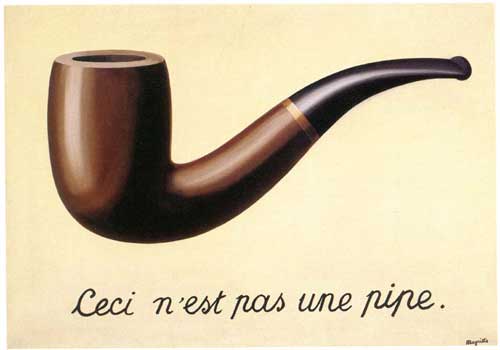
In the first place, the pursuit of “cool,” is always decidedly uncool.  Beside that, though, it is a curious statement to make because it confuses a text for a book.  A book freed from paper (unless you are imagining papyrus or vellum) is an oxymoron.  And this, perhaps, begins to reveal a deeper assumption at play in Benedictus’ essay — materiality is insignificant.  The book as object does not matter. Perhaps what is needed is a work of art along the lines of Magritte’s “This Is Not A Pipe” in order to provoke us into understanding the significance of textual materiality.

Reading is imagined merely as the transfer of immaterial data from one container (book, e-reader, etc.) to another (the human brain).  This seems blind to the significance of the embodied experience involved in reading a book which activates each of our senses in very particular ways, ways an e-reader (regardless of its virtues otherwise) simply cannot.  E-readers, of course, have their own materiality, and that matters as well.

Discounting materiality also ignores the manner in which the book as object, by virtue of its particularity, is the repository of a host of memories and associations.  A book can only be itself and so collects around itself its own unique history; the e-reader is every text it used to read, and thus it is simultaneously none of them.  I remember where and when I bought many of my books.  I remember where I read them and to pick up certain books is to be transported back to different moments in my life.  The book as object, its particular and unique materiality, matters.  This is not to suggest that e-readers have no place and no benefits, but it is to suggest that moving from books to an e-reader is not a transaction without remainder.

A failure to recognize the significance of materiality may also be at play in the willingness to bid adieu to the library.  Benedictus concludes his essay by noting that,

When the children of 2011 look back, they will not see this as the year their local libraries were taken away. This will be the year they all got libraries of their own.

Perhaps, but notice the equivocation.  “Libraries closed” are not the same thing as “libraries of their own.”  The former refers to a material fact, the latter refers vaguely to an assemblage of data.   In any case, when they do look back, if they do, they may also be oblivious to the rich and textured experience of reading that attended those curious relics of a past civilization.

___________________________

Listen to Zadie Smith’s reflections on libraries here.

“Darkness Gathers Around the Book”

“I read and I daydream …. My reading is thus a sort of impertinent absence.  Is reading an exercise in ubiquity?”  An initial, indeed initiatory, experience:  to read is to be elsewhere, where they are not, in another world; it is to constitute a secret scene, a place one can enter and leave when one wishes; to create dark corners into which no one can see within an existence subjected to technocratic transparency and that implacable light that, in Genet’s work, materializes the hell of social alienation.  Marguertie Duras has noted:  “Perhaps one always reads in the dark …. Reading depends on the obscurity of the night.  Even if one reads in broad daylight, outside, darkness gathers around the book.”

— From Michel de Certeau’s The Practice of Everyday Life, Chapter 12, “Reading as Poaching” (173).  The initial quote is from Guy Rosolato’s Essais sur le symbolique.