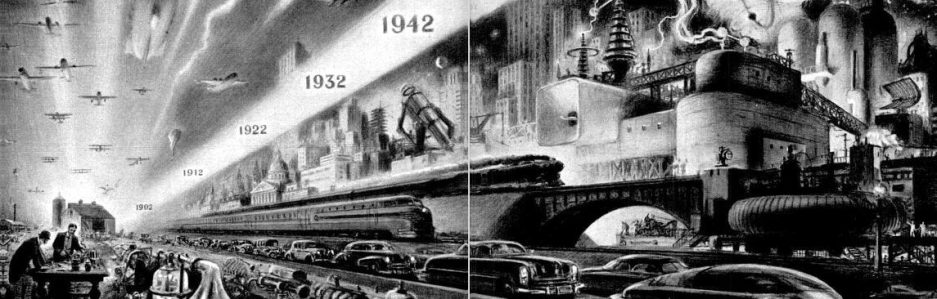
The discipline of anthropology cut its teeth on the study of cultures that were deemed “primitive” and exotic by the standards of nineteenth century Western, industrialized society. North American and European nations were themselves undergoing tremendous transformations wrought by the advent of groundbreaking new technologies — the steam engine, railroad, and telegraph, to name just three. These three alone dramatically reordered the realms of industry, transportation, and communication. Altogether they had the effect of ratcheting up the perceived pace of cultural evolution. Meanwhile, the anthropologists studied societies in which change, when it could be perceived, appeared to proceed at a glacial pace. Age-old ritual and tradition structured the practice of everyday life and a widely known body of stories ordered belief and behavior.
“All that is solid melts into air, and all that is holy is profaned …” — so wrote Marx and Engels in 1848. The line evocatively captures the erosive consequences of modernity. The structures of traditional society then recently made an object of study by the anthropologists were simultaneously passing out of existence in the “modern” world.
I draw this contrast to point out that our own experience of rapid and disorienting change has a history. However out of sorts we may feel as we pass through what may be justly called the digital revolution, it probably does not quite compare with the sense of displacement engendered by the technological revolutions of the late nineteenth and early twentieth century. I still tend to think that the passage from no electricity to near ubiquitous electrification is more transformative than the passage from no Internet to ubiquitous Internet. (But I could be persuaded otherwise.)
So when, in “You’ve Already Forgotten Yesterday’s Internet,” Philip Bump notes that the Internet is “a stunningly effective accelerant” that has rendered knowledge a “blur,” he is identifying the present position and velocity of a trajectory set in motion long ago. Of course, if Bump is right, and I think he is certainly in the ball park so far as his diagnosis is concerned, then this history is irrelevant since no one really remembers it anyway, at least not for long.
Bump begins his brief post by making a joke out of the suggestion that he was going to talk about Herodotus. Who talks about Herodotus? Who even knows who Herodotus was? The joke may ultimately be on us, but Bump is right. The stories that populated the Western imagination for centuries have been largely forgotten. Indeed, as Bump suggests, we can barely keep the last several months in mind, much less the distant past:
“The web creates new shared points of reference every hour, every minute. The growth is exponential, staggering. Online conversation has made reference to things before World War II exotic — and World War II only makes the cut because of Hitler.
Yesterday morning, an advisor to Mitt Romney made a comment about the Etch-A-Sketch. By mid-afternoon, both of his rivals spoke before audiences with an Etch-A-Sketch in hand. The Democratic National Committee had an ad on the topic the same day. The point of reference was born, spread — and became trite — within hours.”
Bump’s piece is itself over a week old, and I’m probably committing some sort of blogging sin by commenting on it at this point. But I’ll risk offending the digital gods of time and forgetting because he’s neatly captured the feel of Internet culture. But this brings us back to the origins of anthropology and the very idea of culture. Whatever we might mean by culture now, it has very little to do with the structures of traditional, “solid” societies that first filled the term with meaning. Our culture, however we might define it, is no longer characterized by the persistence of the past into the present.
I should clarify: our culture is no longer characterized by the acknowledged, normative persistence of the past into the present. By this clarification I’m trying to distinguish between the sense in which the past persists whether we know it or like it, and the sense in which the past persists because it is intentionally brought to bear on the present. The persistence of the past in the former sense is, as far as I can tell, an unavoidable feature of our being time-bound creatures. The latter, however, is a contingent condition that obtained in pre-modern societies to a greater degree, but no longer characterizes modern (or post-modern, if you prefer) society to the same extent.
Notably, our culture no longer trades on a stock of shared stories about the past. Instead (beware, massive generalizations ahead) we moved into a cultural economy of shared experience. Actually, that’s not quite right either. It’s not so much shared experience as it is a shared existential sensibility — affect.
I am reminded of David Foster Wallace’s comments on what literature can do:
“There’s maybe thirteen things, of which who even knows which ones we can talk about. But one of them has to do with the sense of, the sense of capturing, capturing what the world feels like to us, in the sort of way that I think that a reader can tell ‘Another sensibility like mine exists.’ Something else feels this way to someone else. So that the reader feels less lonely.”
Wallace goes on to describe the work of avant-garde or experimental literature as “the stuff that’s about what it feels like to live. Instead of being a relief from what it feels like to live.”
When the objective content of culture, the stories for example, are marginalized for whatever myriad reasons, there still remains the existential level of lived experience which then becomes the object of analysis and comment. Talk about “what it feels like to be alive” now does the work shared stories accomplished in older cultural configurations. We’re all meta now because our focus has shifted to our own experience.
Consider the JFK assassination as a point of transition. It may be the first event about which people began to ask and talk about where they were when the event transpired. The story becomes about where I was when I heard the news. This is an indicator of a profound cultural shift. The event itself fades into the background as the personal experience of the event moves forward. The objectivity of the event becomes less important than the subjective experience. Perhaps this exemplifies a general societal trend. We may not exchange classical or biblical allusions in our everyday talk, but we can trade accounts of our anxiety and nostalgia that will ring broadly true to others.
We don’t all know the same stories, but we know what it feels like to be alive in a time when information washes over us indiscriminately. The story we share is now about how we can’t believe this or that event is already a year past. If feels as if it were just yesterday, or it feels as if it was much longer ago. In either case, what we feel is that we don’t have a grip on the passage of time or the events carried on the flood. Or we share stories about the anxiety that gripped us when we realized we had left our phone at home. This story resonates. That experience becomes our new form of allusion. It is not an allusion to literature or history, it is an allusion to shared existential angst.

 L.M. Sacasas