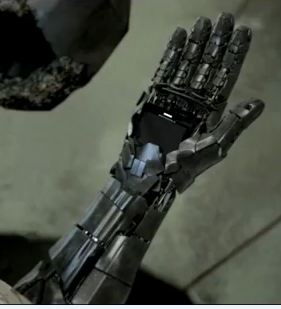
 A cadre of people decked out in half space suits, half combat armor walk through a desolate, arid wilderness toward a bunker. A door opens revealing a passageway into an abandoned underground installation. On a platform elevator they descend hundreds of feet. As they continue through hexagonal corridors they notice a helmet, not unlike theirs, lying ominously on the ground. Finally, they enter a room where a solitary metallic object suspended in mid-air spins on its axis. One man removes his armor from his right arm and extends his now bare arm into an opening in the object. The object stops spinning. His comrades look on with apprehension; the man pulls out his arm. As he does so his arm morphs into a mechanical, cyborg arm. Then, and this is the climax, from the palm of his newly mechanized arm, the Droid X emerges.
Now there’s a commercial, and if you haven’t already seen it, you can watch for yourself at the end of this post. I first saw this commercial sitting in the theater waiting for Inception to begin, only I didn’t immediately realize it was a commercial. Had I walked in just then I would have assumed the previews had started. A bit over-the-top perhaps, but maybe not.
 There’s a lot that can be said about this elaborate piece of sci-fi marketing, but let’s take it at face value. It is actually a rather straightforward dramatization of an important and intriguing metaphor: technology as prosthesis. Marshall McLuhan, patron saint of media studies, popularized the concept that our tools or technologies function as prosthetic extensions of our bodies. For example, the hammer functions as an extension of the hand, the wheel as an extension of the foot, or electric technology functions as an extension of the nervous system. McLuhan, however, was neither the first nor the last to employ the metaphor. In Civilization and Its Discontents, Sigmund Freud suggested that, “Man has, as it were, become a kind of prosthetic god.” But man also wore his prosthetic divinity awkwardly. Freud goes on to say, “When he puts on all his auxiliary organs he is truly magnificent; but those organs have not grown on to him and they still give him much trouble at times.”
Technology as a prosthetic enhancement has been a rich concept deployed by a variety of philosophers and critics including Martin Heidegger, Jacques Derrida, and Donna Haraway. In her “Cyborg Manifesto,” Haraway in particular argued that our technologies have been making the line between natural and artificial, machine and organism, cyborg and human more than a little fuzzy. Often the idea of technology as prosthetic is paired with the related metaphor of amputation — something gained, something lost — so that on the whole there is a certain ambiguity about our prosthetic tools. You can read more about the concept in a well-written overview here, but I want to focus on the very simple idea that our technologies became a part of us.
Think about this in light of the question that I asked in yesterday’s post, “A God that Limps.” Why do we react so defensively when we hear someone criticize our technologies? The concept of prosthesis suggests a compelling response: because we take it not as a criticism of some object apart from us, but rather as an object that has become in some sense a part of us. We hear such criticism as a criticism of ourselves.
The more seamlessly a technologies blends in with our bodies, the more attached we become. Take the Blue Tooth enhanced cell phone, for example, responsible for all those people seemingly talking to themselves. Notice how this metaphor helps explain that odd development. The device has become transparent, we forget it is even there. This makes the communication seem almost unmediated consequently causing us to act as naturally as if we were in the person’s presence (and only that person’s presence). Or take the iTouch/iPhone/iPad that allows us to magically touch the Internet; now that is an extension of the central nervous system! Gone is the clunky mouse or keyboard, we now appear to be touching the information itself, the layers of mediation seem to be peeling away.
The better these tools work, the more invisible they become; or, as the Droid X commercial suggests, the more they become a part of us. Tweaking Arthur C. Clarke’s Third Law just a little, we might say that any sufficiently advanced technology is indistinguishable from our bodies. Naturally, we are pretty defensive of our bodies; not surprisingly we tend to be pretty defensive of our technologies as well.