
John Mayer and John Piper: Twitter Case Studies

I’ve never read the tweets of John Mayer, but I suspect they are an improvement on the tweets of Kanye West. In any case, Mayer apparently tweeted a lot, in fact, he recently owned up to a case of Twitter addiction. At a Berklee Performance Center Clinic for aspiring musicians, he had this to say:

“The tweets are getting shorter, but the songs are still 4 minutes long. You’re coming up with 140-character zingers, and the song is still 4 minutes long…I realized about a year ago that I couldn’t have a complete thought anymore. And I was a tweetaholic. I had four million twitter followers, and I was always writing on it. And I stopped using twitter as an outlet and I started using twitter as the instrument to riff on, and it started to make my mind smaller and smaller and smaller. And I couldn’t write a song.”

Mayer’s comments came to the attention of John Piper, a prominent Christian pastor with his own not insignificant Twitter following.  In a blog post, Piper offered his own experience as an alternative to Mayer’s:

My experience of publishing three Tweets a day (usually written and scheduled a week or two ahead of time) is different. Mayer said, “I couldn’t have a complete thought anymore.” To me this is almost the opposite of what happens. But that may depend on what we aim to do with Twitter.

Piper goes on to add, in what amounts to his philosophy of tweeting, that he aims to be capacious, concise, and compelling when he composes his tweets (preachers seem to have a hard time resisting alliteration). Along the way he likens tweets to proverbs and explains that, “Tweets for me are a kind of poetry.” This is all very nicely put, and I suspect it makes for pretty decent tweets.

Two users, admittedly two very different users, and two quite different experiences. Of course, there is nothing particularly surprising about this.  We shouldn’t necessarily expect any two users to have the same experience with any technology. Yet, I couldn’t help but wonder what might account for the difference, or if one were more typical.

We get a hint at what the difference might be when Piper writes, “My experience of publishing three Tweets a day (usually written and scheduled a week or two ahead of time) is different.”

That parenthetical statement suggests to me that Piper is not really tweeting. Obviously, he is composing words that are eventually shared via Twitter, but he is doing so in a manner that almost renders the platform irrelevant from the standpoint of personal experience. I would even bet that Piper is not the one interacting with the Twitter interface, in other words I wonder if he passes his composed tweets on to a third party who then types them in and publishes them. (There wouldn’t be a thing wrong with this, of course.) A quick look at Piper’s Twitter feed confirms the suspicion that his use of the interface is minimal since we find only the carefully composed statements and occasional links, but no interaction with other Twitter users. He has 185,000+ followers, and follows only 66. There are no @s0andso, no signs of conversation.

So let me suggest that Piper might as well be composing fortune cookie messages. Piper’s experience and habits are solidly in the world of old media. Piper’s thinking is not being influenced by Twitter because he is not using Twitter. In other words, Piper’s experience tells us nothing about the consequences of Twitter for someone who is actually robustly engaged with the interface, like John Mayer for example.

Piper’s closing paragraph further suggests that he is not exactly experiencing Twitter:

I don’t ask that others Tweet the way I try to. I only write this blog post to explain why I don’t experience Twitter the way John Mayer did, and why you don’t have to either. If your goal is to spread capaciousconcisecompelling truth about God and his ways, the Tweet is a fruitfully demanding form.

To describe a Tweet as a “fruitfully demanding form” is to view Twitter through the lens of the literary. Piper is measuring Twitter strictly in light of its verbal qualities, in the same way he might view a sonnet or a haiku. This a valid level of engagement and analysis, but has little to do with the way Twitter is experienced by most of its users. Moreover, it misses the significant points of contrast between print and digital media environments.

I hope it is clear that I’m certainly not criticizing Piper. My point is to understand the influence of technology, and I suspect that it is found in part in the habits formed by use of technology, or the practice of an interface. Piper has not experienced the effects of Twitter because he has not entered into the practice of Twitter defined as a robust and sustained engagement with the interface. I suspect that his Twitter account isn’t open on his desktop or smartphone. He probably is not emerged in the flow of TwitterTime. This is probably a good thing. By not really using the medium, he is not being used by it either. In any case, I would suggest that a tool’s influence will not really be felt until its use becomes a practice integrated into our form of life.

________________________________________________________

H/T: Mr. Greenwald for pointing me to Piper post.
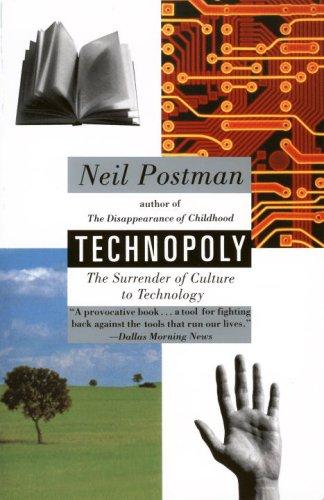
Neil Postman, Technopoly, and Technological Theology

Early in his book Technopoly, Neil Postman presents a helpful summary of the variety of schema or classifications offered by historians for the history of the relationship of technology to culture:

We think at once of the best-known classification:  the Stone Age, the Bronze Age, the Iron Age, the Steel Age.  We speak easily of the Industrial Revolution, a term popularized by Arnold Toynbee, and, more recently, of the Post-Industrial Revolution, so named by Daniel bell.  Oswald Spengler wrote of the Age of Machine Technics, and C. S. Peirce called the nineteenth century the Railway Age.  Lewis Mumford, looking at matters from a longer perspective, gave us the Eotechnic, the Paleotechnic, and Neotechnic Ages.  With equally telescopic perspective, Jose Ortega y Gasset wrote of three stages in the development of technology:  the age of technology of chance, the age of technology of the artisan, the age of technology of the technician.  Walter Ong has written about Oral cultures, Chirographic cultures, Typographic cultures, and Electronic cultures.  McLuhan himself introduced the phrase “the Age of Gutenberg” (which, he believed, is now replaced by the Age of Electronic Communication).

A lot is packed into that paragraph, and if we were to go on and read each of these scholars in order to understand their classifications we would end up with an impressive grasp on the relationship of technology to culture. To these Postman adds his own schema.  He divides cultures into three types:  tool-using cultures, technocracies, and technopolies. Here is a quick overview for your consideration:

In a tool-using culture according to Postman, tools were “largely invented to do two things”:  “solve specific and urgent problems of physical life” and “serve the symbolic world of art, politics, myth, ritual, and religion …” Additionally, “in a tool-using culture technology is not seen as autonomous, and is subject to the jurisdiction of some binding social or religious system.”

In a technocracy, society is “only loosely controlled by social custom and religious tradition” and it is “driven by the impulse to invent.” A technocracy, however, “does not have as its aim a grand reductionism in which human life must find its meaning in machinery and technique.  Technopoly does.”

Technopoly, in Postman’s most succinct formulation, features “the submission of all forms of cultural life to the sovereignty of technique and technology.”  Postman took the assumptions informing Frederick Taylor’s The Principles of Scientific Management to be more less the assumptions of the “thought-world of Technopoly.” These included the following beliefs:

  • “the primary, if not the only, goal of human labor and thought is efficiency”
  • “technical calculation is in all respects superior to human judgment”
  • “human judgment cannot be trusted because it is plagued by laxity, ambiguity, and unnecessary complexity”
  • “subjectivity is an obstacle to clear thinking”
  • “what cannot be measured either does not exist or is of no value”
  • “the affairs of citizens are best guided and conducted by experts.”

Ironically, in Postman’s view, these assumptions amount to a “technological theology.”  In other words, while traditional theologies which governed tool-using cultures are displaced in a technocracy, in a  Technolopy a governing ideology in the mode of theology is reintroduced to order society. The function of theology has not been eradicated, it has just been reconfigured, which rather reminds me of a Dylan tune:

But you’re gonna have to serve somebody, yes indeed
You’re gonna have to serve somebody
Well, it may be the devil or it may be the Lord
But you’re gonna have to serve somebody.

I’ll leave the applications to you.

Training Perecption, Awakening to Experience

The challenge of McLuhan’s work, both in the sense that it is challenging to read and that it lays down a challenge to be taken up, involves the difficulty of thinking about that which shapes our thinking — it is akin to attempting to jump over your own shadow.

Not surprisingly, a good deal of his method, perplexing and infuriating as it could be, seems designed to coax readers over their shadows, to become aware of how their thinking has been formed by the media environment.  Biographer W. Terrence Gordon, citing McLuhan’s own description of his teachers at Cambridge, gets at this when he writes, “There could be no more succinct statement of his own aims, as he left Cambridge to begin a teaching career, than ‘the training of perception.'”

Later on, Gordon cites a letter to Mrs. Pound in which McLuhan writes, “The appeal must be to the young … they have been systematically deprived of all the linguistic tools by which they could nourish their own perceptions at first hand at the usual traditional sources.”

Walter Ong, a former student of McLuhan’s and outstanding scholar in his own right, classified teachers as follows:

A good teacher is one who can encourage others to think actively.  A superior teacher can make the thinking pleasant for the learners. A superb teacher can make the thinking an overpowering activity, delightful even when it is disturbing and exhausting.

“By this criteria,” Ong went on, “Marshall McLuhan was a superb teacher who could stir people’s minds.”  Ong also noted that, “… even with the most brilliant teacher, if the learners are to do any learning, they are the ones who have to do it.”

Putting all of this together yields, in my estimation, the nature of McLuhan’s enduring significance.  In one respect he may be likened to the hedgehog in Isaiah Berlin’s illustration who knows one big thing — changes in media environments change the way we think and the way we experience life.  But he was also a little like the fox who knows many things in that he approached the one big idea from countless angles and drawing promiscuously from the whole of experience.

As some have noted in taking the measure of McLuhan, he drove that one idea home so well that he rendered his work superfluous.  But this is not quite right.  While others have perhaps done a better job of articulating and systematizing the big idea, they have perhaps also domesticated it.  Knowledge has been imparted, but perceptions have not been trained.  Ironically, this may be attributed to a lack of sensitivity to the medium, i.e. McLuhan’s method.

McLuhan understood, as Ong put it, that if learners are too learn anything they are the ones who will have to do it.  All of the probes, the paradoxes, the gnomic statements, the quirkiness, the esotericisms, the inconsistencies, the absurdities, the juxtapositions, the koanish assertions, the puns — all of it aimed at drawing out the work of learning from the learner in such a way that their perceptions would be trained.  Simply clarifying the big idea, extracting and re-presenting the kernel of the thought only captured the data, it did not train perceptions, it did not heighten sensibilities, it did not lead to practical wisdom.  In the end it may very well darken and numb perception.

This insistence on the training of perception, fully embodied perception involving the whole human sensorium, may have been McLuhan’s chief contribution.  Perceiving the world, which is to say being alive to the world, is not a given and much less so in certain media environments.  McLuhan as a teacher seems bent on awakening us to experience; agitating, provoking, inciting us to perceive.  That is no small thing when some degree of variously imposed numbness becomes the cultural default.

McLuhan: 100

The medium is the message … five words, plump and alliterative though they may be, are wildly inadequate … he was born in Edmonton, Alberta on July 21, 1911 … He speaks in canned riddles … Speech as organized stutter is based on time. What does speech do to space? … “Clear prose indicates the absence of thought” … Watching McLuhan, you can’t quite decide whether he was a genius or just had a screw loose … he gave us language that made “media” into a thing …

It feels wistful to imagine a time when people didn’t go about their daily routine with the assumption that at any moment another massive media technology will be dumped on us by some geek in California … “I’m going to be a computer when I grow up” …

“What if he is right”? … “Instead of the book as a fixed package of repeatable and uniform character suited to the market with pricing, the book is increasingly taking on the character of a service … and the book as an information service is tailor-made and custom-built” … First of all – and I’m sorry to have to repeat this disclaimer – I’m not advocating anything … “The next medium, whatever it is – it may be the extension of consciousness – will include television as its content, not as its environment” …

an alchemical mix of his vast historical and literary knowledge, his bombastic personality and a range of behaviors we might now place on the very mild end of the autistic spectrum … McLuhan’s mind was probably situated at the mild end of the autism spectrum. He also suffered from a couple of major cerebral traumas …

First, that McLuhan never made arguments, only assertions … a fixture of culture both nerd and pop, which are increasingly the same thing. He is the patron saint of Wired … what mattered was merely the fact that you were watching TV. The act of analysing the content of TV – or of other mediums – is either sentimental or it’s beside the point … Annie Hallthe fastest brain of anyone I have ever met, and I never knew whether what he was saying was profound or garbage… He wanted his words to knock readers out of their intellectual comfort zones, to get them to entertain the possibility that their accepted patterns of perception might need reordering ..McLuhan was an information canary …

“He writes by paradox — that makes him hard to read (or hard on the reader),” wrote McLuhan … he loved Chesterton’s rhetorical flourishes, imbibed his playfulness, turned his impulse to try out new combinations of ideas into the hallmark of the McLuhan method … He became a daily Mass-goer …

There is absolutely no inevitability … what will be the psychic fallout of these technologies on our inner lives? … Like Marx and Freud, he was an intellectual agitator, a conceptual mind expander, the yeast in the dough …  James Joyce and Ezra Pound especially … The web. The web, with its feeds and flows and rivers and streams … That kaleidoscopic, almost psychedelic style … In that Playboy interview … a celebrity-seeking charlatan …

lost all hope “that the world might become a better place with new technology” …  people who classify McLuhan as a techno-utopian aren’t simply making stuff up … Resenting a new technology will not halt its progress … Many people seem to think that if you talk about something recent, you’re in favor of it … And so eschatological hope appears as nothing more than an early manifestation of cyber-utopianism … Look at what these media are doing to our souls … “Once we have surrendered our senses and nervous systems to the private manipulation of those who would try to benefit by taking a lease on our eyes and ears and nerves, we don’t really have any rights left” …

Your question reflects the usual panic of people confronted with unexplored technologies. I’m not saying such panic isn’t justified … merely that such reactions are useless and distracting … “Man the food-gatherer reappears incongruously as information-gatherer” … But an understanding of media’s effects constitutes a civil defense against media fallout … someone who didn’t just have strong ideas but who invented a whole new way of talking … all a teacher can ever do is get people to think …

outlived his fame … he died in a state of wordlessness …

That’s what McLuhan did.

_______________________________________________________________________

In case it is not apparent, only a very few of these words are mine.  Sources:

Webs and whirligigs:  Marshall McLuhan in his time and ours by Megan Garber
Why McLuhan’s chilling vision still matters today by Douglas Coupland
McLuhan at 100 and McLuhan on the Cloud by Nicholas Carr
Why Bother With Marshall McLuhan by Alan Jacobs
Divine Inspiration by Jeet Heer
Marshall McLuhan:  Escape into Understanding by W. Terrence Gordon
McLuhan, Chesterton, and the Pursuit of Joy
McLuhan as Teacher by Walter Ong

Kevin Kelly, God, and Technology

As I have read and thought about technology and its cultural consequences, I have especially appreciated the work of Marshall McLuhan, Walter Ong, Jacques Ellul, Ivan Illich, and Albert Borgmann.  My appreciation stems not only from the quality and originality of their work, but also from a curiosity about the manner in which their religion informed their thinking; all were deeply committed to some expression of the Christian faith.  We would do well to add the name of Kevin Kelly to the list of theorists and students of technology who bring a theological perspective to their work.

Of course, the Christian tradition is an ocean with many currents, and so it is not surprising that despite their common core commitments, the work of the scholars mentioned each takes on a distinct hue.  Of those mentioned, Kelly is in my estimation the most optimistic about the future of technology and that comes across quite clearly in his recent interview with Christianity Today.

There Kelly connects technology with God’s own creative capacity and the freedom with which He endows humanity:

We are here to surprise God. God could make everything, but instead he says, “I bestow upon you the gift of free will so that you can participate in making this world. I could make everything, but I am going to give you some spark of my genius. Surprise me with something truly good and beautiful.”

He also provides the following explanation of the term technium which he coined:

I use technium to emphasize that human creation is more than the sum of all its parts. An ecosystem behaves differently from its individual plant and animal components. We have thoughts in our minds that are more than the sum of all neuron activity. Society itself has certain properties that are more than the sum of the individuals; there is an agency that’s bigger than us. In the same way, the technium will have a behavior that you’re not going to find in your iPhone or your light bulb alone. The technium has far more agency than is suggested by the word culture.

I find this emergent model to be an interesting way to get at the influence of technology.  I try to navigate a path between approaches to technology that take the tools to be determinative of human action on the one hand, and others which take the tools to be merely neutral objects of human action on the other.  I’m not sure if I’m prepared to unreservedly endorse Kelly’s formulation, but I am generally sympathetic.

I’m less inclined to sign onto the remarkably positive outlook Kelly articulates for the technium, although I must admit that it is both refreshing and invigorating. Kelly is sure that “… the world is a better place now than it was 1,000 years ago. Whatever quantifiable metric you want to give to me about what’s good in life, I would say there’s more of it now than there was 1,000 years ago.” And, indeed, by many if not most measures, it most certainly is.  Yet, I would hesitate to claim that in every way that life has improved it has done so because of the technium, and I would be inclined to argue that in certain important respects elements of the technium have worked against human happiness and fulfillment.

Kelly acknowledges, but underemphasizes the fallibility and folly of humanity. He believes that God’s grace, seemingly operating through the technium, more than cancels out the folly.  I share the hope in principle, but would not so closely connect the operations of God’s grace to the sphere of technological advance.

Perhaps the point of tension that I experience with Kelly’s position stems from his definition of goodness:  “… overall the technium has a positive force, a positive charge of good. And that good is primarily measured in terms of the possibilities and choices it presents us with.”  Kelly illustrates his point by asking us to imagine Mozart being born into a world in which the piano has not been invented – what a tragedy.  This resonates, but then we might ask, what of all of those would be Mozarts that did in fact live, as surely they did.  Is their happiness and fulfillment so tied to an as of yet future invention that their life is otherwise rendered unfulfilled?  Would this not suggest that, in fact, the grass is always greener in the future perpetually and so happiness and fulfillment is never finally attainable?  Fulfillment would taunt us from just around the corner that is the future.

Perhaps the problem arises from too quickly eliding the infinite creative possibilities of the Creator with the limited, derivative creativity of the creature.  To be human is to flourish within the limitations of material and embodied existence. Expanding choice is not necessarily a bad thing, of course, but hitching the possibility of human fulfillment to the relentless expansion of choice seems to overlook the manner in which the voluntary curtailment of choice might also serve as the path to a well-lived life.

Curiously, Kelly practices a way of life that would seem on the surface to be at odds with the gospel of choice maximalization.  He has written engagingly about the Amish and recommended aspects of their approach to technology.  In his personal life, Kelly has implemented a good bit of Amish minimalism.  When asked about whether this constituted an inconsistency between his words and his actions, Kelly responded:

Technology can maximize our special combination of gifts, but there are so many technological choices that I could spend all my time just trying out technologies. So I minimize my technological choices in order to maximize my output. The Amish (and the hippies) are really good at minimizing technologies. That’s what I am trying to do as well. I seek to find those technologies that assist me in my mission to express love and reflect God in the world, and then disregard the rest.

But at the same time, I want to maximize the pool of technologies that people can choose from, so that they can find those tools that maximize their options and minimize the rest.

I can see his angle and would stop short of suggesting that this was indeed an inconsistency on Kelly’s part, but I will say that for my part I find more wisdom in Kelly’s practice than in his unbounded hope for the technium.

______________________________________________________

See also Nicholas Carr’s comments on Kelly’s interview (as well as Kelly’s response in the comment thread) and Kevin Kelly’s TED Talk.