Weekend Reading, 10/7/11

Due to travel and spotty Internet access there was no “Weekend Reading” post last week, but we’re back on track now. Peace and violence, stalling technological progress, Google, nostalgia, and cell phone sentimentality all come your way below.

“A History of Violence” by Steven Pinker (interviewed) at The Edge. Pinker discusses his recent book, The Better Angels of Our Nature, in which he argues that we live in the least violent era in history.

“Delusions of Peace” by John Gray in Prospect. In which Gray concludes that Pinker is considerably off the mark.

“I Just Called to Say ‘I Love You'” by Jonathan Franzen in Technology Review. Franzen takes on cell phones, sentimentality, and public discourse. A taste: “Just 10 years ago, New York City (where I live) still abounded with collectively maintained public spaces in which citizens demonstrated respect for their community by not inflicting their banal bedroom lives on it.”

“The End of the Future” by Peter Thiel in National Review: A bit of a downer if you buy it. The founder a Paypal worries that technological progress has stalled. A hard sell, but if true, wide ranging and unpleasant social consequences follow. May be related to the subject of the next piece.

“Nostalgia on Repeat” by Chuck Klosterman at Grantland: “The net result is a bunch of people defending and bemoaning the impact of nostalgia in unpredictable ways; I suppose a few of these arguments intrigue me, but just barely. I’m much more interested in why people feel nostalgia, particularly when that feeling derives from things that don’t actually intersect with any personal experience they supposedly had.”

“It Knows” by Daniel Soar in London Review of Books: Soar reviews three recent books on the juggernaut that is Google. Coincidentally, Soar logs this passing snide remark directed at Steven Pinker: “Rankings based on citations aren’t necessarily a measure of excellence – if they were, we wouldn’t hear so much about Steven Pinker – but they do reflect where humans have decided that authority lies.”

Love, Beauty, and Design: What Steve Jobs Understood

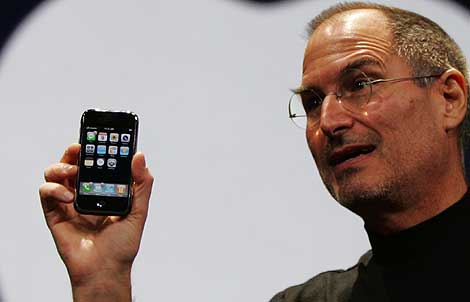
It’s been nearly a week without a post and that largely due to some unexpected travel occasioned by less than happy circumstances. And now that I sit down to write again, it is under the shadow of more sad circumstances. It would be hard to have missed the news of Steve Jobs’ death last night. It poured in from every conceivable medium. I got it first from a friend’s Facebook status, and then from nearly every Facebook status and countless tweets and retweets. This morning my Google Reader was dominated by stories, articles, essays, and posts about Jobs and his legacy.

In one of those articles, Steven Levy’s reflections on Jobs’ life for Wired, I came across this intriguing passage that carried a great deal of wisdom:

Jobs usually had little interest in public self-analysis, but every so often he’d drop a clue to what made him tick. Once he recalled for me some of the long summers of his youth. I’m a big believer in boredom,” he told me. Boredom allows one to indulge in curiosity, he explained, and “out of curiosity comes everything.” The man who popularized personal computers and smartphones — machines that would draw our attention like a flame attracts gnats — worried about the future of boredom. “All the [technology] stuff is wonderful, but having nothing to do can be wonderful, too.”

I’m certain that you will come across countless other lines from Jobs in the coming days; many, I’m sure, will be taken from his now legendary 2005 commencement address at Stanford.

I have come rather late into the Apple fold, I’m typing this on my first Apple computer which was purchased just two months ago. But for longer than that I’ve been fascinated by the cult that has grown around Apple products over the last decade or so (perhaps longer, I’m not certain how to judge the years between Jobs’ two stints with the company in this regard). It is an uncanny phenomenon that has been noted and commented on many times. In recent months news outlets have run reports on studies that link the regard users have for Apple products with the same parts of the brain that have been related to religious experiences and to feelings of love.

It seems reasonably clear that Apple has tapped into something deeper than mere satisfaction with a consumer product. It also seems reasonably clear that the reactions to Steve Jobs’ untimely passing are at least in part wrapped up with the attachment users feel to the products he made possible. At least one Facebook status I read noted how odd it was to feel sadness for the passing of a man one had never met. This is not, of course, a previously unheard of phenomenon; from time to time the death of some public figure generates this sense of sadness and loss.

But it is not exactly common either. Numerous public figures die each year and most occasion little more than a mention and a sigh. Then there are those individuals whose passing generates grief and sorrow that ripples out far beyond the circle of family and friends who had known the person firsthand. Examples are not hard to come by: Abraham Lincoln, John Kennedy, Martin Luther King Jr., Marilyn Monroe, Elvis Presley, Princess Diana, Michael Jackson. I’m sure the list can be populated with other examples easily enough. The lives of all of these were ended prematurely and tragically, and they all managed to form emotional ties, each in their own way, with those who mourned their passing.

Now we may safely add Steve Jobs to this list and this raises some interesting questions. How does he fit in with this group and the others who may be added to their number? What was the source of the emotional bond? Whatever we might think of his genius, his vision, his determination — none of these seem to me to account for the emotional bond. The bond, it would seem, was not with the person of Steve Jobs in the same way that it was with the other individuals whose deaths spurred widespread and heartfelt public mourning.

The emotional bond, rather, is with the objects Steve Jobs envisioned and produced. The bond has been transferred to the man as the embodiment of our love affair with the products. It would not take long to confirm this anecdotally on Twitter. At both the announcement of his resignation in August and now his death, my Twitter feed was populated by mentions of how the products Jobs produced changed lives along with notes about how the very message of appreciation was made possible by an Apple product. This itself is an important index of our age.

And if we were to inquire further, we might note that the genius of his products lay finally in design. Jobs stands apart from both great inventors of the past and great corporate figures of the past. He was some blend of the two, to be sure, but added to the alchemy was a dash of the artist as well.

Apple’s success lay not only in its innovation, but also in its aesthetic. The heart is not so pragmatic that it loves what merely works. It loves beauty, and Jobs seems to have known that the consumer would flock to beautifully designed products. The beauty, of course, is of a certain character — minimalist, functional, clean — but it is a recognizable and appealing aesthetic.

It did not hurt either that Jobs moved Apple products into a symbiotic relationship with other objects of love, music and personal relationships. Music is itself a transcendent source of beauty and love. We love our music, and Jobs tapped that love when he made the iPod. Our love also flows naturally to our family and friends, and with the iPhone Jobs created a product that effortlessly mediated those relationships along with our music. Add to this the manner in which the “Touch” revolution Apple products initiated appropriated the visceral and embodied nature of our loves and affections and you begin to understand Jobs’ genius.

He seemed to have understood this above all else: the consumer was not the rational optimizer of classical economic theory. The consumer, who after all was a human being, was a lover and the lover loves the beautiful.

Conquering the Night: Technology, Fear, and Anxiety

Tim Blanning begins his review of Craig Koslofsky’s Evening’s Empire: A history of the night in early modern Europe as follows:

In 1710, Richard Steele wrote in Tatler that recently he had been to visit an old friend just come up to town from the country. But the latter had already gone to bed when Steele called at 8 pm. He returned at 11 o’clock the following morning, only to be told that his friend had just sat down to dinner. “In short”, Steele commented, “I found that my old-fashioned friend religiously adhered to the example of his forefathers, and observed the same hours that had been kept in his family ever since the Conquest”. During the previous generation or so, elites across Europe had moved their clocks forward by several hours. No longer a time reserved for sleep, the night time was now the right time for all manner of recreational and representational purposes.

Given my recent borrowings from David Nye’s study of electrification, it will come as no surprise that the title of Blanning’s review, “The reinvention of the night,” caught my eye. I was expecting a book dealing with the process of electrification, but Koslofsky’s story, as the subtitle of his book suggests, unfolds two to three hundred years before electrification.

It also features technology less prominently than I anticipated, at least Blanning doesn’t emphasize it in his review. In fact, he writes, “This had little to do with technological progress, for until the nineteenth century only candles and oil lamps were available.” This suggests a rather narrow definition of technology since candles and oil lamps are just that. It may be that Blanning’s emphasis is on the “progress” side of “technological progress,” but immediately after this sentence he writes, “Most advanced was the oil lamp developed in the 1660s by Jan van der Heyden, which used a current of air drawn into the protective glass-paned lantern to prevent the accretion of soot, and made Amsterdam the best-lit city in Europe.” This would amount to technological progress, no?

in any case, what I found most interesting, and what connected directly with Nye, was the following observation by Blanning: “At the heart of his argument is the contrariety between day and night, light and dark. On the one hand, the sixteenth century witnessed an intensification of the association of the night with evil …” That, and the theme of a shifting civic/public sphere (a la Habermas) that moved not only from the town square to the aristocratic halls and coffee houses, but also from the day time to the night time.

Take both together and we have another example of the reciprocal relationship between technology and social structures, assuming you’re buying my hunch that this is a story in which technology, even if it is “primitive” technology, is implicated.

A society’s symbolic tool kit can shift. We might take for granted that night always evoked fear and dread and evil, and although there is something to that of course, the story is more complex. Perhaps night’s identification with evil intensified in part because of the gradual conquest of the night by artificial illumination. It would be a paradoxical case of unintended, unforeseen consequences. The more we domesticate darkness, the more darkness takes its revenge on us. Perhaps if we were more at home in the darkness, we would be less fearful of it.

Consider the following passage cited by Nye from Henry Beston writing in the early twentieth century:

“We of the age of the machines, having delivered ourselves of nocturnal enemies, now have a dislike of night itself. With lights and ever more lights, we drive the holiness and beauty of the night back to the forests and the sea; the little villages, the crossroads even, will have none of it. Are modern folk, perhaps, afraid of night? Do they fear that vast serenity, the mystery of infinite space, the austerity of stars? Having made themselves at home in a civilization obsessed with power, which explains its whole world in terms of energy, do they fear at night for their dull acquiescence and the pattern of their beliefs? Be the answer what it will, today’s civilization is full of people who have not the slightest notion of the character or poetry of night, who have never even seen the night.”

This is an interesting passage not only because it suggests how technologies enter into symbolic ecosystems and reshape those ecosystems just as their adoption is conditioned by that same ecosystem. It is also interesting because what Beston feared losing — the serenity, mystery, austerity — is itself a very modern sensibility. This is the sensibility of a modern individual formed by a post-Copernican cosmology. A medieval individual could not have written that passage, and not only because illumination was for them a still distant and unimagined phenomenon. They were still at home in a much smaller and coherent universe. They did not look up and see “space,”they looked up and saw the vastly populated heavens. But that is another story.

Night has been on the retreat for quite some time now, conquered by the science and technology of illumination. Night’s retreat has had social, political, and psycho-symbolic consequences. The mystery of the night is chased away only to allow in the terror of the night. Technology shapes and is shaped by its semiotic environment.

One of the wonders of writing is that you’re never quite sure where you will end up when you start. So while my initial intent was simply to note another illustration of Nye’s notion of the social construction of technology, writing’s momentum leads me to the notion that domestication may, ironically, lead to the displacement of fear and anxiety to another register. It is as if, like Dr. Moreau’s creatures, the realms we tame through our techno-scientific prowess remain sources of reconfigured and intensified fear and anxiety. Dr. Moreau instills fear in his beasts through violence because he fears the violence they may do to him. Fear begets fear — that is perhaps the core of H. G. Wells’ tale — and that principle is at work in our uneasy relationship with technology.

If we pursue technology in order to conquer what we fear, then we also create an attending anxiety over the (inevitable?) failure of our systems of control and mastery. It would seem that what we tame, retains its wildness veiled, yet palpable and intensified.
Electrification, Refrigerators, and the Social Construction of Technology

Yesterday, I alluded to David Nye’s Electrifying America, a social history of the electrification of America from 1880-1940. At the heart of Nye’s study is the contention that technology is a social construction. By this he means that technology always enters into a pre-existing social world and a technology’s adoption, use, and meaning is derived from that social world. So, for example, Nye writes:

“A technology is not merely a system of machines with certain functions; it is part of a social world. Electrification is not an implacable force moving through history, but a social process that varies from one time period to another and from one culture to another. In the United States electrification was not a ‘thing’ that came from outside society and had an ‘impact’; rather, it was an internal development shaped by its social context. Put another way, each technology is an extension of human lives: someone makes it, someone owns it, some oppose it, many use it, and all interpret it.” (ix, emphasis mine)

The history of technology is full of similar stores about social factors conditioning the adoption of new technologies. In a post titled “How the refrigerator got its hum,” science writer Alice Bell briefly recounts the story of early refrigeration and the adoption of electric over gas refrigerators. It’s a quick and interesting read if your are not familiar with the story. She notes near the end that, “In many respects, the history of technology is a history of failed machines; of routes we didn’t take, not the ones we did.” And she cites David Edgerton’s Shock of the Old to the same effect:

The history of invention is not the history of a necessary future to which we must adapt or die, but rather of failed futures, and of futures firmly fixed in the past. We do not have a history of invention, but instead histories of the invention of only some of the technologies which were later successful (Edgerton, 2006: 184. Emphasis as original).

She then ties it all up with the following conclusion:

And there’s the moral of the story: the possibilities around technology are multiple. They are not limitless, but they aren’t singular either, and they certainly are not linear. There are choices when it comes to the technologies we choose to take on, and choices about how we make use of them, when and if.

This is very well and succinctly put. I would only add that these choices later constrain and condition future choices yielding what Thomas Hughes has called “technological momentum.”

Nathaniel Hawthorne Anticipates McLuhan and de Chardin

Those familiar with Marshall McLuhan will remember his view, and it was not his alone, that our technologies are fundamentally extensions of ourselves. And in McLuhan’s view, electric technologies were extensions of our nervous system. So, for example, In Understanding Media, McLuhan writes:

“With the arrival of electric technology, man extended, or set outside himself, a live model of the central nervous system itself.” (65)

“When information moves at the speed of signals in the central nervous system, man is confronted with the obsolescence of all earlier forms of acceleration, such as road and rail. What emerges is a total field of inclusive awareness.” (143)

“It is a principle aspect of the electric age that it establishes a global network that has much of the character of our central nervous system. Our central nervous system is not merely an electric network, but it constitutes a single unified field of experience.” (460-461)

Those familiar with McLuhan will also know not only that McLuhan was a Roman Catholic (recent essay on that score here), but that he was influenced by the thought of a relatively fringe Catholic paleontologist and theologian/philosopher, Teilhard de Chardin, who, in The Future of Man, spoke of technology creating “a nervous system for humanity … a single, organized, unbroken membrane over the earth … a stupendous thinking machine.”

As it turns out, McLuhan and de Chardin were trading in a metaphor/analogy that had even older roots. At the outset of his fascinating (if your into this sort of stuff) study Electrifying America, David E. Nye cites the following passage from Nathaniel Hawthorne’s The House of Seven Gables, in which the character Clifford exclaims,

“Then there is electricity, the demon, the angel, the mighty physical power, the all-pervading intelligence!” … “Is it a fact — or have i dreamt it — that, by means of electricity, the world of matter has become a great nerve, vibrating thousands of miles in a breathless point of time? Rather, the round globe is a vast head, a brain, instinct with intelligence! Or, shall we say, it is itself a thought, nothing but a thought, and no longer the substance which we deemed it!”

Hawthorne’s novel, in case you’re wondering, dates from 1851.