Facebook as Rear Window: What Hitchcock and Gadamer Can Teach Us About Online Profiles

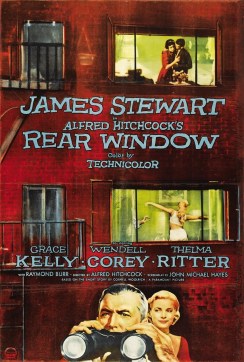
In Hitchcock’s 1954 classic, Rear Window, Jimmy Stewart plays a photojournalist named Jeff who is laid up with a broken leg and passes his time observing his neighbors through his apartment’s rear window. The window looks out on a courtyard onto which the rear windows of all the other apartments in the building also open up. It’s a multiscreen gallery for Stewart’s character who reclines in the shadows and becomes engrossed in the lives of his neighbors – the attractive dancer, the lonely woman, the young pianist, the newlyweds, and, most significantly, the unhappy married couple. Increasingly playing the part of the obsessive voyeur, he becomes convinced the disgruntled husband murdered his wife. The film’s plot is driven by Jeff’s determination to prove the man’s guilt.

The film came to my attention again when I received a link to the clip below, which impressively and artfully splices all of the scenes depicting what Jeff sees out of his window. [Update: The video is no longer available.] Serendipitously, I watched the clip not long after reading some comments on Hans-Georg Gadamer’s hermeneutical aesthetics developed in Truth and Method. Naturally, I then thought of Facebook … as one does after watching Hitchcock and reading Gadamer.

Let’s start with Hitchcock. Like the windows in Hitchcock’s film, Facebook profiles offer an opening into a life and one through which others can observe without the observed knowing it. This is classic Facebook behavior. The platform has always abetted and elicited stalker-ish activity from users. This is why one of the most popular of the many spam links that circulate on the social network purports to reveal who has been looking at your profile. If ever such a capability were enabled it would likely lead to a massive reduction in page views for Facebook.

Like Jeff’s character, Facebook users look through the profiles-as-windows at the lives of their virtual neighbors. And as with Jeff, it may begin in a relatively innocent curiosity born of boredom, or it may veer into the obsessive. There is, of course, one glaring difference between the rear windows and Facebook profiles: Stewart’s neighbors were presumably unaware that they were being watched. Facebook users are not only aware they are being watched – they are counting on it.
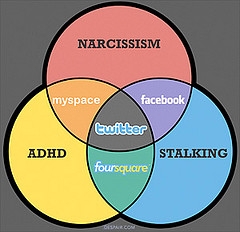
On Facebook we’re all flâneurs, simultaneously watching and being watched. But we don’t exactly know who is doing the watching and how much watching they’re doing or to what end. The uncanny moment in Rear Window comes when the watcher becomes the watched. Needless to say, such a moment would be equally uncanny where it to unfold online. Yet it is enough that we know we are being watched in general. This alone renders the profile something other than a representation of our life. It becomes itself a presentation. And that is were Gadamer first comes in.

As he develops his hermeneutical aesthetics, Gadamer challenges the representational view of the work of art that understands the work of art as a mere re-presentation of some real thing. On this view, whatever meaning the work of art holds is derivative of the thing it re-presents. Against this view, Gadamer contends that the appearing of the work of art before the participant (for the one who takes in a work of art is never merely a passive observer) constitutes an “event of being.” Meaning inheres in the work of art in itself. It is a presentation, not a re-presentation.

Now think again about a Facebook profile. It may be tempting to understand a profile as a representation of a life or of a personality whose meaning derives from the lived experience of the user who creates the profile. But is this entirely true? It is certainly the case that the online profile is, in a certain sense, grounded in the offline experience of the user. Also, we would do well to resist a digital dualism that abstracts the “real,” offline experience from “virtual,” online experience. Offline and online experience impinge upon one another; it would be misleading to compartmentalize the two.

Yet, there are multiple ways of construing the nature of their enmeshment. One way of resisting digital dualism is to note how the possibility of self-documentation asserts itself in lived experience. I’ve discussed this here on more than a few occasions and Nathan Jurgenson’s notion of “Facebook Eye” captures this dynamic neatly. On this view online profiles impinge upon offline experience by reordering our conscious intentionality – to the person with a social media profile, experience becomes a field of potential self-documentation to be publicized through social media. To the person with a hammer, everything looks like a nail. To the person with a Facebook profile, everything looks like a potential status update. Or alternatively, to the person with a Facebook profile, the question is always “How many ‘likes’ will this get?” But Gadamer offers another complimentary construal.

It begins by noting the presentational character of the online profile. It is not a mere copy of the original life; in its appearing before a profile viewer, it appears on its own terms. It’s meaning is not merely derived from the manner in which it copies life, rather it emerges out of the dynamics of the life as it is presented in the profile. And here is why, as I see it, this does not constitute a digital dualism. Gadamer’s discussion of the work of art as an “event of being” includes what Peter Leithart has called “retroactive ontological consequences” for the thing it refers to in the “real” world.

Leithart interprets Gadamer by reference to landscape painting. When a landscape is painted by Constable, its character has been altered, it is now a “landscape-that-inspires-painting.” When person maintains an online profile, they are now a person-with-a-profile. The landscape painting, Leithart continues, is an “event of being” because it is “an enhancement of the thing itself.” Likewise the online profile, although perhaps enhancement is not necessarily the best word to use here. Moreover Leithart concludes, “every encounter with the real landscape involves a moment of interpretation that is a ‘performance’ of the thing, and after Constable (even for many who are not directly aware of Constable) the interpretive performance is inflected by Constable’s work …” Translated: every encounter with a person-with-a-profile invites acts of interpretation that are inflected by Facebook. Now back to Rear Window to illustrate.

In the film, the windows presented a slice of a life. What Jeff saw was not something other than the lived experience of the people he watched, but the windows did the work of constituting those slices of their lives as something in themselves for Jeff inviting interpretation, not unlike the way a profile presents itself as something in itself for the viewer also inviting the viewer into a work of interpretation. And as we noted, via Gadamer, as a thing in itself the window-as-presentation gives off meaning that has retroactive ontological consequences. If Jeff were to meet any of the people he watched outside of their apartments, his interactions with them would be contoured by his interpretations of their fenestrated (when would I ever have another chance of using that word) presentations.

Likewise, when Facebook users encounter one another offline, their mutual interpretations of one another are loaded with whatever interpretations their profiles have already invited.

Now one final thought. Our presentations always produce more meaning than we intend. This is another way of saying that we are not entirely in control, despite our best efforts, of the manner in which our profile presentations are interpreted. Because they are always partial re-presentations (insofar as they are alluding back to lived experience), our profiles hide while they reveal and thus invite or even demand acts of creative interpretation. These interpretative surpluses, for better or worse, are those that are then brought to bear on our face-to-face encounters.

___________________________________________

An expanded and revised version of this post appeared at The Medias Res.

Tracking the Spread of Technology

The graph below which plots the diffusion of new technologies throughout the twentieth century came to my attention via Derek Thompson’s post at The Atlantic, “The 100 Year March of Technology in One Graph.”

Take a second and click to enlarge the graph. The lines trace the percentage of US households that adopted the technologies in question over time. There’s a lot of information condensed into this chart, and of course, there’s a lot that a chart can’t convey. Below the graph I’ll list a few of the things that caught my attention.

Grap by Visualizing Economics. Click to enlarge.

The first thing to note is that this chart gives us a glimpse at the social history of technology, a dimension of the story of technology that sometimes gets left out. Very often the focus is on the inventors and the process of invention or on the capabilities of a technology and its consequences. But behind each of these lines there is often a very interesting, and very human story. Naturally, this chart doesn’t quite give us those stories, but they do hint at them. (Many of these stories have been told in quite compelling fashion. America Calling by Claude Fischer, for instance, is a well regarded treatment of the social history of the telephone up to 1940.)

This particular chart, however, gives the impression that technologies always track toward almost full saturation of a society. Once invented, they inexorably trend upwards, some more quickly than others. But remember what this particular chart leaves out: the myriad of technologies that fail to achieve widespread adoption and those that are superseded and recede downward toward near extinction. So consider that this chart might also have included cassette players, laser discs, and typewriters.

That said, the far end of the chart does begin to show us a little of this kind of falling off. You’ll notice, for example, that the VCR adoption rate begins to tail off around the year 2000. So too does the telephone. This is not too surprising and we can readily guess at the causes: the appearance of the DVD player and cell phone respectively. Interestingly, the computer also shows a falling off which raises the question of how the “computer” is defined for the purposes of this chart.

As an aside, this reminds us that visual data, of which we are lately so fond, tends to present itself in rather objective, even clinical fashion, but interpretations are already built in to the data.

There are also instances of dips in adoption rates on the way to full saturation. Notably we see dips in the adoption of telephones, electricity, and automobiles. Not surprisingly, the most pronounced of these dips occurred in the early 1930s as the nation entered the Great Depression. This reminds us that economic conditions play an important role in the stories of technology adoption. It also prompts certain questions: why, for example, did telephone adoption dip while radio adoption continued to increase steadily?

The point of the chart — judging by its title, “Consumption Spreads Faster Today” — is to show that technologies are adopted more quickly today than in the past. There seems to be something to this claim; in fact, it feels intuitively commonsensical to us. But at second glance, it seems a bit more complicated than that.

Remember, for starters, the problem of interpretation that is buried below the apparent objectivity of the graph. It would seem, for instance, that the Internet began in the early 1990s, but arriving at this date involves defining out of existence the early history of the Internet which stretches back into the 1970s at least. Also, several earlier technologies — the radio, the refrigerator, the color TV —  appear to rise as precipitously in adoption rate as more recent technologies.

Interesting as well are the rather languid adoption rates for certain “time-saving” household technologies such as the  clothes washer (but not the clothes dryer) and the dishwasher. By contrast, the microwave enjoys a rather steep rate of adoption. This recalls Ruth Schwartz Cowan’s classic work in the social history of technology, More Work for Mother: The Ironies of Household Technology from the Open Hearth to the Microwave, in which she dismantled the assumption that the introduction of modern household technologies radically unburdened the average housewife.

This chart, then, is chiefly valuable for what it points to: the fascinating social history of technology. It’s a history that is often forgotten, but one whose consequences we all share in. In America Calling, Fischer sums up:

“Inventors, investors, competitors, organized customers, agencies of government, the media, and others conflict over how an innovation will develop. The outcome is a particular definition and a structure for the new technology, perhaps even a “reinvention” of the device. The story could always have been otherwise if the struggles had proceeded differently.”

Agency and Embodiment

If you’ve been following this blog over the last few months, you may justly be wondering if there is any unifying thread to what I post. The answer is: sort of. Clearly the vast majority involves “technology” in the broadest sense, but I would say that there are a few more specific unifying threads (in my mind at least). One of those threads will (hopefully) tie together the posts on embodiment, place, and the worlds’ fairs. How neatly I’m able to tie that thread remains to be seen.

My reading of Carrie Noland’s Agency and Embodiment contributes to this particular thread and I’ll be posting a few excerpts with minimal comment in the coming days (tumblr style). In this post, I’m picking out some portions from the Introduction that will give you a feel for her project and the approach she takes to it. I’m particularly sympathetic to the manner in which she forges a third way through certain perennially intractable oppositions.

One last note before the excerpts. There is also significant rhetorical variety among the sources that I cite on this blog. They range from straightforward, clear journalistic prose to more obscure, academic theoretical writing. Noland’s text veers toward the latter, but for someone dealing with theory in the French phenomenological tradition, she writes with surprising clarity. That said, this will not be everyone’s cup of tea, of course.

Here’s Noland’s statement of her thesis:

“If bodily motility is, as Henri Bergson once claimed, the single most important filtering device in the subject’s negotiations with the external world, then a theory of agency that places movement center stage is essential to understanding how human beings are embodied within — and impress themselves on — their worlds.

The hypothesis I advance in this book is that kinesthetic experience, produced by acts of embodied gesturing, places pressure on the conditioning a body receives, encouraging variations in performance that account for larger innovations in cultural practice that cannot otherwise be explained.”

She adds:

“In these pages I will speak of ‘variations in performance’ and not only instances of ‘resistance,’ in order to avoid the agonistic overtones of Michel Foucault’s highly influential but largely binary account of power, which reduces the field of cultural practices to techniques of ‘strict subjection.'”

In other words, the experience of having, or perhaps better, being a body creates the conditions for the possibility of agency within the fields that operate to constrain and form our subjectivity.

More from Noland:

“Kinesthetic sensations are a particular kind of affect belonging both to the body that precedes our subjectivity (narrowly construed) and the contingent, cumulative subjectivity our body allows us to build over time. Because these sensations are also preserved as memories, they help constitute the ’embodied history of the subject,’ a history stored in gestural ‘I can’s’ that determines in large part how that embodiment will continue to unfold. Kinesthesia allows us to correct recursively, refine, and experiment with the practices we have learned. The knowledge obtained through kinesthesia is thus constitutive of — not tangential to — the process of individuation.”

“You know, like when you realize you left your phone at home …”

The discipline of anthropology cut its teeth on the study of cultures that were deemed “primitive” and exotic by the standards of nineteenth century Western, industrialized society. North American and European nations were themselves undergoing tremendous transformations wrought by the advent of groundbreaking new technologies — the steam engine, railroad, and telegraph, to name just three. These three alone dramatically reordered the realms of industry, transportation, and communication. Altogether they had the effect of ratcheting up the perceived pace of cultural evolution. Meanwhile, the anthropologists studied societies in which change, when it could be perceived, appeared to proceed at a glacial pace. Age-old ritual and tradition structured the practice of everyday life and a widely known body of stories ordered belief and behavior.

“All that is solid melts into air, and all that is holy is profaned …” — so wrote Marx and Engels in 1848. The line evocatively captures the erosive consequences of modernity. The structures of traditional society then recently made an object of study by the anthropologists were simultaneously passing out of existence in the “modern” world.

I draw this contrast to point out that our own experience of rapid and disorienting change has a history. However out of sorts we may feel as we pass through what may be justly called the digital revolution, it probably does not quite compare with the sense of displacement engendered by the technological revolutions of the late nineteenth and early twentieth century. I still tend to think that the passage from no electricity to near ubiquitous electrification is more transformative than the passage from no Internet to ubiquitous Internet. (But I could be persuaded otherwise.)

So when, in “You’ve Already Forgotten Yesterday’s Internet,” Philip Bump notes that the Internet is “a stunningly effective accelerant” that has rendered knowledge a “blur,” he is identifying the present position and velocity of a trajectory set in motion long ago. Of course, if Bump is right, and I think he is certainly in the ball park so far as his diagnosis is concerned, then this history is irrelevant since no one really remembers it anyway, at least not for long.

Bump begins his brief post by making a joke out of the suggestion that he was going to talk about Herodotus. Who talks about Herodotus? Who even knows who Herodotus was? The joke may ultimately be on us, but Bump is right. The stories that populated the Western imagination for centuries have been largely forgotten. Indeed, as Bump suggests, we can barely keep the last several months in mind, much less the distant past:

“The web creates new shared points of reference every hour, every minute. The growth is exponential, staggering. Online conversation has made reference to things before World War II exotic — and World War II only makes the cut because of Hitler.

Yesterday morning, an advisor to Mitt Romney made a comment about the Etch-A-Sketch. By mid-afternoon, both of his rivals spoke before audiences with an Etch-A-Sketch in hand. The Democratic National Committee had an ad on the topic the same day. The point of reference was born, spread — and became trite — within hours.”

Bump’s piece is itself over a week old, and I’m probably committing some sort of blogging sin by commenting on it at this point. But I’ll risk offending the digital gods of time and forgetting because he’s neatly captured the feel of Internet culture. But this brings us back to the origins of anthropology and the very idea of culture. Whatever we might mean by culture now, it has very little to do with the structures of traditional, “solid” societies that first filled the term with meaning. Our culture, however we might define it, is no longer characterized by the persistence of the past into the present.

I should clarify: our culture is no longer characterized by the acknowledged, normative persistence of the past into the present. By this clarification I’m trying to distinguish between the sense in which the past persists whether we know it or like it, and the sense in which the past persists because it is intentionally brought to bear on the present. The persistence of the past in the former sense is, as far as I can tell, an unavoidable feature of our being time-bound creatures. The latter, however, is a contingent condition that obtained in pre-modern societies to a greater degree, but no longer characterizes modern (or post-modern, if you prefer) society to the same extent.

Notably, our culture no longer trades on a stock of shared stories about the past. Instead (beware, massive generalizations ahead) we moved into a cultural economy of shared experience. Actually, that’s not quite right either. It’s not so much shared experience as it is a shared existential sensibility — affect.

I am reminded of David Foster Wallace’s comments on what literature can do:

“There’s maybe thirteen things, of which who even knows which ones we can talk about.  But one of them has to do with the sense of, the sense of capturing, capturing what the world feels like to us, in the sort of way that I think that a reader can tell ‘Another sensibility like mine exists.’  Something else feels this way to someone else.  So that the reader feels less lonely.”

Wallace goes on to describe the work of avant-garde or experimental literature as “the stuff that’s about what it feels like to live.  Instead of being a relief from what it feels like to live.”

When the objective content of culture, the stories for example, are marginalized for whatever myriad reasons, there still remains the existential level of lived experience which then becomes the object of analysis and comment. Talk about “what it feels like to be alive” now does the work shared stories accomplished in older cultural configurations. We’re all meta now because our focus has shifted to our own experience.

Consider the JFK assassination as a point of transition. It may be the first event about which people began to ask and talk about where they were when the event transpired. The story becomes about where I was when I heard the news. This is an indicator of a profound cultural shift. The event itself fades into the background as the personal experience of the event moves forward. The objectivity of the event becomes less important than the subjective experience. Perhaps this exemplifies a general societal trend. We may not exchange classical or biblical allusions in our everyday talk, but we can trade accounts of our anxiety and nostalgia that will ring broadly true to others.

We don’t all know the same stories, but we know what it feels like to be alive in a time when information washes over us indiscriminately. The story we share is now about how we can’t believe this or that event is already a year past. If feels as if it were just yesterday, or it feels as if it was much longer ago. In either case, what we feel is that we don’t have a grip on the passage of time or the events carried on the flood. Or we share stories about the anxiety that gripped us when we realized we had left our phone at home. This story resonates. That experience becomes our new form of allusion. It is not an allusion to literature or history, it is an allusion to shared existential angst.