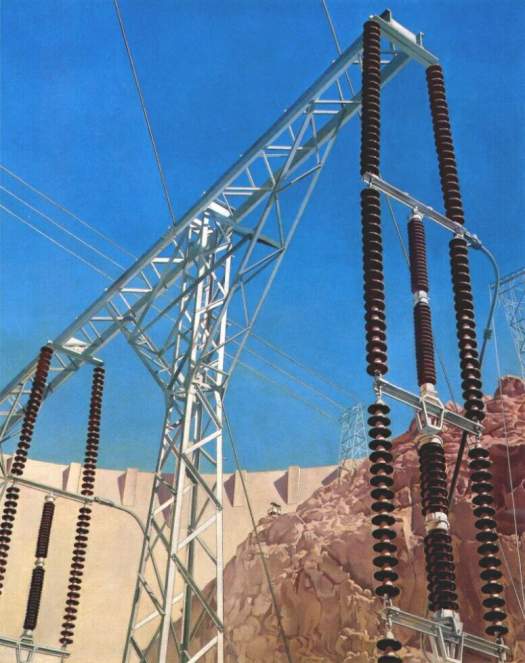
The American painter Charles Sheeler was contracted by Fortune magazine to create a series of paintings that captured the power and majesty of American technology. Nye describes Sheeler’s paintings as follows:
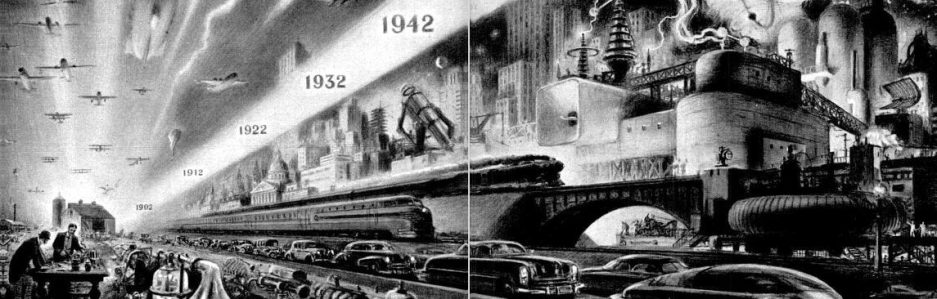
Like many artists of his generation, Charles Sheeler explored the apparent omnipotence of industrialization. In six paintings commissioned by Fortune he depicted the central objects of the technological sublime: the water wheel, the railroad, electrification, and flight. Martin Friedman has observed of the series: ‘Sheeler always depicted power at absolute stasis. In his hermetic visualizations, power is not treated in terms of crashing strength but as an intellectualized concept with its mechanisms always in mint condition.’ The immobility of these paintings creates a tension between the static forms and the reader’s knowledge that all these objects move at great speed. Published together in a single issue of Fortune, Sheeler’s images were presented like a photographic essay. The accompanying text asserted: ‘The heavenly serenity of Sheeler’s style brings out the significance of the instruments of power he portrays here … He shows them for what they truly are: not strange, inhuman masses of material, but exquisite manifestations of human reason.'”
“Heavenly serenity” was not the only religiously inflected language to appear in the text. Here is another portion of the text, cited by Nye, that accompanied Sheeler’s paintings:
“What is this incredible, elusive power that man has taken so magnificently from the waters and the hills? What unguessed secrets of the universe are hinted by its transmission unchanged through unchanging strands of copper or aluminum? In what way have men’s minds, grappling with the raw phenomena of lightning and magnetism, managed to contrive so swift and carefully guarded a channel for a force that no one can fully apprehend? … It is not surprising that the modern scientist, confronted with such questions and with their partial answers, which open up still further questions, should often be a man of deep religious feeling. And it is not surprising either that the modern artist, depicting such a scientist’s handiwork, should put a devout intensity into the painting. This is as truly a religious work of art as any altarpiece, or stained-glass window, or vaulted choir.”
This further points to the entanglement of religion and technology explored by historian David Noble among others. It also suggests to me that while some have referred to the 1930s as America’s most irreligious decade, coming on the heals of the Scopes Trial debacle and fed by H. L. Menken’s acerbic wit, this may be a mischaracterization. It may be better to suggest that in the 1930s the religious impulse was more thoroughly displaced onto technology and its possibilities. Although as Nye’s study of the American technological sublime makes clear, this was a displacement that had long been in the making.
Below is one of the Sheeler’s paintings that appeared in Fortune. Another is included in the preceding post. You can see the whole spread by following the link in the first paragraph.
David Nye, the author of Electrifying America which I cited a handful of times in the past month or so, is also the author American Technological Sublime (1995), a classic work in the history of technology. Except that it is not a work of history in the strict disciplinary sense. Nye draws promiscuously from other fields — citing for example Burke, Kant, Durkheim, Barthes and Baudrillard among others — to present a wide ranging and insightful study into the American character.
The concept of the technological sublime was not original to Nye. It had first been developed by Perry Miller, a prominent mid-twenieth century scholar of early American history, in his study The Life of the Mind in America. There Miller noted in passing the almost religious veneration that sometimes attended the experience of new technologies in the early republic.
Miller found that in the early nineteenth century “technological majesty” had found a place alonside the “starry heavens above and the moral law within to form a peculiarly American trinity of the Sublime.” Taking the steamboat as an illustration, Miller suggests that technology’s cultural ascendancy was abetted by a decidedly non-utilitarian aspect of awe and wonder bordering on religious reverence. “From the beginning, down to the great scenes of Mark Twain,” Miller explains, “the steamboat was chiefly a subject of ecstasy for its sheer majesty and might, especially for its stately progress at night, blazing with light through the swamps and forests of Nature.”
Leo Marx, who I’ve also mentioned here of late, also employed the technological sublime, but again in passing. It fell to David Nye, a student of Marx’s, to develop a book length treatment of the concept. Nye looks to Edmund Burke and Immanuel Kant in order fill out the concept of the sublime, but it is apparent from the start that Nye is less interested in the philosopher’s solitary experience of the sublime in the presence of natural wonders than he is in the popular and often collective experience of the sublime in the presence of technological marvels.
Nye, with a historian’s eye for interesting and compelling sources, weaves together a series of case studies that demonstrate the wonder, awe, and not a little trepidation that attended the appearance of the railroads, the Brooklyn bridge, the Hoover Dam, the factory, skyscrapers, the electrified cityscape, the atomic bomb, and the moon landing. Through these case studies Nye demonstrates how Americans have responded to certain technologies, either because of their scale or their dynamism, in a manner that can best be described by the category of the sublime. And perhaps more importantly, he argues that this experience of the technological sublime laced throughout American history has acted as a thread stitching together the otherwise diverse and divided elements of American society.
If the philosophers provided Nye with the terminology to name the phenomenon, he takes his interpretative framework from the sociologists of religion. Nye’s project is finally indebted more to Emile Durkheim than to either Burke or Kant. Nye notes early on that “because of its highly emotional nature, the popular sublime was intimately connected to religious feeling.” Later he observes that the American sublime was “fused with religion, nationalism, and technology” and ceased to be a “philosophical idea” instead it “became submerged in practice.”
This emphasis on practice is especially important to Nye’s overall thesis and it is on the practices surrounding the technological sublime that he concentrates his attention. For example, with each new sublime technology he discusses, Nye explores the public ceremonies that attended its public reception. The 1939 World’s Fair, to take another example, appears almost liturgical in Nye’s exposition with its carefully choreographed exhibitions featuring religiously intoned narration and a singular vision for a utopian future.
This attention to practices and ceremonies was signaled at the outset when Nye cited David Kertzer’s “Neo-Durkheimian view” that “ritual can produce bonds of solidarity without requiring uniformity of belief.” This functionalist view of religious ritual informs Nye’s analysis of the technological sublime throughout. In Nye’s story, the particular technologies are almost irrelevant. They are significant only to the degree that they gather around themselves a set of practices. And these practices are important to the degree that they serve to unify the body politic in the absence of shared blood lines or religion.
All told, Nye has written a book about a secular civil religion focused on sublime technologies and he has presented a convincing case. Absent the traditional elements that bind a society together, the technological sublime provided Americans a set of shared experiences and categories around which a national character could coalesce.
Nye has woven a rich, impressive narrative that draws technology and religion together to help explain the American national character. There’s a great deal I’ve left out that Nye develops. For example: the evolving relationship of reason to nature and technology as mediated through the sublime or the diminishing active role of citizens, and especially laborers, in the public experience of the technological sublime. But these, in my view, are minor threads.
The take-away insight is that Americans blended, almost seamlessly, their religious affections with their veneration for technology until finally the experience of technology took on the unifying role of religion in traditional societies. Historically American’s have been divided by region, ethnicity, race, religion, and class. American share no blood lines and they have no ancient history in their land. What they have possessed, however, is a remarkable faith in technological progress that his been periodically rekindled by one sublime technology after another all the way to the space shuttle program and its final mission.
The question I’m left with is this: What happens when the technological sublime runs dry? As Nye points out, it is, unlike the natural sublime, a non-renewable sublime. In other words, the sublime response wears off and must find another object to draw it out. If Nye is right — and I do think it is possible to overreach so I want to be careful — there is not much else that serves as well as the technological sublime to bind American society together. Perhaps then, part of our recent sense of unraveling, our heightened sense of disunity, the so called culture wars — perhaps these are accentuated by the withdrawal of the technological sublime. Perhaps, but that would take another book to explore.
“With the approach of the new millennium, we are witness to two seemingly incompatible enthusiasms, on the one hand a widespread infatuation with technological advance and a confidence in the ultimate triumph of reason, on the other a resurgence of fundamentalist faith akin to a religious revival.”
Noble believes that this will strike many readers as an incongruous juxtaposition. On the one hand, it had been assumed by Enlightenment types that the advance of technology (and science) went hand in hand with the retreat of religious belief. The plot, however, turned out to be more complex. “Today,” Noble continues, “we are seeing the simultaneous flourishing of both, not only side by side but hand in hand.”
This should not surprise us according to Noble. It is, and this is his thesis in brief, “a continuation of a thousand-year-old Western tradition in which the advance of the useful arts was inspired by and grounded upon religious expectation.”
On the other hand, “Some contemporary observers have argued … that the resurgence of religious expression testifies to the spiritual sterility of technological rationality, that religious belief is now being renewed as a necessary complement to instrumental reason …” But this view also wrongly assumes a “basic opposition” between technology and religion.
Against this assumption of opposition, Noble argues the following:
“… modern technology and modern faith are neither complements nor opposites, nor do they represent succeeding stages of human development. They are merged, and always have been, the technological enterprise being, at the same time, an essentially religious endeavor.
This is not meant in a merely metaphorical sense, to suggest that technology is similar to religion in that it evokes religious emotions of omnipotence, devotion, and awe, or that it has become a new (secular) religion in and of itself, with its own clerical caste, arcane rituals, and articles of faith. Rather it is meant literally and historically, to indicate that modern technology and religion have evolved together and that, as a result, the technological enterprise has been and remains suffused with religious belief.”
Noble goes on to add that nowhere is this more evident than in the United States where “an unrivaled popular enchantment with technological advance is matched by an equally earnest popular expectation of Jesus Christ’s return.” What is often missed, according to Noble, is that these are often the same people.
Lastly, the suffusion of technology with religious faith manifests itself when
“we routinely expect more from our artificial contrivances than mere convenience, comfort, or even survival. We demand deliverance. This is apparent in our virtual obsession with technological development, in our extravagant anticipations of every new technical advance — however much each fails to deliver on its promise — and, most important, in our utter inability to think and act rationally about this presumably most rational of human endeavors.”
A little bit of politics, religion, parenting, plagiarism … you know, all the stuff you’re not supposed to talk about at the dinner table. Plus one surprise for you at the end. Hope you have a lovely weekend.
“Pew’s Must See Picture of US Politics” by Rod Dreher at The American Conservative: Dreher provides an overview of the recently released Pew Center Political Typology Report, its first since 2005. Some interesting, counter-intuitive findings. Follow his link to the Pew page and you can take the survey to find out where you are in the Pew Typology.
“Varieties of irreligious experience” by Jonathan Rée in New Humanist: “The dividing lines between religiosity and secularism, or between belief and disenchantment, are not getting any clearer as time goes by, and if there has been a lot of traffic travelling from the camp of religion to the camp of disbelief in the past couple of centuries, it has followed many different paths, and is bound for many different destinations.” Well written piece in a Jamesian key on the subtleties of dis-belief in traditional religion.
“The Evolution of Data Products” by Mike Loukides at O’Reilly Radar: Helpful piece on the evolution and future trajectory of data and data products. “Data products are striving for the same goal: consumers don’t want to, or need to, be aware that they are using data. When we achieve that, when data products have the richness of data without calling attention to themselves as data, we’ll be ready for the next revolution.”
“What if the Secret to Success is Failure” by Paul Tough at the NY Times Magazine: Longish piece on efforts to instill character education in schools. “This push on tests is missing out on some serious parts of what it means to be a successful human.” “Our kids don’t put up with a lot of suffering. They don’t have a threshold for it. They’re protected against it quite a bit. And when they do get uncomfortable, we hear from their parents.”
“Uncreative Writing” by Kenneth Goldsmith at the The Chronicle of Higher Ed: Be warned, this piece may make you angry. Author argues the virtues of plagiarism claiming that writing must adjust to the conditions brought about by the computer, although there is a trajectory leading to this moment that pre-dates the computer. Some interesting points — it’s not a “crazy” piece — but my response is mixed.
And, last but not least, an impressive and surprising rendition of the national anthem from someone you wouldn’t have guessed could pull it off: watch it here.
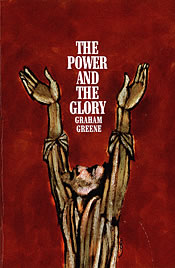
“When you visualize a man or woman carefully, you could always begin to feel pity.” Or so the nameless priest in Graham Greene’s 1940 novel, The Power and the Glory, thought to himself as he sat in a dark, dank, crowded jail cell accosted by a self-righteous woman intent on exposing his unworthiness.
The unnamed priest, however, needed no convincing. Earlier in the novel we read that,
He was a bad priest, he knew it: they had a word for his kind — a whiskey priest — but every failure dropped out of his sight and out of mind: somewhere they accumulated in secret — the rubble of his failures. One day they would choke up, he supposed, altogether the source of grace. Until then he carried on, with spells of fear, weariness, with a shamefaced lightness of heart.
The Power and the Glory is set in the Mexican state of Tabasco during the 1930’s when the Red Shirts, a rabidly anti-clerical paramilitary organization, came to power and brutally suppressed the Catholic Church. Greene’s protagonist, along with Padre Jose, a priest who agreed to marry and forsake his calling in exchange for his life, are the last vestiges of the Church in the state.
Throughout the story the whiskey priest eludes a fanatical police lieutenant who is hell bent on eradicating each and every reminder of the state’s religious past. “He wanted to destroy everything,” the narrator’s voice explains, “to be alone without any memories at all.” While evading capture, the nameless priest reluctantly and with an ever-present sense of his worthlessness ministers the sacraments in secret. He hears confession in the darkness before dawn, he holds a Mass with illicit wine — the Red Shirts also banned alcohol — in dingy jungle huts, and finally he forsakes the promise of safety across the state border to attend to an American convict dying of a gun shot wound that he might be absolved.
Through it all, as author Scott Turrow recently put it, “he emerges as a figure of intense humility and faith, willing to sacrifice himself to attend in secret to the devoted and utterly unaware of his own goodness.” Not unlike Christ, who in John’s Gospel returns to Jerusalem fully aware that it will cost him his life in order to attend to the dying Lazarus, the priest returns to attend to the dying American knowing that he is to be betrayed to the police and most likely executed. And indeed, that is the path marked out for him.
In the concluding pages of the novel, after the priest has been unceremoniously executed, an event we witness through the eyes of an English dentist with whom the story had begun, we revisit a number of the families and individuals who along the way had harbored or otherwise interacted with the nameless priest. In each case, we discover that the priest’s presence among them had been consequential — perhaps ambiguously so, but felt and remembered nonetheless. This was particularly evident in the case of a young boy whose family had early on sheltered the whiskey priest. At various points in the novel we listen in as the mother reads to the boy and his sisters an account of the death of a famous Mexican martyr. The boy had been distracted, unimpressed. But in the end, when he learns that the shabby priest with the “funny smell” who had been in their very house was also put to death, had now also become a martyr, he has a change of heart.
It brought it home to one — to have had a hero in the house, though it had only been for twenty-four hours. And he was the last. There were no more priests and no more heroes.
The priest’s presence, in retrospect, had made the difference. This appears, from one perspective, to be the central premise of the novel. By contrast, the oppressive quality of the setting is early on described as a “huge abandonment,” and the antagonist, the hell-bent lieutenant, was marked by the experience of a “vacancy,” and absence. The priest, tortured by his own failures — often drunk and father of an illegitimate child — cannot quite see the significance of his presence. He is in his own eyes merely a “fool” who “loves all the wrong things.” But it is his presence we learn that has made all the difference, that has given hope and sustained faith.
In that prison with which we began, in the darkness, the priest gives profound expression to the significance of presence.
When you visualized a man or woman carefully, you could always begin to feel pity … that was a quality God’s image carried with it … when you saw the lines at the corners of the eyes, the shape of the mouth, how the hair grew, it was impossible to hate.
Greene considered The Power and the Glory to be his best novel. Critics including John Updike, who wrote the Introduction to the 50th Anniversary Edition, agreed. It is frequently listed among the best novels of the 20th century. I read The Power and the Glory while also reflecting on the theme of presence along the lines suggested by Jaron Lanier. Lanier drew attention to what we might call our presence to ourselves, that is our full engagement in our own experience that was threatened whenever our desire to record and publish our lives through social media led us to fragment our focus and our attention, to become spectators of our own lives.
Reflecting on Greene’s novel provided yet another angle from which to think of presence. It suggested that our presence to one another may be the most significant gift we can offer. Alienation and loneliness are still with us. We speak incessantly of our living in a “connected” age, and indeed it has never been easier to make and maintain connection. But connection is not presence. It is true that very often, especially where great distance separates us, a connection is all we can offer — it is better than nothing. But how often do we fail to give our whole presence to one another when we are separated by feet and inches? How often do we fail not only to give our own, but to perceive the other’s presence so that we may notice “the lines at the corners of the eyes, the shape of the mouth, how the hair grew”?
Like the unnamed whiskey priest, we may never know what difference our presence will make in the life of another. What we do know is that our absence, whether literal or effected by our fractured inattentiveness, may in the end contribute to a “huge abandonment.”




 L.M. Sacasas