“The Past Is Never Dead”

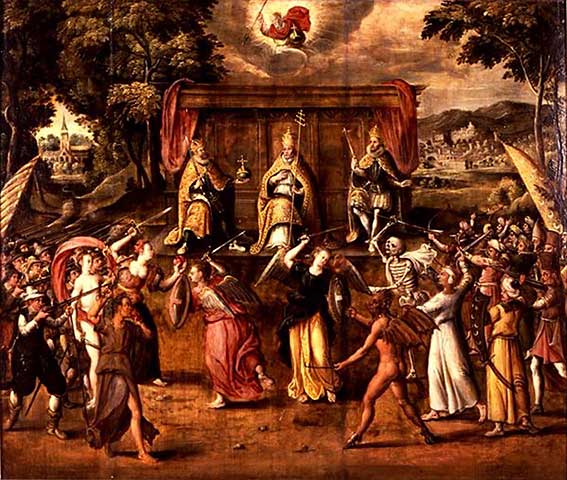
In the wake of the Protestant Reformation, religious violence tore across Europe.  The Wars of Religion, culminating with the Thirty Years’ War, left the continent scarred and exhausted.  Out of ashes of war the secular nation state arose to establish a new political order which privatized religion and enshrined reason and tolerance as the currency of the public sphere ensuring an end to irrational violence.

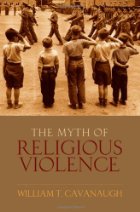
That is one of the more familiar historical narratives that we tell ourselves.  It is sweeping and elegant in its scope and compelling in its explanatory power.  There’s only one problem according to William Cavanaugh:  it’s not true.  Cavanaugh lays out his case in his most recent book, The Myth of Religious Violence: Secular Ideology and the Roots of Modern Conflict (Oxford UP, 2009).  Needless to say, he has his work cut out for him.  The narrative he seeks to deconstruct is deeply entrenched and we’ve staked a lot on it.  His point, to be clear, is not that religion has never been implicated in violence.  As he puts it elsewhere, “Given certain conditions, Christianity, Islam, and other faiths can and do contribute to violence.”  Rather, he is contesting the particular historical narrative whereby the secular nation state arises in response to religious violence in order to secure peace for society by marginalizing religious practice and discourse.

To begin with, Cavanaugh demonstrates that the very concept of religion is problematic and thus renders any neat parsing of violence into either religious or secular categories tenuous at best.  Moreover, the nation state precedes the so called wars of religion and is best seen as a contributing cause, not an effect of the wars.  The historical realities of the wars resist the simplistic “Wars of Religion” schema anyway.  For example, during the  Thirty Years’ War, Catholics were at times fighting other Catholics and sometimes in league with Protestants.  The Thirty Years’ War as it turns out was a scramble by competing dynasties and rising national governments to fill the power vacuum created by the collapse of the medieval political order.  Furthermore, Cavanaugh suggests that the state co-opted and assumed for itself many of  the qualities of the church creating, as one reviewer put it, “its own sacred space, with its own rituals, hymns, and theology, and its own universal mission.”  In the end, the secular nation state, particularly in its 20th century totalitarian apotheosis, hardly appears as the champion of reason, peace, and tolerance.  The nation state secured its status by monopolizing the use of coercive force.  In doing so, however, it clearly did not put an end to violence.

Cavanaugh presents a counter-intuitive thesis and he takes care to make his case.  It is a case he has been working out since 1995 when, as a graduate student, he published “‘A fire strong enough to consume the house:’ The Wars of Religion and the Rise of the Nation State.” In the intervening years he has honed and strengthened his argument which finds mature expression in the The Myth of Religious Violence.

Whether one ultimately agrees with Cavanaugh’s thesis or not, his work highlights two important considerations regarding historical narratives.  First, historical reality is usually more complex than the stories we tell, and the complexity matters.  We are living through a cultural moment when historical awareness is a rare commodity, so perhaps we shouldn’t complain too much about shallow historical knowledge when the alternative may be no historical knowledge.  But that said, much of what does pass for historical knowledge too frequently is filtered through Hollywood, the entertainment industry, or the talk-show circuit, and for all these subtlety must necessarily be sacrificed to the demands of the medium.  The big picture sometimes is painted at the expense of important details, so much so that the big picture is rendered misleading.

Perhaps most days of the week, this is not a terribly important consideration.  But it can become very significant under certain circumstances.  When a historical narrative is hotly contested and passionately defended it is usually because the real battle is over the present.  Consider heated debates about the Christian or secular origins of the American constitutional order, or arguments over the causes of the American Civil War and Southern identity.  Leaving the terrain of American history, consider the Armenian genocide, the Japanese atrocities at Nanking, or the the tangled history of the Balkans.  In each case the real issue is clearly not the accuracy of our historical memory so much as it is the perceived implications for the present.  In other words, we fight for our vision for the present on the battlefield of the past.  This raises a host of other questions related to the status of arguments from history, philosophies of history, and historiography.  These sorts of questions, however, are rarely raised at rallies or on television — it would be hard to fit them on a placard or in a 10 second sound bite.

A debate about the origins of the modern nation state is likewise about more than historical accuracy.  Critics of religion and the place of religion in public life, Christopher Hitchens and Sam Harris for example, have made the historical narrative we began with a key component of their case — religion kills, the secular state saves.  Cavanaugh has offered the compelling rejoinder.

Either way it appears Faulkner was right:  “The past is never dead.  It’s not even past.”

_____

You can listen to a lecture and link to a number of essays by Cavanaugh here.

Life Amid Ruins

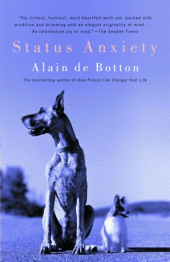
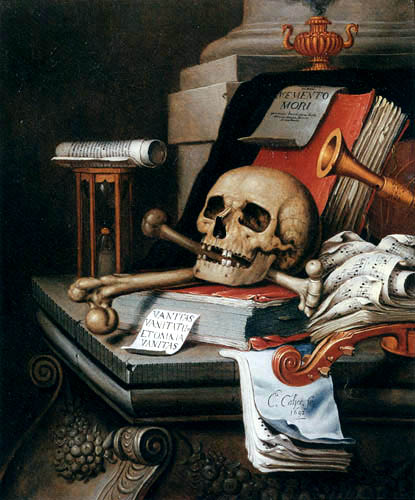
In Status Anxiety — his part philosophically-minded self-help book, part social history — Alain de Botton describes two fashions that were popular in the art world during the 17th and 18th century respectively.  The first, vanitas art, took its name from the biblical book of Ecclesiastes in which it is written, “Vanity of vanity, all is vanity.”  Vanitas art which flourished especially in the Netherlands, and also in Paris, was, as the biblical citation implies, concerned with life’s fleeting nature.  As de Botton describes them,

Each still-life featured a table or sideboard on which was arranged a contrasting muddle of objects.  There might be flowers, coins, a guitar or mandolin, chess pieces, a book of verse, a laurel wreath or wine bottle: symbols of frivolity and temporal glory.  And somewhere among these would be set the two great symbols of death and the brevity of life:  a skull and an hourglass.

A bit morbid we might think, but as de Botton explains,

The purpose of such works was not to send their viewers into a depression over the vanity of all things; rather, it was to embolden them to find fault with particular aspects of their own experience, while at the same time attending more closely to the virtues of love, goodness, sincerity, humility and kindness.

Okay, still a bit morbid you might be thinking, but fascinating nonetheless.  Here is the first of two examples provided in Status Anxiety:

Philippe de Champaigne, circa 1671

Here is the second example:

Simon Renard de Saint-Andre, circa 1662

And here are a few others from among the numerous examples one can find online:

Edwart Collier, 1640
Pieter Boel, 1663
Adam Bernaert, circa 1665
Edwart Collier, 1690

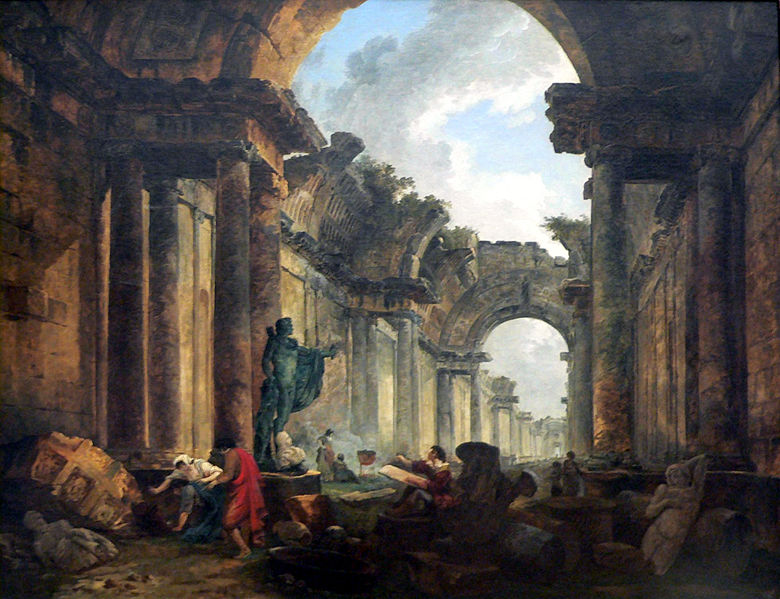
Less morbid and more nostalgic, the second art fashion de Botton examines is the 18th and 19th century fascination with ruins.  This fascination was no doubt inspired in part by the unearthing of Pompeii’s sister city, Herculaneum, in 1738.  The most intriguing subset of these paintings of ancient ruins, however, were those paintings that imagined not the past in ruins, but the future.  “A number of artists,” according to de Botton, “have similarly delighted in depicting their own civilization in a tattered future form, as a warning to, and reprisal against, the pompous guardians of the age.”  Consider these the antecedents of the classic Hollywood trope in which some famous city and its monuments lies in ruins — think Planet of the Apes and the Statue of Liberty.

Status Anxiety provides three examples these future ruins.  The first depicts the Louvre in ruins:

Hubert Robert, Imaginary View of the Grande Gallerie of the Louvre in Ruins, 1796

The second depicts the ruins of the Bank of London:

Joseph Gandy, View of the Rotunda of the Bank of England in Ruins, 1798

And the third, from a later period, depicts the city of London in ruins being sketched by a man from New Zealand, “the country that in Dore’s day symbolized the future,” in much the same way that Englishmen on their Grand Tours would sketch the ruins of Athens or Rome.

Gustav Dore, The New Zealander, 1871

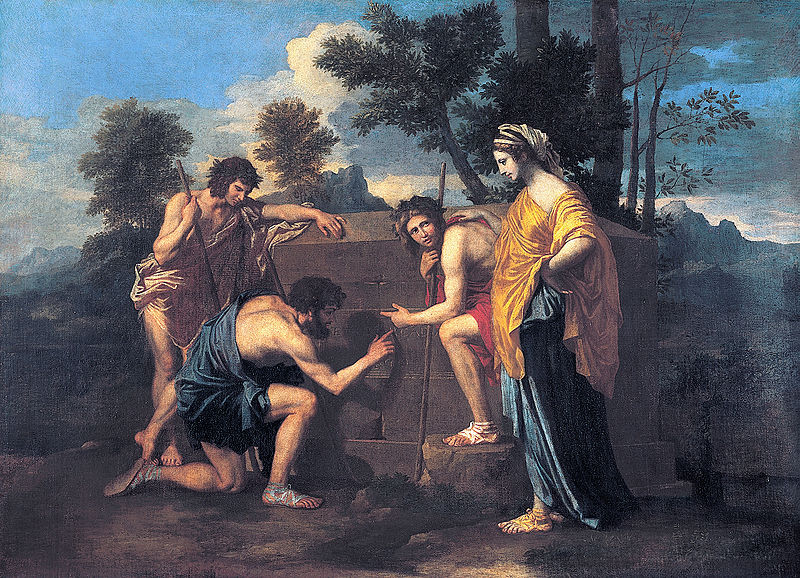
Finally, both of these art fashions suggested to my mind Nicolas Poussin’s Et in Arcadia ego from 1637-1638:

Nicolas Poussin, Et in Arcadia ego, 1637-38

Here, shepherds stumble upon some ancient tomb in which they read the inscription, Et in Arcadia ego.  There has been some debate about the precise way the phrase should be taken.  It may be read as the voice of death personified saying “even in Arcadia I exist,” or it may mean “the person buried in this tomb lived in Arcadia.”  In either case the moral is clear.  Death comes for the living.  It is a memento mori, a reminder of death (note the appearance of that phrase in the last piece of vanitas art above).

Admittedly, these are not the most uplifting of reflections.  However, de Botton’s point and the point of the artists who painted these works strikes me as sound:  we make a better go of the present if we live with the kind of perspective engendered by these works of art.  Our tendency to ignore our mortality and our refusal to acknowledge the limitations of a single human life may be animating much of our discontent and alienation.  Perhaps.  Certainly there is some wisdom here we may tap into.  This is pure conjecture, of course, but I wonder how many, having contemplated Gandy’s paiting, would have found the phrase “too big too fail” plausible?  Might we not, with a renewed sense of our mortality, reorder some of our priorities bringing into sharper focus the more meaningful elements of life?

It is also interesting to consider that not only do we have few contemporary equivalents of the kind of art work we’ve considered, but neither do we have any actual ruins in our midst.  America seems uniquely prepared to have been a country without a sense of the past.  Not only are we an infant society by historical standards, but even the ancient inhabitants of our lands, unlike those further south, left no monumental architecture, no tokens of antiquity.  Those of us who live in suburbia may go days without casting our eyes on anything older than twenty years.  We have been a forward looking society whose symbolic currency has not been — could not have been — ruins of the past, but rather the Frontier with its accent on the future and what may be.

I would not call into question the whole of this cultural sensibility, but perhaps we could have used just a few ruins.

The Search

Kurt Vonnegut’s “Harrison Bergeron” presented us with a striking illustration of the potentially debilitating consequences of the constant distraction.  In that story the distraction is brutally imposed; but, as we noted last week, we choose our distractions.  In fact, we embrace our Internet-empowered distractions.  We love to be distracted and we crave diversion.  We can hardly stand it if we are without distraction or diversion for more than a few moments at a time.  We complain incessantly about our busyness, but were it all to stop we would hardly know what to do with ourselves.  This raises some interesting questions.  Why are we so keen to envelope ourselves in constant distraction?  Why do some of us develop an addictive relationship to the constant flow of distraction?  Why are we so uneasy when the distractions stop?

Back in June, I reflected on the theme of distraction and diversion on the heels of a post about the religious aura that sometimes surrounds our love affair with sports.  We were then, you will remember, at the height of World Cup fever.  I want to revisit some of those same thoughts and tweak them just a little bit as a follow up to Friday’s post on distraction and “Harrison Bergeron.”

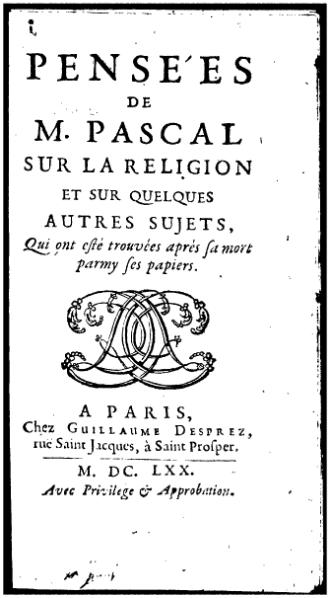
Distractedness and the need for diversion are not new phenomenon of course.  Although the condition may now be intensified and heightened, it has been with us at least since the 17th century, and almost certainly before then.  It was in the 17th century that Blaise Pascal began assembling a series of notes on scraps of paper in preparation for a book he never wrote.  When he died at the age of 39 he left behind hundreds of barely organized notes which were later collected and published under the French title Pensées, or thoughts.  Pascal is today remembered, if at all, either for his law of fluid pressure or an argument for God’s existence known as Pascal’s Wager.  Neither quite does justice to the depth of his insight into what we used to call the human condition.

Pascal knew that we needed our diversions and distractions and that without them we would be miserable.  His description of the younger generation sounds wholly contemporary:

Anyone who does not see the vanity of the world is very vain himself.  So who does not see it, apart from young people whose lives are all noise, diversions, and thoughts for the future?  But take away their diversion and you will see them bored to extinction.  Then they feel their nullity without recognizing it, for nothing could be more wretched than to be intolerably depressed as soon as one is reduced to introspection with no means of diversion.

But Pascal is not merely an old crank berating a younger generation he fails to understand.  Pascal applies the same analysis indiscriminately.  Young or old, rich or poor, male or female — for Pascal it just comes with being human.  “If our condition were truly happy,” he explains, “we should not need to divert ourselves from thinking about it.”  As things stand, however,

What people want is not the easy peaceful life that allows us to think of our unhappy condition, nor the dangers of war, nor the burdens of office, but the agitation that takes our mind off it and diverts us.  That is why we prefer the hunt to the capture.

We need distractions and diversions to keep us from contemplating our true condition, frail and mortal as it is.  For this reason we cannot stand to be alone with our own thoughts and seek to fill every moment with distraction.  Pascal’s view is admittedly rather grim even as it resonates with our experience.  Yet, Pascal knew there was more than this to the human condition.  There was also love and passion, knowledge and creativity, wonder and courage.  Pascal knew this and he insisted that we recognize both the glory and the misery of humanity:

Let man now judge his own worth, let him love himself, for there is within him a nature capable of good; but that is no reason for him to love the vileness within himself.  Let him despise himself because this capacity remains unfilled; but that is no reason for him to despise this natural capacity.  Let him both hate and love himself; he has within him the capacity for knowing truth and being happy, but he possesses no truth which is either abiding or satisfactory.

Pascal insists that we reckon with all that is good and all that is bad in us.  It is our awareness of the possibility of goodness, however, which heightens our misery.  And, yet again, it is our awareness of our misery that is part of our glory.  In the end Pascal believed that “God alone is man’s true good” and Christ the “via veritas.”  With St. Augustine, whose influence permeates Pascal’s thought, he would have prayed, “Our hearts are restless until they find their rest in Thee.”  Perhaps this is why at times something akin to spirituality and the language of worship suffuses our most prominent and powerful diversions.

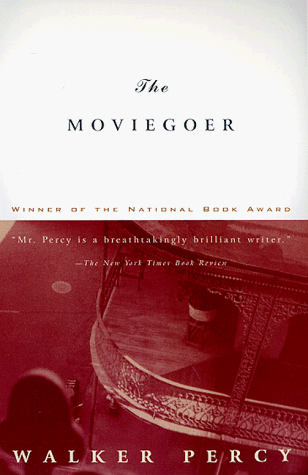
Augustine and Pascal in turn both helped shape the thought of  2oth century novelist Walker Percy.  Percy blended Pascalian insight with a touch of existentialism in his best known novel The Moviegoer (1960) in which the main character, Binx Bolling, finds himself on a search.  “What is the nature of the search? you ask.”

Really it is very simple, at least for a fellow like me; so simple that it is easily overlooked.  The search is what anyone would undertake if he were not sunk in the everydayness of his own life …. To become aware of the possibility of the search is to be onto something.  Not to be onto something is to be in despair.

Near the middle of the novel throughout which Bolling has been amassing clues he thinks are somehow related to the search, he despairs:

… when I awake, I awake in the grip of everydayness.  Everydayness is the enemy.  No search is possible.  Perhaps there was a time when everydayness was not too strong and one could break its grip by brute strength.  Now nothing breaks it — but disaster.

However, through a rather tortured relationship with a very broken young woman named Kate whom he has come to love, Binx begins to see grace in the ordinary.  Near the very end of the novel, while he and Kate are sitting at a service station discussing marriage and the worries that still fill Kate’s mind, Binx notices a man coming out of a church.  It is Ash Wednesday.  Binx watches while the man sits in his car looking down at something on the seat beside him.  The man’s presence puzzles Binx:

It is impossible to say why he is here.  Is it part and parcel of the complex business of coming up in the world?  Or is it because he believes that God himself is present here at the corner of Elysian Fields and Bons Enfants?  Or is he here for both reasons:  through some dim dazzling trick of grace, coming for the one and receiving the other as God’s own importunate bonus?  It is impossible to say.

In June with sports on my mind, I wondered whether, as Pascal would have it, sports were a mere distraction which facilitated our unwillingness to acknowledge our true condition; or, taking a cue from Percy, whether it might be a rupture of the “everydayness,” the ordinariness of our lives that may awaken us to the possibility of the search.  My sense at the time was that both were on to something, each was a possibility.  Sports can be merely a distraction conducive to living in bad faith in denial of the truth of our situation.  But at times bursts of grace and beauty appeared suddenly and unexpectedly in the midst of our diversion to remind us that we ought to be searching for their source.  “Through some dim dazzling trick of grace, coming for the one” we receive “the other as God’s own importunate bonus.”

Thinking now about the distractions enabled by the Internet, social media, smart phones, and all the rest I wonder if something like the same analysis might also apply.  Do we embrace these distractions as a way of refusing silence and contemplation because we do not care to entertain the thoughts that may come?  Perhaps.  Surely more than this is going on.  Sometimes a moment of carefree distraction is just that.  Is it possible that coming for distraction we might find something more — a real connection with another human being, a new insight, real wisdom, genuine laughter?

I am not so much of a pessimist that I would discount such possibilities.  But I do fear that more often than not our distractions, as Pascal would put it, are diversions that keep us from considering our true condition. They are part of the “everydayness” of life that is the enemy of the search and might even hide from us the possibility of the search.   To give up on the search, to be unaware of it, is to be in despair. If it doesn’t feel like despair, is it because, as Kierkegaard put it in a line that opens The Moviegoer, “… the specific character of despair is precisely this:  it is unaware of being despair”?

Perhaps it is also because we are too distracted to notice.  We are the “diverted selves” Percy described in Lost in the Cosmos: The Last Self-Help Book,

In a free and affluent society, self is free to divert itself endlessly from itself.  It works in order to enjoy the diversions that the fruit of one’s labor can purchase.  The pursuit of happiness becomes the pursuit of diversion …

Follow Ups

Often valuable  material related to earlier posts I had written comes to my attention.  Rather than attach the new stuff to the original posts which are by then buried beneath more recent items, it made more sense to collect the new material and from time to time devote  a post to these follow ups.  So here you go:

Following up on “Hitchens and Prayer,” here is one of the more thoughtful reflections I’ve come across on the topic:  “The Most Pressing Question” by Damon Linker at The New Republic.

Following up on “Parenting and Its Discontents,” Jason Peters at Front Porch Republic writes on the importance of extended families in “The Orphans of Success.”

And following up on “Technology Sabbaths and Other Strategies for the Digitized World,” I found that Erika Kosina had also written a great post, “Time for a Technology Sabbath?”, at Yes! with some very helpful suggestions.

Technology Sabbaths and Other Strategies for the Digitized World

We avert catastrophes by making adjustments.  At times those adjustments are sudden swerves out of the path of some suddenly on-rushing disaster.  More often our adjustments amount to subtle course corrections as distant dangers become visible on the horizon.  My sense is that a growing number of people are beginning to make just these kinds of small but deliberate adjustments in their interaction with the wide array of technologies that envelop our daily lives.

In a remarkably helpful post (complete with charts), “Are You An Internet Optimist or Pessimist?  The Great Debate over Technology’s Impact on Society,” Adam Thierer surveys the major voices in the debate and proposes a pragmatic middle ground between unbridled optimism and reactionary pessimism.  In his view, the pragmatic middle should, all things considered, lean toward optimism.  The pragmatic middle is not a bad place to be, although my tendency is to slouch toward pessimism.  I attribute this to my sense that we are more likely to embrace technologies uncritically rather than the reverse, so it is important to advocate for a certain critical distance.  Again, this is just my sense and I could be off target.

One thing I am sure about though:  very few people care about the criticism you offer unless you also have some solutions in tow, practical solutions that can be readily implemented.  Now, in the case of navigating the world the Internet created, I’m not sure that solutions are quite what we’re looking for.  Perhaps the better word is strategies, and a growing number of people are talking about the strategies they employ to strike a more fulfilling balance between the technology in their lives and other significant priorities.

A constellation of these strategies can be group together under the heading “slow movements.”  These are strategies designed to counteract the break-neck speed of our digitally enhanced world.  In his article, “The Art of Slow Reading,” a somewhat skeptical Patrick Kingsley tells us,

First we had slow food, then slow travel. Now, those campaigns are joined by a slow-reading movement – a disparate bunch of academics and intellectuals who want us to take our time while reading, and re-reading. They ask us to switch off our computers every so often and rediscover both the joy of personal engagement with physical texts, and the ability to process them fully.

Along the same lines, in his 2009 article, “Not So Fast,” John Freeman advocates “slow communication.”  We have come to take progress for granted, but Freeman is surely right in observing that “the ultimate form of progress … is learning to decide what is working and what is not,” and, in his view, the pace of our digitally enhanced communication is one of those things that is not working for us:

The speed at which we do something — anything — changes our experience of it.  Words and communication are not immune to this fundamental truth. The faster we talk and chat and type over tools such as email and text messages, the more our com­munication will resemble traveling at great speed. Bumped and jostled, queasy from the constant ocular and muscular adjust­ments our body must make to keep up, we will live in a constant state of digital jet lag.

The remedy Freeman suggests is simple and yet elegantly stated,

The difference between typing an email and writing a letter or memo out by hand is akin to walking on concrete versus stroll­ing on grass. You forget how natural it feels until you do it again. Our time on this earth is limited, the world is vast, and the people we care about or need for our business life to operate will not always live and work nearby; we will always have to com­municate over distance. We might as well enjoy it and preserve the space and time to do it in a way that matches the rhythms of our bodies.

Like Freeman, Linda Stone is attentive to the forgotten significance of our embodiment.  In “A new era of post-productivity computing?” Stone takes issue with recent applications such as Freedom which are designed to “force” us to focus on our work by locking us out of the Internet for predetermined amounts of time.  She is concerned that with such an approach,

… we re-assign the role of tyrant to the technology. The technology dictates to the mind. The mind dictates to the body. Meanwhile, the body that senses and feels, that turns out to offer more wisdom than the finest mind could even imagine, is ignored.

For example, she draws our attention to something so basic that it easily slips beneath our notice:  just breathe.

At the heart of compromised attention is compromised breathing. Breathing and attention are commutative. Athletes, dancers, and musicians are among those who don’t have email apnea. Optimal breathing contributes to regulating our autonomic nervous system and it’s in this regulated state that our cognition and memory, social and emotional intelligence, and even innovative thinking can be fueled.

Neither Stone nor Freeman suggest that we abandon our technologies; they carry no pitchforks or torches.  Their very legitimate concern is that we not allow our technologies to determine the pace and shape of our lives.  Better that our lives be attuned to more humane rhythms that honor our embodiment and our personhood.
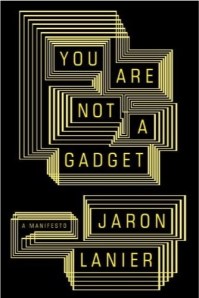
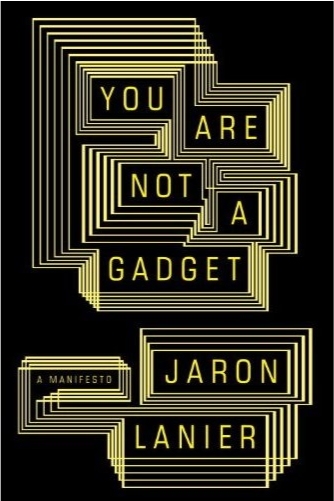
Jaron Lanier, a tech-industry insider if ever there was one, also voices concerns about the loss of personhood in his 2010 book You Are Not a Gadget: A Manifesto.  In a recent post at Text Patterns, Alan Jacobs helpfully summarizes the very practical advice Lanier offers for those interested in preserving their integrity as a human person while online:

“These are some of the things you can do to be a person instead of a source of fragments to be exploited by others.”

  • Don’t post anonymously unless you really might be in danger.
  • If you put effort into Wikipedia articles, put even more effort into using your personal voice and expression outside of the wiki to attract people who don’t yet realize that they are interested in the topics you contributed to.
  • Create a website that expresses something about who you are that won’t fit into the template available to you on a social networking site.
  • Post a video once in a while that took you one hundred times more time to create than it takes to view.
  • Write a blog post that took weeks of reflection before you heard the inner voice that needed to come out.
  • If you are twittering, innovate in order to find a way to describe your internal state instead of trivial external events, to avoid the creeping danger of believing that objectively described events define you, as they would define a machine.

All of it very good, and very practical advice.  Like Stone and Freeman, Lanier is not advising people to disconnect and unplug.  His advice is for those desiring to navigate the Internet world rather than retreat from it.  There have been some, however, who have experimented with the option of unplugging altogether.  James Sturm, for example, has recently concluded a four month experiment in Life Without the Web.  He has chronicled his experience through a series of columns at Slate (he used a third party to submit his columns).  He writes engagingly about his experiment and he appears to have inspired more than a few others (look up “quitting the internet” on Google, all the while noting the irony, but then keeping it to yourself because it is really not that clever).

In his last post, Sturm reflected on the possibility of writing a book based on his experience.  Feeling four months might be unreasonable for those whose livelihood now depends on the Internet, he wonders if a 30 day hiatus might not be more manageable.  But then he writes,

… even if a few of you could disconnect for 30 days, then what? It’s only a finger in the proverbial dike. One month might be a futile effort—how long until you’re back in front of the computer, incessantly updating your Facebook page? When dealing with something as powerful as the Internet, perhaps a more extreme measure is needed, a manifesto along the lines of Jerry Mander’s 1978 classic Four Arguments for the Elimination of Television.  I’m not hard-core enough to write a book that advocates living entirely without the Internet, but I do find taking such a forceful position appealing.

In the end it might be a less severe approach that turns out to be most helpful.  In a 2008 post on his blog MediaShift, Mark Glaser observed a growing trend “among bloggers and media people who are overwhelmed with the always-on nature of the broadband Internet and smartphones.  [And for whom] the overwhelming feeling, is exacerbated by instant messaging, social networking and services such as Twitter, that allow us to do more informal communications electronically rather than in person.”  It was a trend toward taking a “Technology Sabbath.”  Not surprisingly, it was also a trend emerging in certain Jewish and Christian circles.  In the two years since Glasser wrote, the circle of the overwhelmed has almost certainly expanded.
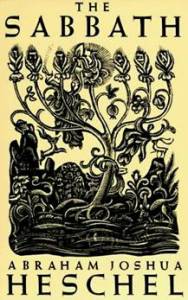
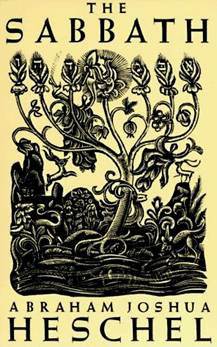
There is a good chance that talk of keeping Sabbath will most likely suggest a rather drab and joyless affair, a relic of a grayer age.  Either that or it conjures images of debilitating attention to countless puritanical  rules regulating the life out of an otherwise pleasant day.  We tend, after all, to equate restriction with loss.  But consider this alternative vision articulated by Jewish scholar Abraham Heschel in his class work, The Sabbath:

To observe the seventh day does not mean merely to obey or to conform to the strictness of a divine commandment. To observe is to celebrate the creation of the world and to create the seventh day all over again, the majesty of holiness in time, a day of rest, a day of freedom …

Heschel goes on to quote a Jewish prayer that describes the Sabbath as “a day of rest and holiness, a rest in love and generosity, a true and genuine rest, a rest that yields peace and serenity, tranquility and security, a perfect rest with which Thou art pleased.”

This vision of the Sabbath should resonate with those who may be experiencing tech-fatigue accompanied by that disquieting sense that their tools are running, rather than facilitating their lives.  The Sabbath was intended to remind us that while we must work and work can be noble and useful, we were not made for work and work is not our highest calling.  Taking a day, or even some hours in a day, to disconnect and rest from our technologies, useful and noble as they may otherwise be, can likewise remind us that we were not made for our technology and being connected is not our highest calling.

The idea of a technology Sabbath presents a number of advantages.  It is simple, practical, and effective.  It recognizes the significance of intentional practices in shaping our habits and our dispositions.  It avoids extremes.  And it creates a space for both  silence and introspection on the one hand, and on the other, celebration and joy in company friends and family.

It may be that deliberate and regular unplugging can help us rediscover a more humane rhythm for our lives, one that is attuned to the needs of our bodies and in sync with the world around us.  If so, then perhaps celebration, rest, freedom, love and generosity, peace, serenity, and tranquility may more frequently characterize our experience.