McLuhan’s Catholicism

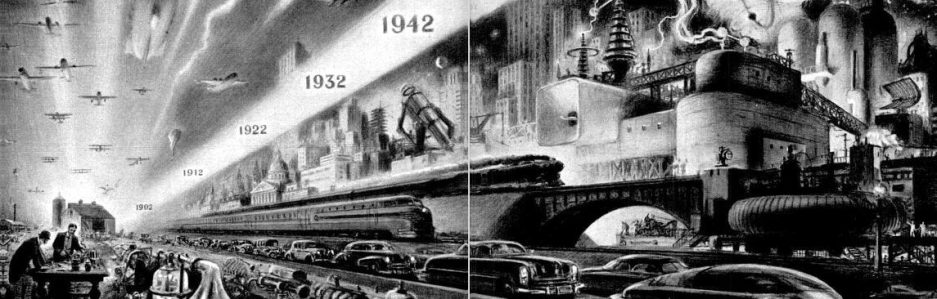
Just passing along a link to Nick Carr’s brief review in The New Republic of Douglas Coupland’s new biography of Marshall McLuhan, Marshall McLuhan: You Know Nothing of My Work!.  In the review, Carr makes the following observation:

Neither his fans nor his foes saw him clearly. The central fact of McLuhan’s life, as Coupland makes clear, was his conversion, at the age of twenty-five, to Catholicism, and his subsequent devotion to the religion’s rituals and tenets. Though he never discussed it, his faith forms the moral and intellectual backdrop to all his mature work. What lay in store, McLuhan believed, was the timelessness of eternity. The earthly conceptions of past, present, and future were, by comparison, of little consequence. His role as a thinker was not to celebrate or denigrate the world but simply to understand it, to recognize the patterns that would unlock history’s secrets and thus provide hints of God’s design. His job was not dissimilar, as he saw it, from that of the artist.

Below is a clip of the exchange between McLuhan and Norman Mailer that Carr references in his review:

One of my favorite YouTube videos is a clip from a Canadian television show in 1968 featuring a debate between Norman Mailer and Marshall McLuhan. The two men, both heroes of the ’60s, could hardly be more different. Leaning forward in his chair, Mailer is pugnacious, animated, engaged. McLuhan, abstracted and smiling wanly, seems to be on autopilot. He speaks in canned riddles. “The planet is no longer nature,” he declares, to Mailer’s uncomprehending stare; “it’s now the content of an art work.”

After watching the clip, I’ve got to agree with Carr; ten minutes well spent.

________________________________________________

*See also Marx, Freud, and … McLuhan.

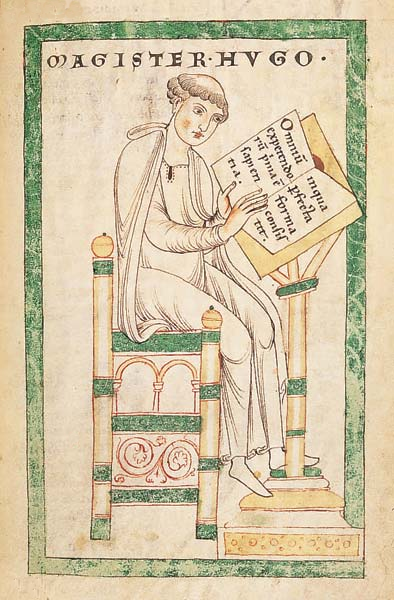
“Monastic Reading” — Reading with the Body

“Monastic Reading,” the third chapter in Ivan Illich’s In the Vineyard of the Text, gives us a window into a form of reading that involved the body along with the mind.  Illich is attentive to the physicality of reading and modes of remembering that (figuratively) engrave the text onto the body so that the body and mind work in tandem to remember and recall what has been read and learned.  Very interesting material given my recent fascination with embodied knowledge.

The easiest way to recognize instances of embodied knowledge is to take note of athletes and dancers who “know” how to do a great deal of things that they may have a very hard time putting into words.  Or, if you can type, ask yourself, where is the letter “L” on the keyboard?  How did you think of the answer?  If you are like most people in that situation you moved your fingers around to remember.

I’m most interested in how embodied knowledge — which is also picked up through the habits and rituals, religious and otherwise, that make up our cultural milieu — plays a significant role in shaping our dispositions, attention, inclinations.

Illich, who is drawing on the work of anthropologist Marcel Jousse, gives us some more instances of embodied knowledge, this time in the service of recalling articulated speech.

Previous posts:  Introduction, chapter one, chapter two.

  • Quoting Hugh of Saint Victor:  “Meditation is sustained thought along planned lines . . . . Meditation takes its start from reading, but is bound by none of the rules or precepts of reading.  Meditation delights to range along open ground, where it fixes its free gaze upon the contemplation of truth, drawing together now these, now those causes of things, or now penetrating into profundities, leaving nothing doubtful, nothing obscure.  The beginning of learning thus lies in reading but its consummation lies in meditation.” (52)
  • “Meditative reading can sometimes be difficult, a chore which must be faced with courage, fortitudo.  But the reader, sustained by the ‘zeal to inquire,’ will derive joy from his application.  Eagerness comes with practice.  To foster his zeal, the student needs encouraging example rather than instruction.”  (53)
  • “Hugh’s meditation is an intensive reading activity and not some passive quietist plunge into feelings.  This activity is described by analogy to body movements:  striding from line to line, or flapping one’s wings while surveying the already well-known page.  Reading is experienced by Hugh as a bodily motor activity.
  • In a tradition of one and a half millennia, the sounding pages are echoed by the resonance  of the moving lips and tongue.  The reader’s ears pay attention, and strain to catch what the reader’s mouth gives forth.  In this manner the sequence of letters translates directly into body movements and patterns nerve impulses.  the lines are a sound track picked up by the mouth and voiced by the reader for his own ear.  By reading, the page is literally embodied, incorporated.
  • The modern reader conceives of the page as a plate that inks the mind, and of the mind as a screen onto which the page is projected and from which, at a flip, it can fade.  For the monastic reader, whom Hugh addresses, reading is a much less phantasmagoric and much more carnal activity:  the reader understands the lines by moving to their beat, remembers them by recapturing their rhythm, and thinks of them in terms of putting them into his mouth and chewing.  No wonder that pre-university monasteries are described to us in various sources as the dwelling places of mumblers and munchers.” (54)
  • “For Hugh, who uses Latin, the act of reading with the eyes implies an activity not unlike a search for firewood:  his eyes must pick up the letters of the alphabet and bundle these into syllables.  The eyes are at the service of the lungs, the throat, the tongue, and the lips that do not usually utter single letters but words.”  (58)
  • “. . . for the monk, reading is not one activity but a way of life . . . . Reading impregnates his days and nights.”  (58-59)
  • “The process by which the written text of Scripture becomes part of each monk’s biography is typically Jewish rather than Greek.  Antiquity had no one book that could be swallowed.  Neither Greeks nor Romans were people of a book.  No one book was — or could be — at the center of the classical way of life, as it is for Jews, Christians, and Muslims.  For the first Christian millennium, memorization of this one book was performed by a process which stands in stark contrast to the building of memory palaces.  The book was swallowed and digested through the careful attention paid to the psychomotor nerve impulses which accompany the sentences being learned. Even today, pupils in Koranic and Jewish schools sit on the floor with the book open on their knees.  Each one chants his lines in a singsong, often a dozen pupils simultaneously, each a different line.  While they read, their bodies sway from the hips up or their trunks gently rock back and forth.  The swinging and the recitation continue as if the student is in a trance, even when he closes his eyes or looks down the aisle of the mosque.  The body movements re-evoke those of the speech organs that have been associated with them.  In a ritual manner these students use their whole bodies to embody the lines.
  • Marcel Jousse has studied these psychomotor techniques of fixing a spoken sequence in the flesh.  He has shown that for many people, remembrance means the triggering of a well-established sequence of muscular patterns to which the utterances are tied.  When the child is rocked during a cradle song, when the reapers bow to the rhythm of a harvest song, when the rabbi shakes his head while he prays or searches for the right answer, or when the proverb comes to mind only upon tapping for a while — according to Jousse, these are just a few examples of a widespread linkage of utterance and gesture.  Each culture has given its own form to this bilateral, dissymmetric complementarity by which sayings are graven right and left, forward and backward into trunk and limbs, rather than just into the ear and the eye.  Monastic existence can be viewed as a carefully patterned framework for the practice of such techniques.”  (pages 60-61)
  • “It is, however, not a social technique incorporated in the rule which makes the monk, but rather the attitude with which he approaches the book as the center of his life.  In the short chapter on meditation, Hugh refers to the spirit in which this life of reading ought to be lived.  He uses the word vacare, which says all but just cannot be translated into English . . . . Vacare means ‘to have been set or become free.’  When Christian authors use the term the stress is not on the release a person gets, but on the freedom he takes of his own volition.  The term stresses ‘the desire to be engaged ‘ in a new way of life rather than a release or flight from one’s old habits of bondage and lifestyle.  The verb is also used in classical Latin . . . . With generosity, [Seneca] urges, one should choose what to be free for.  True leisure can be found only by those who give themselves to wisdom (sapientiae vacant).”  (61-62)
  • Lectio is forever a beginning, meditatio a consummatio, and both integral to studium . . . For Hugh, there is only one kind of reading that is worthwhile, lectio divina.  This place him at the end of one thousand years during which lectio and otio vacare had defined each other.”  (63-64)
  • “The new way of reading the newly laid-out page calls for a new setting within the city:  colleges that engender the university, with its academic rather than monastic rituals.  The studium legendi ceases to be a way of life for the great majority of disciplined readers, and is viewed as one particular ascetical practice now called ‘spiritual reading.’  On the other hand, ‘study’ increasingly refers to the acquisition of knowledge.  Lectio divides into prayer and study.”  (64-65)
“Order, Memory, and History”

Excerpts from the second chapter of Ivan Illich’s In the Vineyard of the Text, “Order, Memory, and History.”  Previous posts:  Introduction and first chapter.

From the first few excerpts, one gets a feel for a mental world which had not yet divorced the sign from the signifier and still regarded the cosmos as inherently meaningful, like a book to be read.  Most of what follows centers on the fascinating history of memory techniques and Hugh’s attempt to revive these techniques as the foundation of the search for wisdom.  What we end up with then is an effort to microcosmically represent the macrocosmic order of things in the mind.  The mind symbolically captures the order of the cosmos.  I hope the excerpts below convey the gist of this ambitious project.

(Read here for an excellent recent essay delving into the history of memory techniques and books.)

  • “The passage from childlike searching to adult reading is governed by something that Hugh calls ordo.  In many instances Hugh stresses the importance that the reader advance with order, ordinate procedere debet, or that one ought to stride forward with a harmonious gait.  Hugh does not create, he follows, observes, searches the order of things.  “To order” is the interiorization of that cosmic and symbolic harmony which God has established in the act of creation.  “To order” means neither to organize and systematize knowledge according to preconceived subjects, nor to manage it.  The reader’s order is not imposed on the story, but the story puts the reader into its order.  The search for wisdom is a search for the symbols of order that we encounter on the page.”  (31)
  • Quoting Gerhart Ladner:  “It was one of the fundamental character traits of the early Christian and medieval mentalities that the signifying, symbolizing and allegorizing function was anything but arbitrary or subjective; symbols were believed to represent objectively and to express faithfully various aspects of a universe that was perceived as widely and deeply meaningful.”  (31)
  • In the “somethings never change” category:  “Hugh expresses dissatisfaction with the students of his day who, ‘whether from ignorance or from unwillingness, fail to hold to a fit method of study, and therefore we find many who study but few who are wise” . . . . Hugh looks for students who read so well that without leafing they instantly have details ready in their heart.  Memory training, for Hugh, is a precondition for reading, and something which he treats in a manual that readers of the Didascalicon are supposed to know.” (35)
  • “The child’s mind was trained to build the memory mazes, and to establish the habit to dart and retrieve in them.  Remembrance was not conceived as an act of mapping but of psychomotor, morally charged activity.  As a modern youth, from childhood on I was trained to the Baedeker [popular German travel guide].  As a mountain guide I learned to decipher maps and photographs before venturing into the rock.  Decades later, when I first arrived in Japan I purchased a map of Tokyo.  But I was not allowed to use it.  My host’s wife simply refused to let me map my way through the city’s mazes by looking at them, mentally, from above.  Day after day she led me around this, and then that corner, until I could navigate the labyrinth and reach my destinations without ever knowing abstractly where I was.  Reference work before the table of contents and the index must have been much more like this kind of mapless orientation for which our modern schools disqualify us.” (37)
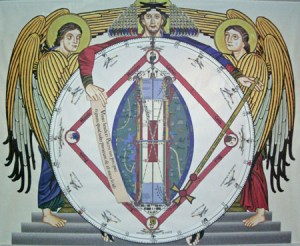
  • “For more advanced readers, Hugh proposed a much more complex, three-dimensional ark — a space-time matrix built within the mind of the student and modeled on Noah’s ark . . . [a] three-dimensional multicolored monster memory scheme.  The man who has best studied Hugh’s writings on the moral and mystical ark has come to the following conclusion:  220 square feet of paper would be needed for a still readable blueprint of Hugh’s ark-model of historical interrelationships.  Twentieth-century medievalists, who in the great majority have never had any training in mnemotechnics, can perhaps imagine a blueprint of Hugh’s ark, but they cannot recapture the experience of having such an ark in their own mind, or ‘be thoroughly at home with this thought and way of imagining.'”  (37-38)

Read here about a recent digital reconstruction of Hugh’s ark by Conrad Rudolph of the University of California and commissioned by the US National Gallery of Art.  Click on the image above for a more detailed representation.

  • “Some rudiments from the history of memory must be recalled to grasp Hugh’s unique place.  What anthropologists distinguish as ‘cultures’ the historian of mental spaces might distinguish as different ‘memories.’  The way to recall, to remember, has a history which is, to some degree, distinct from the history of the substance that is remembered.”  (39)
  • “We sometimes forget that words are creatures of the alphabet.” (39)
  • “In fact, the alphabet is an elegant technology for the visualization of sounds.  Its two dozen shapes trigger the memory of utterances that have been articulated by the mouth, the tongue, or the lips, and filter out what is said by gesture, mime, or the guts.  Unlike other writing systems, it records sounds, not ideas.”  (39)
  • “The one most common method used by the Greeks to achieve this purpose was the mental construction of a memory palace . . . . To become the student of a reputable teacher, the pupil had to prove that he was at home and at ease in some vast architecture that existed only in his mind, and within which he could move at an instant to the spot of his choice.”  (41)
  • “Early on it was found that the most effective way for locating and retrieving memories was that of randomly affixing to each one a mental label from a large set familiar to the student.  For example, to a goat or the sun, a branch or a knife, a sentence was attached for rote memorization.  The author who had thus equipped his palace for a speech or a dispute just moved to the appropriate imaginary room, took in at a glance the object placed on the labels, and had at his fingertips the memorized formulations that — for this particular occasion — he had associated with these emblems.”  (41-42)
  • “The art of memory as a symbolic labeling of memorized speech-acts was created in fourth-century Greece, taught by Sophists and used in politics.  In Rome, at least since Quintilian (35-100), its purpose and technique changed.  It was mainly used by lawyers.  Here memory training stresses the art of internalized reading.  The public speaker learned in late Roman antiquity how to ‘take notes’ in his mind and ‘read them off’ on the right occasion.”  (42)
  • “The rhetorical virtuoso was henceforth the one who could mentally register and label each sentence he intended to use, and promptly recover it from the appropriate architectonic feature in his own inner topology.  Today, in an age dazed by the feats of computers, this skill sounds like an impossible undertaking or freakish acrobatics for some academic circus.  But such memory training was part of the equipment expected by Hugh from the beginner.”  (42)
  • Reminding us that coping with information is not an entirely new challenge:  “By reviving ancient architectural memory training, Hugh hopes to prepare boys born around 1120 to read their way toward wisdom in an age in which the new collections could only too easily have scattered their brains and overwhelmed them.  He offers them a radically intimate technique of ordering this huge heritage in a personally created, inner spime [i.e., space time, taken from Einstein].” (45)
  • “Everything can make sense when it is related to this ordo of time; and noting is meaningful that is not placed by the reader into this ordo.  Hugh’s moral and spiritual Ark of Noah is more than a mnemotechnic palace with biblical features.  The Ark stands for a social entity, a process that begins with creation and continues to the end of time, what Hugh calls ‘the Church.’  The activity which Hugh calls ‘reading’ mediates between this macrocosmic Church and the microcosmos of the reader’s personal intimacy.  Each person, each place, each thing within this spatiotemporal cosmos must first be literally understood.  It then reveals itself as also something else:  as sign for something to come in the future, and as accomplishment of some other thing that, by analogy, has pointed toward its coming.”  (46-47)

“Reading toward Wisdom”

More from Ivan Illich’s In the Vineyard of the Text.  Excerpts from the first chapter, “Reading toward Wisdom” (page numbers in parenthesis).  Previous post in the series:  “In the Vineyard of the Text”.

There is a line, whose source I’ve forgotten, that goes something like, “The past is a foreign country, they do things differently there.”  Reading about the past is then a little like visiting a foreign country.  Such visits can teach us a good deal about ourselves by throwing our own habits and patterns of thought into relief against the backdrop of the past.  To recognize our difference from the other is to see ourselves a little more clearly.

And so Illich is our guide on this particular foray into the past and below are some observations that touch on the end or goal of reading, the relationship between reading/learning and character, and the correlation between new forms of reading and new understandings of the self:

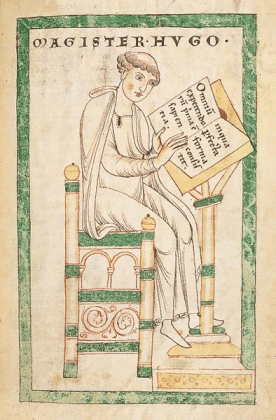
  • Omnium expetendorum prima est sapentia.  ‘Of all things to be sought, the first is wisdom.’  This is how Jerome Taylor translates the lead sentence of the Didascalicon of Hugh of Saint Victor, written around 1128.” (7)
  • “Hugh’s writings are drenched in Augustine.  He lived in a community that followed Augustine’s rule.  He read, reread, and copied the texts of his master.  Reading and writing were for him two almost indistinguishable sides of the same studium.” (9)
  • “As with Augustine, wisdom was for Hugh not something but someone.  Wisdom in the Augustinian tradition is the second person of the Trinity, Christ . . . . The wisdom Hugh seeks is Christ himself.  Learning and, specifically, reading, are both simply forms of a search for Christ the Remedy, Christ the Example and Form which fallen humanity, which has lost it, hopes to recover.  The need of fallen humanity for reunion with wisdom is central to Hugh’s thought.  This makes the concept of remedium, remedy or medicine, crucial for an understanding of Hugh.”  (10)
  • “Hugh, by developing the concept of remedium, provides for the twentieth-century thinker a unique way to address the issue of technique or technology.  Reading, as Hugh perceives and interprets it, is an ontologically remedial technique.  I intend to explore it as such.  I analyze what Hugh has to say about the techniques used in reading in order to explore the role that alphabetic technology played around 1130 in the shaping of these techniques.”  (11)
  • “I am here concerned primarily with ‘alphabetic technology’ which interacts in a unique, epoch-specific way around 1130 with the northwest European symbolic universe, and how changes in world perception in turn facilitated and oriented the choice of technologies.  In taking this approach to the alphabet as a technology I am indebted to Walter Ong, S. J., Orality and Literacy . . .”  (11, footnote 11)
  • “Authorities, in this now obsolete sense, are sentences which created precedents and defined reality . . . The sentence states an obvious truth precisely because it has been disembedded from the discourse of this or that particular author; it had become a free-floating statement.  As such a verbal institution, the auctorias [sentence worthy of repetition] quoted by Hugh became an exemplary testimony to untouchable tradition.”  (13)
  • “. . . the thought of an ultimate goal of all readings is not meaningful to us.  Even less is there any idea that such a goal could motivate or ’cause’ our action whenever we open a book.  We are steeped in the spirit of engineering and think of the trigger as the cause of a process.  We do not think of the heart as the cause of the bullet’s trajectory . . . . Even more thoroughly, the idea of one first or primary Final Cause, one ultimate motivating reason of all desires that are hidden in the nature of the stone or of the plant or of the reader, has become foreign to our century.  ‘End stage’ in the twentieth-century mental universe connotes death.  Entropy is our ultimate destiny. We experience reality as monocausal.  We know only efficient causes. ”  (13-14)
  • “Studies pursued in a twelfth-century cloister challenged the student’s heart and sense even more than his stamina and brains.  Study did not refer to a liminal epoch of life, as it usually does in modern times, when we say that someone ‘is still a student.’  They encompassed the person’s daily and lifelong routine, his social status, and his symbolic function.” (14-15)
  • “The studium legendi forms the whole monk and reading will become perfect as the monk himself strives for, and finally reaches, perfection.

The beginning of discipline is humility . . . and for the reader there are three lessons taught by humility that are particularly important:  First, that he hold no knowledge or writing whatsoever in contempt.  Second, that he not blush to learn from any man.  Third, that when he as attained learning himself, he not look down upon anyone else.”  (15-16)

  • “The reader is one who has made himself into an exile in order to concentrate his entire attention and desire on wisdom, which thus becomes the hoped-for home.” (17)
  • “That which we mean today when, in ordinary conversation, we speak of the ‘self’ or the ‘individual,’ is one of the great discoveries of the twelfth century . . . .  A social reality in which our kind of self is taken for granted constitutes an eccentricity among cultures . . . .  [Hugh] wants the reader to face the page so that  by the light of wisdom he shall discover his self in the mirror of the parchment.  In the page the reader will acknowledge himself not in the way others see him or by the titles or nicknames by which they call him, but by knowing himself by sight.”  (22-23)
  • “With the spirit of self-definition, estrangement acquires a new positive meaning.  Hugh’s call away from the ‘sweetness of one’s native soil’ and to a journey of self-discovery is but one instance of the new ethos . . . . [that] addresses people at all levels of the feudal hierarchy to leave the common mind-set of the neighborhood, within which identity comes from the way others have named me and treat me, and to discover their selves in the loneliness of the long road . . . . Hugh’s insistence on the need that the scholar be an exile-in-spirit echoes this mood.”  (23)
  • “I am not suggesting that the ‘modern self’ is born in the twelfth century, nor that the self which here emerges does not have a long ancestry.  We today think of each other as people with frontiers.  Our personalities are as detached from each other as are our bodies.  Existence in an inner distance from the community, which the pilgrim who set out to Santiago or the pupil who studied the Didascalicon had to discover on their own, is for us a social reality, something so obvious that we would not think of wishing it away.  We were born into a world of exiles . . . . This existential frontier is of the essence for a person who wants to fit into our kind of world.  Once it has shaped a child’s mental topology, that being will forever be a foreigner in all ‘worlds’ except those integrated by exiles like himself.”
  • “What I want to stress here is a special correspondence between the emergence of selfhood understood as a person and the emergence of ‘the’ text from the page.  Hugh directs his reader to a foreign land.  But he does not ask him to leave his family and accustomed landscape to move on the road from place toward Jerusalem or Santiago.  Rather he demands that he exile himself to start on a pilgrimage that leads through the pages of a book.  He speaks of the Ultimate which should attract the pilgrim, not as the celestial city for pilgrims of the staff, but as the form of Supreme Goodness which motivates the pilgrims of the pen.  He points out that on this road the reader is on his way into the light which will reveal his own self to him.”

Jacques Lacan, Jansenist?

If I imagine a Venn diagram consisting of one circle representing those interested in Jacques Lacan (a modest circle), and another representing those who read this blog (a rather tiny circle), then the overlapping area probably includes one person … if I count myself.  Nonetheless, I’ll post this anyway.

In conversation with a friend I was made aware of an article that contains this intriguing anecdote (if you’re in that overlapping area in the Venn diagram):

Jan Miel was, he says, the first to propose translating a text of Lacan’s into English and as a result had been invited to lunch in his country house in Guirrancourt, not far from Paris.  After the meal during a stroll in the garden Lacan turned to him and said:  ‘You are neither an analyst nor an analysand, so why are you interested in my teaching?’.  Miel found it difficult to answer because, he admits, he really did not know what he found so fascinating in Lacan’s work, so he eventually stammered:  ‘Well, my main interest is in Pascal.’  To which Lacan replied, ‘Ah, I understand’ and led him back to his library where he showed him a quite substantial collection of Jansenist books.  So if reading Lacan leads to Pascal, it appears that reading Pascal may also lead to Lacan.

“Ah, I understand” — loved that, and wondered how many times those same words were uttered in a Lacan seminar!

The article goes on to explore the use Lacan makes of Pascal’s Wager and presents some helpful background material on the Wager.  Be warned though, some math is involved.