Body and Soul

From Alasdair MacIntyre’s Dependent Rational Animals. Speaking of Aristotle’s many commentators:

“They have underestimated the importance of the fact that our bodies are animal bodies with the identity and continuities of animal bodies. Other commentators have understood this. And it was his reading not only of Aristotle, but also of Ibn Rushd’s commentary that led Aquinas to assert: ‘Since the soul is part of the body of a human being, the soul is not the whole human being and my soul is not I” (Commentary on Paul’s First Letter to the Corinthians XV, 1, 11; note also that Aquinas, unlike most moderns, often refers to nonhuman animas as ‘other animals’). This is a lesson that those of us who identify ourselves as contemporary Aristotelians may need to relearn, perhaps from those phenomenological investigations that enabled Merleau-Ponty also to conclude that I am my body.”

This passage struck me for two reasons. The first is the host of assumptions that are challenged by that one line from Aquinas. That line alone troubles all sorts of commonly held misconceptions regarding the theological anthropology of the medieval Christian tradition. Misconceptions held both by those inside and outside of the tradition.

The second, of course, is MacIntyre’s recommendation of Merleau-Ponty and his investigations of the body’s role in structuring experience. Seconded.

Creatures of Technological Habit

Sometimes the most obvious realities are those that slip just below our awareness of things, blending into the background of lived experience, surreptitiously shaping and forming our assumptions, intentions, and actions. These realities are in a sense too big to notice, or better, too pervasive to notice. Their very ordinariness renders them ordinarily invisible.

When we think and talk about technology, particularly digital technologies or the Internet, we tend not to think very much about our bodies. In fact, digital technologies have inspired dreams (or, nightmares) of disembodied existence and uploaded consciousness. Even if we are not quite entertaining the possibility of digital immortality, we do tend to talk about digital technology in language that obscures the body’s presence. The Cloud, the Information Age, virtual reality — each of these terms, and others beside, suggest something ethereal and abstract. In any case, they certainly do not invite us to notice the role our bodies may play in the digital order of things.

The scholars associated with the website Cyborgology have coined the phrase digital dualism to describe the tendency to abstract the virtual world of bits and data from the “real” world of atoms and stuff when we talk and think about the Internet. I’m sympathetic to their critique of digital dualism. There are different kinds of realities at play, each with their own distinguishing characteristics, but one is not less real than the other and each affects the other in very real ways. Simply put, there is only one reality with digital and material dimensions always informing one another.

But dualisms can be hard to overcome. We like to think in oppositional pairs or binaries. Interestingly, like many of our habits of thought, this may in part be linked to our experience of moving about as bodies in physical space. The world presents itself to us as either here or there, near or far, up or down. As we move about, we are faced with a choice between left and right, backward and forward. And so it may be that digital dualism is built upon a much earlier and more venerable dualism — the old fashioned mind/body variety usually associated with Descartes.

But, consider the following for a moment:

When we update our status on Facebook, we are doing something with our body.

When we send out a tweet, we are doing something with our body.

When we take a picture with our phones, we are doing something with our body.

When we enter and send a text, we are doing something with our body.

When we search the Internet, we are doing something with our body.

And on and on it goes. Our bodies are the one intractable fact that we cannot escape. The body is the ground of being. And I say this while not adhering to philosophical materialism. We may be more than our bodies, but we are certainly not less than our bodies. But we really need not get caught up in metaphysical debates here. What I’m talking about is tangible, not unlike Samuel Johnson’s stone.

Dancers, athletes, craftsmen, and members of liturgical religious communities have an intuitive grasp of the body’s often unnoticed but pervasive influence on the conduct of our everyday lives. Let me illustrate with a personal anecdote or two from the realm of athletics.

A few days ago, when I was getting ready to go running I asked my wife to toss me a shoe that was just out of reach. She did, and without thinking about it, as the shoe was coming toward me, I “trapped” it with my foot using the same gesture I would’ve used to trap a soccer ball. Now it has been a very long time since I’ve played soccer, but that gesture materialized without any conscious thought on my part. It was instinctively activated from a repertoire of possible techniques that my body knew and deployed without my conscious reflection. It became a part of this repertoire by being repeated until it became habitual.

When I played baseball I was a catcher. To this day, some years since I’ve actually caught a game, if I crouch I can feel all sorts of latent bodily “I-cans” coiling up. I can feel the movements of the arm and wrist used to receive a pitch. I can feel exactly what to do if a ball comes in the dirt or if runner breaks for second. These movements are inscribed in me as a form of bodily, non-theoretical know-how. I am told that the experience of professional dancers is similar as is that of craftsmen who have honed an intuitive feel for their work in whatever their medium of specialization. The craftsmen is an especially apt example for our purposes for the way in which tools are implicated in the craftsman’s bodily skill. Finally, consider also the religious believer shaped by a liturgy. For example, the Catholic who crosses themselves reflexively at appropriate moments.

All of this reflects what Henri Bergson called “habit memory.” The temptation may be to minimize this form of memory when compared to our explicit memory of people, events, images, etc. But, returning to my example above, I remember less and less of my soccer games in that sense, while I will never forget how to trap a soccer ball (even if my ability to actually do so wanes significantly over time).

Our ordinary experience in the world is constantly mediated by this kind of embodied, not quite conscious “know-how.” The preeminent philosopher of the body, Merleau-Ponty, called it coping. Hubert Dreyfus, building on Merleau-Ponty, has called it “intelligence without representation.” It is the way in which we are constantly and non-consciously fine-tuning our movements and actions so as to find the best “grip” on reality as we experience it.

Charles Taylor offers this illustration of Merleau-Ponty’s notion of coping, or how we make our way about the world:

“Living with things involves a certain kind of understanding, which we might also call ‘pre-understanding.’ That is, things figure for us in their meaning or relevance for our purposes, desires, activities. As I navigate my way along the path up the hill, my mind totally absorbed anticipating the difficult conversation I’m going to have at my destination, I treat the different features of the terrain as obstacles, supports, openings, invitations to tread more warily or run freely, and so on. Even when I’m not thinking of them, these things have those relevances for me; I know my way about among them.”

The best way to become aware of this dimension of our experience is to think about the moments when it breaks down. My favorite example of this is the Empty Milk Jug Effect. When you pick up an empty milk jug that you think is full, you’re caught off guard; you experience a palpable rupture between non-conscious, embodied judgments and the feedback flowing back through the embodied instantiation of those judgments. The point is that without consciously thinking about it, your body had adjusted itself to find “optimal grip” based on habit memory and when those adjustments proved inadequate you get that sudden sensation of applying way too much force. But what we need to consider is how infrequently this happens. Most of the time our bodies, the world, and our non-conscious thought processes are more or less in sync.

One more example to bring it closer to the realm of digital technology. Since I’ve become habituated to the use of my MacBook, I have an odd experience every once and awhile. Perhaps it’s just me, but I’m willing to bet it’s not. When opening a new window or tab I often begin scrolling with my fingers on the track pad simultaneously with the loading of the page. There are times, however, when there is a slight delay in the opening of the page and I experience a momentary visual disorientation as my eyes move to track with a page that isn’t moving as it should given my habit memory associated with my fingers scrolling on the track pad.

Now at one level this may seem insignificant, but it functions like the tip of an iceberg. It’s a momentary awareness of an immense but ordinarily veiled reality that structures the whole of our experience. (I could be talked down from the scope of that last statement, but I’ll let it stand for now.)

Taylor added that “our grasp of things is not something that is in us, over against the world; it lies in the way we are in contact with the world.” And this brings us to the point: we are in contact with the world through our tools. Our tools, our bodies, our brains, and the world form a circuit of pre-understanding, perception, thinking, and action. A large portion of this circuit is composed of non-conscious habit-memory, and some of that habit-memory is formed through our technologically mediated engagement with the world. The way we use our tools can form habits that sink below the level of consciousness and thereby become part of the pre-understanging through which we navigate experience. And this happens because we use our technologies with our bodies and repeated bodily actions turn into our habit-memory.

We casually (with a nervous laughter) speak of being addicted to the Internet or to Facebook or of panicking when we forget our cell phones. We feel a certain compulsion, but we tend to psychologize this compulsion, that is we render it a mental or emotion disposition. And so it may be, in part. But the compulsions of technology may be less in the mind than in the body. Or better yet, they are anchored in the mind through the body.

Moreover, because our technologies enter into the circuit comprising our engagement with the world, they change the nature of our experience. As we navigate the world, our pre-understanding does not merely recognize objects in themselves within our field of experience. Rather, we perceive objects as they are for-us and how they figure in whatever activity we are engaged in. Our tools then shape how things and experiences appear to be for-us. Having hammer in hand changes how things present themselves; it opens up new possibilities for action that were not present before. For the person with a smartphone, their grasp of things lies in all of the ways the smartphone enables contact with the world. Repeated, embodied activation of these possibilities form habit memories that are then sedimented into the pre-understandings we bring to bear upon experience.

We have formed countless habit memories with our digital technologies, especially as they have become increasingly portable and handheld. We instinctively relate to the world through the capacities and capabilities that we have learned through the embodied use of our tools.

______________________________________________________________

Two related posts:

Technology, Habit, and Being in the World 

Technology Use and the Body
Facebook as Rear Window: What Hitchcock and Gadamer Can Teach Us About Online Profiles

In Hitchcock’s 1954 classic, Rear Window, Jimmy Stewart plays a photojournalist named Jeff who is laid up with a broken leg and passes his time observing his neighbors through his apartment’s rear window. The window looks out on a courtyard onto which the rear windows of all the other apartments in the building also open up. It’s a multiscreen gallery for Stewart’s character who reclines in the shadows and becomes engrossed in the lives of his neighbors – the attractive dancer, the lonely woman, the young pianist, the newlyweds, and, most significantly, the unhappy married couple. Increasingly playing the part of the obsessive voyeur, he becomes convinced the disgruntled husband murdered his wife. The film’s plot is driven by Jeff’s determination to prove the man’s guilt.

The film came to my attention again when I received a link to the clip below, which impressively and artfully splices all of the scenes depicting what Jeff sees out of his window. [Update: The video is no longer available.] Serendipitously, I watched the clip not long after reading some comments on Hans-Georg Gadamer’s hermeneutical aesthetics developed in Truth and Method. Naturally, I then thought of Facebook … as one does after watching Hitchcock and reading Gadamer.

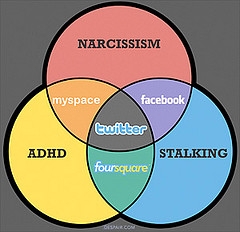
Let’s start with Hitchcock. Like the windows in Hitchcock’s film, Facebook profiles offer an opening into a life and one through which others can observe without the observed knowing it. This is classic Facebook behavior. The platform has always abetted and elicited stalker-ish activity from users. This is why one of the most popular of the many spam links that circulate on the social network purports to reveal who has been looking at your profile. If ever such a capability were enabled it would likely lead to a massive reduction in page views for Facebook.

Like Jeff’s character, Facebook users look through the profiles-as-windows at the lives of their virtual neighbors. And as with Jeff, it may begin in a relatively innocent curiosity born of boredom, or it may veer into the obsessive. There is, of course, one glaring difference between the rear windows and Facebook profiles: Stewart’s neighbors were presumably unaware that they were being watched. Facebook users are not only aware they are being watched – they are counting on it.

On Facebook we’re all flâneurs, simultaneously watching and being watched. But we don’t exactly know who is doing the watching and how much watching they’re doing or to what end. The uncanny moment in Rear Window comes when the watcher becomes the watched. Needless to say, such a moment would be equally uncanny where it to unfold online. Yet it is enough that we know we are being watched in general. This alone renders the profile something other than a representation of our life. It becomes itself a presentation. And that is were Gadamer first comes in.

As he develops his hermeneutical aesthetics, Gadamer challenges the representational view of the work of art that understands the work of art as a mere re-presentation of some real thing. On this view, whatever meaning the work of art holds is derivative of the thing it re-presents. Against this view, Gadamer contends that the appearing of the work of art before the participant (for the one who takes in a work of art is never merely a passive observer) constitutes an “event of being.” Meaning inheres in the work of art in itself. It is a presentation, not a re-presentation.

Now think again about a Facebook profile. It may be tempting to understand a profile as a representation of a life or of a personality whose meaning derives from the lived experience of the user who creates the profile. But is this entirely true? It is certainly the case that the online profile is, in a certain sense, grounded in the offline experience of the user. Also, we would do well to resist a digital dualism that abstracts the “real,” offline experience from “virtual,” online experience. Offline and online experience impinge upon one another; it would be misleading to compartmentalize the two.

Yet, there are multiple ways of construing the nature of their enmeshment. One way of resisting digital dualism is to note how the possibility of self-documentation asserts itself in lived experience. I’ve discussed this here on more than a few occasions and Nathan Jurgenson’s notion of “Facebook Eye” captures this dynamic neatly. On this view online profiles impinge upon offline experience by reordering our conscious intentionality – to the person with a social media profile, experience becomes a field of potential self-documentation to be publicized through social media. To the person with a hammer, everything looks like a nail. To the person with a Facebook profile, everything looks like a potential status update. Or alternatively, to the person with a Facebook profile, the question is always “How many ‘likes’ will this get?” But Gadamer offers another complimentary construal.

It begins by noting the presentational character of the online profile. It is not a mere copy of the original life; in its appearing before a profile viewer, it appears on its own terms. It’s meaning is not merely derived from the manner in which it copies life, rather it emerges out of the dynamics of the life as it is presented in the profile. And here is why, as I see it, this does not constitute a digital dualism. Gadamer’s discussion of the work of art as an “event of being” includes what Peter Leithart has called “retroactive ontological consequences” for the thing it refers to in the “real” world.

Leithart interprets Gadamer by reference to landscape painting. When a landscape is painted by Constable, its character has been altered, it is now a “landscape-that-inspires-painting.” When person maintains an online profile, they are now a person-with-a-profile. The landscape painting, Leithart continues, is an “event of being” because it is “an enhancement of the thing itself.” Likewise the online profile, although perhaps enhancement is not necessarily the best word to use here. Moreover Leithart concludes, “every encounter with the real landscape involves a moment of interpretation that is a ‘performance’ of the thing, and after Constable (even for many who are not directly aware of Constable) the interpretive performance is inflected by Constable’s work …” Translated: every encounter with a person-with-a-profile invites acts of interpretation that are inflected by Facebook. Now back to Rear Window to illustrate.

In the film, the windows presented a slice of a life. What Jeff saw was not something other than the lived experience of the people he watched, but the windows did the work of constituting those slices of their lives as something in themselves for Jeff inviting interpretation, not unlike the way a profile presents itself as something in itself for the viewer also inviting the viewer into a work of interpretation. And as we noted, via Gadamer, as a thing in itself the window-as-presentation gives off meaning that has retroactive ontological consequences. If Jeff were to meet any of the people he watched outside of their apartments, his interactions with them would be contoured by his interpretations of their fenestrated (when would I ever have another chance of using that word) presentations.

Likewise, when Facebook users encounter one another offline, their mutual interpretations of one another are loaded with whatever interpretations their profiles have already invited.

Now one final thought. Our presentations always produce more meaning than we intend. This is another way of saying that we are not entirely in control, despite our best efforts, of the manner in which our profile presentations are interpreted. Because they are always partial re-presentations (insofar as they are alluding back to lived experience), our profiles hide while they reveal and thus invite or even demand acts of creative interpretation. These interpretative surpluses, for better or worse, are those that are then brought to bear on our face-to-face encounters.

___________________________________________

An expanded and revised version of this post appeared at The Medias Res.

Agency and Embodiment

If you’ve been following this blog over the last few months, you may justly be wondering if there is any unifying thread to what I post. The answer is: sort of. Clearly the vast majority involves “technology” in the broadest sense, but I would say that there are a few more specific unifying threads (in my mind at least). One of those threads will (hopefully) tie together the posts on embodiment, place, and the worlds’ fairs. How neatly I’m able to tie that thread remains to be seen.

My reading of Carrie Noland’s Agency and Embodiment contributes to this particular thread and I’ll be posting a few excerpts with minimal comment in the coming days (tumblr style). In this post, I’m picking out some portions from the Introduction that will give you a feel for her project and the approach she takes to it. I’m particularly sympathetic to the manner in which she forges a third way through certain perennially intractable oppositions.

One last note before the excerpts. There is also significant rhetorical variety among the sources that I cite on this blog. They range from straightforward, clear journalistic prose to more obscure, academic theoretical writing. Noland’s text veers toward the latter, but for someone dealing with theory in the French phenomenological tradition, she writes with surprising clarity. That said, this will not be everyone’s cup of tea, of course.

Here’s Noland’s statement of her thesis:

“If bodily motility is, as Henri Bergson once claimed, the single most important filtering device in the subject’s negotiations with the external world, then a theory of agency that places movement center stage is essential to understanding how human beings are embodied within — and impress themselves on — their worlds.

The hypothesis I advance in this book is that kinesthetic experience, produced by acts of embodied gesturing, places pressure on the conditioning a body receives, encouraging variations in performance that account for larger innovations in cultural practice that cannot otherwise be explained.”

She adds:

“In these pages I will speak of ‘variations in performance’ and not only instances of ‘resistance,’ in order to avoid the agonistic overtones of Michel Foucault’s highly influential but largely binary account of power, which reduces the field of cultural practices to techniques of ‘strict subjection.'”

In other words, the experience of having, or perhaps better, being a body creates the conditions for the possibility of agency within the fields that operate to constrain and form our subjectivity.

More from Noland:

“Kinesthetic sensations are a particular kind of affect belonging both to the body that precedes our subjectivity (narrowly construed) and the contingent, cumulative subjectivity our body allows us to build over time. Because these sensations are also preserved as memories, they help constitute the ’embodied history of the subject,’ a history stored in gestural ‘I can’s’ that determines in large part how that embodiment will continue to unfold. Kinesthesia allows us to correct recursively, refine, and experiment with the practices we have learned. The knowledge obtained through kinesthesia is thus constitutive of — not tangential to — the process of individuation.”

Displacement and Nostalgia

Another tumblr-style post with excerpts from Casey’s Getting Back Into Place:

“… each of us is caught in the toils of displacement. As moderns and postmoderns in the Eurocentric West, we too are displaced persons … and inescapably so.”

The symptoms of this displacement, Casey claims, are “disruptive and destructive”:

“Among these symptoms, nostalgia is one of the most revealing. At the moment, our own culture suffers from acute nostalgia. Proust, living on the edge between the modern and the postmodern periods, described the drama of an entire life delivered over to nostalgia. But we do not need to turn to literature for evidence of the pervasive presence of nostalgia; we witness its cinematic expression in certain of Woody Allen’s films and its commercial exploitation in Disney World.”

This was, of course, before Midnight in Paris.

In Casey’s view, our displacement is in part a function of a faulty conceptualization. The triumph of abstraction over the particular:

“… the placeless is the thoughtless; and if we fail to honor and remember places, this is a direct reflection of our unthinking and increasingly ill condition. Another telling sign is the fact that ‘for the modern self, all places are essentially the same: in the uniform, homogeneous space of a Euclidean-Newtonian grid, all places are essentially interchangeable. Our places, even our places for homes, are defined by objective measures.'”

“The uniformity of space and the equability of time have replaced, or more exactly displaced, the priority of place. If nostalgia is a characteristically modern malaise, this may be due to its covert recognition that a time once existed when place was ‘the first of all things,’ when time and space in their modern (dis)guises were not yet fatally at work. For in the pathos of nostalgia, ‘space and time [are] not yet separable concepts, [they are] scarcely concepts at all.’ But in the modern era we have accepted and incorporated space and time in their objectivity and (in)difference … We calculate, and move at rapid speeds, in time and space. But we do not live in these abstract parameters; instead, we displaced in them and by them.”

For related musings see Fatal Nostalgia and Generalized Anxiety.