The New New (Actually Old, Pascalian) Atheists

So I thought this was interesting. In a discussion of the New New Atheists (no, that wasn’t a typo) in Harper’s, Christopher Beha cites Alex Rosenberg, a philosopher at Duke, who “insists that doing away with religion means doing away with most of what comes with it: a sense of order in the universe, the hope that life has some inherent meaning, even the belief in free will.”
Now, is it just me or wasn’t that kind of Nietzsche’s whole point some hundred and twenty or so years ago? So at least one of the New New Atheists is actually just like the Old Atheists. In any case, I appreciate the consistency.

Of course, this is a gloomy picture and Rosenberg acknowledges that it can create a certain angst in some:  “There is . . . in us all the hankering for a satisfactory narrative to make ‘life, the universe and everything’ (in Douglas Adams’s words) hang together in a meaningful way. When people disbelieve in God and see no alternative, they often find themselves wishing they could believe, since now they have an itch and no way to scratch it.”

So Beha asks Rosenberg what can be done about this. Response:

“Rosenberg’s answer in his book is basically to ignore it. The modern world offers lots of help in this effort. To begin with, there are pharmaceuticals; Rosenberg strongly encourages those depressed by the emptiness of the Godless world to avail themselves of mood-altering drugs. Then there are the pleasures of acquisitive consumer culture—the making of money and the getting of things.”

Well, at least this is honest — and oddly Pascalian in an inverted sort of way.

Knowledge, Love, and Criticism

What does the critic love? I keep asking this because I keep getting stimulating feedback. In one instance it was suggested that the critic loves knowledge; in another, soul-searching. There is, no doubt, something to both, and, in fact, to both together. The critic is definitely driven to know and to understand. That much seems clear. And it is certainly true that knowledge in itself can be remarkably rewarding. I’m not sure that I would defend it to the death, but there is something that resonates with me in Housman’s line, “All human knowledge is precious whether or not it serves the slightest human use.” For some critics, then, the answer may be as simple as this, the love of knowledge or the love of knowing.

But those last two phrases are not quite synonymous are they (… I ask the audience that cannot hear me as I type the question)? The love of knowledge and the love of knowing — the former loves the object, the latter loves the state of possessing the object. Consider it the difference between the person who loves to contemplate the work of art, and the one who loves to point guests to the work of art on their wall. The love of knowledge would seem less instrumental, more disinterested. The love of knowing suggests to me the spirit of the pedant. That said, I believe both are recognizable dispositions and we know the difference when we encounter each case.

Setting aside the pedant, I’d readily grant that love of knowledge drives the critic. But more distinctions: what does love of knowledge for the music critic, to take one example, mean? It probably does not only mean loving knowledge about the music. Surely, it involves knowledge as a form of intimate participation with the music. (Save the Leslie Nielsen/Airplane crack.) The love of knowledge is multifaceted, it’s not simply a matter of loving information. This holds, I suspect, for critics not only of music, but also of art, literature, food, film, etc. In each of these cases, the knowledge the critic loves is in part experiential. I’m tempted to say that it is finally not a love of knowledge as we normally think of knowledge, but a love of the thing itself. The critic accumulates knowledge about the object of criticism in order to heighten and deepen the experience of the object.

But all of these instances of criticism strike me as something apart from what we might call social or cultural criticism. The critic who takes society or aspects of society as their object of criticism may also be motivated by a love of knowledge, but of what sort? The knowledge the social critic cultivates seems different than the knowledge cultivated by the music critic. It seems to lack the element of contemplative participation that music or an object of art invite. Perhaps, it is better to say that the knowledge of the social critic does not culminate in an act of contemplation.

With that last phrase I think I’ve brought into view the distinction I was struggling to articulate. For the critic of art, the accumulation of knowledge culminates in an act of contemplation. That is, it has as its goal the enjoyment of beauty. The social critic’s knowledge does not culminate in anything comparable. The culmination of the social critic’s work would seem to be action not contemplation, transformation rather than participation. Perhaps we might say that the social critic aims at goodness enacted while the artistic critic aims at beauty contemplated, and the pursuit of truth is undertaken in the service of both aims.

But there is one more consideration that may draw these two forms of criticism together. Perhaps we might also say that the critic is driven by love of self. There are two ways of construing this that track with the distinction above. The critic might be driven by self-love in the sense that they love nothing more than to see their own values and desires reflected by society. This critic loves nothing so much as their image reflected back to them. Whatever does this is praised, whatever does not is held in contempt. This critic pursues knowledge with contemplation as its aim and it is the contemplation of their own image.

Self-love, however, may also drive the critic who seeks not to contemplate their own image, but to transform themselves, to move toward some higher ideal. In this case, we may speak of a self-love that is animated by the love of something greater than the self and that loves the self in the sense of wanting what is best for the self in light of this higher ideal. Their criticism is aimed at self-knowledge for the sake of self-transformation. Their criticism is, in fact, an act of soul-searching.

What’s Really At Stake When We Debate Technology

What does the critic love? More specifically, what does the critic of technology love? This question presented itself to me while I was thinking about some comments left on a recent post. The comment questioned whether mourning or celebrating technology was proper to the role of the critic. Naturally, I wrote about it. It was, as is often the case, an exercise in clarifying my thoughts through writing.

I’ve thought some more about the work of technology criticism today, and again it was thanks to some online interactions. Let me put these before you and then offer a few more thoughts on the matter.

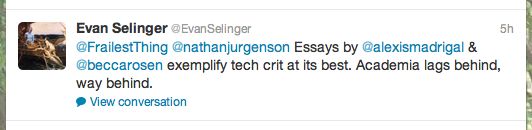
Evan Selinger tweeted the following:

And then:

Selinger, whose doctoral work was advised by Don Idhe, echoes Ihde who wrote:

“… I would say the science critic would have to be a well-informed, indeed much better than simply well-informed amateur, in its sense as a ‘lover’ of the subject matter, and yet not the total insider …  Just as we are probably worst at our own self-criticism, that move just away from self-identity is needed to position the critical stance. Something broader, something more interdisciplinary, something more ‘distant’ is needed for criticism.”

Later on, Nathan Jurgenson made the following comment during an exchange about his recent essay:

“while it is technically true there has been a “loss” of sorts, i think it might be better to say at this juncture there has been a “change”; a change in how our reality has been augmented over time via various information technologies.”

I replied:

“Change” is certainly a more value-neutral way of putting it than “loss,” and depending on rhetorical context it certainly has its strengths. Sorting better and worse, of course, entails a normative framework of some sort, etc.

All of this began coalescing in my mind and what follows are some of the conclusions that emerged. Of course, I’m not claiming that these conclusions are necessarily entailed by the comments of others above. As the “Acknowledgements” in books always put it: I’m indebted to these, but any errors of fact or judgment are mine.

There is a reason why, as Selinger and Ihde put it, each in their own way, the critic must be something of an outsider. Criticism of technology, if it moves beyond something like mere description and analysis, implies making what amount to moral and ethical judgments. The critic of technology, if they reach conclusions about the consequences of technology for the lives of individual persons and the lives of institutions and communities, will be doing work that necessarily carries ethical implications.

In this they are not altogether unlike the music critic or the literary critic who is excepted to make judgments about the merits of a work art given the established standards of their field. These standards take shape within an established and institutionalized tradition of criticism. Likewise, the critic of technology — if they move beyond questions such as “Does this technology work?” or “How does this technology work?” to questions such as “What are the social consequences of this technology?” — is implicated in judgments of value and worth. Judgments, it might be argued, of greater consequence than those of the art or literary critic.

But according to what standards and from within which tradition? Not the standards of “technology,” if such could even be delineated, because these would merely be matters of efficiency and functionality (although even these are not exactly “value neutral”). It was, for example, a refusal to evaluate technology on its own terms that characterized the vigorous critical work of the late Jacques Ellul. As Ellul saw it, technology had achieved its nearly autonomous position in society because it was shielded from substantive criticism — criticism, that is, which refused to evaluate technology by its own standards. The critic of technology, then, proceeds with an evaluative framework that is independent of the logic of “technoscience,” as Ihde called it, and so they becomes an outsider to the field.

The libertarian critic, the Marxist critic, the Roman Catholic critic, the posthumanist critic, and so on — each advances their criticism of technology from the perspective of their ethical commitments. Their criticism of technology flows from their loves. Each criticizes technology according to the larger moral and ethical framework implied by the movements, philosophies, and institutions that have shaped their identity. And, of course, so it must be. There is no avoiding this, and there is nothing particularly undesirable about this state of affairs. It is true that prior to reaching conclusions about the moral and ethical consequences of technology, careful and patient work needs to be done to understand technology. But I suspect this work of understanding, particularly because it can be arduous, is typically driven by some deeper commitment that lends urgency and passion to the critic’s work.

Such commitments are often veiled for the sake of appearing appropriately objective and neutral within certain rhetorical contexts that demand as much, the academy for example.  But I suspect that there are times when debates about the merits of technology would be advanced if the participants would acknowledge the tacit ethical frameworks that underlie the positions being staked out. And this is because, In such cases, the technology in question is only a proxy for something else — the object of the critic’s love.

Don Ihde on Technology’s Resistance to Criticism

“Why Not Science Critics?”, philosopher Don Ihde’s essay that was brought to my attention by a reader’s comment on a previous post, offers some interesting insights into the challenges faced by critics of what Ihde calls technoscience. Take a look at whole thing, but here are a few notable excerpts.

Ihde takes as his point of departure observations by Langdon Winner on the resistance of technology to criticism:

“Writers who venture beyond the most ordinary conceptions of tools and uses, writers who investigate ways in which technical forms are implicated in the basic patterns and problems of our culture are met with the charge that they are merely “antitechnology” [or “antiscience”] or “blaming [technoscience]”. All who have stepped forward as critics in this field–Lewis Mumford, Paul Goodman, Jacques Ellul, Ivan Illich, and others–have been tarred with the same brush, an expression of a desire to stop the dialogue rather than expand it. (Winner, Paths of Technopolis, p.3)”

Ihde adds the following on the knee-jerk charge of Luddism (remember the Borg Complex!):

“The contrast between art and literary criticism and what I shall call ‘technoscience criticism’ is marked. Few would call art or literary critics “anti-art” or “anti-literature” in the working out, however critically, of their products. And while it may indeed be true that given works of art or given texts are excoriated, demeaned, or severely dealt with, one does not usually think of the critic as generically “anti-art” or “anti-literature.” Rather, it is precisely because the critic is passionate about his or her subject matter that he or she becomes a ‘critic …. The critic–as I shall show below–is either regarded as an outsider, or if the criticism arises from the inside, is soon made to be a quasi-outsider.”

Among the reasons for this resistance to criticism, Ihde cites the historical emergence of technoscience as an alternative to religion, really as an alternative religion:

“The most obvious barrier to the formation of an institutionalized technoscience criticism lies in the role of late modern technoscience itself. Technoscience, as institution, began in early modernity by casting itself as the ‘other’ of religion. Its mythologies, drawn from Classical pre-Christian and often materialist (Democritean/Epicurean) sources; its anti-authoritarianism, including the Galilean claim to have exceeded the Scriptures and Church Father’s insights by replacing these with the new sighting possible through his telescope; and the much stronger later anti-religiousity of the Enlightenment which cast religion as ‘superstition’ and science as ‘rationality,’ all led to the Modernist substitution of what I am calling technoscience for religion. 
In the process, science–whether advertently or inadvertently–itself took on a quasi-theological characteristic. To be critical of the new ‘true faith’ was to be, in effect, ‘heretical’ now called ‘irrational.'”

Finally, I’ll throw in Ihde’s discussion of whistleblowers in the scientific community, which challenges the popular image of scientific objectivity:

“The second instance is one which begins with the critic as in insider, a “whistle blower” example: I suspect everyone here remembers the news coverage of the l99l “Gulf War.” It was a trial run on one of our “Star Wars” developments, the anti-missile missile, the “Patriot.” The newsbroadcasts showed over and over again the presumed ‘interceptions’ and claimed hits up to 95% effectiveness. If, then, you followed the more critical analyses to follow, you will probably recall that there was an admission that effectiveness or ‘hits’ declined to about 24%. Part of this admission was due to the early-on analysis performed by Theodore Postal, a ballistics expert and MIT scientist who took news videotapes used to make the hit claims and subjected them to magnified, enhanced, and computer image techniques which on closer inspection showed that claimed hits were not hits at all. Eventually, he concluded that there may not have been a single, verifiable hit which had been made by a Patriot! Needless to say, this claim was not appreciated by Raytheon, the manufacturer of the missile, nor by his colleague, Shaoul Ezekiel, who had advised Raython, and eventually not even by MIT itself which got caught in the cross-fire of claims and anti-claims. 
The battle turned nasty: Raytheon implied that Postal had actually doctored the tapes, but later reduced this to the claim, suggested by Ezekiel, that the grain structure and imaging of video tapes was simply too gross to draw the conclusions drawn. The battle continues to this day, particularly between Postol and Exekiel concerning ethical conduct, with MIT trying to shy away due to the large amounts it gets annual from Raytheon. (see Science, 23 February l996, pp. l050-l052). 
Nor is this some isolated instance. In a study of the “costs of whistle blowing’ Science (5 January l996, p. 35) reports that more than two thirds of whistle blowers (within science as an institution) experience negative effects ranging from ‘ostracism’ through ‘pressure to drop allegations,’ to the actual non-renewals or losses of jobs. The long drawn out ‘David Baltimore’ case is another of these scenarios, in which the whistle blower–not the offender who faked the notebooks–was fired. The insider critic is isolated and, if possible, often separated and thus made into an outsider or ‘other.’ 
While the above scenario would not be much different for business corporations, neither would we be surprised about this ostracization from the corporate sector within business, but for the popular image of science as being more like a Church in the claims about critical concern for truth, this may come as a surprise, although not for those of us close enough to realize that science-as-institution is today much more like the corporate world than it is a church!”

In Search of the Real

While advancing age is no guarantee of advancing self-knowledge, I have found that growing up a bit can be enlightening. Looking back, it now seems pretty clear to me that I have always been temperamentally Arcadian – and I’m grateful to W. H. Auden for helping me come to this self-diagnosis. In the late 1940s, Auden wrote an essay distinguishing the Arcadian and Utopian personalities. The former looks instinctively to the past for truth, goodness, and beauty; the latter searches for those same things in the unrealized future.

Along with Auden, but in much less distinguished fashion, I am an Arcadian; there is little use denying it. When I was on the cusp of adolescence, I distinctly recall lamenting with my cousin the passing of what we called the “good old days.” Believe it; it is sadly true. The “good old days” incidentally were the summer vacations we enjoyed not more than two or three years earlier. If I am not careful, I risk writing the grocery list elegiacally. I believe, in fact, that my first word was a sigh. This last is not true, alas, but it would not have been out of character.

So you can see that this presents a problem of sorts for someone who writes about technology. The temptation to criticize is ever present and often difficult to resist. With so many Utopians about, one can hardly be blamed. In truth, though, there are plenty of Arcadians about as well. The Arcadian is the critic of technology, the one whose first instinct is to mourn what is lost rather than celebrate what is gained. It is with this crowd that I instinctively run. They are my kindred spirits.

But Auden knew enough to turn his critical powers upon his own Arcadianism. As Alan Jacobs put it in his Introduction to Auden’s “The Age of Anxiety,” “Arcadianism may have contributed much to Auden’s mirror, but he knew that it had its own way of warping reflections.” And so do I, at least in my better moments.

I acknowledge my Arcadianism by way of self-disclosure leading into a discussion of Nathan Jurgenson’s provocative essay in The New Inquiry, “The IRL Fetish.” IRL here stands for “in real life,” offline experience as opposed to the online or virtual, and Jurgenson takes aim at those who fetishize offline experience. I can’t be certain if he had Marx, Freud, or Lacan in view when he chose to describe the obsession with offline experience as a fetish. I suspect it was simply a rather suggestive term that connoted something of the irrational and esoteric. But it does seem clear that he views this obsession/fetish as woefully misguided at best and this because it is built on an erroneous conceptualization of the relationship between the online and the offline.

The first part of Jurgenson’s piece describes the state of affairs that has given rise to the IRL Fetish. It is an incisive diagnosis written with verve. He captures the degree to which the digital has penetrated our experience with clarity and vigor. Here is a sampling:

“Hanging out with friends and family increasingly means also hanging out with their technology. While eating, defecating, or resting in our beds, we are rubbing on our glowing rectangles, seemingly lost within the infostream.” [There is more than one potentially Freudian theme running through this piece.]

“The power of ‘social’ is not just a matter of the time we’re spending checking apps, nor is it the data that for-profit media companies are gathering; it’s also that the logic of the sites has burrowed far into our consciousness.”

“Twitter lips and Instagram eyes: Social media is part of ourselves; the Facebook source code becomes our own code.”

True. True. And, true.

From here Jurgenson sums up the “predictable” response from critics: “the masses have traded real connection for the virtual,” “human friends, for Facebook friends.” Laments are sounded for “the loss of a sense of disconnection,” “boredom,” and “sensory peace.” The equally predictable solution, then, is to log-off and re-engage the “real” world.

Now it does not seem to me that Jurgenson thinks this is necessarily bad counsel as far as it goes. He acknowledges that, “many of us, indeed, have been quite happy to occasionally log-off …” The real problem, according to Jurgenson, what is “new” in the voices of the chorus of critics is arrogant self-righteousness. Those are my words, but I think they do justice to Jurgenson’s evaluation. “Immense self-satisfaction,” “patting ourselves on the back,” boasting, “self-congratulatory consensus,” constructing “their own personal time-outs as more special” – these are his words.

This is a point I think some of Jurgenson’s critics have overlooked. At this juncture, his complaint is targeted rather precisely, at least as I read it, at the self-righteousness implicit in certain valorizations of the offline. Now, of course, deciding who is in fact guilty of self-righteous arrogance may involve making judgment calls that more often than not necessitate access to a person’s opaque intentions, and there is, as of yet, no app for that. (Please don’t tell me if there is.) But, insofar as we are able to reasonably identify the attitudes Jurgenson takes to task, then there is nothing particularly controversial about calling them out.

In the last third of the essay, Jurgenson pivots on the following question: “How have we come to make the error of collectively mourning the loss of that which is proliferating?” Response: “In great part, the reason is that we have been taught to mistakenly view online as meaning not offline.”

At this point, I do want to register a few reservations. Let me begin with the question above and the claim that “offline experience” is proliferating. What I suspect Jurgenson means here is that awareness of offline experience and a certain posture toward offline experience is proliferating. And this does seem to be the case. Semantically, it would have to be. The notion of the offline as “real” depends on the notion of the online; it would not have emerged apart from the advent of the online. The online and the offline are mutually constitutive as concepts; as one advances, the other follows.

It remains the case, however, that “offline,” only recently constituted as a concept, describes an experience that paradoxically recedes as it comes into view. Consequently, Jurgenson’s later assertion – “There was and is no offline … it has always been a phantom.” – is only partially true. In the sense that there was no concept of the offline apart from the online and that the online, once it appears, always penetrates the offline, then yes, it is true enough. However, this does not negate the fact that while there was no concept of the offline prior to the appearance of the online, there did exist a form of life that we can retrospectively label as offline. There was, therefore, an offline (even if it wasn’t known as such) experience realized in the past against which present online/offline experience can be compared.

What the comparison reveals is that a form of consciousness, a mode of human experience is being lost. It is not unreasonable to mourn its passing, and perhaps even to resist it. It seems to me that Jurgenson would not necessarily be opposed to this sort of rear-guard action if it were carried out without an attendant self-righteousness or aura of smug superiority. But he does appear to be claiming that there is no need for such rear-guard actions because, in fact, offline experience is as prominent and vital as it ever was. Here is a representative passage:

“Nothing has contributed more to our collective appreciation for being logged off and technologically disconnected than the very technologies of connection. The ease of digital distraction has made us appreciate solitude with a new intensity. We savor being face-to-face with a small group of friends or family in one place and one time far more thanks to the digital sociality that so fluidly rearranges the rules of time and space. In short, we’ve never cherished being alone, valued introspection, and treasured information disconnection more than we do now.”

It is one thing, however, to value a kind of experience, and quite another to actually experience it. It seems to me, in fact, that one portion of Jurgenson’s argument may undercut the other. Here are his two central claims, as I understand them:

1. Offline experience is proliferating, we enjoy it more than ever before.

2. Online experience permeates offline experience, the distinction is untenable.

But if the online now permeates the offline – and I think Jurgenson is right about this – then it cannot also be the case that offline experience is proliferating. The confusion lies in failing to distinguish between “offline” as a concept that emerges only after the online appears, and “offline” as a mode of experience unrecognized as such that predates the online. Let us call the former the theoretical offline and the latter the absolute offline.

Given the validity of claim 2 above, then claim 1 only holds for the theoretical offline not the absolute offline. And it is the passing of the absolute offline that critics mourn. The theoretical offline makes for a poor substitute.

The real strength of Jurgenson’s piece lies in his description of the immense interpenetration of the digital and material (another binary that does not quite hold up, actually). According to Jurgenson, “Smartphones and their symbiotic social media give us a surfeit of options to tell the truth about who we are and what we are doing, and an audience for it all, reshaping norms around mass exhibitionism and voyeurism.” To put it this way is to mark the emergence of a ubiquitous, unavoidable self-consciousness.

I would not say as Jurgenson does at one point, “Facebook is real life.” The point, of course, is that every aspect of life is real. There is no non-being in being. Perhaps it is better to speak of the real not as the opposite of the virtual, but as that which is beyond our manipulation, what cannot be otherwise. In this sense, the pervasive self-consciousness that emerges alongside the socially keyed online is the real. It is like an incontrovertible law that cannot be broken. It is a law haunted by the loss its appearance announces, and it has no power to remedy that loss. It is a law without a gospel.

Once self-consciousness takes its place as the incontrovertibly real, it paradoxically generates a search for something other than itself, something more real. This is perhaps the source of what Jurgenson has called the IRL fetish, and in this sense it has something in common with the Marxian and Freudian fetish: it does not know what it seeks. The disconnection, the unplugging, the logging off are pursued as if they were the sought after object. But they are not. The true object of desire is a state of pre-digital innocence that, like all states of innocence, once lost can never be recovered.

Perhaps I spoke better than I knew when I was a child, of those pleasant summers. After all, I am of that generation for which the passing from childhood into adulthood roughly coincided with the passage into the Digital Age. There is a metaphor in that observation. To pass from childhood into adulthood is to come into self-awareness, it is to leave naivety and innocence behind. The passage into the Digital Age is also a coming into a pervasive form of self-awareness that now precludes the possibility of naïve experience.

All in all, it would seem that I have stumbled into my Arcadianism yet again.