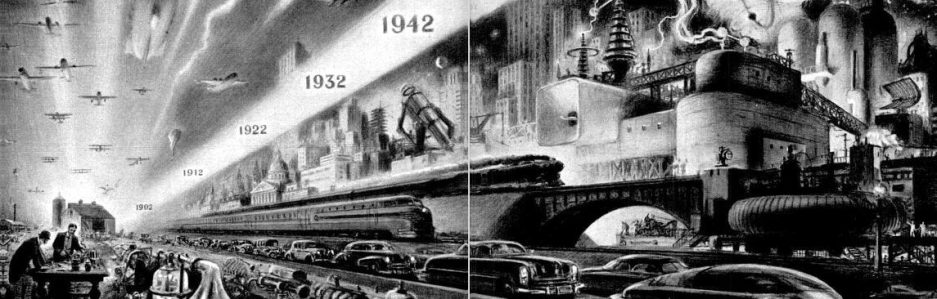
Traditions of Technological Criticism

Given how the word technology gets used and abused, we might sometimes be tempted to respond this way.

In fact, technology is a word we use all of the time, and ordinarily it seems to work well enough as a shorthand, catch-all sort of word. That same sometimes useful quality, however, makes it inadequate and counter-productive in situations that call for more precise terminology. See yesterday’s post for more on that.

The challenge lies in the difficulty of precisely defining what we mean by technology, but this wasn’t always the case. In fact, the word wasn’t commonly used at all until roughly the mid-20th century. See, for example, this Google ngram charting the use of the word technology from 1800 – 2000:

Google_Ngram technology

Ngrams aren’t perfect, for one thing they are limited to the books Google has managed to scan, but in this case I think it may give us a pretty good picture of what was actually the case. It certainly supports Langdon Winner’s claim that by the late ’70s “technology” had become a ubiquitous concern in a way it had not been before, say, World War II. Of course, this doesn’t mean that no one was talking about technology until roughly 1920 or so. There were other words or phrases that named the sort of stuff we would just dump in the category of technology. If you’re interested, Leo Marx’s article on the word technology gives a helpful summary of the semantic history of the concept.

Long before the word got both popular and complicated, though, it had a fairly straightforward sense. You can probably guess it by thinking of some similar words that we use with less ambiguity, words like biology, geology, and theology. The words are derived from Greek roots suggesting the study of a field or subject. In these three cases, the study of life, the earth, and God respectively.

Likewise, the word technology, derived from the Greek root techne meaning “craft” or “art,” originally suggested not the technical or mechanical artifacts themselves, but rather their study or the knowledge involved in their making. Winner, for example, cites Webster’s Second International dictionary published in 1909, which defines technology as “industrial science, the science of systematic knowledge of the industrial arts, especially of the more important manufactures.”

By 1961, however, Webster’s was defining technology as “the totality of means employed by a people to provide itself with the objects of material culture.”

One of the most comprehensive definitions I’ve seen lately comes from David Kaplan and runs to paragraph length:

“Technologies are best seen as systems that combine technique and activities with implements and artifacts, within a social context of organization in which the technologies are developed, employed, and administered. They alter patterns of human activity and institutions by making worlds that shape our culture and our environment. If technology consists of not only tools, implements, and artifacts, but also whole networks of social relations that structure, limit, and enable social life, then we can say that a circle exists between humanity and technology, each shaping and affecting the other. Technologies are fashioned to reflect and extend human interests, activities, and social arrangements, which are, in turn, conditioned, structured, and transformed by technological systems.”

This definitional bloat is a symptom of the technological complexity of modern societies. It is also a consequence of our growing awareness of the significance of what we make.

One interesting, somewhat whimsical way at getting at this complexity and at the pervasive place that technology occupies in modern societies might be to imagine that the earliest sense of the word technology persisted and that their existed a disciplined called Technology.

It would, I suggest, occupy the same place in our universities that Theology occupied in the medieval schools. It might even give substance to the claim implicit in the etymology of the word university by unifying the disparate disciplines and organizing the human experience around what we make rather than what we know, driven by material rather spiritual aims.

If we imagine that medieval society envisioned Theology as the pinnacle of a pyramid of human knowledge, unifying human experience by providing a transcendental goal from above, we might consider Technology instead as the base of the pyramid, the foundation upon which all else rested, providing unity from below.

Theology took as its object of study an unseen reality that permeated and ordered human experience and yet could never be fully understood. Analogously, Technology would take as its object of study a mostly seen reality that permeates and orders our experience which also resists our understanding. As St. Paul said of God, so we might say of technology: in it we move and breathe and have our being.

In fact, there is no one master discipline called Technology. While matters technological are threaded through every discipline to greater and lesser extents, these are never woven into any coherent theoretical fabric. Approaches to the study of technology also mirror the diversity of disciplines: historical, sociological, philosophical, economic, etc.

I’ve been thinking lately of laying out a taxonomy of sorts for the many approaches to technology, or the question concerning technology if you like. This would be mostly for my benefit, although I imagine others might find it useful. Consider it a heuristic that might introduce one to the field of technology studies (not that there is something quite so coherent that encompasses all of the theorists/thinkers/writers I have in mind).

I’m struggling to find the best organizational schema. Academic disciplines or fields of study might work, but I’m leaning toward loosely defined schools or traditions of thought that may not necessarily overlap with disciplinary boundaries. The richest explorations of technology, after all, tend not to abide traditional disciplinary boundaries. Take someone like N. Katherine Hayles, for example, who’s background includes both computer science and literary studies and ranges in her work from deep readings of cyberpunk fiction to in-depth discussions of mid-20th century cybernetic theory.

Eventually, I’d like to identify the leading representatives of these schools of tech criticism, along with their key ideas and concepts, a history of their development, etc., but to wrap up this meandering post I’m going to list a few of the schools of tech criticism that I’ve been toying around with and leave it to you, if you are so inclined, to help me refine my categories, fill in my blind spots, and otherwise improve my organizational schema.

Again, the object here is to find a useful way of grouping, for purely heuristic purposes, a diverse field of scholars and writers that includes Martin Heidegger, Albert Borgmann, Langdon Winner, Jacques Ellul, Walter Ong, David Nye, Karl Marx, Michel Foucault,  Walter Benjamin, Neil Postman, Katherine Hayles, Lewis Mumford, Leo Marx, Donna Haraway, Marshall McLuhan, Herbert Marcuse, Carl Mitcham, Don Ihde, Bruno Latour, Andrew Feenberg, David Noble, and the list could go on. It is, to say the least, an eclectic field.

So here is my first attempt with a few examples to give you an idea of what I’m thinking with each grouping:

Media-critical tradition including Ong, Postman, and McLuhan.

Critical-theoretical tradition including Frankfurt Schoolers (better than Frankfurters, no?) and their heirs such as Benjamin, Adorno, Marcuse, Habermas, and Feenberg.

Phenomenological tradition including Heidegger, Borgmann, and Ihde.

Autonomous Technology tradition including Winner and Ellul.

Posthumanist tradition including Hayles and Haraway.

Social Constructivist tradition including Nye and Thomas Hughes.

I can see a lot of problems with this first offering, but it’s a start. Here are some questions to consider for take two: Does Actor-Network Theory get its own category? What about the journalistic critics (and I don’t mean that disparagingly) such as Nicholas Carr or Alexis Madrigal? What about someone like Sherry Turkle? Is there grounds for a psycho-analytic tradition? Where does someone like Mumford fit in? Or Leo Marx? Could there be a French tradition that might include both Foucault and Ellul? What about a literary-poetic tradition?

Suggestions welcome.

Technology Is A License To Forget

“It is at this point [when the power of technology becomes evident] that a pervasive ignorance and refusal to know, irresponsibility, and blind faith characterize society’s orientation toward the technical. Here it happens that men release powerful changes into the world with cavalier disregard for consequences; that they begin to ‘use’ apparatus, technique, and organization with no attention to the ways in which these ‘tools’ unexpectedly rearrange their lives; that they willingly submit the governance of their affairs to the expertise of others. It is here also that they begin to participate without second thought in megatechnical systems far beyond their comprehension or control; that they endlessly proliferate technological forms of life that isolate people from each other and cripple rather than enrich the human potential; that they stand idly by while vast technical systems reverse the reasonable relationship between means and ends. It is here above all that modern men come to accept an overwhelmingly passive response to everything technological [….]

[…] there is a sense in which all technical activity contains an inherent tendency toward forgetfulness. Is not the point of all invention, technique, apparatus, and organization to have something and have it over with? One does not want to bother anymore with building, developing, or learning it again. One does not want to bother with its structure or the principles of its internal workings. One simply wants the technical thing to be present in its utility. The goods are to be oriented without having to understand the factory or the distribution network. Energy is to be utilized without understanding the myriad of connections that made its generation and delivery possible. Technology, then, allows us to ignore our own works. It is license to forget. In its sphere the truths of all important processes are encased, shut away, and removed from our concern. This more than anything else, I am convinced, is the true source of the colossal passivity in man’s dealings with technical means.”

More from Langdon Winner’s Autonomous Technology. Let the record show that I do not consider myself immune to this sweeping indictment.

Understanding Technology

In the Introduction to his 1977 book, Autonomous Technology: Technics-out-of-Control as a Theme in Political Thought, Langdon Winner identifies a “pervasive sense of puzzlement and disorientation” as a chief characteristic of late twentieth century discussions of technology. He adds:

“[…] writers who have isolated technology as an issue have repeatedly stressed that what is involved is not merely a problem of values or faith, but more importantly, a problem in our understanding of things. There is, they assert, something wrong in the way we view technology and man’s relationship to it. In its present array of vast and complex forms, technology continually surprises us and baffles our attempts at comprehension. From all sides one hears the call for new evidence and new interpretations to remedy our disoriented state.”

I would suggest that the situation is only more acute some 30+ years later. Winner is right to focus on understanding, or a lack thereof, and he is right to insist that understanding is not simply a matter of accumulating more data.

Speaking of research about technology and society Winner notes, “Much of social scientific research in this area amounts to a triumph of instrumentation–virtuosity in measuring and comparing quantifiable variables–rather than an earnest effort to advance our understanding.” Consequently, he adds a little further on,

“[…] in almost every book or article on the subject [of technology] the discussion stalls on the same sterile conclusion: ‘We have demonstrated the relationship between Technology X and social changes A, B, and C. Obviously, Technology X has implications for astounding good and evil. It is now up to mankind to decide which the case will be.'”

The problem, or at least one aspect of the problem, is that technology in some form or another is what we use to think about technology. Or, to put it differently, our understanding of technology tends to be circumscribed by technology and its modes of framing the world. Consider this example I serendipitously happened upon this morning courtesy of Alan Jacobs: the Reporter app. Reporter is the work of Nicholas Felton, who has been ambitiously documenting every quantifiable aspect of his life for the past few years. He is a lifelogger par excellence; a pioneer of the Quantified Self. Here is the description of Reporter cited by Jacobs:

“Reporter works by buzzing you several times per day with a brief quiz based on the questions Felton asks himself. They range from “Where are you?” to “What are you doing?” and “Who are you with?” Some questions can be answered by tapping Yes or No, while others are multiple choice questions, let you type in text, or offer a location picker that polls Foursquare for nearby places. You can also add your own questions (like “Are you happy?”) or program certain questions to occur only when you hit the app’s Awake or Sleep switch (like “How did you sleep?” and “What did you learn today?”). Each time you report, the app also pulls in various pieces of information like the current weather, how many steps you’ve taken today (using the iPhone 5s’ M7 motion coprocessor), and how noisy it is around you using your phone’s mic.”

Jacobs puts his finger on the problem: this kind of data collection proceeds on an impoverished view of the self. To make his point Jacobs suggest another set of questions that Reporter might choose to ask. I’ll let you click through to Jacobs’ post to read those.

Apart from its specific failures, the Reporter app is a useful example of a larger pattern. Whatever understanding the app may provide is already circumscribed by the limits of the sort of data that it can collect and process. Moreover, it already proceeds on the assumption that data collection is the best way to arrive at self-knowledge.

If I read him rightly, Winner might take the Reporter app to be illustrative of the whole of our relationship with modern technology. Our understanding of technology is stymied by how technology already sets the terms and conditions of our thinking;this is why getting any traction in our attempt to understand technology can be so challenging.

__________________________________________________________

N.B. I’ve bracketed the question of the usefulness of “technology” as a category. It is a question that I go back and forth on, and in a subsequent post I’ll discuss it again in conversation with Winner.

On Paper

“The world of Paper is an anachronism. It’s a screenless world created to sell you a thing made for the screen. It’s the past resurrected in order to convince you that something entirely common today is actually a portal to the future. Anyone touching a shiny, bright screen is going to look futuristic when they’re ensconced in a world furnished with stuff from Grandmother’s attic. This is a manipulation. If we want the world of Her, let’s actually go build it. Let’s figure out how to build technology that can be productively used without having to stare at it all the time. Let’s figure out how to do that in a way that doesn’t continue to hand over our privacy and free will to corporations that clearly still haven’t figured out how to get out of the advertising game. Let’s figure out how to break the attention barrier and return to a sense of technological progress that is measured by how useful things are, not how good they are at catching us in digital traps where we waste our lives clicking things. But let’s not delude ourselves that we’re just an app-install away from a frictionless and clean world of invisible technology.”

From Christopher Butler’s wide-ranging reflection on Facebook’s new app, Paper, “fashionable Luddism,” the commercial uses of nostalgia, depictions of the future in film, and our perpetually re-negotiated settlements with technology. Read the whole thing.

Langdon Winner On the Separation of Technology and Politics

The following excerpts are taken from Langdon Winner’s “Citizen Virtues in a Technological Order.” The article first appeared in the journal Inquiry in 1992. The version linked here is from Technology and the Politics of Knowledge, a collection of essays edited by Andrew Feenberg and Alastair Hannay.

Winner begins his essay by arguing that ancient Greek and Roman philosophy isolated technology from politics, an isolation that persisted through the medieval era. In the modern era, technology and politics are still sealed off from one another but for different reasons. Describing the modern view, Winner writes,

“Technological change, defined as ‘progress,’ is seen as an ineluctable process in modern history, one that develops as the result of the activities of men and women seeking private good, activities which include the development of inventions and innovations that benefit all of society. To encourage progress is to encourage private inventors and entrepreneurs to work unimpeded by state interference [….] The burden of proof rests on those who would interfere with beneficent workings of the market and processes of technological development.

If one compares liberal ideology about politics and technology with its classical precursors, an interesting irony emerges. In modern thought the ancient pessimism about techne is eventually replaced by all-out enthusiasm for technological advance. At the same time basic conceptions of politics and political membership are reformulated in ways that help create new contexts for the exercise of power and authority. Despite the radical thrust of these intellectual developments, however, the classical separation between the political and the technical spheres is strongly preserved, but for entirely new reasons. Technology is still isolated from public life in both principle and practice. Citizens are strongly encouraged to become involved in proving modern material culture, but only in the market or other highly privatized settings. There is no moral community or public space in which technological issues are topics for deliberation, debate, and shared action.”

To be clear, the problem, according to Winner, is not necessarily an absence of thinking about technology, although that thinking tends to be already mired in “technocratic” assumptions. Rather, it is an absence of political structures that might put such thinking into action. Hence, “The lack of any coherent identity for the ‘public’ or of well-organized, legitimate channels for public participation contributes to two distinctive features of contemporary policy debates about technology, (1) futile rituals of expert advice and (2) interminable disagreements about which choices are morally justified.”