
Richard Wilbur on W. H. Auden

“The soul shrinks from all that it is about to remember.”

“… but for that look of rigorous content.”

“… the fountain-quieted square …”

“… gust of grace …”

” … having taught hell’s fire a singing way to burn …”

These are just a few of the many delightful and haunting lines from the poetry of Richard Wilbur, a former national poet laureate and two-time Pulitzer Prize  winner who turned 91 last month.

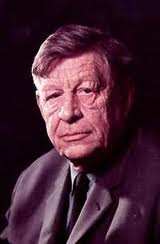
Those of you who have been reading for a while will have gathered that W. H. Auden is a poet I hold in high esteem. In light of that, here is Richard Wilbur’s “For W. H. Auden” which first appeared in The Atlantic in 1979:

   Now I am surer where they were going.
The brakie loping the tops of the moving freight,
The beautiful girls in their outboard, waving to someone
As the stern dug in and the wake pleated the water.

   The uniformed children led by a nun
Through the terminal’s uproar, the clew-drawn scholar descending
The cast-iron stair of the stacks, shuffling his papers,
The Indians, two to a blanket, passing in darkness,

   Also the German prisoner switching
His dusty neck as the truck backfired and started—
Of all these noted in stride and detained in memory
I now know better that they were going to die,

   Since you, who sustained the civil tongue
In a scattering time, and were poet of all our cities,
Have for all your clever difference quietly left us,
As we might have known that you would, by that common door.

The Wisdom of Gandalf for the Information Age

Tolkien is in the air again. In December of this year, the eagerly awaited first part of Peter Jackson’s The Hobbit will be released. The trailers for the film have kindled a great deal of excitement and the film promises to be a delight for fans of one of the most beloved stories ever written. By some estimates it is the fourth best selling book ever. Ahead of it are A Tale of Two Cities in the top spot, The Little Prince, and Tolkien’s own The Lord of the Rings trilogy.

I happily count myself among the Tokien devotees and I’ve declared this my very own Year of Tolkien. Basically this means that when I’m not reading some thing I must read, I’ll be reading through Tolkien’s works and a book or two about Tolkien.

Reading The Fellowship of the Ring several days ago, I was captivated once again by an exchange between the wizard Gandalf and the hobbit Frodo. If you’re familiar with the story, then the following needs no introduction. If you are not, you really ought to be, but here’s what you need to know to make sense of this passage. In The Hobbit, the main character, Bilbo, passes on an opportunity to kill a pitiable but sinister creature known as Gollum. The creature had been corrupted by the Ring of Power, which had been forged by an evil being known as Sauron. It would take too long to explain more, but in the following exchange Gandalf is retelling those events to Bilbo’s nephew Frodo.

Frodo has just proclaimed, “What a pity that Bilbo did not stab that vile creature, when he had a chance!”

Here is the ensuing exchange:

‘Pity? It was Pity that stayed his hand. Pity, and Mercy: not to strike without need …

‘I am sorry,’ said Frodo. ‘But I am frightened; and I do not feel any pity for Gollum.’

“You have not seen him,’ Gandalf broke in.

‘No, and I don’t want to,’ said Frodo. ‘I can’t understand you. Do you mean to say that you, and the Elves, have let him live on after all those horrible deeds? Now at any rate he is as bad as an Orc, and just an enemy. He deserves death.’

‘Deserves it! I daresay he does. Many that live deserve death. And some that die deserve life. Can you give it to them? Then do not be too eager to deal out death in judgement. For even the very wise cannot see all ends. I have not much hope that Gollum can be cured before he dies, but there is a chance of it. And he is bound up with the fate of the Ring. My heart tells me that he has some part to play yet, for good or ill, before the end; and when that comes, the pity of Bilbo may rule the fate of many — yours not least …’

This is, in my estimation, among the most evocative portions of a body of writing replete with wise and often haunting passages. Among the many things that could be said about this exchange and the many applications one could draw, I will note just one.

Gandalf is renowned for his wisdom, he is after all a great wizard. But in what does his wisdom lie? In this particular instance, it lies not in what he knows, rather it lies in his awareness of the limits of his knowledge. His wisdom issues from an awareness of his ignorance. “Even the very wise cannot see all ends,” he confesses. He does not have much hope for Gollum, but he simply does not know and he will not act, nor commend an action, that would foreclose the possibility of Gollum’s redemption. Moreover, he does not know what part Gollum may play in the unfolding story. For these reasons, which amount to an acknowledgement of his ignorance, Gandalf’s actions and judgments are tempered and measured.

These days we are enthralled by the information at our command. We are awestruck by what we know. The data available to us constitutes an embarrassment of riches. And yet one thing we lack: an awareness of how much we nevertheless do not know. We have forgotten our ignorance and we are judging and acting without the compassion or wisdom of Gandalf because we lack his acute awareness of the limitations of his knowledge.

We do not have to search very far at all to find those who will rush to judgment and act out of a profound arrogance. I will let you supply the examples. They are too many to list in any case. More than likely we need not look further than ourselves.

I have more than once cited T. S. Eliot’s lament from “Choruses from ‘The Rock'”:

“Where is the Life we have lost in living?
Where is the wisdom we have lost in knowledge?
Where is the knowledge we have lost in information?”

Our problem is that we tend to think of the passage from information to knowledge and on to wisdom as a series of aggregations. We accumulate enough information and we pass to knowledge and we accumulate enough knowledge and we pass to wisdom. The truth is that we pass to wisdom not by the aggregation of information or knowledge, both of which are available as never before; we pass to wisdom by remembering what we do not know. And this, in an age of information, seems to be the one thing we cannot keep in mind.
“Many books are read but some books are lived”

Just a quick post to pass along a link to a wonderful essay that appeared recently in The New Republic. Leon Wieseltier’s “Voluminous” is a smart, evocative reflection on the meaning of books and a personal library that is Benjamin-esque in its effect. Here are a couple of excerpts.  Do click through to read the rest. I trust you will find it worth your time.

“Many books are read but some books are lived, so that words and ideas lose their ethereality and become experiences, turning points in an insufficiently clarified existence, and thereby acquire the almost mystical (but also fallible) intimacy of memory.”

And…

“My books are not dead weight, they are live weight—matter infused by spirit, every one of them, even the silliest. They do not block the horizon; they draw it. They free me from the prison of contemporaneity: one should not live only in one’s own time. A wall of books is a wall of windows.”

This is one of those pieces that resonates deeply with me for how well it puts words to my own sensibilities (even if I might not strike quite so adversarial a tone toward digital media). I hope you’ll enjoy.

Many thanks to the reader who took the time to email me the link!

Poetry in an Age of Technology

The juxtaposition of poetry and technology might seem slightly incongruous to some, but there is a great deal that poetry can teach us about living well with technology.   By taking the (significant) liberty of speaking broadly about the poetic and the technological imaginations, I’d like to suggest that the poetic imagination offers a needful supplement to the technological imagination.

To begin with, the technological imagination very often fragments reality into its constituent parts.  The machine with its interchangeable components becomes a kind of master metaphor; the technological imagination sees parts where the poetic imagination takes in the whole.  Consider that poetry very often works through metaphor and metonymy which pushes us to see relationships.  With poetry we understand by bringing reality together rather than by dividing it up.

Along similar lines, James Gleick recently reminded that the key to the digital revolution came when mathematician Claude Shannon recognized that communication could be abstracted from concrete contexts, divorced from meaning, and efficiently transmitted as a series of binary decisions — yes/no, 1/0 — or, as he called them, bits.  Reduce to essentials, kill redundancy; abstract the message from the medium, the content from the form.  These were the principles of information theory and the foundations of the digital age.

Poetry suggests to us the limits of such an approach.  In his review of The Information, Nicholas Carr observed that, “What information theorists call redundancy … is also the stuff of poetry.”  We would have a very hard time abstracting the meaning of poetry from its form.  The assumption that one could do so is probably why so many have such a hard time “understanding” or “getting” poetry.  In a way, the desire to “understand” is misguided because it seeks a “meaning” apart from the form of the text.  It desires to reduce to themes stated in prose what the poem captures in its own unique form.  The meaning is in the reading, and in the reading out loud at that.  When Robert Frost was asked to tell what his poem was about in other words, Frost responded that if he could have done so, he wouldn’t have written the poem.  With poetry the form is the meaning; at least, it is inseparable from the meaning.

Describing her project in How We Became Posthuman — a book that touches on Shannon, cybernetics, and the onset of the information age — Katherine Hayles spoke of explaining “how information lost its body.”  This is a suggestive formulation.  Where digital technologies tend in some respects to push us toward a neglect of the body, poetry relies on embodiment for its meaning.  I emphasized reading out loud above because poetry conveys its meaning and does its work by the operation of the sounds it produces through our body.  Another problem with our “understanding” of poetry may then be that we seek its meaning in the silence of our minds.  We can “hear” something of the sounds in that silence, but not quite in the way that we would when our mouths are forming words and enacting the rhythms of the poem.

One last thought, in so far as poetry remains elusive, it also combats the sense of mastery encouraged by technology.  Technology can, as Heidegger warned, position the world at our service, ready to be manipulated in the worst sense.  Poetry refuses to thus accommodate us, it resists our efforts to “grasp” it and use it.  It provides resistance in a social world that is otherwise increasingly designed to be “frictionless.”  In this way, poetry is an antidote to the worst delusions we might become subject to in a world that, we are repeatedly told, is at our fingertips.

If I am at all on to something, then we can sum up by saying that the poetic imagination (which is to say the imagination nurtured by poetry) balances the technological imagination by seeking to hold the world together and by refusing the abstraction and alienation often engendered by a technological orientation to reality.

____________________________________

“My heart rouses

thinking to bring you news

of something

that concerns you

and concerns many men.  Look at

              what passes for the new.

You will not find it there but in

despised poems.

It is difficult

to get the news from poems

      yet men die miserably every day

for lack

of what is found there.”

William Carlos Williams, from “Asphodel, That Greeny Flower”

A Chance to Find Yourself

At The American Scholar you can read William Deresiewicz’s lecture to the plebe class of 2009 at West Point. The lecture is titled “Solitude and Leadership” and it makes an eloquent case for the necessity of solitude, and solitary reading in particular, to the would-be leader.

Throughout the lecture, Deresiewicz draws on Joseph Conrad’s The Heart of Darkness and near the end of his talk he cites the following passage. Speaking of an assistant to the manager of the Central Station, Marlow observes:

“I let him run on, this papier-mâché Mephistopheles and it seemed to me that if I tried I could poke my forefinger through him, and would find nothing inside but a little loose dirt. . . .

It was a great comfort to turn from that chap to . . . the battered, twisted, ruined, tin-pot steamboat. . . . I had expended enough hard work on her to make me love her. No influential friend would have served me better. She had given me a chance to come out a bit—to find out what I could do. No, I don’t like work. I had rather laze about and think of all the fine things that can be done. I don’t like work—no man does—but I like what is in the work,—the chance to find yourself. Your own reality—for yourself, not for others—what no other man can ever know.”

Much to think about in those few short lines. “Papier-mâché Mephistopheles” — what a remarkably apt image for what Arendt would later call the banality of evil. It is also worth reflecting on Conrad’s estimation of work in this passage. He evocatively captures part of what I’ve tried to describe in my posts on the discontents of the frictionless life and disposable reality.

It was, however, the line “for yourself, not for others” that struck me with peculiar force. I’ve written here before about the problems with solipsistic or misanthropic individualism. And it should go without saying that, in some important sense, we certainly ought to think and act for others. But I don’t think this is the sort of thing that Conrad had in mind. Perhaps he was driving at some proto-existenialist pour soi. In any case, what came to my mind was the manner in which a life mediated by social media and smart phones is lived “for others”.

Let me try to clarify. The mediated variety of being “for others” is a form of performance and presentation. What we are doing is constructing and offering an image of ourselves for others to consume. The pictures we post, the items we Like, the tweets we retweet, the status updates, the locations we announce on Foursquare, the music we stream, and dare I say it, the blog posts we write — all of these are “for others” and, at least potentially, “for others” without real regard for them. Others, in the worst forms of this dynamic, are merely an audience that can reflect back to us and reinforce our performance of ourselves. In being “for others” in this sense, we risk being “for ourselves” in the worst way.

There is another, less problematic way of being “for others”. At the risk of oversimplifying, let’s call this an unmediated way of being “for others”. This mode of being for others is not self-consciously focused on performance and presentation. This way of being for others does not reduce others to the status of mirrors reflecting our own image back to us. Other are in this case an end, not a means. We lose ourselves in being for others in this way. We do not offer ourselves for consumption, but we are consumed in the work of being for others. The paradox here is that those who are able to lose themselves in this way tend to have a substantial and steady sense of self. Perhaps because they have been “for themselves” in Conrad’s sense, they have nurtured their convictions and character in solitude so that they can be for other in themselves, that is “for others” for the sake of others.

Those who are for others only by way of being for themselves finally end up resembling Conrad’s papier-mâché Mephistopheles, we could poke our fingers through them and find nothing but a little dirt. All is surface.

Altogether, we might conclude that there is an important difference between being for other for the sake of being for yourself and being for yourself for the sake of being for others.

The truth, of course, is that these modes of being “for others” are not new and the former certainly does not owe its existence uniquely to social media. The performed self has roots in the emergence of modernity and this mode of being for others has a family resemblance to flattery which has an even older pedigree. But ubiquitous connectivity and social media do the work of amplifying and generalizing the condition. When their use becomes habitual, when we begin to see the world as potential material for social media, then the space to be for ourselves/by ourselves collapses and we find that we are always being for others for our own sake, preoccupied with the presentation of surfaces.

The consequences of this mode of being are good neither for us, nor for others.