“We like lists because we don’t want to die”

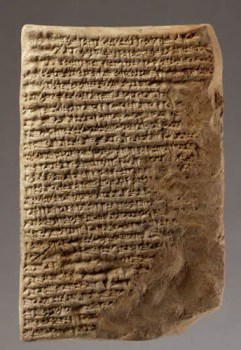
It may not look like much, but that grocery list sitting on the kitchen counter is a faint visual echo of the beginnings of civilization.  At least from a certain angle of vision explicated and illustrated in Umberto Eco’s The Infinity of Lists: An Illustrated Essay (2009).  In a Der Spiegel interview from November 2009, Eco explains,

The list is the origin of culture. It’s part of the history of art and literature. What does culture want? To make infinity comprehensible. It also wants to create order — not always, but often. And how, as a human being, does one face infinity? How does one attempt to grasp the incomprehensible? Through lists, through catalogs, through collections in museums and through encyclopedias and dictionaries.

There is a point at which scholars, philosophers, intellectuals (public or otherwise), critics, etc. — one is temped to list on — reach either a certain age or a certain stature, which it is sometimes hard to tell, when they are able to make simple, direct, and yet curiously ambiguous claims and assertions which, had they been made by a lesser figure, would certainly be dismissed out of hand, but coming from the sage achieve a certain matter-of-fact status and attain the aura of profundity.  So, a list of such from Eco:

  1. “We like lists because we don’t want to die.”
  2. “The essential definition is primitive compared with the list.”
  3. “Lists can be anarchistic.”

In fact, read in context, these make a good deal of sense, or at least one sees how they may make sense.  Then one also attains a certain permission to be blunt:

If you interact with things in your life, everything is constantly changing.  And if nothing changes, you’re an idiot.

In passing Eco also manages to make some interesting claims about the Internet:

With context:

SPIEGEL: But you also said that lists can establish order. So, do both order and anarchy apply? That would make the Internet, and the lists that the search engine Google creates, prefect for you.

Eco: Yes, in the case of Google, both things do converge. Google makes a list, but the minute I look at my Google-generated list, it has already changed. These lists can be dangerous — not for old people like me, who have acquired their knowledge in another way, but for young people, for whom Google is a tragedy. Schools ought to teach the high art of how to be discriminating.
I appreciated Eco’s distinction between modes of knowledge acquisition, which can make all the difference.  Sometimes those who were trained on the older model and subsequently enter the digital world fail to appreciate how their cognitive position and sensibility are different from those who are, as they say, born digital.

One last observation from Eco,

My interests change constantly, and so does my library. By the way, if you constantly change your interests, your library will constantly be saying something different about you.

This along with Eco’s ruminations about lists as a means of holding off the specter of death and creating order from chaos echoed (pun hesitantly intended, although technically, foreshadowed) Nathan Schneider’s excellent “In Defense of The Memory Theater” from some months ago.  I’ve recommended before, and I’ll do so again as my own thinking and interests, along with the books around me, take a turn toward memory.  From Schneider:

Ever since the habit of writing first took hold of me as a teenager, I knew precisely why I did it, and why I did it so compulsively: to hedge against the terror of having a terrible memory. Though still young enough to expect no sympathy, I constantly feel the burden of this handicap. Confirmation of it, and that writing is its cure, I discover every time I pick up something I wrote years, or even months ago. Reading those things puts me in an uncanny state, like a past-life regression. Meanwhile, unrecorded impressions, sayings, old friends, and good books vanish without warning or trace. Some read and write to win eternal life; I would be happy enough just to keep a hold of this one.

Writing birthed lists and lists yielded annals and annals, history — personal and cultural.
Agitate for Beauty

One of the convenient consequences of posting one’s thoughts on a blog is that readers (the happy few in my case) will send along links to interesting ideas or stories related to what I’ve written.  Yesterday I wrote about resisting the temptation to communicate thoughtlessly and artlessly via digital media and pushing back against the pressures for more efficient, mechanical, and soulless communication.  In response I received a link to a post titled, “How ‘EOM’ Makes Your Email More Efficient.” (h/t:  DFR)

EOM, for the blissfully uninitiated, is short for “End of Message.”  The idea is pretty simple: turn your email subject lines into the actual content of the message and add on “EOM” so that the recipient knows they don’t need click through to read the body.  This saves you the time of writing a subject line and a greeting and a body and a closing.  It also saves the recipient the effort of clicking through to the main text of the email.  But wait there’s more!  Actually there are TEN listed benefits to EOM-ing (might as well — texting, emailing, Facebooking, Twittering, friending —  in our exciting, transgressive times nouns become verbs!).  Other advantages include:  if you do it, others will do it too and EOM encourages 100% readership!

All very efficient to be sure.  Reading the cheerfully and engagingly written post I was almost convinced this was a wonderful, life-changing practice.  Okay, dropping the sarcasm, I get it, seriously.  There are certain exchanges that happen over email that do not need to be packaged in the style and form of a royal proclamation or a papal encyclical.  Fine, fair enough.  And to their credit, one of the advantages listed is that you encourage more face-to-face communication.  If you can’t say it efficiently via email, then maybe you just need to go talk to the person (pause for audible gasp).  Great, that would be wonderful (unless our face-to-face adopt the syntax and style of our online communication).  The work place is busy, hectic, stressful; easing the demands of always online work life is commendable.

But (you knew it was coming), there is still this lingering fear that the ideals of efficiency and instrumentality, perfectly appropriate at some points and in certain contexts, will spread into realms of human communication where they ought properly to be unwelcome and shunned.  Yet, efficiency and instrumentality are alluring ideals that make few demands and promise great rewards, and so they insidiously infiltrate and colonize.

Sometimes I wonder if we are not operating under the unspoken assumption that perfect communication is something like the telepathic communication depicted in science fiction and fantasy.   That would be efficient indeed.  No words, no sounds, no effort.  No risk, no charm, no beauty.

So my tendency is to resist the push for increasing efficiency and instrumentality in our communication; not because I fail to see the advantages, but precisely because I recognize their appeal.  I tend to think Goethe was right, “We should do our best to encourage the Beautiful, for the Useful encourages itself.”  Agitate for beauty.

I’ll leave off with another poet, W. H. Auden, who also knew a thing or two about language, beauty, and responsibility.

As I listened from a beach-chair in the shade
To all the noises that my garden made,
It seemed to me only proper that words
Should be withheld from vegetables and birds.

A robin with no Christian name ran through
The Robin-Anthem which was all it knew,
And rustling flowers for some third party waited
To say which pairs, if any, should get mated.

Not one of them was capable of lying,
There was not one which knew that it was dying
Or could have with a rhythm or a rhyme
Assumed responsibility for time.

Let them leave language to their lonely betters
Who count some days and long for certain letters;
We, too, make noises when we laugh or weep:
Words are for those with promises to keep.

(“Their Lonely Betters”)

“Gratitude Is Happiness Doubled By Wonder”

When I think of gratitude, I think of G. K. Chesterton. I can think of few others who appeared to be always animated by a deep and inexhaustible gratitude for life and all that it entailed. With that in mind, here are few lines from Chesterton on the theme of gratitude and thanks:

  • “I would maintain that thanks are the highest form of thought, and that gratitude is happiness doubled by wonder.”
  • “You say grace before meals. All right. But I say grace before the concert and the opera, and grace before the play and pantomime, and grace before I open a book, and grace before sketching, painting, swimming, fencing, boxing, walking, playing, dancing and grace before I dip the pen in the ink.”
  • “When it comes to life the critical thing is whether you take things for granted or take them with gratitude.”

And then I am also reminded of the closing line of a poem by Wendell Berry.  The poem is inspired by a poignant scene in Shakespeare’s “King Lear”:

I think of Gloucester, blind, led through the world
To the world’s edge by the hand of a stranger
Who is his faithful son. At the cliff’s verge
He flings away his life, as of no worth,
The true way lost, his eyes two bleeding wounds—
And finds his life again, and is led on
By the forsaken son who has become
His father, that the good may recognize
Each other, and at last go ripe to death.
We live the given life, and not the planned.

“We live the given life, and not the planned.”  That line etched itself into my mind the moment I first read it.  Simple and profound, an antidote to the disorders of our time.

It would make a great difference, would it not, if our posture toward life were such that we received it as a gift with gratitude and wonder;  if our hands were open to receive and to give in turn rather than clutched to take and to keep?

I tend to think it would make all the difference.

_______________________________________________________________

Also consider my 2011 Thanksgiving post: “Gratitude as a Measure of Technology”

The Cost of Distraction: What Kurt Vonnegut Knew

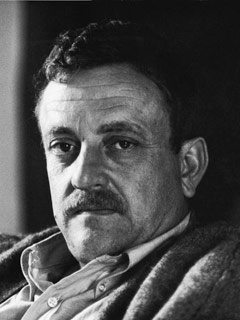
“The year was 2081, and everybody was finally equal.”

So begins the late Kurt Vonnegut’s 1961 short story, “Harrison Bergeron.” In 2009, Chandler Tuttle released a 25 minute film version of the story titled 2081, and you can watch the trailer at the end of this post.

Vonnegut goes on to describe the conditions of this equality:

They weren’t only equal before God and the law. They were equal every which way. Nobody was smarter than anybody else. Nobody was better looking than anybody else. Nobody was stronger or quicker than anybody else. All this equality was due to the 211th, 212th, and 213th Amendments to the Constitution, and to the unceasing vigilance of agents of the United States Handicapper General.

This government enforced equality was achieved by imposing prosthetic technologies on those who were above average; these prosthetics, however, were designed not to enhance, but to diminish.  So, for example, ballerinas who might otherwise rise above their peers in grace, elegance and beauty,

were burdened with sashweights and bags of birdshot, and their faces were masked, so that no one, seeing a free and graceful gesture or a pretty face, would feel like something the cat drug in.

Then there were those of above average intelligence like the title character’s father, George Bergeron.

[He] had a little mental handicap radio in his ear. He was required by law to wear it at all times. It was tuned to a government transmitter. Every twenty seconds or so, the transmitter would send out some sharp noise to keep people like George from taking unfair advantage of their brains.

Whenever George began to formulate a complex idea, which often involved questioning the status quo, a sharp, piercing noise would shoot in his ear distracting him and derailing his train of thought.  Sometimes the noise was like a siren going off, other times “like somebody hitting a milk bottle with a ball peen hammer.”  Regular and incessant, the distraction overwhelmed and undermined natural intelligence.

George’s son, Harrison Bergeron possessed gifts and abilities that rendered him an especially potent threat to the regime of equality.  Because of this he was taken away and locked up by the authorities when he was fourteen.  Midway through the story, however, as George and his wife Hazel watch encumbered ballerinas dancing on television, a news bulletin interrupts the performance.  A ballerina takes over from a stuttering  announcer to read the bulletin.

“Harrison Bergeron, age fourteen,” she said in a grackle squawk, “has just escaped from jail, where he was held on suspicion of plotting to overthrow the government. He is a genius and an athlete, is under-handicapped, and should be regarded as extremely dangerous.”

Shortly thereafter, Harrison, whose debilitating prosthetics made him look “like a walking junkyard,” bursts into the building.  He effortlessly rips off the multiple “handicaps” that had been attached to his body in an unsuccessful effort to equalize his prodigious strength and ability.  He then proclaims himself emperor, declaring to the wonder-struck onlookers, “Now watch me become what I can become!”

Having been joined by a beautiful ballerina who came forward to be his empress, they dance.  They dance majestically and preternaturally breaking not only “the laws of the land,” but “the law of gravity and the laws of motion as well.”  And while they danced so high they kissed the ceiling,

Diana Moon Glampers, the Handicapper General, came into the studio with a double-barreled ten-gauge shotgun. She fired twice, and the Emperor and the Empress were dead before they hit the floor.

And just like that, equality is restored.

“Harrison Bergeron” is a nicely executed short story that can be read from a number of perspectives, yielding insights that can be variously applied to political, economic, or cultural circumstances.  As I read it, the story shares a certain sensibility with both Orwell’s 1984 and Huxley’s Brave New World.  It has been noted by, among others, Huxley himself that Brave New World pictures a more likely image of the future because it is not posited on a heavy-handed totalitarianism.  It is, rather, a freely embraced dystopia.  I want to suggest that, in “Harrison Bergeron,” Vonnegut offered us an Orwellian adumbration of one particular dimension of our Internet soaked world that has in fact emerged along a more Huxleyian trajectory.

Consider the manner in which the advantages of the intellectually gifted are equalized in Vonnegut’s story — distraction, regular and constant distraction.  The story provides a vivid and disturbing image of the consequences of perpetual distraction.

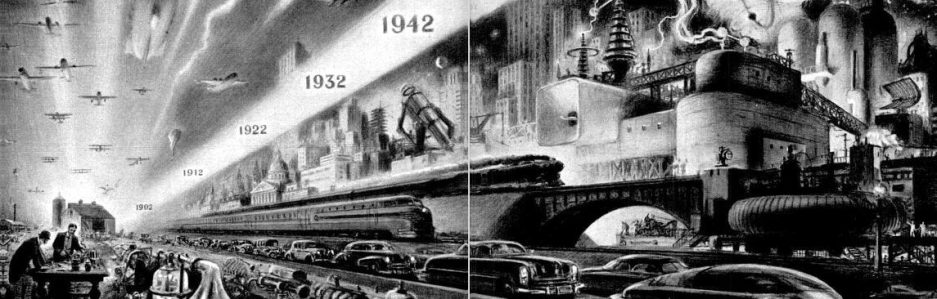
We’ve noted more than a few critics who have been pointing to the costly consequences of living with the perpetual distractions created by the very nature of the Internet and the ubiquity of portable tools which allow us to be always connected, always accessible.   Recently a group of neuroscientists made news by taking a trip into the Utah wilderness to disconnect long enough to appreciate the mental costs of constant connectivity and the perpetual distraction that comes with it.

In the world of 2081 imagined by Vonnegut, the distracting technology  is ruthlessly imposed by a government agency.  We, however, have more or less happily assimilated ourselves to a way of life that provides us with regular and constant distraction.  We have done so because we tend to see our tools as enhancements.  They promise, and often provide, pleasure, comfort, efficiency, and productivity.  What’s more, our distractions are not nearly so jarring as those that afflict the characters in “Harrison Bergeron”; in fact, our distractions can often be quite pleasant.

But might they also be inhibiting the development of our fullest potential?  Are we trading away certain real and important pleasures and possibilities?  Have we adopted technologies that in their democratizing power, also engender mediocrity? Do our perpetual distractions constitute a serious impairment of our cognitive abilities?  Can we learn to use our tools in a way that mitigates the costs?

These are just a few of the questions suggested by “Harrison Bergeron.”  Our future, at least in part, may hinge on the answers.

The Possibilities of Science Fiction

One commenter on yesterday’s post noted that science fiction “can also be used as a formidable stock of thought experiments, with profound philosophical implication.”  I have hardly read any science fiction (I am currently working on Lewis’ Space Trilogy) yet I have no doubt this is the case.  Another commenter made note of Ray Bradbury.  Kurt Vonnegut and Aldous Huxley also come to mind as well as Jules Vernes and H. G. Wells as early practitioners.  It seems to me that Mary Shelley deserves recognition at least as a forerunner.  I’m sure those familiar with the field can fill out the list quite a bit.

Hannah Arendt, writing in the mid-twentieth century, appears to be one of the few intellectuals of the time to have recognized the value of science fiction.  Writing in The Human Condition she notes that the “respectable newspapers” were only just then catching up on implications of science which,

up to then had been buried in the highly non-respectable literature of science fiction (to which, unfortunately, nobody yet has paid the attention it deserves as a vehicle of mass sentiments and mass desires).

Perhaps someone can correct me on this, but it seems the most profound science fiction also tends to be of the dystopian variety.