Paradise Interrupted: Train Whistles, Cell Phones, and Social Change

In his classic study of the pastoral ideal in American culture, The Machine in the Garden, Leo Marx takes a passage from Nathaniel Hawthorne’s journal as a point of departure. In his journal entry from July 27, 1844, Hawthorne describes what he observes as he sits down in the woods near Concord, Massachusetts to take in “such little events as may happen.”

Hawthorne, whose prescient metaphor for electrification we noted a few days ago, begins by describing the spot as follows:

“… a shallow space scooped out among the woods, which surround it on all sides, it being pretty nearly circular, or oval, and two or three hundred yards — perhaps four or five hundred — in diameter. The present season, a thriving field of Indin corn, now in its most perfect growth, and tasseled out, occupies nearly half of the hollow; and it is like the lap of bounteous Nature, filled with bread stuff.”

He goes on to note that, “… sunshine glimmers though shadow, and the shadow effaces sunshine, imaging that pleasant mood of mind where gaiety and pensiveness intermingle.”

Then he turns from landscape to soundscape and notes, in Marx’ summary, “the village clock, the cowbell tinker, and the mowers whetting scythes.” These sounds are not perceived as an intrusion into the peace of the idyll, rather they blend harmoniously into the whole.

Marx notes how Hawthorne is not idealizing undisturbed nature for itself, but rather nature and human culture in seeming harmony with one and for one another. Marx also observes that the journal entry is not merely about the place, it is about the human psyche as well. The subjective experience of the place is the primary object of consideration.

As we continue reading, suddenly the acoustical and psychic harmony is shattered:

“But, hark! there is the whistle of the locomotive — the long shriek, harsh, above all other harshness, for the space of a mile cannot mollify it into harmony. It tells a story of busy men, citizens, from the hot street, who have come to spend a day in a country village, men of business; in short of all unquietness; and no wonder that it gives such a startling shriek, since it brings the noisy world into the midst of our slumbrous peace.”

Hawthorne then turns back to his observations and of nature, noting the leaves and “comparing their different aspects.”

This passage is notable for how often its pattern is independently repeated in the literature of the period. Marx notes similar patterns of peace and tranquility suddenly and harshly interrupted by a machine. In Walden, Thoreau likewise is disturbed from his admiration of nature by the sound of a locomotive. In Moby Dick, Ishmael is exploring the skeleton of a beached whale and suddenly the scene shifts an he is inside a textile mill. In Huckleberry Finn, Huck and Jim  are calmly floating down the river when suddenly they are rammed by a steamboat.

The specific case of the train’s piercing whistle is also recorded by Ralph Waldo Emerson and Marx suspects that if we had access to all the writer’s notebooks from the period we would have countless more instances of this “little event.”
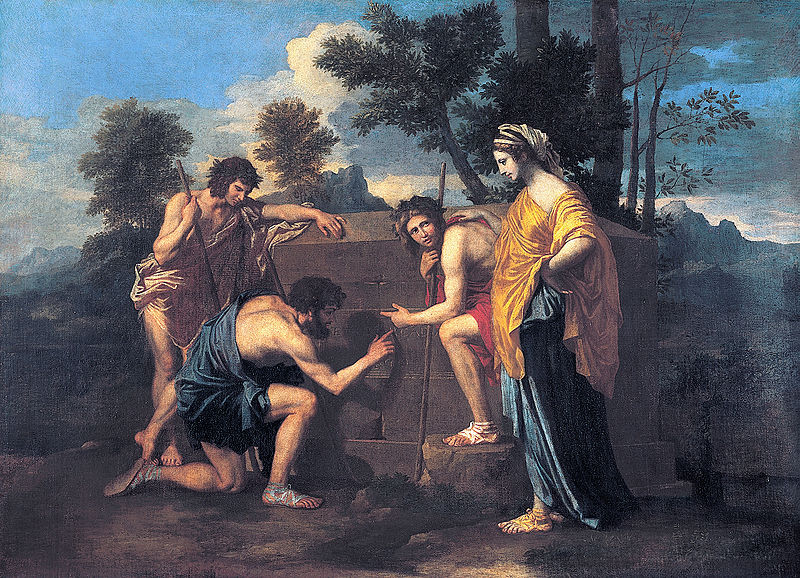
It is, on Marx’s view, characteristic of a much older literary pattern employed first by Virgil in his Eclogues. The harmony of man with nature, positioned between civilization on the one side and wilderness on the other, is troubled by the intrusion of some “counterforce” which signals the greater reality within which the pastoral ideal is played out. The same gesture is made visible in the landscape paintings of the 17th century that introduced some momento mori into the idealized scenery. It is, for example, spelled out by Poussin when his shepherds stumble upon a grave with the inscription, “Et in Arcadia Ego.”

The trains whistle, then, symbolically signaled the larger realities that were inescapably inserting themselves into the cultural landscape. The train’s whistle signaled the arrival of Industrialization and the disordering and reordering of society that came in its wake. Emerson, for example, is explicit about this:

“I hear the whistle of the locomotive in the woods. Wherever that music comes it has its sequel. It is the voice of the civility of the Nineteenth Century saying, “Here I am.” It is interrogative: it is prophetic: and this Cassandra is believed: ‘Whew! Whew! Whew! How is real estate here in the swamp and wilderness? Ho for Boston! Whew! Whew! … I will plant a dozen houses on this pasture next moon …”

It is as if these “little events” were analogous to our asking where we were when Kennedy was shot or when the Twin Towers were attacked. We all, at least those of a certain age, have little narratives we tell about such moments when reality harshly intruded into our idylls and signaled the changing of the times.

As I read all of this, I also wondered whether similar widely shared, equally mundane “little events” were characteristic of other periods of social change. Perhaps, the first time one heard the ring of the telephone or the engine of an airplane overhead. What about our own time? I remember when I first began to notice, in the mid-1990s, that ads on television were now prominently featuring web site addresses. Perhaps, if we’re going for jarring, we might recall the when we began to notice people talking for all to hear on their cell phones in public spaces. I can imagine a contemporary, Hawthorne-like, taking in the scenery at a park let’s say, and then suddenly startled by ones side of some too-audible conversation. (Interestingly, this very scenario was the inspiration for a recent essay by Jonathan Franzen, a literary figure of our time if ever there was one.) All of these “little events,” these little annoyances, might be, like Hawthorne’s train whistle, signifiers of shifting social worlds and mental/emotional states of being.

Any other suggestions?  What your “little events” that in retrospect were harbingers of significant cultural change? What change did they signal? What symbolic role did they play? What larger meanings did they clarify?

Whither the Future?

“There have been men who loved the future like a mistress, and the future mixed her breath into their breath and shook her hair about them, and hid them from the understanding of their times.”

— William Butler Yeats

With those evocative words Yeats began his essay on William Blake. Blake was, in Yeats’ estimation, one of these men who loved the future like a mistress. If he were thinking of nations rather than individuals, Yeats’ might have spoken those same words  of American culture. To say that throughout their history Americans have been more interested  in looking forward to the future rather than backwards at the past is a generalization, but it is rather safe one to make.

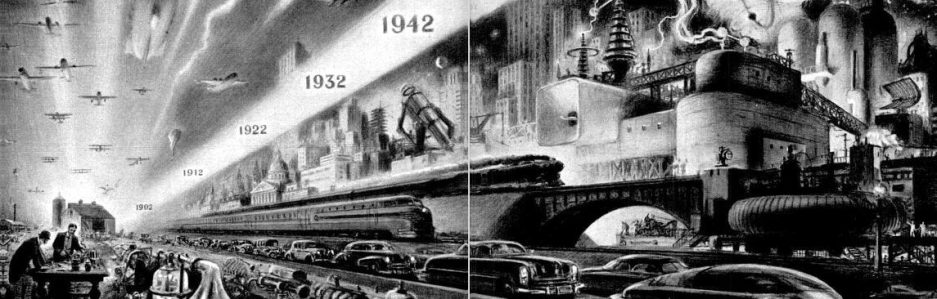
One stunning and not too distant instance of this future orientation was on display at the 1939 New York World’s Fair. I’ve been reading about the fair in both David Nye’s Electrifying America and his later American Technological Sublime. The 1939 Fair is interesting on a number of levels, but I’m especially taken by the manner in which the Fair synthesized perhaps the most remarkable generation or so of technological development with a (corporate) modernist aesthetic to produce an evocative and cohesive utopian vision of the future. The future, or The World of Tomorrow, was the theme of just about every major exhibit at the Fair, and for the first time the most extravagant and well-conceived exhibits were not the national exhibits, but the corporate ones (General Electric, General Motors, AT&T, Chrysler, to name a few). Three major exhibits featured intricate scale model representations of the future city complete with dramatic narration, symphonic music, and 1000 voice choirs making the whole a “quasi-religious experience of escape into an ideal future.”

During the planning that had led up to the Fair, architect and philosopher of technology Lewis Mumford had called for the Fair to be a concrete anticipation of “the future of the whole civilization.” This heady, vaguely spiritualized optimism and expectation for the world of tomorrow is all the more remarkable when we consider that it was articulated and experienced in the latter years of the Great Depression. This may not be all that surprising if we imagine that the hardship of the Depression made people all the more hungry for an escapist model of the future. However, we might also consider the possibility that the Depression could just as easily have quelled all optimism and hope for the future after the very long decade.

And this is our segue to the present. It appears that the cultural mood has shifted. Our collective eyes seemed to be fixed not on the future, but on the past. One indicator of this shift is the resurgence of nostalgia in popular culture that we have noted here before. The nostalgic turn, however, did not just emerge with Mad Men (and now its imitations) and Instagram’s faux-vintage photo apps. It was noted by scholars in the 1990’s and is complicit with the postmodern repurposing of the past as far back as the 1970s. Take all of these together and over the last generation something has been afoot. And if it might be described as a gradual reorientation of American society’s collective gaze toward past rather than the future, then it amounts a startling transformation of immense cultural consequence.

All of this had been flitting about my head for the past several weeks when I came across a piece by Peter Thiel titled “The End of the Future”. Therein, Thiel argues suggestively that, despite appearances to the contrary, scientific and technological development has stagnated over the last couple of decades (with the not insignificant exception of information processing) and our current economic crisis is, in part, a reflection of this stagnation. Consider the following paragraph:

When tracked against the admittedly lofty hopes of the 1950s and 1960s, technological progress has fallen short in many domains. Consider the most literal instance of non-acceleration: We are no longer moving faster. The centuries-long acceleration of travel speeds — from ever-faster sailing ships in the 16th through 18th centuries, to the advent of ever-faster railroads in the 19th century, and ever-faster cars and airplanes in the 20th century — reversed with the decommissioning of the Concorde in 2003 … Today’s advocates of space jets, lunar vacations, and the manned exploration of the solar system appear to hail from another planet. A faded 1964 Popular Science cover story — “Who’ll Fly You at 2,000 m.p.h.?” — barely recalls the dreams of a bygone age.

Thiel also cites this 1967 passage from Jean-Jacques Servan-Schreiber’s The American Challenge,

In 30 years America will be a post-industrial society. . . . There will be only four work days a week of seven hours per day. The year will be comprised of 39 work weeks and 13 weeks of vacation. With weekends and holidays this makes 147 work days a year and 218 free days a year. All this within a single generation.

It’s not unusual, of course, for predictions of this sort to dissolve in the more turbulent waters of reality, but it’s not just that the prediction turned out to be mistaken, it’s that the thought of making any kind of similar prediction today would appear absurd, silly, or infantile.

I’m not necessarily endorsing Thiel’s argument, in fact, I’m not even sure Thiel is endorsing his argument, it felt more like a speculative piece than an argument. But it does add to the growing number of data points that together suggest Americans may be losing their confidence in the future. It would be ill advised to pin this on any one cause, but I especially want to resist pinning this on the economic downturn itself. Remember the exuberance of the 1939 World’s Fair came after ten years of the Great Depression and while the light at the end of the tunnel was not quite visible.

So any thoughts? What’s your take on the future? Any other relevant cultural indicators you can think of?


The Religion of Technology

In the Introduction to The Religion of Technology (1997) historian David Noble writes,

“With the approach of the new millennium, we are witness to two seemingly incompatible enthusiasms, on the one hand a widespread infatuation with technological advance and a confidence in the ultimate triumph of reason, on the other a resurgence of fundamentalist faith akin to a religious revival.”

Noble believes that this will strike many readers as an incongruous juxtaposition. On the one hand, it had been assumed by Enlightenment types that the advance of technology (and science) went hand in hand with the retreat of religious belief. The plot, however, turned out to be more complex. “Today,” Noble continues, “we are seeing the simultaneous flourishing of both, not only side by side but hand in hand.”

This should not surprise us according to Noble. It is, and this is his thesis in brief, “a continuation of a thousand-year-old Western tradition in which the advance of the useful arts was inspired by and grounded upon religious expectation.”

On the other hand, “Some contemporary observers have argued … that the resurgence of religious expression testifies to the spiritual sterility of technological rationality, that religious belief is now being renewed as a necessary complement to instrumental reason …” But this view also wrongly assumes a “basic opposition” between technology and religion.

Against this assumption of opposition, Noble argues the following:

“… modern technology and modern faith are neither complements nor opposites, nor do they represent succeeding stages of human development. They are merged, and always have been, the technological enterprise being, at the same time, an essentially religious endeavor.

This is not meant in a merely metaphorical sense, to suggest that technology is similar to religion in that it evokes religious emotions of omnipotence, devotion, and awe, or that it has become a new (secular) religion in and of itself, with its own clerical caste, arcane rituals, and articles of faith. Rather it is meant literally and historically, to indicate that modern technology and religion have evolved together and that, as a result, the technological enterprise has been and remains suffused with religious belief.”

Noble goes on to add that nowhere is this more evident than in the United States where “an unrivaled popular enchantment with technological advance is matched by an equally earnest popular expectation of Jesus Christ’s return.” What is often missed, according to Noble, is that these are often the same people.

Lastly, the suffusion of technology with religious faith manifests itself when

“we routinely expect more from our artificial contrivances than mere convenience, comfort, or even survival. We demand deliverance. This is apparent in our virtual obsession with technological development, in our extravagant anticipations of every new technical advance — however much each fails to deliver on its promise — and, most important, in our utter inability to think and act rationally about this presumably most rational of human endeavors.”

Weekend Reading, 10/7/11

Due to travel and spotty Internet access there was no “Weekend Reading” post last week, but we’re back on track now. Peace and violence, stalling technological progress, Google, nostalgia, and cell phone sentimentality all come your way below.

“A History of Violence” by Steven Pinker (interviewed) at The Edge. Pinker discusses his recent book, The Better Angels of Our Nature, in which he argues that we live in the least violent era in history.

“Delusions of Peace” by John Gray in Prospect. In which Gray concludes that Pinker is considerably off the mark.

“I Just Called to Say ‘I Love You'” by Jonathan Franzen in Technology Review. Franzen takes on cell phones, sentimentality, and public discourse. A taste: “Just 10 years ago, New York City (where I live) still abounded with collectively maintained public spaces in which citizens demonstrated respect for their community by not inflicting their banal bedroom lives on it.”

“The End of the Future” by Peter Thiel in National Review: A bit of a downer if you buy it. The founder a Paypal worries that technological progress has stalled. A hard sell, but if true, wide ranging and unpleasant social consequences follow. May be related to the subject of the next piece.

“Nostalgia on Repeat” by Chuck Klosterman at Grantland: “The net result is a bunch of people defending and bemoaning the impact of nostalgia in unpredictable ways; I suppose a few of these arguments intrigue me, but just barely. I’m much more interested in why people feel nostalgia, particularly when that feeling derives from things that don’t actually intersect with any personal experience they supposedly had.”

“It Knows” by Daniel Soar in London Review of Books: Soar reviews three recent books on the juggernaut that is Google. Coincidentally, Soar logs this passing snide remark directed at Steven Pinker: “Rankings based on citations aren’t necessarily a measure of excellence – if they were, we wouldn’t hear so much about Steven Pinker – but they do reflect where humans have decided that authority lies.”

Conquering the Night: Technology, Fear, and Anxiety

Tim Blanning begins his review of Craig Koslofsky’s Evening’s Empire: A history of the night in early modern Europe as follows:

In 1710, Richard Steele wrote in Tatler that recently he had been to visit an old friend just come up to town from the country. But the latter had already gone to bed when Steele called at 8 pm. He returned at 11 o’clock the following morning, only to be told that his friend had just sat down to dinner. “In short”, Steele commented, “I found that my old-fashioned friend religiously adhered to the example of his forefathers, and observed the same hours that had been kept in his family ever since the Conquest”. During the previous generation or so, elites across Europe had moved their clocks forward by several hours. No longer a time reserved for sleep, the night time was now the right time for all manner of recreational and representational purposes.

Given my recent borrowings from David Nye’s study of electrification, it will come as no surprise that the title of Blanning’s review, “The reinvention of the night,” caught my eye. I was expecting a book dealing with the process of electrification, but Koslofsky’s story, as the subtitle of his book suggests, unfolds two to three hundred years before electrification.

It also features technology less prominently than I anticipated, at least Blanning doesn’t emphasize it in his review. In fact, he writes, “This had little to do with technological progress, for until the nineteenth century only candles and oil lamps were available.” This suggests a rather narrow definition of technology since candles and oil lamps are just that. It may be that Blanning’s emphasis is on the “progress” side of “technological progress,” but immediately after this sentence he writes, “Most advanced was the oil lamp developed in the 1660s by Jan van der Heyden, which used a current of air drawn into the protective glass-paned lantern to prevent the accretion of soot, and made Amsterdam the best-lit city in Europe.” This would amount to technological progress, no?

in any case, what I found most interesting, and what connected directly with Nye, was the following observation by Blanning: “At the heart of his argument is the contrariety between day and night, light and dark. On the one hand, the sixteenth century witnessed an intensification of the association of the night with evil …” That, and the theme of a shifting civic/public sphere (a la Habermas) that moved not only from the town square to the aristocratic halls and coffee houses, but also from the day time to the night time.

Take both together and we have another example of the reciprocal relationship between technology and social structures, assuming you’re buying my hunch that this is a story in which technology, even if it is “primitive” technology, is implicated.

A society’s symbolic tool kit can shift. We might take for granted that night always evoked fear and dread and evil, and although there is something to that of course, the story is more complex. Perhaps night’s identification with evil intensified in part because of the gradual conquest of the night by artificial illumination. It would be a paradoxical case of unintended, unforeseen consequences. The more we domesticate darkness, the more darkness takes its revenge on us. Perhaps if we were more at home in the darkness, we would be less fearful of it.

Consider the following passage cited by Nye from Henry Beston writing in the early twentieth century:

“We of the age of the machines, having delivered ourselves of nocturnal enemies, now have a dislike of night itself. With lights and ever more lights, we drive the holiness and beauty of the night back to the forests and the sea; the little villages, the crossroads even, will have none of it. Are modern folk, perhaps, afraid of night? Do they fear that vast serenity, the mystery of infinite space, the austerity of stars? Having made themselves at home in a civilization obsessed with power, which explains its whole world in terms of energy, do they fear at night for their dull acquiescence and the pattern of their beliefs? Be the answer what it will, today’s civilization is full of people who have not the slightest notion of the character or poetry of night, who have never even seen the night.”

This is an interesting passage not only because it suggests how technologies enter into symbolic ecosystems and reshape those ecosystems just as their adoption is conditioned by that same ecosystem. It is also interesting because what Beston feared losing — the serenity, mystery, austerity — is itself a very modern sensibility. This is the sensibility of a modern individual formed by a post-Copernican cosmology. A medieval individual could not have written that passage, and not only because illumination was for them a still distant and unimagined phenomenon. They were still at home in a much smaller and coherent universe. They did not look up and see “space,”they looked up and saw the vastly populated heavens. But that is another story.

Night has been on the retreat for quite some time now, conquered by the science and technology of illumination. Night’s retreat has had social, political, and psycho-symbolic consequences. The mystery of the night is chased away only to allow in the terror of the night. Technology shapes and is shaped by its semiotic environment.

One of the wonders of writing is that you’re never quite sure where you will end up when you start. So while my initial intent was simply to note another illustration of Nye’s notion of the social construction of technology, writing’s momentum leads me to the notion that domestication may, ironically, lead to the displacement of fear and anxiety to another register. It is as if, like Dr. Moreau’s creatures, the realms we tame through our techno-scientific prowess remain sources of reconfigured and intensified fear and anxiety. Dr. Moreau instills fear in his beasts through violence because he fears the violence they may do to him. Fear begets fear — that is perhaps the core of H. G. Wells’ tale — and that principle is at work in our uneasy relationship with technology.

If we pursue technology in order to conquer what we fear, then we also create an attending anxiety over the (inevitable?) failure of our systems of control and mastery. It would seem that what we tame, retains its wildness veiled, yet palpable and intensified.